Fault Detection, Isolation, and Recovery (FDIR) is an automated distribution grid control architecture that detects electrical faults, isolates the faulted feeder segment by opening the appropriate switching devices, and restores service to de-energized but healthy sections via alternative sources. It replaces manual switching procedures with algorithmic logic executed by Intelligent Electronic Devices (IEDs) and recloser controls, reducing outage duration from hours to seconds.

Glossary
Fault Detection, Isolation, and Recovery (FDIR)
An automated grid control architecture that identifies electrical faults, disconnects the affected section, and restores power to healthy portions of the network without human intervention.
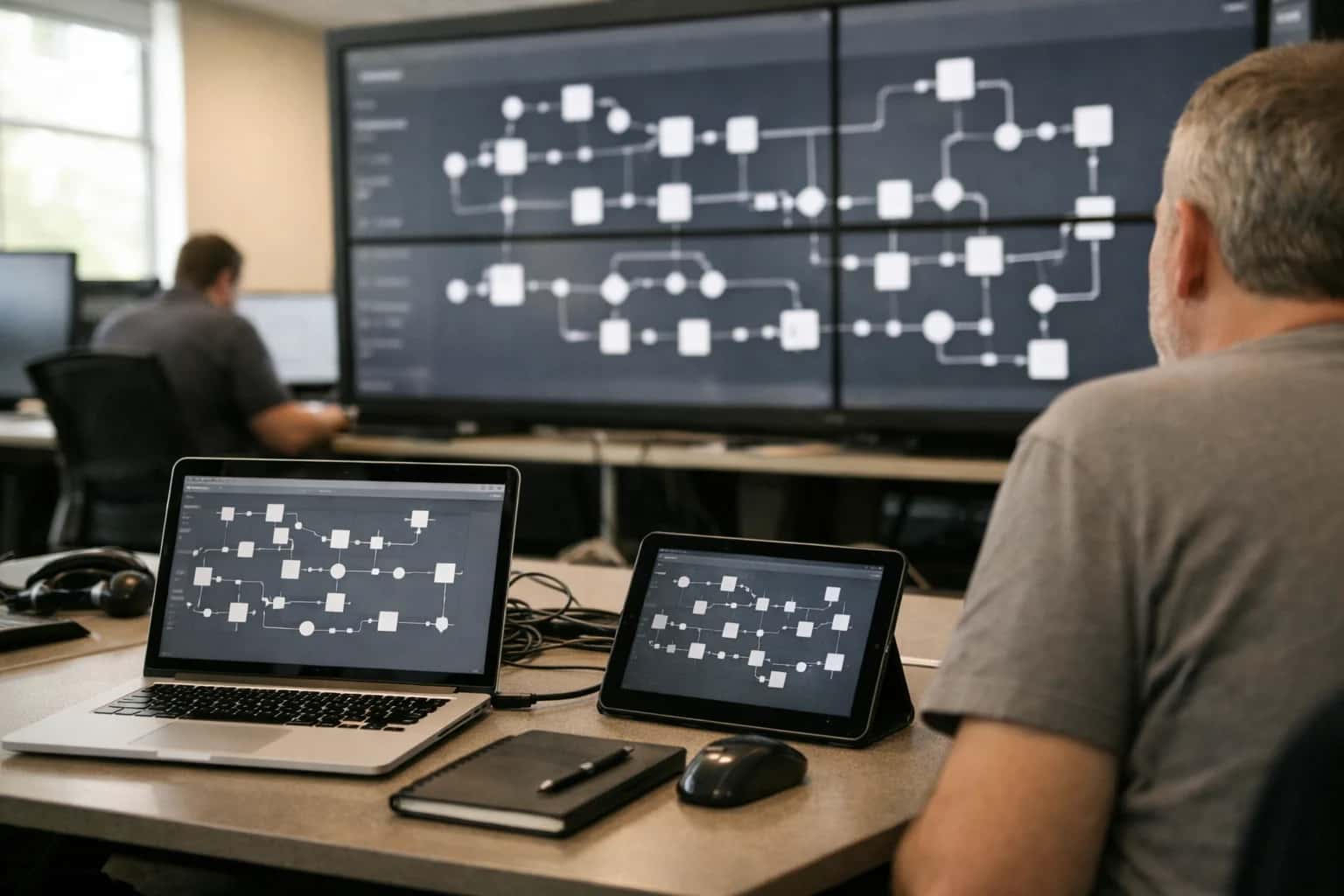
AUTOMATED GRID RESTORATION
What is Fault Detection, Isolation, and Recovery (FDIR)?
FDIR is an automated control architecture that identifies electrical faults, disconnects the affected section, and restores power to healthy portions of the network without human intervention.
FDIR systems rely on peer-to-peer communication protocols like IEC 61850 GOOSE messaging to exchange fault status and permissive signals between devices in milliseconds. The service restoration algorithm calculates optimal switching sequences while respecting thermal limits and voltage constraints, ensuring that only the faulted segment remains de-energized. This architecture is foundational to the self-healing grid concept.
CORE ARCHITECTURAL PILLARS
Key Characteristics of FDIR Systems
Fault Detection, Isolation, and Recovery (FDIR) systems are defined by a set of core characteristics that enable sub-cycle decision-making and autonomous grid restoration. These pillars distinguish a true self-healing grid from simple automated switching.
01
Distributed Intelligence
FDIR logic executes directly on Intelligent Electronic Devices (IEDs) at the grid edge, not in a central SCADA master. This eliminates the latency of polling remote terminal units. Peer-to-peer IEC 61850 GOOSE messaging allows reclosers and switches to share fault flags and voltage measurements in under 3 milliseconds, enabling coordinated isolation without controller intervention.
02
Deterministic Fault Classification
The system must discriminate between transient faults (e.g., tree branch contact) and permanent faults (e.g., downed conductor). This is achieved through:
- Multi-shot auto-reclosing logic with programmable dead times
- High-impedance fault detection algorithms to identify downed conductors on high-resistance surfaces
- Traveling wave analysis to pinpoint fault location within a single tower span
03
Topology-Agnostic Isolation
FDIR engines maintain a real-time connectivity model of the distribution network. When a fault occurs, the system calculates the minimum fault isolation area by opening the nearest upstream and downstream switching devices. This adaptive protection scheme dynamically adjusts coordination logic based on the current network topology, generation dispatch, and load conditions, ensuring selectivity even in meshed or reconfigured networks.
04
Constraint-Based Service Restoration
After isolation, the service restoration algorithm computes optimal switching sequences to re-energize healthy sections via alternate feeders. The engine respects:
- Thermal limits of cables and transformers
- Voltage constraints to prevent under-voltage conditions
- Load balancing to avoid overloading alternate sources
- Inrush current from cold-load pickup after extended outages
05
Sub-Cycle Execution Speed
End-to-end FDIR operations—from fault detection to isolation—complete in under 100 milliseconds, often within 2-3 power cycles. This speed prevents equipment damage from fault currents and maintains transient stability. Arc flash detection using optical sensors triggers ultra-fast trips in under 2 milliseconds for switchgear protection, while teleprotection schemes use fiber optic channels for high-speed permissive tripping between substations.
06
Post-Event Forensic Analysis
Every FDIR event generates a comprehensive audit trail for protection engineers. Digital Fault Recorders (DFRs) capture high-resolution voltage and current waveforms, storing them in COMTRADE (IEEE C37.111) format. This data enables:
- Validation of relay operating times against IDMT curve expectations
- Detection of CT saturation that may have affected differential protection
- Analysis of distributed generation fault current contributions from inverter-based resources
FDIR FUNDAMENTALS
Frequently Asked Questions
Clear, technically precise answers to the most common questions about Fault Detection, Isolation, and Recovery architectures in modern distribution automation.
Fault Detection, Isolation, and Recovery (FDIR) is an automated grid control architecture that identifies electrical faults, disconnects the affected section, and restores power to healthy portions of the network without human intervention. The process executes in three sequential stages. Detection uses intelligent electronic devices (IEDs) and protection relays to monitor voltage and current waveforms for anomalies, often communicating via IEC 61850 GOOSE messaging for high-speed peer-to-peer data exchange. Isolation commands the circuit breakers and reclosers immediately adjacent to the fault to open, minimizing the de-energized segment. Recovery triggers a service restoration algorithm that calculates the optimal switching sequence to back-feed power from alternate sources, respecting thermal limits and voltage constraints. This entire cycle typically completes in under 60 seconds, dramatically reducing the Customer Average Interruption Duration Index (CAIDI).
Enabling Efficiency, Speed & Accuracy
Intelligent Analysis, Decision & Execution
We build AI systems for teams that need search across company data, workflow automation across tools, or AI features inside products and internal software.
Talk to Us
Search across company data
Give teams answers from docs, tickets, runbooks, and product data with sources and permissions.
Useful when people spend too long searching or get different answers from different systems.
Enterprise searchRAGPermissions
Read more
Automate internal workflows
Use AI to route work, draft outputs, trigger actions, and keep approvals and logs in place.
Useful when repetitive work moves across multiple tools and teams.
AI agentsWorkflow automationGovernance
Read more
Add AI to products and internal tools
Build assistants, guided actions, or decision support into the software your team or customers already use.
Useful when AI needs to be part of the product, not a separate tool.
AI integrationDecision supportModel routing
Read more
About the author
Prasad Kumkar
CEO & MD, Inference Systems
Prasad Kumkar is the CEO & MD of Inference Systems and writes about AI systems architecture, LLM infrastructure, model serving, evaluation, and production deployment. Over 5+ years, he has worked across computer vision models, L5 autonomous vehicle systems, and LLM research, with a focus on taking complex AI ideas into real-world engineering systems.
His work and writing cover AI systems, large language models, AI agents, multimodal systems, autonomous systems, inference optimization, RAG, evaluation, and production AI engineering.
LinkedIn
Limited slotsGet a Free AI Consultation
Partnered with leading AI, data, and software stack.





How We Work
Custom AI workflows for your Business
One-fit-all AI don't work for modern businesses. At Inferensys, we aim to understand your business & custom requirements; which we use to define most efficient agentic workflows, the data, and the tools for your business.
01
Review the use case
We understand the task, the users, and where AI can actually help.
Read more02
Pick the right approach
We define what needs search, automation, or product integration.
Read more03
Build the first useful version
We implement the part that proves the value first.
Read more04
Improve from there
We add the checks and visibility needed to keep it useful.
Read moreThe first call is a practical review of your use case and the right next step.
Talk to Us