Edge inference disaggregation executes the computational process of decomposing a building's aggregate electrical signal into individual appliance loads locally on the meter or gateway hardware. By running optimized TinyML or compressed deep learning models directly on the microcontroller, the system eliminates the latency, bandwidth cost, and privacy risks associated with streaming granular power data to a central server. This architecture transforms a standard smart meter into an autonomous sensor capable of identifying appliance-specific signatures in real time.

Glossary
Edge Inference Disaggregation
The deployment of trained Non-Intrusive Load Monitoring (NILM) models directly onto embedded hardware or smart meters to perform on-device load analysis without transmitting high-frequency data to the cloud.
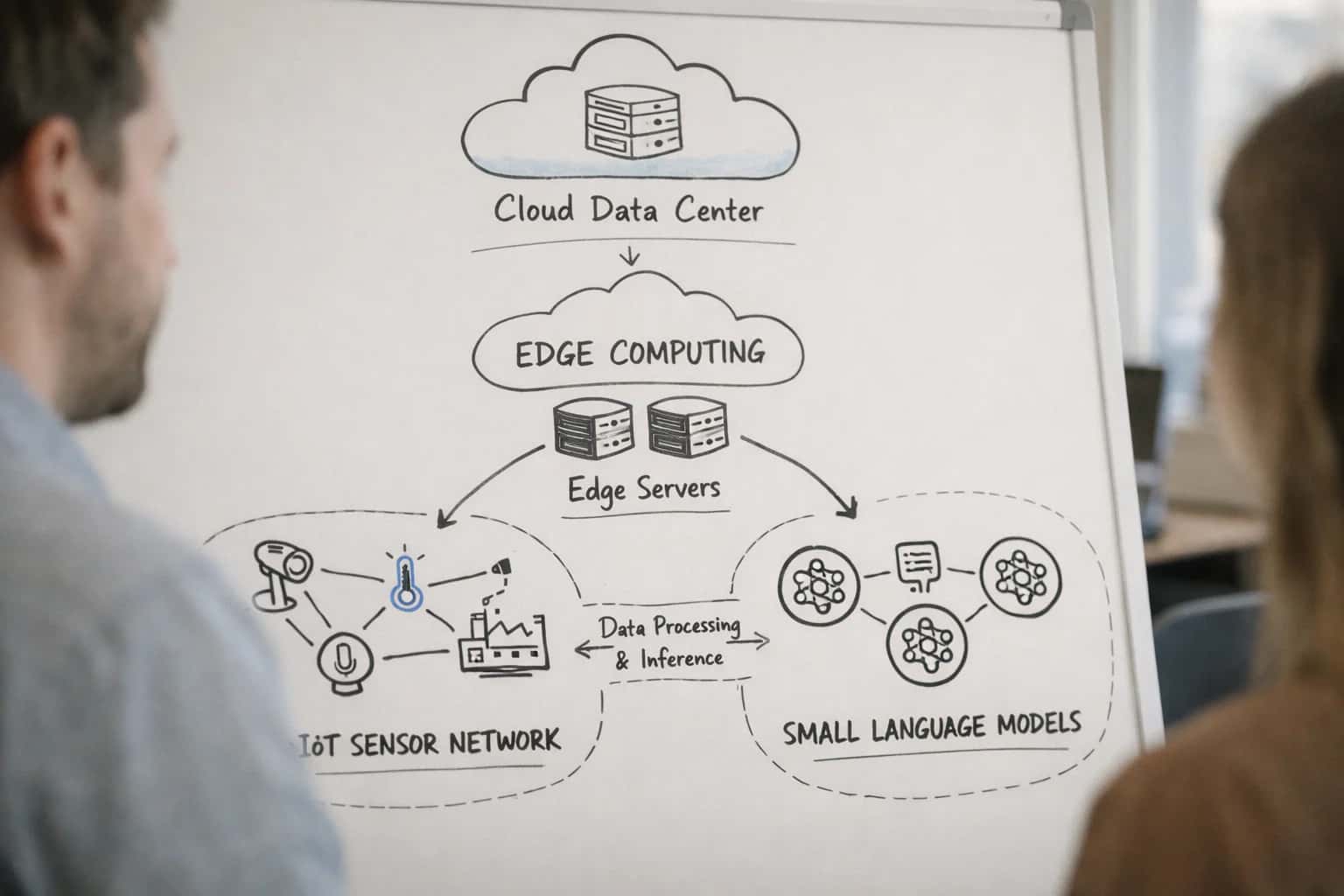
ON-DEVICE LOAD ANALYTICS
What is Edge Inference Disaggregation?
Edge inference disaggregation is the deployment of trained Non-Intrusive Load Monitoring (NILM) models directly onto embedded hardware or smart meters to perform on-device load analysis without transmitting high-frequency data to the cloud.
The primary engineering challenge involves compressing complex sequence-to-sequence or convolutional neural networks to fit within the severe memory and processing constraints of embedded systems. Techniques such as post-training quantization and weight pruning are critical to achieving real-time inference on hardware lacking a dedicated neural processing unit. This approach ensures that sensitive, high-resolution energy data never leaves the physical premises, satisfying strict data sovereignty requirements while enabling immediate feedback for demand response and energy efficiency applications.
ON-DEVICE NILM ARCHITECTURE
Key Characteristics of Edge Inference Disaggregation
Edge inference disaggregation shifts the computational burden of load analysis from the cloud to the meter itself. This paradigm is defined by distinct architectural constraints and performance advantages.
01
Ultra-Low Latency Feedback
By executing inference directly on the embedded processor, the system eliminates the round-trip delay to a cloud server. This enables real-time appliance state detection, which is critical for immediate demand response signals and dynamic load control. Latency is reduced from hundreds of milliseconds to sub-10ms deterministic execution, allowing the meter to react to a motor starting before it causes a local voltage sag.
< 10 ms
Inference Latency
02
Data Privacy Preservation
High-frequency electrical data can reveal sensitive occupancy patterns and appliance usage. Edge inference ensures that raw current and voltage waveforms never leave the meter. Only anonymized, low-resolution metadata—such as the disaggregated consumption totals—is transmitted to the utility. This architecture satisfies strict GDPR and data minimization requirements by processing personally identifiable information at the source and discarding it immediately.
03
Bandwidth Minimization
Streaming kilohertz-range sampling data from millions of endpoints is economically prohibitive. Edge disaggregation compresses the data at the source by transmitting only the inferred appliance states and energy values. This reduces the required uplink bandwidth by a factor of 1,000x to 10,000x, converting an impossible big data problem into a manageable, low-cost telemetry stream suitable for narrowband IoT networks.
04
Model Compression Techniques
Deploying neural networks on a microcontroller with limited SRAM requires aggressive optimization. Key techniques include:
- Post-training quantization: Reducing 32-bit floating-point weights to 8-bit integers.
- Weight pruning: Removing near-zero connections from the network.
- Knowledge distillation: Training a compact 'student' model to mimic a larger 'teacher' model. These methods shrink a model footprint to under 100KB while retaining acceptable accuracy.
05
Resilience to Connectivity Loss
Unlike cloud-dependent solutions, edge inference operates independently of WAN availability. The meter continues to perform accurate load disaggregation during network outages, storing time-stamped results in local non-volatile memory. This offline-first architecture ensures continuous energy monitoring and local decision-making, synchronizing data back to the headend only when the connection is restored.
06
Federated Model Updates
To prevent model drift without compromising privacy, edge disaggregation leverages federated learning. The central server sends a base model update to the meter. The meter fine-tunes this model on local data and sends back only the encrypted gradient updates, not the training data. This allows the global NILM model to learn new appliance signatures across the fleet without ever centralizing sensitive consumer data.
EDGE INFERENCE DISAGGREGATION
Frequently Asked Questions
Clear, technically precise answers to the most common questions about deploying non-intrusive load monitoring models directly onto embedded hardware and smart meters.
Edge inference disaggregation is the deployment of a trained Non-Intrusive Load Monitoring (NILM) model directly onto an embedded processor within a smart meter or edge gateway to perform on-device appliance-level energy analysis. Instead of streaming high-frequency aggregate power data to the cloud, the model executes inference locally, mapping the total power signal to individual appliance states using architectures like sequence-to-sequence networks or factorial hidden Markov models. The edge device ingests voltage and current samples, extracts features such as steady-state power steps or transient signatures, and outputs a breakdown of consumption by appliance type. This approach eliminates the latency, bandwidth cost, and privacy risks associated with cloud-dependent disaggregation, enabling real-time feedback to consumers and grid operators without raw data ever leaving the premises.
Enabling Efficiency, Speed & Accuracy
Intelligent Analysis, Decision & Execution
We build AI systems for teams that need search across company data, workflow automation across tools, or AI features inside products and internal software.
Talk to Us
Search across company data
Give teams answers from docs, tickets, runbooks, and product data with sources and permissions.
Useful when people spend too long searching or get different answers from different systems.
Enterprise searchRAGPermissions
Read more
Automate internal workflows
Use AI to route work, draft outputs, trigger actions, and keep approvals and logs in place.
Useful when repetitive work moves across multiple tools and teams.
AI agentsWorkflow automationGovernance
Read more
Add AI to products and internal tools
Build assistants, guided actions, or decision support into the software your team or customers already use.
Useful when AI needs to be part of the product, not a separate tool.
AI integrationDecision supportModel routing
Read more
About the author
Prasad Kumkar
CEO & MD, Inference Systems
Prasad Kumkar is the CEO & MD of Inference Systems and writes about AI systems architecture, LLM infrastructure, model serving, evaluation, and production deployment. Over 5+ years, he has worked across computer vision models, L5 autonomous vehicle systems, and LLM research, with a focus on taking complex AI ideas into real-world engineering systems.
His work and writing cover AI systems, large language models, AI agents, multimodal systems, autonomous systems, inference optimization, RAG, evaluation, and production AI engineering.
LinkedIn
Limited slotsGet a Free AI Consultation
Partnered with leading AI, data, and software stack.





How We Work
Custom AI workflows for your Business
One-fit-all AI don't work for modern businesses. At Inferensys, we aim to understand your business & custom requirements; which we use to define most efficient agentic workflows, the data, and the tools for your business.
01
Review the use case
We understand the task, the users, and where AI can actually help.
Read more02
Pick the right approach
We define what needs search, automation, or product integration.
Read more03
Build the first useful version
We implement the part that proves the value first.
Read more04
Improve from there
We add the checks and visibility needed to keep it useful.
Read moreThe first call is a practical review of your use case and the right next step.
Talk to Us