Distributed Energy Resource Aggregation is the technical and commercial process of networking heterogeneous behind-the-meter assets—such as rooftop solar, battery energy storage systems, electric vehicles, and smart thermostats—into a unified, dispatchable portfolio. By leveraging a Distributed Energy Resource Management System (DERMS), an aggregator harmonizes the individual operational profiles and constraints of thousands of assets to present a single, reliable capacity block to the grid operator, effectively creating a Virtual Power Plant (VPP) that can bid into ancillary service markets.

Glossary
Distributed Energy Resource Aggregation
The process of combining numerous small-scale energy assets into a single, controllable virtual resource large enough to participate in wholesale energy markets.
VIRTUAL POWER PLANT FUNDAMENTALS
What is Distributed Energy Resource Aggregation?
Distributed Energy Resource (DER) aggregation is the process of combining numerous small-scale, geographically dispersed energy assets into a single, controllable virtual resource large enough to participate in wholesale energy markets and provide grid services.
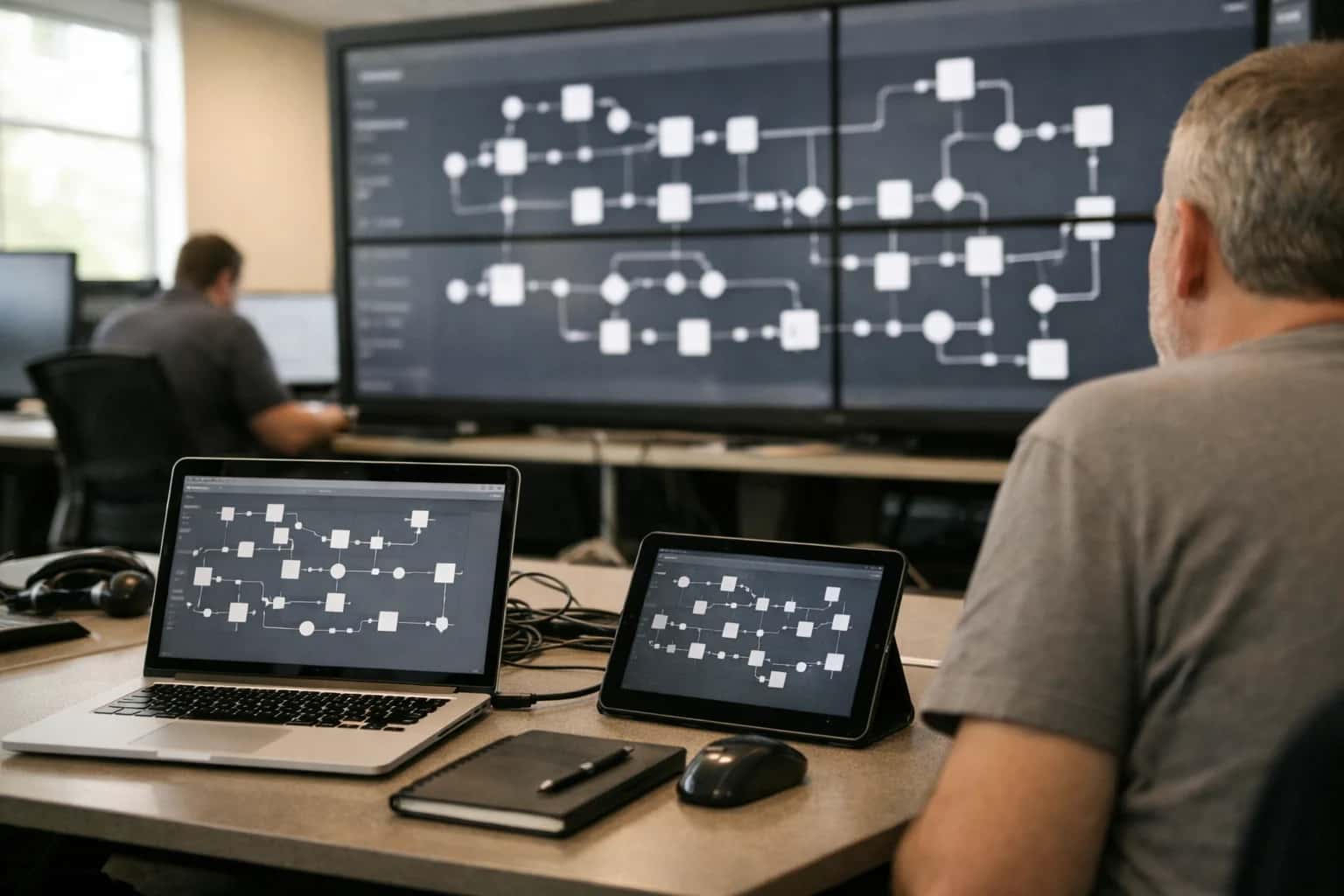
The aggregation platform continuously monitors real-time telemetry from enrolled devices and uses predictive algorithms to calculate the net available flexible capacity. When a dispatch signal is received—such as a frequency regulation request or a peak shaving command—the system autonomously decomposes the total required load adjustment into discrete, optimized setpoints for each individual asset. This orchestration must account for local constraints, customer preferences, and communication latency to ensure the aggregated response is as deterministic and measurable as a traditional centralized generator.
VIRTUAL POWER PLANT ARCHITECTURE
Key Characteristics of DER Aggregation
Distributed Energy Resource (DER) aggregation transforms thousands of small-scale assets into a single, dispatchable grid resource. The following characteristics define how these systems achieve the scale, reliability, and controllability required for wholesale market participation.
01
Spatial and Technological Heterogeneity
Aggregation platforms must normalize a diverse mix of asset types—rooftop solar, battery energy storage systems (BESS), smart thermostats, and EV chargers—spread across different nodes of the distribution grid.
- Protocol translation: Converts proprietary OEM APIs (e.g., Enphase, Tesla, SolarEdge) into a unified control schema.
- Locational awareness: Maps each asset to its specific Locational Marginal Price (LMP) node to value its contribution accurately.
- Latency compensation: Accounts for varying network latencies from residential Wi-Fi to cellular backhaul to ensure synchronous dispatch.
02
Real-Time Telemetry and State Estimation
A DER aggregator must maintain a live, second-by-second model of the aggregate's available capacity. This requires continuous polling of behind-the-meter (BTM) assets that are not directly visible to the utility SCADA system.
- State of charge (SoC) for batteries and curtailment status for solar inverters are ingested at sub-second intervals.
- Kalman filtering and other state estimation techniques reconcile noisy, intermittent telemetry streams into a coherent aggregate view.
- The system must distinguish between a device that is offline versus one that is simply idle to avoid over-committing capacity.
03
Dispatch Decomposition and Load Shaping
A single dispatch signal from the grid operator—e.g., 'reduce load by 50 MW for 2 hours'—must be algorithmically decomposed into thousands of individual device-level commands.
- Optimization solvers allocate the dispatch across assets to minimize customer impact while respecting individual device constraints (e.g., minimum battery SoC, maximum HVAC temperature drift).
- Load shaping creates a synthetic aggregate response curve that matches the grid operator's requested ramp rate and duration.
- The system continuously re-optimizes the allocation mid-event if individual assets fail to respond as predicted.
04
Baseline Measurement and Settlement Integrity
Financial settlement in wholesale markets depends on proving how much load was actually reduced compared to a counterfactual baseline. The aggregator's Measurement and Verification (M&V) engine is its profit center.
- Calculates Customer Baseline Load (CBL) using methodologies like '10-in-10' or weather-adjusted regression models.
- Must pass rigorous performance audits by independent market monitors to avoid financial penalties.
- Settlement engines reconcile meter data with dispatch records to allocate revenue shares to individual asset owners.
05
Cybersecurity and Authorization Governance
An aggregator controlling millions of distributed assets represents a critical attack surface. Compromised dispatch signals could destabilize the grid rather than support it.
- IEEE 2030.5 and OpenADR protocols enforce certificate-based mutual authentication between the aggregator and every endpoint.
- Role-based access control (RBAC) ensures that customer overrides (e.g., opting out of an event) are respected and cannot be bypassed by automated dispatch logic.
- Continuous SCADA anomaly detection monitors for command injection patterns that deviate from normal operational cadence.
06
Market Multi-Participation and Value Stacking
A sophisticated aggregator maximizes revenue by bidding the same portfolio into multiple value streams simultaneously, a practice known as value stacking.
- A residential battery can provide frequency regulation (fast response) while also contracted for peak shaving (slower, sustained response).
- The optimization engine must respect the physical limits of the asset to avoid double-counting capacity.
- Participation spans wholesale ancillary service markets, distribution-level non-wires alternatives, and retail time-of-use arbitrage.
DISTRIBUTED ENERGY RESOURCE AGGREGATION
Frequently Asked Questions
Clear, technically precise answers to the most common questions about combining distributed energy assets into a single, market-ready virtual resource.
Distributed energy resource (DER) aggregation is the process of combining numerous small-scale, geographically dispersed energy assets—such as rooftop solar panels, battery storage systems, electric vehicles, and smart thermostats—into a single, controllable virtual resource large enough to participate in wholesale energy markets. The aggregation is orchestrated by a central software platform, typically a Distributed Energy Resource Management System (DERMS) or a Virtual Power Plant (VPP) platform, which communicates with individual assets via standard protocols like IEEE 2030.5 or OpenADR. The platform continuously monitors the real-time status, state of charge, and available capacity of each asset, then dispatches aggregated control signals to charge, discharge, or curtail load in response to grid operator requests. This transforms a collection of kilowatt-scale devices into a megawatt-scale resource capable of providing frequency regulation, spinning reserves, or peak shaving services that were previously the exclusive domain of centralized power plants.
Enabling Efficiency, Speed & Accuracy
Intelligent Analysis, Decision & Execution
We build AI systems for teams that need search across company data, workflow automation across tools, or AI features inside products and internal software.
Talk to Us
Search across company data
Give teams answers from docs, tickets, runbooks, and product data with sources and permissions.
Useful when people spend too long searching or get different answers from different systems.
Enterprise searchRAGPermissions
Read more
Automate internal workflows
Use AI to route work, draft outputs, trigger actions, and keep approvals and logs in place.
Useful when repetitive work moves across multiple tools and teams.
AI agentsWorkflow automationGovernance
Read more
Add AI to products and internal tools
Build assistants, guided actions, or decision support into the software your team or customers already use.
Useful when AI needs to be part of the product, not a separate tool.
AI integrationDecision supportModel routing
Read more
About the author
Prasad Kumkar
CEO & MD, Inference Systems
Prasad Kumkar is the CEO & MD of Inference Systems and writes about AI systems architecture, LLM infrastructure, model serving, evaluation, and production deployment. Over 5+ years, he has worked across computer vision models, L5 autonomous vehicle systems, and LLM research, with a focus on taking complex AI ideas into real-world engineering systems.
His work and writing cover AI systems, large language models, AI agents, multimodal systems, autonomous systems, inference optimization, RAG, evaluation, and production AI engineering.
LinkedIn
Limited slotsGet a Free AI Consultation
Partnered with leading AI, data, and software stack.





How We Work
Custom AI workflows for your Business
One-fit-all AI don't work for modern businesses. At Inferensys, we aim to understand your business & custom requirements; which we use to define most efficient agentic workflows, the data, and the tools for your business.
01
Review the use case
We understand the task, the users, and where AI can actually help.
Read more02
Pick the right approach
We define what needs search, automation, or product integration.
Read more03
Build the first useful version
We implement the part that proves the value first.
Read more04
Improve from there
We add the checks and visibility needed to keep it useful.
Read moreThe first call is a practical review of your use case and the right next step.
Talk to Us