Quantization is a model compression technique that reduces the numerical precision of a neural network's weights and activations, converting them from high-precision formats like 32-bit floating-point (FP32) to lower-precision formats like 8-bit integers (INT8). This process decreases the model's memory footprint, reduces power consumption, and accelerates inference on hardware optimized for integer arithmetic, such as CPUs, GPUs, and specialized Neural Processing Units (NPUs). The primary goal is to maintain model accuracy while achieving significant gains in efficiency for deployment on edge devices and in production servers.

Glossary
Quantization
Quantization is a model compression technique that reduces the numerical precision of a neural network's weights and activations to decrease model size and accelerate inference.
MODEL COMPRESSION
What is Quantization?
Quantization is a core model compression technique in machine learning that reduces the numerical precision of a model's parameters and computations.
The technique is implemented through methods like Post-Training Quantization (PTQ), which calibrates a pre-trained model using a small dataset, and Quantization-Aware Training (QAT), which simulates quantization during training for higher accuracy. Quantization introduces a trade-off between precision and efficiency, managed by scaling factors that map floating-point ranges to integer buckets. It is a foundational step in optimization pipelines using frameworks like TensorFlow Lite and TensorRT, enabling the deployment of large models like Transformers on resource-constrained hardware.
MODEL COMPRESSION
Key Quantization Techniques
Quantization reduces the numerical precision of a model's weights and activations. These are the primary methodologies for implementing this critical compression technique.
01
Post-Training Quantization (PTQ)
Post-Training Quantization (PTQ) is applied to a fully trained model without any further training. A small, representative calibration dataset is used to observe the dynamic ranges of activations and calculate optimal scaling factors (quantization parameters).
- Process: The pre-trained FP32 model's weights are converted to INT8. Activations are quantized on-the-fly using the pre-computed scales.
- Advantage: Fast and simple; requires no retraining, making it ideal for rapid deployment.
- Trade-off: Can lead to higher accuracy loss compared to QAT, especially for models with narrow activation ranges or outliers.
- Use Case: The default method for deploying models via frameworks like TensorFlow Lite and ONNX Runtime.
02
Quantization-Aware Training (QAT)
Quantization-Aware Training (QAT) simulates quantization effects during the training or fine-tuning process. Fake quantization nodes are inserted into the model graph to mimic the rounding and clipping of INT8 arithmetic in the forward pass.
- Process: The model learns to adapt its weights to the precision loss. The Straight-Through Estimator (STE) is used to approximate gradients through the non-differentiable quantization operation during backpropagation.
- Advantage: Typically achieves higher accuracy than PTQ by allowing the model to compensate for quantization error.
- Trade-off: Requires a full training cycle (or fine-tuning), which is more computationally expensive than PTQ.
- Use Case: Essential for compressing models where PTQ causes unacceptable accuracy degradation.
03
Static vs. Dynamic Quantization
This distinction defines when activation ranges are determined.
- Static Quantization: The most common approach for PTQ and QAT. Scaling factors for all activations are pre-calculated during calibration (PTQ) or training (QAT) and remain fixed during inference. Enables maximal hardware optimization and kernel fusion.
- Dynamic Quantization: Weights are pre-quantized, but activations are quantized on-the-fly during inference based on their observed range for each input. This is more flexible for inputs with highly variable ranges (e.g., in NLP models) but introduces runtime overhead for computing scales.
Hybrid Quantization schemes also exist, such as statically quantizing some layers (e.g., CNN filters) and dynamically quantizing others (e.g., attention activations).
04
Integer Quantization (INT8/INT4)
Integer Quantization refers to mapping floating-point values to integer types. INT8 quantization is the industry standard, offering a 4x reduction in model size and memory bandwidth compared to FP32.
- Mechanism: Uses affine quantization:
Q = round(R / S) + Z, whereRis the real value,Sis a scaling factor (float), andZis an integer zero-point. - Hardware Support: INT8 arithmetic is natively supported by modern AI accelerators (e.g., NVIDIA Tensor Cores, Intel DL Boost, ARM DOT), providing significant speedups.
- Lower Precision: INT4 and binary/ternary quantization push compression further, reducing size by 8x or more, but require sophisticated mixed-precision strategies or specialized hardware to maintain usable accuracy.
05
Per-Tensor vs. Per-Channel Quantization
This defines the granularity at which scaling factors are applied.
- Per-Tensor Quantization: A single scaling factor and zero-point are used for an entire tensor (e.g., all weights in a layer). This is simpler but less accurate if the tensor's values have a wide distribution.
- Per-Channel Quantization: (Primarily for weights) A separate scaling factor and zero-point are used for each output channel of a convolutional kernel or each column of a linear layer. This accounts for variation across channels and significantly improves accuracy, especially for weight tensors. It is the default for weight quantization in frameworks like TensorRT.
Choosing the right granularity is a key optimization step in the quantization pipeline.
06
Hardware-Aware Quantization
Effective quantization must account for target hardware capabilities. This involves co-designing the quantization scheme with the deployment platform.
- Compiler Optimization: Tools like TVM, TensorRT, and XNNPACK fuse operations (e.g., Conv + ReLU + Quantize) and select optimal low-precision kernels for the target CPU, GPU, or NPU.
- Supported Ops: Hardware may only support specific quantization schemes (e.g., symmetric vs. asymmetric, per-tensor only). The model must be quantized within these constraints.
- Calibration for Latency: The calibration process can be tuned not just for accuracy, but for end-to-end latency on the target device, sometimes accepting different quantization parameters to maximize throughput.
This technique bridges the gap between algorithmic compression and real-world performance gains.
PRECISION FORMATS
Common Data Types for Quantization
A comparison of numerical precision formats used to represent neural network weights and activations, detailing their bit-width, typical use cases, and hardware support.
| Data Type | Bit Width | Primary Use Case | Hardware Support | Memory Savings vs. FP32 |
|---|---|---|---|---|
FP32 (Full Precision) | 32 bits | Training, High-Accuracy Inference | Universal (CPUs, GPUs) | 0% (Baseline) |
BFLOAT16 (Brain Floating Point) | 16 bits | Training, High-Performance Inference | Modern AI Accelerators (TPUs, NVIDIA Ampere+ GPUs) | 50% |
FP16 (Half Precision) | 16 bits | Training, Inference | Modern GPUs, AI Accelerators | 50% |
INT8 (8-bit Integer) | 8 bits | Post-Training & Quantization-Aware Training Inference | Widespread (CPUs, GPUs, NPUs, MCUs) | 75% |
INT4 (4-bit Integer) | 4 bits | Extreme Compression for Large Models | Emerging (Specialized NPUs, Research) | 87.5% |
FP8 (8-bit Floating Point) | 8 bits | Training & Inference (Emerging Standard) | Next-Gen AI Accelerators (e.g., NVIDIA Hopper) | 75% |
Binary / Ternary Weights | 1-2 bits | Research, Extreme Edge Deployment | Specialized Hardware / Software Kernels |
|
MODEL COMPRESSION
How Quantization Works
Quantization is a fundamental technique for deploying large neural networks on resource-constrained hardware by reducing their numerical precision.
Quantization is a model compression technique that reduces the numerical precision of a neural network's weights and activations. It converts parameters from high-precision formats, typically 32-bit floating-point (FP32), to lower-precision formats like 8-bit integers (INT8) or 16-bit floats (FP16). This process dramatically decreases the model's memory footprint and accelerates inference by enabling faster, more efficient integer arithmetic on specialized hardware like NPUs and GPUs. The core challenge is minimizing the accuracy loss from this precision reduction.
The technique works by mapping a continuous range of floating-point values to a finite set of discrete integer levels. A quantization function applies scaling factors and zero-point offsets to perform this mapping. Post-Training Quantization (PTQ) statically calibrates these factors using a small dataset, while Quantization-Aware Training (QAT) simulates quantization during training, allowing the model to adapt. The result is a significantly smaller, faster model suitable for edge deployment, though often with a trade-off in exact numerical fidelity.
QUANTIZATION
Benefits and Tradeoffs
Quantization offers a powerful set of advantages for deploying models to resource-constrained environments, but these benefits come with inherent tradeoffs that must be carefully managed.
01
Drastic Reduction in Model Size
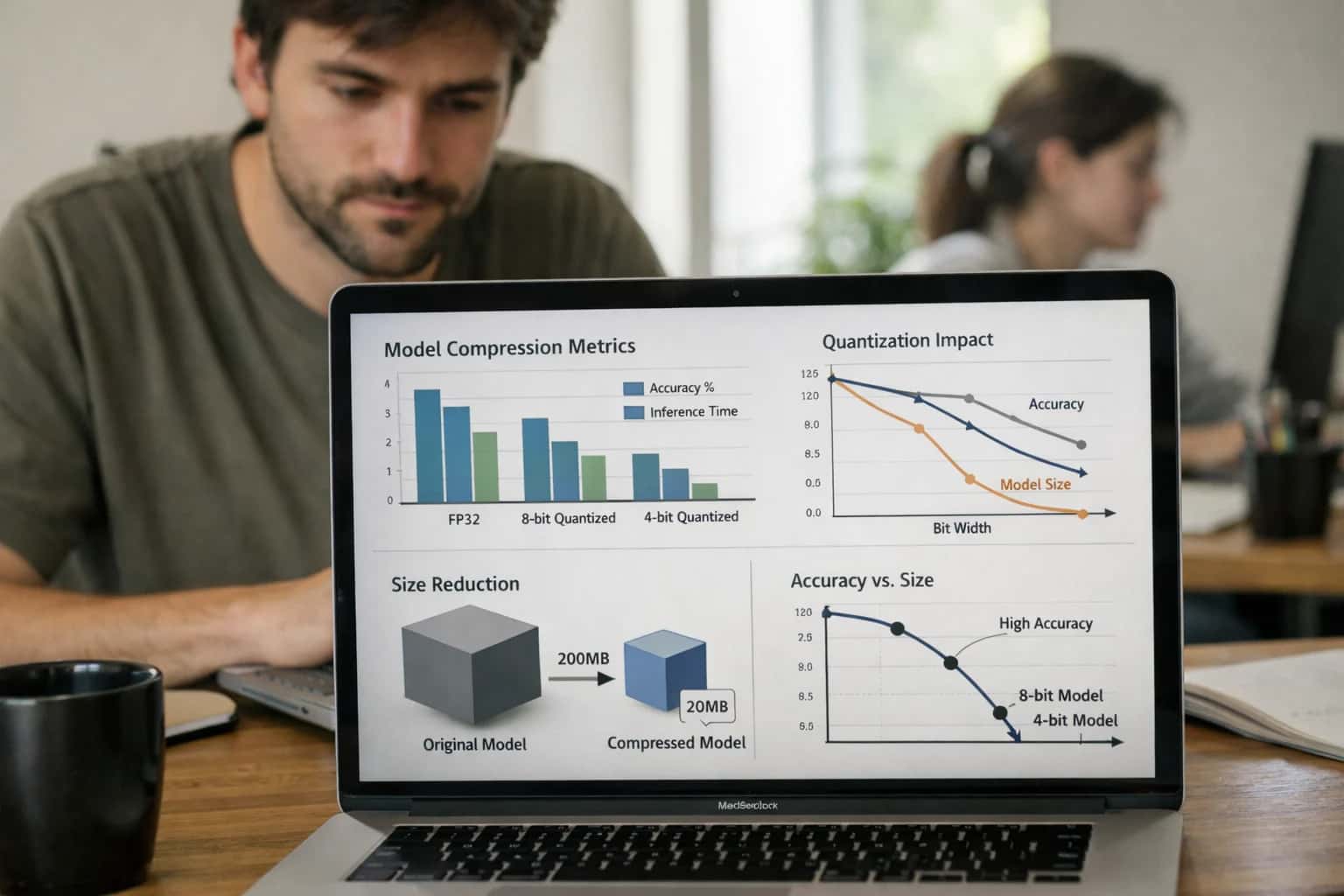
The primary benefit of quantization is a significant decrease in the memory footprint of a neural network. Converting parameters from 32-bit floating-point (FP32) to 8-bit integers (INT8) reduces the storage requirement by approximately 75%. For example, a 100MB FP32 model becomes ~25MB after INT8 quantization. This enables deployment on devices with limited storage, such as mobile phones, microcontrollers, and edge hardware, where every megabyte counts.
~75%
Storage Reduction (FP32 → INT8)
02
Accelerated Inference Speed
Lower precision arithmetic enables faster computation. Integer operations (INT8) are fundamentally faster and more energy-efficient than floating-point operations (FP32) on most general-purpose CPUs and specialized hardware like NPUs and DSPs. This latency reduction is critical for real-time applications such as live video analysis, voice assistants, and autonomous systems. Frameworks like TensorRT and TensorFlow Lite leverage quantized models to execute optimized kernels.
03
Increased Power Efficiency
Reduced memory bandwidth and simpler integer computations directly translate to lower power consumption. This is a paramount concern for battery-powered edge devices and large-scale server deployments. By minimizing data movement and using efficient integer units, quantization extends device battery life and reduces operational costs in data centers, making sustainable AI deployment more feasible.
04
Inevitable Precision Loss & Accuracy Drop
The core tradeoff is a loss of numerical precision, which can degrade model accuracy. Mapping a continuous range of float values to a finite set of integers introduces quantization error. The impact varies:
- Post-Training Quantization (PTQ): Fast but can cause noticeable accuracy loss, especially below 8-bit.
- Quantization-Aware Training (QAT): Mitigates loss by simulating quantization during training, typically recovering near-original accuracy but requiring extra compute and a training pipeline. Sensitive tasks like medical imaging may tolerate less error than object detection.
05
Hardware and Software Complexity
Effective quantization requires compatibility with the target hardware. Not all operations or models quantize equally well; some layers (e.g., attention in Transformers) are more sensitive. Deployment requires:
- Specialized runtimes (e.g., TFLite, ONNX Runtime) to execute quantized graphs.
- Hardware support for integer math (e.g., ARM NEON, Intel VNNI).
- Careful calibration to determine optimal scaling factors for activations. This adds complexity to the ML pipeline compared to deploying FP32 models.
06
Calibration Overhead and Non-Linearity
Static quantization requires a representative calibration dataset to determine the dynamic range of activations, adding a step to the deployment process. Dynamic quantization removes this overhead for activations but incurs a runtime cost. Furthermore, non-linear operations (e.g., sigmoid, GELU) and outlier values in weights can be challenging to quantize effectively, often requiring specific techniques like clipping or per-channel quantization to maintain accuracy.
QUANTIZATION
Frequently Asked Questions
Quantization is a cornerstone technique for deploying AI on resource-constrained hardware. These FAQs address the core concepts, trade-offs, and implementation details critical for engineers and architects.
Quantization is a model compression technique that reduces the numerical precision of a neural network's weights and activations, converting them from high-precision formats like 32-bit floating-point (FP32) to lower-precision formats like 8-bit integers (INT8) or 16-bit floating-point (BF16). The primary goals are to decrease model memory footprint and accelerate inference latency by leveraging efficient integer arithmetic units common in edge hardware and data center accelerators. This process introduces a trade-off between precision and efficiency, often managed through calibration and fine-tuning to minimize accuracy loss.
Enabling Efficiency, Speed & Accuracy
Intelligent Analysis, Decision & Execution
We build AI systems for teams that need search across company data, workflow automation across tools, or AI features inside products and internal software.
Talk to Us
Search across company data
Give teams answers from docs, tickets, runbooks, and product data with sources and permissions.
Useful when people spend too long searching or get different answers from different systems.
Enterprise searchRAGPermissions
Read more
Automate internal workflows
Use AI to route work, draft outputs, trigger actions, and keep approvals and logs in place.
Useful when repetitive work moves across multiple tools and teams.
AI agentsWorkflow automationGovernance
Read more
Add AI to products and internal tools
Build assistants, guided actions, or decision support into the software your team or customers already use.
Useful when AI needs to be part of the product, not a separate tool.
AI integrationDecision supportModel routing
Read more
About the author
Prasad Kumkar
CEO & MD, Inference Systems
Prasad Kumkar is the CEO & MD of Inference Systems and writes about AI systems architecture, LLM infrastructure, model serving, evaluation, and production deployment. Over 5+ years, he has worked across computer vision models, L5 autonomous vehicle systems, and LLM research, with a focus on taking complex AI ideas into real-world engineering systems.
His work and writing cover AI systems, large language models, AI agents, multimodal systems, autonomous systems, inference optimization, RAG, evaluation, and production AI engineering.
LinkedIn
Limited slotsGet a Free AI Consultation
Partnered with leading AI, data, and software stack.





How We Work
Custom AI workflows for your Business
One-fit-all AI don't work for modern businesses. At Inferensys, we aim to understand your business & custom requirements; which we use to define most efficient agentic workflows, the data, and the tools for your business.
01
Review the use case
We understand the task, the users, and where AI can actually help.
Read more02
Pick the right approach
We define what needs search, automation, or product integration.
Read more03
Build the first useful version
We implement the part that proves the value first.
Read more04
Improve from there
We add the checks and visibility needed to keep it useful.
Read moreThe first call is a practical review of your use case and the right next step.
Talk to Us