
Inferensys

Glossary

Multi-Teacher Distillation

Multi-Teacher Distillation is a model compression technique where a single, efficient student model is trained to aggregate and internalize knowledge from multiple, potentially diverse, teacher models.
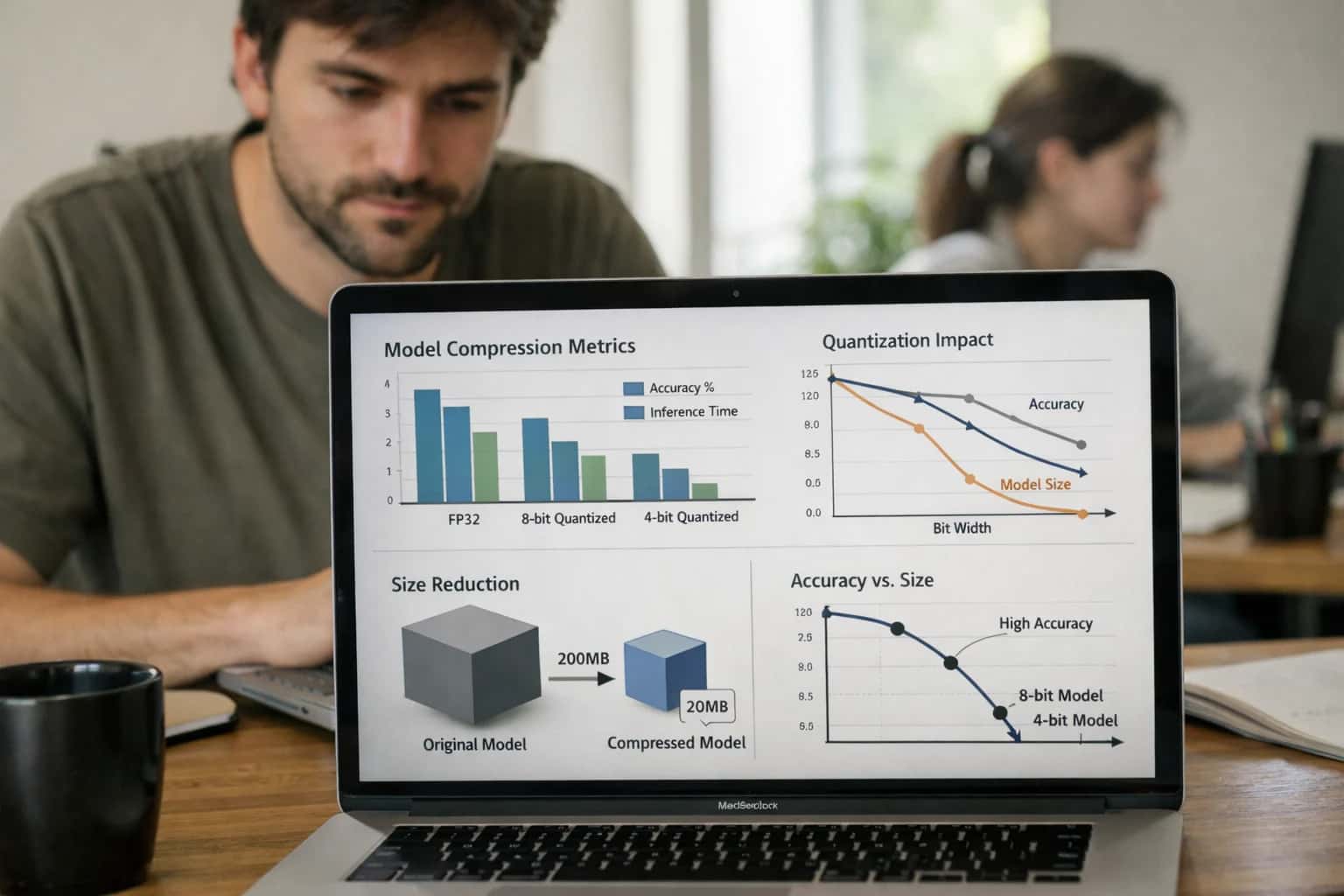
ML engineer working on model compression and quantization, laptop showing performance benchmarks, technical workspace.
KNOWLEDGE DISTILLATION

What is Multi-Teacher Distillation?

Multi-Teacher Distillation is an advanced model compression technique where a single, compact student model is trained to aggregate and internalize knowledge from multiple, often diverse, teacher models.

Multi-Teacher Distillation is a knowledge distillation technique where a single student model learns from the combined outputs of multiple teacher models. This method leverages the complementary strengths, diverse architectures, or specialized expertise of several teachers, allowing the student to achieve performance that often surpasses learning from a single source. The core challenge is designing an effective aggregation strategy—such as averaging logits, weighted voting, or attention-based fusion—to harmonize the supervisory signals into a coherent training objective for the student.

The primary advantage over single-teacher distillation is knowledge amalgamation, where the student integrates insights from teachers trained on different tasks, data domains, or architectural inductive biases. Common strategies include logit-based distillation from an ensemble or intermediate feature alignment from heterogeneous networks. This technique is crucial for creating versatile, compact models for edge deployment, where a single efficient model must perform multiple functions previously handled by several larger specialists, directly supporting the development of capable small language models.

MULTI-TEACHER DISTILLATION

Core Mechanisms for Knowledge Fusion

Multi-Teacher Distillation is a technique where a single student model is trained to aggregate and distill knowledge from multiple, potentially diverse, teacher models. This section details the core mechanisms that enable this fusion of expertise.

01

Ensemble Knowledge Aggregation

This is the foundational mechanism where the student model learns from the combined outputs of multiple teachers. The teachers can be:

  • Homogeneous models (same architecture, different initializations or data subsets).
  • Heterogeneous models (different architectures or modalities).

Common aggregation methods include:

  • Averaging logits or soft targets from all teachers.
  • Weighted averaging, where weights are based on teacher confidence or expertise.
  • Voting mechanisms for classification tasks.

The student learns a more robust and generalized representation by integrating these diverse supervisory signals, reducing variance and bias inherent in any single teacher.

02

Specialized Teacher Gating

This advanced mechanism dynamically selects which teacher(s) to learn from for a given input sample. Instead of a static average, a gating network (often a small neural network) learns to assign weights to each teacher's output based on the input's characteristics.

Key aspects:

  • Enables expertise routing, where a teacher specialized in a certain data domain provides stronger guidance for samples from that domain.
  • The gating mechanism itself can be distilled into the final student, or used only during training.
  • This is particularly powerful when teachers are trained on different tasks or non-overlapping data distributions, allowing the student to become a multi-task or generalist model.
03

Multi-Layer Feature Alignment

Beyond final outputs, this mechanism transfers intermediate representations. The student is trained to mimic feature maps or activations from corresponding layers across multiple teachers.

Implementation involves:

  • Defining hint layers in each teacher model.
  • Using a loss function (e.g., Mean Squared Error, Cosine Similarity) to minimize the distance between student features and a fusion of the teachers' features (e.g., concatenation, averaging).
  • This transfers not just what the teachers know, but how they build internal representations, leading to students with richer feature hierarchies. It's crucial when teachers have diverse architectural strengths.
04

Contrastive Knowledge Fusion

This mechanism uses a contrastive learning objective to fuse knowledge. The student learns to produce embeddings where:

  • Representations for an input are pulled closer to the collective embedding from the teachers.
  • Representations for different inputs are pushed apart.

Process:

  1. An input is passed through all teachers and the student.
  2. The teachers' embeddings are fused (e.g., averaged) to create a positive target.
  3. The student's loss encourages similarity to this fused target and dissimilarity to embeddings of other inputs (negatives). This teaches the student the relational structure of the data as understood by the teacher ensemble, often leading to more transferable representations.
05

Adversarial Imitation Framework

This mechanism employs a Generative Adversarial Network (GAN)-style setup to fuse teacher knowledge. A discriminator network is trained to distinguish between the feature representations of the student model and the aggregated representations of the teacher ensemble.

The student acts as a generator, learning to produce features that are indistinguishable from the fused teacher features, thereby fooling the discriminator.

Benefits:

  • Provides a powerful, adaptive training signal.
  • Can better match the complex, multi-modal distribution of the teachers' combined feature space.
  • Often used in data-free distillation scenarios, where a generator creates synthetic inputs that maximize the disagreement or response of the teacher ensemble.
06

Sequential & Curriculum Distillation

This mechanism orders the knowledge transfer process. Instead of learning from all teachers simultaneously, the student learns from them in a strategic sequence or following a curriculum.

Common strategies:

  • Easier-to-harder: Learn from a simpler, more accurate teacher first to establish a good baseline, then incorporate more complex teachers to refine performance.
  • Progressive fusion: Start by distilling from one teacher, then use the partially-trained student as a base to distill from a second teacher, and so on.
  • Task-specific sequencing: For multi-task teachers, distill task-specific knowledge in a logical order (e.g., foundational tasks first). This structured approach can stabilize training and lead to better convergence than parallel fusion.
KNOWLEDGE DISTILLATION

How Multi-Teacher Distillation Works

Multi-Teacher Distillation is an advanced model compression technique where a single, compact student model learns by aggregating knowledge from multiple, often diverse, teacher models.

Multi-Teacher Distillation is a knowledge distillation variant where a single student model is trained to mimic and synthesize the outputs or internal representations of multiple pre-trained teacher models. This approach leverages the complementary strengths and diverse expertise of an ensemble of teachers, allowing the student to learn a more robust and generalized function than it could from a single source. The core mechanism involves calculating a distillation loss between the student's predictions and a combined supervisory signal derived from all teachers, often through averaging or weighted aggregation of their soft targets or intermediate features.

The process typically employs a weighted distillation loss, such as Kullback-Leibler Divergence, to balance the influence of each teacher. Techniques like attention transfer or feature mimicking can be applied in parallel across all teachers. This method is particularly effective for model compression via distillation, creating a unified student that approximates the performance of a cumbersome teacher ensemble. It is a foundational step towards more complex paradigms like knowledge amalgamation, where teachers may be specialized for different tasks or modalities.

ARCHITECTURAL COMPARISON

Multi-Teacher vs. Single-Teacher Distillation

A comparison of the core characteristics, advantages, and trade-offs between using multiple teacher models versus a single teacher model for knowledge distillation.

Feature / MetricSingle-Teacher DistillationMulti-Teacher Distillation

Core Architecture

One pre-trained teacher model.

Two or more pre-trained teacher models.

Primary Knowledge Source

A single model's predictions and internal representations.

An aggregated or selected combination of knowledge from diverse models.

Knowledge Diversity

Limited to the expertise and biases of one model.

High; can integrate complementary expertise, modalities, or task specializations.

Robustness to Teacher Errors

Low; student inherits all teacher-specific errors and biases.

Higher; aggregation can average out individual teacher errors and idiosyncrasies.

Typical Aggregation Method

Not applicable (N/A).

Logit averaging, weighted voting, attention-based fusion, or adversarial selection.

Training Data Efficiency

Standard; relies on teacher's soft labels for the dataset.

Potentially higher; multiple perspectives can provide richer supervisory signals per sample.

Architectural Flexibility

Teacher and student architectures often similar.

High; teachers can be heterogeneous (e.g., CNNs, Transformers) with different architectures.

Computational & Memory Overhead (Training)

Lower; requires forward passes for one teacher.

Higher; requires forward passes and fusion logic for multiple teachers.

Risk of Conflicting Supervision

None.

Moderate; requires careful fusion to resolve contradictory teacher signals.

Common Use Case

General model compression for a well-defined task.

Creating a multi-talented student, model amalgamation, or boosting accuracy on complex datasets.

Typical Performance Ceiling

Bounded by the single teacher's performance.

Can exceed the best individual teacher; approaches an ensemble's performance.

MULTI-TEACHER DISTILLATION

Primary Use Cases and Applications

Multi-Teacher Distillation is applied to create robust, generalist student models by aggregating specialized knowledge from diverse sources. Its primary applications focus on enhancing performance, efficiency, and generalization beyond the capabilities of a single teacher.

01

Performance Boosting via Ensemble Knowledge

This is the most common application, where the collective predictive power of multiple teacher models is compressed into a single student. The student learns a more accurate and stable decision boundary by averaging over the teachers' diverse perspectives and reducing individual model variance.

  • Key Benefit: The student often matches or exceeds the performance of any single teacher, approaching the accuracy of the full teacher ensemble but at a fraction of the inference cost.
  • Example: Distilling knowledge from an ensemble of five large vision models (e.g., ResNet-152, EfficientNet-B7) into one small MobileNetV3 student for mobile deployment.
02

Cross-Domain & Multi-Task Generalization

Multi-Teacher Distillation excels at creating a unified, multi-talented student from teachers specialized in different domains or tasks. The student amalgamates this heterogeneous knowledge, learning a richer, more general feature representation.

  • Key Benefit: Enables a single compact model to perform well on multiple tasks (e.g., object detection, segmentation, classification) without task-specific heads or significant parameter inflation.
  • Example: Training a student language model using teachers separately fine-tuned on legal document analysis, medical Q&A, and code generation, resulting in a broadly capable assistant.
03

Robustness and Uncertainty Calibration

By learning from multiple teachers, the student model inherits a better understanding of predictive uncertainty and becomes more robust to noisy inputs and adversarial examples. Teachers may disagree on edge cases, teaching the student about ambiguity.

  • Key Benefit: The student's output probabilities become better calibrated (reflecting true likelihood), and its predictions are more stable under distribution shift.
  • Mechanism: The student is trained to match the consensus and variance across teachers' soft targets, learning which predictions are certain and which are ambiguous.
04

Privacy-Preserving Federated Learning

In Federated Distillation, multiple teachers are trained on decentralized, private client data. Instead of sharing sensitive raw gradients or weights, clients share only the distilled knowledge (e.g., soft labels on a public proxy dataset) to train a central student model.

  • Key Benefit: Enables collaborative model improvement across institutions (e.g., hospitals, banks) without exposing the underlying private training data, complying with regulations like GDPR and HIPAA.
  • Workflow: Each client acts as a teacher on its local data. Their knowledge is aggregated on a server to update the global student model.
05

Efficient Model Specialization for Edge

This application targets hardware-aware deployment. A large, general-purpose teacher and a smaller, domain-specialized teacher can jointly distill a student optimized for a specific edge device and use case.

  • Key Benefit: Produces a tiny model that balances general knowledge from the large teacher with crucial, efficient features from the specialized teacher, maximizing performance per compute cycle.
  • Example: For a drone's obstacle detection system, distill from a general Vision Transformer teacher and a teacher specialized in low-light, blurry images into a student optimized for the drone's specific NPU.
06

Knowledge Amalgamation from Heterogeneous Architectures

This advanced use case involves merging knowledge from teachers with incompatible architectures (e.g., CNN and Transformer) or output spaces (e.g., different classification heads) into a cohesive student. Techniques focus on aligning intermediate representations or task-specific logits.

  • Key Benefit: Allows the fusion of breakthrough insights from disparate model families into a next-generation, unified architecture.
  • Challenge & Solution: The primary challenge is aligning disparate feature spaces. Solutions often employ adaptation layers or project all teacher outputs into a common, intermediate semantic space for the student to learn from.

MULTI-TEACHER DISTILLATION

Frequently Asked Questions

Multi-Teacher Distillation is an advanced model compression technique where a single, compact student model is trained to aggregate and internalize knowledge from multiple, often diverse, teacher models. This FAQ addresses its core mechanisms, advantages, and practical implementation.

Multi-Teacher Distillation is a knowledge transfer technique where a single, smaller student model is trained to mimic the collective behavior of multiple, larger teacher models. It works by aggregating the supervisory signals—such as softened logits, intermediate features, or attention maps—from several teachers during the student's training. The student's objective is to minimize a combined distillation loss that measures its discrepancy from each teacher's output, effectively learning a consensus or specialized fusion of their expertise. This process allows the student to inherit complementary knowledge, potentially achieving higher accuracy and robustness than if it were distilled from a single teacher.

Prasad Kumkar

About the author

Prasad Kumkar

CEO & MD, Inference Systems

Prasad Kumkar is the CEO & MD of Inference Systems and writes about AI systems architecture, LLM infrastructure, model serving, evaluation, and production deployment. Over 5+ years, he has worked across computer vision models, L5 autonomous vehicle systems, and LLM research, with a focus on taking complex AI ideas into real-world engineering systems.

His work and writing cover AI systems, large language models, AI agents, multimodal systems, autonomous systems, inference optimization, RAG, evaluation, and production AI engineering.



