Federated Learning on Edge is a decentralized machine learning paradigm where a global model is trained collaboratively across a distributed network of edge devices. Each device performs on-device training using its local data and transmits only encrypted model updates—never raw data—to an aggregating server. This approach directly addresses core enterprise requirements for data privacy, reduced bandwidth consumption, and operational resilience in disconnected environments.

Glossary
Federated Learning on Edge
A decentralized machine learning paradigm where a global model is trained collaboratively across edge devices using local data, sharing only model updates—not raw data—with a central server.
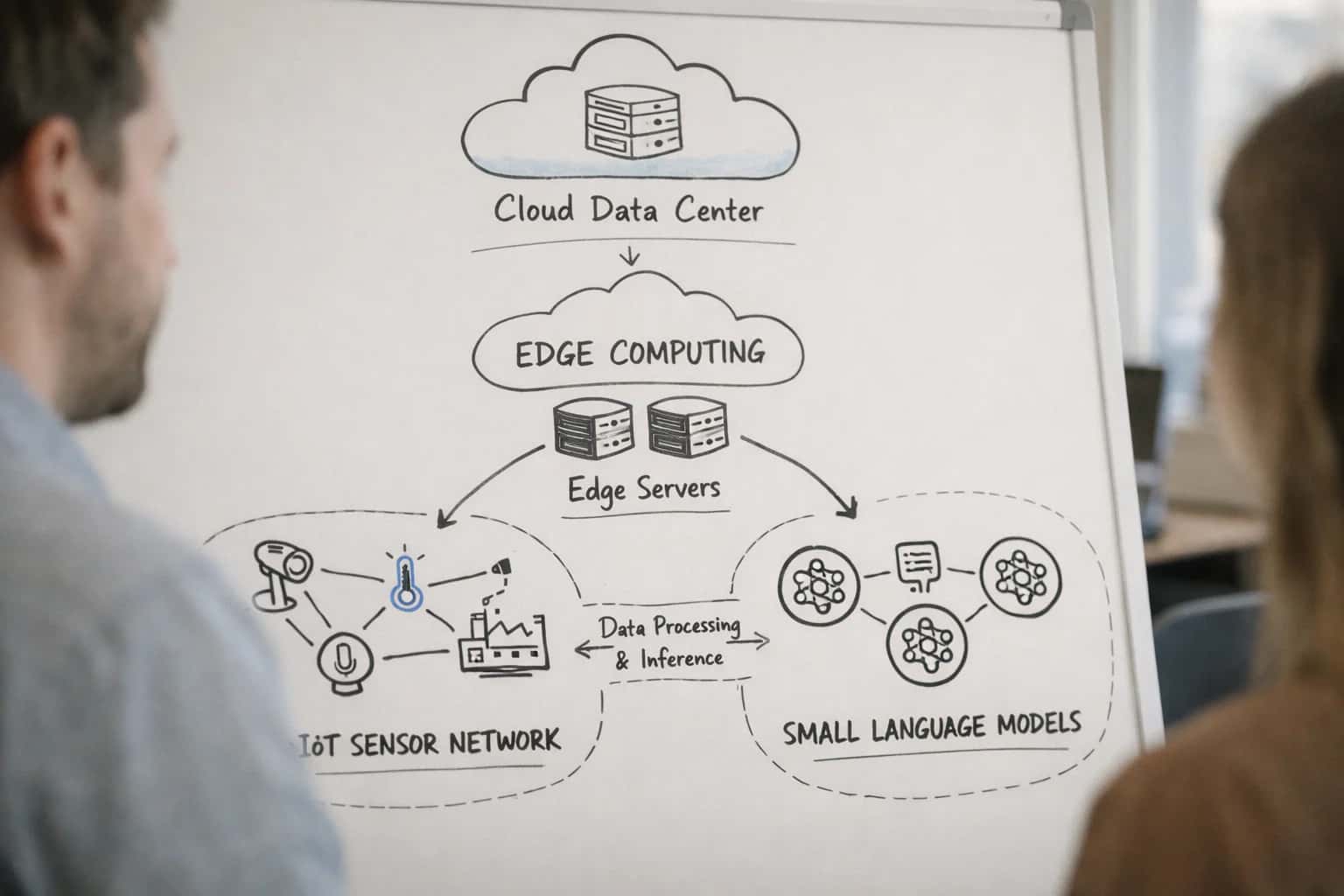
HARDWARE-AWARE MODEL DESIGN
What is Federated Learning on Edge?
Federated learning on edge is a decentralized machine learning paradigm where a global model is trained collaboratively across a large number of edge devices, with each device learning from its local data and sharing only model updates (not raw data) with a central server.
This paradigm is a cornerstone of Hardware-Aware Model Design, requiring co-optimization of algorithms, neural architectures, and target silicon. The process involves iterative federated averaging, where the server securely aggregates updates to refine the global model. Key technical challenges include managing statistical heterogeneity across non-IID data, ensuring communication efficiency, and implementing robust privacy-preserving techniques like differential privacy or secure multi-party computation to fortify the update exchange.
DECENTRALIZED AI
Core Characteristics of Federated Edge Learning
Federated edge learning is a distributed machine learning paradigm where a global model is trained collaboratively across a vast number of edge devices, with each device learning from its local data and sharing only model updates—not raw data—with a central coordinator.
01
Decentralized Data Sovereignty
The fundamental principle where raw training data never leaves the edge device. This ensures absolute data privacy and compliance with regulations like GDPR and HIPAA, as sensitive information (e.g., personal photos, medical records, factory sensor data) remains on-premises. Only aggregated mathematical updates (model gradients or weights) are transmitted, decoupling model improvement from data centralization.
02
Heterogeneous & Constrained Hardware
Training occurs across a diverse fleet of devices with varying compute, memory, and power profiles—from smartphones and IoT sensors to embedded industrial controllers. Key challenges include:
- Statistical Heterogeneity: Non-IID (Non-Independently and Identically Distributed) data across devices creates local data skew.
- Systems Heterogeneity: Devices have different hardware capabilities, connectivity (intermittent, low-bandwidth), and availability (only active when charging).
- Algorithms must be robust to partial participation, where only a subset of devices is available for any given training round.
03
Communication-Efficient Protocols
Minimizing the cost of transmitting model updates over potentially slow or metered networks is critical. Core techniques include:
- Model Compression: Applying sparsification (sending only the most significant gradient updates) and quantization (reducing update precision from 32-bit floats to lower bitwidths).
- Secure Aggregation: Cryptographic protocols that allow a central server to compute the sum of user updates without being able to inspect any individual device's contribution, adding a layer of privacy.
- Asynchronous Updates: Allowing devices to report updates on their own schedule to handle stragglers and maintain training progress.
04
Robust Aggregation Algorithms
The server must intelligently combine potentially noisy or malicious updates from thousands of devices. The standard Federated Averaging (FedAvg) algorithm is often enhanced with:
- Robust Aggregation: Methods like median-based or trimmed-mean aggregation to defend against Byzantine failures or poisoned updates from compromised devices.
- Adaptive Client Weighting: Weighting a device's update based on its dataset size, compute reliability, or data quality to improve global model convergence.
- Personalization: Techniques that allow a global model to be fine-tuned locally on each device, adapting to its unique data distribution without harming global performance.
05
On-Device Learning Efficiency
Local training on edge devices must be extremely resource-aware. This involves:
- Lightweight Model Architectures: Using models like MobileNet or specially designed small networks that fit within tight memory budgets.
- Efficient Optimizers: Employing optimizers like Federated Stochastic Gradient Descent with adaptive learning rates that converge quickly with few local epochs to save battery and compute cycles.
- Differential Privacy: Adding calibrated noise to local updates before sending them to the server, providing a mathematically rigorous privacy guarantee against inference attacks.
06
Cross-Silo vs. Cross-Device Federations
Two primary deployment patterns define the scale and trust model:
- Cross-Silo Federated Learning: Involves a small number (e.g., 2-100) of reliable, powerful organizational clients (e.g., hospitals, banks). Focus is on horizontal federation (same features, different samples) with high-value, partitioned data. Trust and coordination are higher.
- Cross-Device Federated Learning: Involves a massive number (millions) of unreliable consumer devices (e.g., phones, tablets). Focus is on extreme scalability, handling dropouts, and communication efficiency. This is the classic 'edge' scenario with severe constraints.
TECHNICAL OVERVIEW
How Federated Learning on Edge Works: The Technical Process
Federated learning on edge is a decentralized training paradigm where a global model is collaboratively improved across distributed devices without centralizing raw data. This process involves iterative cycles of local computation and secure aggregation.
The process begins with a central server initializing a global model and distributing it to participating edge devices. Each device performs local training on its private dataset, computing a model update (typically weight gradients or deltas). This local training phase respects data sovereignty, as raw data never leaves the device. The server then collects these encrypted updates from a subset of devices.
The server performs secure aggregation, often using algorithms like Federated Averaging (FedAvg), to merge the updates into a single, improved global model. This aggregated model is redistributed to the fleet, beginning a new round. The cycle repeats, enabling continuous, privacy-preserving model improvement directly on decentralized hardware where the data is generated.
ARCHITECTURAL COMPARISON
Federated Learning on Edge vs. Centralized Cloud Training
A technical comparison of the core operational, performance, and security characteristics between decentralized federated learning on edge devices and traditional centralized cloud-based model training.
| Feature / Metric | Federated Learning on Edge | Centralized Cloud Training |
|---|---|---|
Data Privacy & Sovereignty | ||
Primary Data Location | Local device memory (never leaves) | Central cloud storage |
Network Bandwidth Consumption | Low (model updates only, ~MBs) | Very High (raw dataset transfer, ~GBs/TBs) |
Training Latency Per Round | High (constrained by slowest device) | Low (powerful, homogeneous hardware) |
System Resilience | High (operates with intermittent connectivity) | Low (requires stable cloud connection) |
Hardware Heterogeneity | Must handle diverse CPUs, NPUs, memory | Uniform, high-performance cloud instances |
Model Personalization Potential | High (local updates capture device-specific patterns) | Low (single global model for all users) |
Initial Setup & Orchestration Complexity | Very High (device management, secure aggregation) | Moderate (standard cloud ML pipelines) |
Operational Cost Profile | Distributed (device compute, minimal data transfer) | Centralized (cloud compute & egress fees) |
Real-time Adaptation to Local Data Drift | Yes (continuous local learning) | No (requires retraining pipeline) |
Attack Surface for Data Poisoning | Distributed (harder to corrupt global model) | Centralized (single point of failure) |
FEDERATED LEARNING ON EDGE
Real-World Applications and Use Cases
Federated learning on edge enables collaborative model training across distributed devices without centralizing sensitive data. This paradigm is critical for applications where data privacy, bandwidth constraints, and real-time personalization are paramount.
01
Smartphone Keyboard Prediction
Major mobile operating systems use federated learning to improve next-word prediction and autocorrect models. Local training occurs on each user's device using their private typing history. Only encrypted model updates (gradients) are sent to a central server for aggregation, never the raw keystroke data. This allows the global language model to learn from diverse linguistic patterns while preserving user privacy.
Billions
Devices Deployed
02
Healthcare Diagnostic Models
Hospitals and research institutions collaboratively train medical imaging models (e.g., for detecting tumors in X-rays) without sharing patient data. Each institution acts as an edge node, training on its local, siloed dataset. A central coordinator aggregates updates to create a robust global model that benefits from a wider variety of cases than any single hospital possesses, all while complying with strict regulations like HIPAA and GDPR.
03
Industrial IoT Predictive Maintenance
Manufacturing plants deploy federated learning across fleets of machinery equipped with sensors. Each machine learns a local model of normal operational vibration, temperature, and acoustic signatures. Anomaly detection models are improved globally by aggregating learnings from thousands of edge devices, enabling predictive maintenance alerts for rare failure modes without transmitting vast streams of proprietary sensor data to the cloud.
>90%
Uptime Improvement
04
Autonomous Vehicle Perception
Fleets of autonomous vehicles use federated learning to improve perception models for object detection and scene understanding. Each vehicle trains on local driving data from its sensors, learning to handle rare edge cases like unusual weather or road obstacles. Model updates are shared during periodic connectivity, allowing the entire fleet to benefit from experiences encountered by any single vehicle, accelerating collective learning while keeping sensitive location and video data on-device.
05
Financial Fraud Detection
Banks and financial institutions can collaboratively build more accurate fraud detection models without exposing transaction details of their customers. Each bank trains a model on its local transaction history to identify suspicious patterns. Federated aggregation creates a global model that understands a broader spectrum of fraudulent tactics across institutions, enhancing security for all participants while maintaining strict data sovereignty and competitive confidentiality.
06
Personalized Retail & Recommendations
Edge devices like smart TVs, set-top boxes, or in-store sensors can run federated learning to personalize content and product recommendations. The model learns user preferences locally based on interaction history (watch time, purchases). Aggregated updates improve the base recommendation algorithm for all users without building a centralized profile of individual behavior, balancing personalization with privacy and reducing cloud data transfer costs.
FEDERATED LEARNING ON EDGE
Frequently Asked Questions
Federated learning on edge is a decentralized machine learning paradigm where a global model is trained collaboratively across a large number of edge devices, with each device learning from its local data and sharing only model updates (not raw data) with a central server.
Federated Learning on Edge is a decentralized machine learning paradigm where a global model is trained collaboratively across a large number of distributed edge devices (e.g., smartphones, sensors, IoT devices). It works through an iterative, privacy-preserving process: 1) A central server initializes a global model and distributes it to participating devices. 2) Each device trains the model locally on its private data, generating a local model update (typically weight gradients or deltas). 3) Devices send only these encrypted model updates—never the raw data—back to the server. 4) The server aggregates these updates (e.g., using Federated Averaging (FedAvg)) to form an improved global model. This cycle repeats, enabling the model to learn from vast, distributed datasets while keeping sensitive data on-device.
Enabling Efficiency, Speed & Accuracy
Intelligent Analysis, Decision & Execution
We build AI systems for teams that need search across company data, workflow automation across tools, or AI features inside products and internal software.
Talk to Us
Search across company data
Give teams answers from docs, tickets, runbooks, and product data with sources and permissions.
Useful when people spend too long searching or get different answers from different systems.
Enterprise searchRAGPermissions
Read more
Automate internal workflows
Use AI to route work, draft outputs, trigger actions, and keep approvals and logs in place.
Useful when repetitive work moves across multiple tools and teams.
AI agentsWorkflow automationGovernance
Read more
Add AI to products and internal tools
Build assistants, guided actions, or decision support into the software your team or customers already use.
Useful when AI needs to be part of the product, not a separate tool.
AI integrationDecision supportModel routing
Read more
About the author
Prasad Kumkar
CEO & MD, Inference Systems
Prasad Kumkar is the CEO & MD of Inference Systems and writes about AI systems architecture, LLM infrastructure, model serving, evaluation, and production deployment. Over 5+ years, he has worked across computer vision models, L5 autonomous vehicle systems, and LLM research, with a focus on taking complex AI ideas into real-world engineering systems.
His work and writing cover AI systems, large language models, AI agents, multimodal systems, autonomous systems, inference optimization, RAG, evaluation, and production AI engineering.
LinkedIn
Limited slotsGet a Free AI Consultation
Partnered with leading AI, data, and software stack.





How We Work
Custom AI workflows for your Business
One-fit-all AI don't work for modern businesses. At Inferensys, we aim to understand your business & custom requirements; which we use to define most efficient agentic workflows, the data, and the tools for your business.
01
Review the use case
We understand the task, the users, and where AI can actually help.
Read more02
Pick the right approach
We define what needs search, automation, or product integration.
Read more03
Build the first useful version
We implement the part that proves the value first.
Read more04
Improve from there
We add the checks and visibility needed to keep it useful.
Read moreThe first call is a practical review of your use case and the right next step.
Talk to Us