Data governance is the formal orchestration of people, processes, and technology to manage data as a valuable enterprise asset. It establishes clear accountability through defined data stewardship roles and enforces data quality, security, privacy, and compliance standards via documented policies. The core objective is to ensure data is trustworthy, accessible, and used appropriately to drive reliable business decisions and machine learning outcomes, particularly in regulated or edge computing environments where data sovereignty is critical.

Glossary
Data Governance
Data governance is the framework of policies, standards, and processes that ensure the availability, integrity, security, and usability of data in an organization.
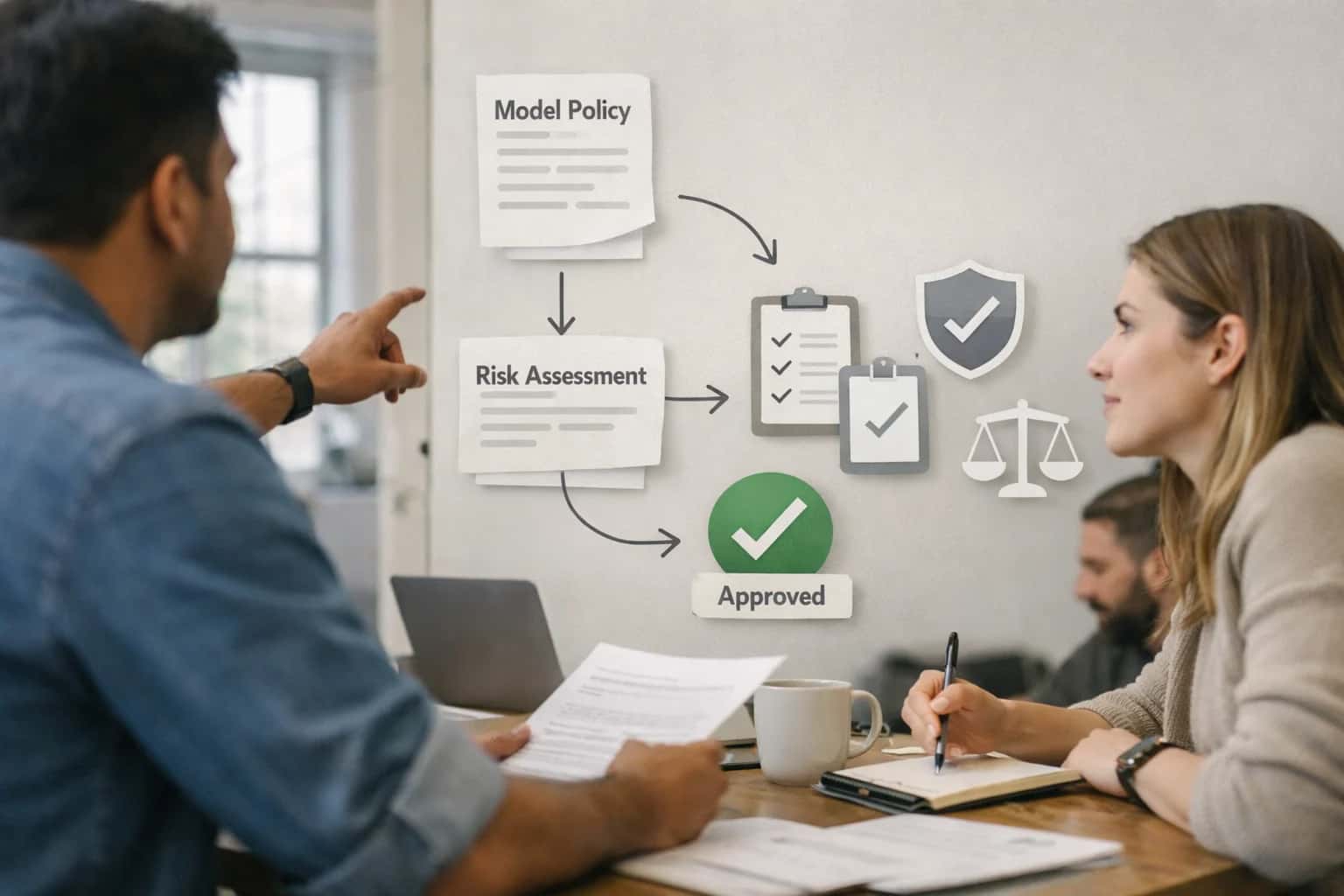
DEFINITION
What is Data Governance?
Data governance is the comprehensive framework of policies, standards, roles, and processes that ensures an organization's data is managed as a high-integrity strategic asset.
For machine learning and edge AI, effective governance provides the data integrity and lineage tracking required for model reproducibility and auditability. It mandates processes for data validation, versioning, and monitoring for data drift to prevent performance degradation. By implementing a federated learning or on-device training strategy within a governance framework, organizations can maintain strict data privacy and residency controls, ensuring sensitive information never leaves the local device while still enabling model improvement.
STRUCTURAL ELEMENTS
Core Components of a Data Governance Framework
A robust data governance framework is built on interconnected pillars that define authority, establish rules, and enforce accountability for data as a strategic enterprise asset. These components work in concert to ensure data is trustworthy, secure, and usable.
01
Data Policies & Standards
Data policies are formal, high-level rules that define the organization's strategic stance on data management, covering principles for ownership, quality, security, and lifecycle management. Data standards are the specific, actionable technical and business rules that implement these policies, such as:
- Naming conventions for database tables and columns.
- Mandatory data formats (e.g., ISO 8601 for dates).
- Minimum acceptable data quality thresholds (e.g., 95% completeness for customer records).
- Classification schemas (e.g., Public, Internal, Confidential, Restricted). These documents provide the definitive rulebook for how data is to be handled across all systems and processes.
02
Data Stewardship & Ownership
This component defines the organizational roles and responsibilities for data. Data owners are business executives accountable for a data domain (e.g., Customer Data, Product Data). They have the authority to approve access and define usage policies. Data stewards are subject-matter experts (often in business units) responsible for the day-to-day management of data quality, definitions, and lifecycle within their domain. They act as the bridge between IT and business, ensuring data is fit for purpose. A clear RACI matrix (Responsible, Accountable, Consulted, Informed) is typically used to formalize these roles, eliminating ambiguity over who governs what data.
03
Data Quality Management
This is the continuous process of defining, measuring, monitoring, and improving the fitness of data for its intended uses. It involves:
- Quality Dimensions: Establishing metrics for accuracy, completeness, consistency, timeliness, uniqueness, and validity.
- Profiling & Monitoring: Using automated tools to scan data against rules to detect anomalies (e.g., invalid postal codes, duplicate records).
- Issue Resolution: A workflow for stewards to triage, root-cause, and remediate data defects.
- Business Glossary: A centralized repository of approved business terms and definitions (e.g., "What constitutes an 'Active Customer'?") to ensure consistent interpretation. High-quality data is the non-negotiable foundation for reliable analytics and AI.
04
Data Security, Privacy & Compliance
This component ensures data is protected according to its sensitivity and that handling complies with legal and regulatory mandates. Key elements include:
- Access Controls & Encryption: Role-based access policies and encryption of data at rest and in transit.
- Data Classification: Tagging data based on sensitivity to apply appropriate security controls automatically.
- Privacy by Design: Implementing principles from frameworks like GDPR, including data minimization, purpose limitation, and facilitating data subject rights (e.g., right to erasure).
- Audit Logging: Maintaining immutable logs of who accessed what data and when for security forensics and compliance reporting. This pillar is critical for managing risk and maintaining stakeholder trust.
05
Data Lifecycle Management
This governs data from its creation or acquisition to its archival and secure deletion. It defines policies for each stage:
- Creation/Ingestion: Standards for how new data enters the system.
- Storage & Active Use: Rules for where and how data is stored during its primary useful life.
- Archival: Moving infrequently accessed data to lower-cost storage while retaining it for compliance or historical analysis.
- Destruction: Secure, auditable processes for permanently deleting data that has exceeded its legal or business retention period. Effective lifecycle management controls storage costs, reduces risk from retaining unnecessary data, and ensures compliance with data retention laws.
06
Metadata Management & Lineage
Metadata is "data about data." This component involves creating and maintaining a centralized metadata repository that catalogs:
- Technical Metadata: Schema, data types, table/column names.
- Business Metadata: Definitions, stewards, quality rules, classification tags.
- Operational Metadata: Data freshness, update frequencies, pipeline execution logs.
- Data Lineage: A visual map tracing the origin of data, its transformations, and its movement across systems. Lineage is essential for impact analysis (e.g., understanding what reports will break if a source column changes), debugging data errors, and proving compliance for regulatory audits.
FOUNDATION
Why Data Governance is Critical for Machine Learning
Data governance provides the essential framework of policies, standards, and controls that ensure the quality, security, and ethical use of data throughout the machine learning lifecycle.
Data governance is the comprehensive management framework of policies, standards, and processes that ensures the availability, usability, integrity, and security of an organization's data assets. For machine learning, this framework is non-negotiable, as it directly dictates the quality of the training data that shapes model behavior, performance, and compliance. Without robust governance, models risk being trained on biased, inaccurate, or non-compliant data, leading to unreliable outputs and significant operational risk.
Effective data governance establishes clear data lineage for traceability, enforces data validation rules to maintain quality, and implements access controls to protect sensitive information. It provides the audit trail and accountability required for algorithmic explainability and regulatory compliance, such as with the EU AI Act. Ultimately, governance transforms raw data into a trusted, high-fidelity asset, enabling the development of robust, ethical, and legally defensible machine learning systems that deliver consistent business value.
DATA GOVERNANCE
Frequently Asked Questions
Data governance is the comprehensive framework of policies, standards, and processes that ensure the proper management of data across its lifecycle. For edge AI and small language models, this translates to rigorous controls over data quality, lineage, privacy, and compliance in resource-constrained, decentralized environments.
Data governance is the overarching management framework of policies, standards, and processes that ensure the availability, usability, integrity, and security of data within an organization. For edge AI, it is critical because models deployed on distributed devices operate outside centralized security perimeters, handle sensitive local data, and require consistent quality controls to maintain performance. Effective governance ensures that data used for on-device training or inference is trustworthy, compliant with regulations like GDPR, and traceable from its origin through all transformations, mitigating risks of model failure, data breaches, and regulatory non-compliance in decentralized architectures.
Enabling Efficiency, Speed & Accuracy
Intelligent Analysis, Decision & Execution
We build AI systems for teams that need search across company data, workflow automation across tools, or AI features inside products and internal software.
Talk to Us
Search across company data
Give teams answers from docs, tickets, runbooks, and product data with sources and permissions.
Useful when people spend too long searching or get different answers from different systems.
Enterprise searchRAGPermissions
Read more
Automate internal workflows
Use AI to route work, draft outputs, trigger actions, and keep approvals and logs in place.
Useful when repetitive work moves across multiple tools and teams.
AI agentsWorkflow automationGovernance
Read more
Add AI to products and internal tools
Build assistants, guided actions, or decision support into the software your team or customers already use.
Useful when AI needs to be part of the product, not a separate tool.
AI integrationDecision supportModel routing
Read more
About the author
Prasad Kumkar
CEO & MD, Inference Systems
Prasad Kumkar is the CEO & MD of Inference Systems and writes about AI systems architecture, LLM infrastructure, model serving, evaluation, and production deployment. Over 5+ years, he has worked across computer vision models, L5 autonomous vehicle systems, and LLM research, with a focus on taking complex AI ideas into real-world engineering systems.
His work and writing cover AI systems, large language models, AI agents, multimodal systems, autonomous systems, inference optimization, RAG, evaluation, and production AI engineering.
LinkedIn
Limited slotsGet a Free AI Consultation
Partnered with leading AI, data, and software stack.





How We Work
Custom AI workflows for your Business
One-fit-all AI don't work for modern businesses. At Inferensys, we aim to understand your business & custom requirements; which we use to define most efficient agentic workflows, the data, and the tools for your business.
01
Review the use case
We understand the task, the users, and where AI can actually help.
Read more02
Pick the right approach
We define what needs search, automation, or product integration.
Read more03
Build the first useful version
We implement the part that proves the value first.
Read more04
Improve from there
We add the checks and visibility needed to keep it useful.
Read moreThe first call is a practical review of your use case and the right next step.
Talk to Us