Product Quantization (PQ) is a lossy compression technique for high-dimensional vectors that dramatically reduces memory usage by splitting each vector into subvectors, independently quantizing each subspace into a small codebook, and representing the original vector as a concatenation of subvector codeword indices. This process transforms a full-precision vector into a short PQ code, enabling the storage of massive vector indices in memory and accelerating approximate nearest neighbor (ANN) search through efficient distance estimation using pre-computed lookup tables. The core innovation is treating the vector space as a Cartesian product of lower-dimensional subspaces.

Glossary
Product Quantization (PQ)
Product Quantization (PQ) is a compression technique for high-dimensional vectors that divides them into subvectors, quantizes each subspace separately, and represents vectors by short codes, dramatically reducing memory requirements for vector indices on edge devices.
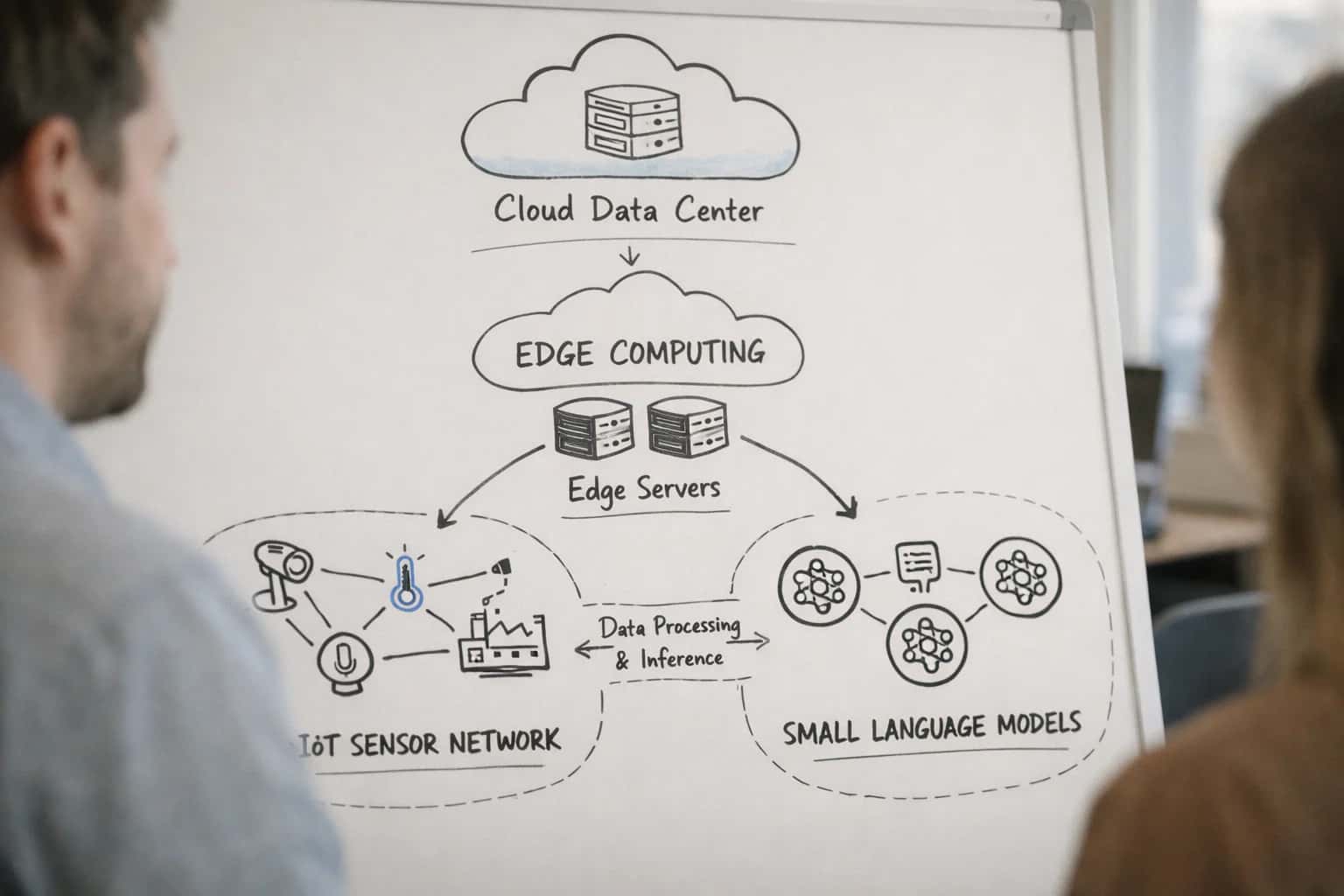
VECTOR COMPRESSION
What is Product Quantization (PQ)?
Product Quantization (PQ) is a cornerstone technique for compressing high-dimensional vectors, enabling efficient similarity search on memory-constrained edge devices.
In an edge-specific RAG optimization context, PQ is critical for deploying retrieval indices on devices with limited RAM. The technique directly reduces the footprint of vector database indices, making on-device inference feasible. A key operational detail is that similarity search is performed using asymmetric distance computation (ADC), where the query remains in full precision but distances to database vectors are approximated using their PQ codes. This balances accuracy with the drastic reductions in storage and I/O bandwidth required for efficient model architectures in production edge AI systems.
COMPRESSION TECHNIQUE
Key Characteristics of Product Quantization
Product Quantization (PQ) is a cornerstone technique for compressing high-dimensional vectors, enabling efficient similarity search on memory-constrained edge devices. Its core mechanism involves partitioning, quantization, and codebook-based reconstruction.
01
Subspace Partitioning
The fundamental first step where a high-dimensional vector is split into m distinct subvectors. For a D-dimensional vector, this creates m subvectors, each of dimension D/m. This decomposition is the 'product' in Product Quantization, as the total vector space is treated as the Cartesian product of these lower-dimensional subspaces. Partitioning reduces the complexity of the quantization problem by allowing separate, simpler quantizers to operate on each subspace.
02
Codebook-Based Quantization
Each subspace is quantized independently using a learned codebook. A codebook is a set of prototype vectors (or centroids) for that subspace, typically learned via k-means clustering on the training data.
- For each of the m subspaces, a separate codebook with k centroids is created.
- Each subvector is then represented by the index (an integer ID) of its nearest centroid in that subspace's codebook.
- This transforms a continuous-valued subvector into a discrete symbolic code.
03
Compact Code Representation
A vector is represented by a concatenation of m sub-quantizer indices, forming a short code. This is the compressed representation.
- Storage requirement drops from storing D floating-point values (e.g., 32*D bits) to storing m integers, each requiring log₂(k) bits.
- A typical configuration: m=8, k=256. Each sub-index is 1 byte (8 bits, since 2⁸=256), so the full vector is represented by an 8-byte code, a 16x compression over a 128-dimensional float32 vector (512 bytes).
8-16x
Typical Compression
04
Asymmetric Distance Computation (ADC)
A critical optimization for efficient search. ADC pre-computes and stores a lookup table of distances between the query's subvectors and all centroids in each codebook.
- During search: The query vector is not quantized. Instead, its exact subvectors are used.
- For a database vector represented by its code, its approximate distance to the query is computed by summing pre-computed distances: the distance between the query's i-th subvector and the centroid indexed by the code's i-th byte.
- This avoids reconstructing the database vector, making distance calculations extremely fast—just m table lookups and additions.
05
Memory vs. Accuracy Trade-off
PQ introduces a controlled approximation error. The key parameters m (number of subvectors) and k (centroids per sub-quantizer) govern this trade-off:
- Higher m, lower k: Finer partitioning with fewer centroids per subspace. Increases memory efficiency (shorter codes) but can reduce accuracy as each subspace is coarsely quantized.
- Lower m, higher k: Coarser partitioning with richer representation per subspace. Increases accuracy and code length.
- Tuning (m, k) is essential for balancing recall rates with the memory budget of an edge device.
COMPARISON
Product Quantization vs. Other Compression Methods
A technical comparison of Product Quantization against other common vector compression and indexing techniques, highlighting trade-offs in memory, accuracy, and computational cost critical for edge RAG systems.
| Feature / Metric | Product Quantization (PQ) | Scalar Quantization (SQ) | Binary Embeddings | Pruning |
|---|---|---|---|---|
Primary Compression Mechanism | Subspace decomposition & codebook assignment | Reduced bit-width per vector dimension | Binarization of full embeddings to {0, 1} | Removal of low-magnitude weights/vectors |
Memory Reduction (Typical) | 16x - 64x | 4x (32-bit to 8-bit) | 32x (32-bit to 1-bit) | 2x - 10x (highly variable) |
Search Speed | Fast (table lookups, asymmetric distance computation) | Very Fast (integer arithmetic) | Extremely Fast (bitwise Hamming distance) | Unchanged or slightly faster |
Search Accuracy (Recall) | High (preserves coarse structure via subvectors) | Very High (minimal precision loss) | Low to Moderate (high information loss) | High (preserves active connections) |
Index Construction Cost | High (requires k-means per subspace) | Low (statistical range calculation) | Low (thresholding operation) | Moderate (requires importance scoring) |
Supports Non-Exhaustive Search | ||||
Common Use Case in Edge RAG | Compressing billion-scale vector databases for on-device ANN | Reducing embedding storage in vector caches | First-stage retrieval in memory-starved microcontrollers | Reducing size of the retrieval model itself |
Compatibility with ANN Libraries (e.g., FAISS) |
APPLICATIONS
Use Cases for Product Quantization
Product Quantization (PQ) is a cornerstone technique for deploying high-performance vector search on memory-constrained hardware. Its primary use cases revolve around drastically reducing the memory footprint of vector indices to enable efficient similarity search at the edge.
01
On-Device Vector Search
PQ enables semantic search and retrieval-augmented generation (RAG) directly on smartphones, IoT devices, and embedded systems. By compressing billion-scale vector databases to fit in limited RAM, it allows for:
- Private, offline querying of personal or proprietary data.
- Ultra-low latency retrieval by eliminating network round-trips.
- Deployment of Approximate Nearest Neighbor (ANN) search on microcontrollers and edge GPUs where full-precision vectors are prohibitive.
4-64x
Memory Reduction
< 10ms
Query Latency Target
02
Billion-Scale Vector Databases
In cloud and data center environments, PQ is fundamental for managing massive vector indices. It allows platforms like Facebook's FAISS and other vector databases to serve high-recall search over datasets with trillions of vectors. Key mechanisms include:
- Inverted File Index (IVF) combined with PQ (IVFPQ) for fast, two-stage search: coarse cluster selection followed by fine-grained PQ distance calculation.
- Storing vectors as short codes (e.g., 8-64 bytes) instead of full 32-bit floats, reducing storage costs by orders of magnitude.
- Enabling efficient hybrid search systems where dense, quantized vectors are searched alongside sparse lexical indices.
1B+
Vectors in Memory
03
Compressing Embedding Layers
PQ is applied directly to the embedding tables of large recommendation systems and language models. These tables, which map categorical features to dense vectors, often constitute the majority of a model's memory. PQ addresses this by:
- Dividing each high-dimensional embedding vector into subvectors and quantizing them.
- Sharing centroid codes across millions of embeddings, dramatically shrinking model size.
- Enabling the deployment of large-vocabulary models (e.g., for ad targeting or content recommendation) on memory-constrained servers without significant accuracy loss.
04
Multi-Modal Retrieval Systems
PQ facilitates efficient cross-modal search, such as finding images with text or matching audio to video clips. In these systems, different modalities (text, image, audio) are encoded into a shared quantized vector space. This allows for:
- Unified, compressed indices for heterogeneous data types.
- Fast k-NN search across modalities on a single device.
- Deployment of sophisticated multi-modal RAG pipelines on edge hardware, where separate full-precision indices for each modality would be impossible.
05
Streaming & Incremental Indexing
PQ supports dynamic environments where new data arrives continuously. The structure of PQ allows for incremental indexing without full rebuilds:
- New vectors are quantized using the existing, pre-trained set of subspace centroids (codebooks).
- The resulting codes are appended to the inverted index with minimal overhead.
- This is critical for edge applications like real-time document ingestion in a personal RAG agent or live sensor data analysis, where the knowledge base must update constantly with low computational cost.
06
Privacy-Preserving Similarity Search
PQ can be integrated into privacy-enhancing workflows. While the codes themselves are not encrypted, the compression acts as a form of non-invertible transformation. More advanced applications combine PQ with cryptographic techniques:
- Serving as a preprocessing step before homomorphic encryption, reducing the computational burden of operating on ciphertext.
- Enabling private federated retrieval where devices share only quantized model updates or query codes, not raw data.
- Allowing sensitive data to be stored and searched in a non-reversible, coded format on less trusted edge hardware.
PRODUCT QUANTIZATION
Frequently Asked Questions
Product Quantization (PQ) is a cornerstone technique for compressing high-dimensional vectors, enabling efficient vector search on memory-constrained edge devices. This FAQ addresses its core mechanics, trade-offs, and role in edge RAG systems.
Product Quantization (PQ) is a lossy compression technique for high-dimensional vectors that dramatically reduces memory usage for vector search indices by representing vectors as short codes. It works by dividing the original vector space into multiple disjoint subspaces, performing k-means clustering independently within each subspace to create a set of codewords (centroids), and then representing each original vector by the concatenated indices of its nearest centroid in each subspace. The resulting code is stored instead of the full-precision vector, enabling approximate distance calculations using pre-computed lookup tables.
Key Steps:
- Split: A D-dimensional vector is split into
msubvectors of dimensionD/m. - Quantize: Each subspace is quantized separately. A k-means algorithm is run on each subspace, creating
kcentroids (e.g., k=256). This yieldsmseparate codebooks. - Encode: For a new vector, each subvector is assigned the index of its nearest centroid in the corresponding codebook. The vector is now represented by a
m-byte code (if k=256). - Search: During query time, distances are approximated by looking up pre-computed distances between the query's subvectors and all centroids in each codebook, then summing these partial distances.
Enabling Efficiency, Speed & Accuracy
Intelligent Analysis, Decision & Execution
We build AI systems for teams that need search across company data, workflow automation across tools, or AI features inside products and internal software.
Talk to Us
Search across company data
Give teams answers from docs, tickets, runbooks, and product data with sources and permissions.
Useful when people spend too long searching or get different answers from different systems.
Enterprise searchRAGPermissions
Read more
Automate internal workflows
Use AI to route work, draft outputs, trigger actions, and keep approvals and logs in place.
Useful when repetitive work moves across multiple tools and teams.
AI agentsWorkflow automationGovernance
Read more
Add AI to products and internal tools
Build assistants, guided actions, or decision support into the software your team or customers already use.
Useful when AI needs to be part of the product, not a separate tool.
AI integrationDecision supportModel routing
Read more
About the author
Prasad Kumkar
CEO & MD, Inference Systems
Prasad Kumkar is the CEO & MD of Inference Systems and writes about AI systems architecture, LLM infrastructure, model serving, evaluation, and production deployment. Over 5+ years, he has worked across computer vision models, L5 autonomous vehicle systems, and LLM research, with a focus on taking complex AI ideas into real-world engineering systems.
His work and writing cover AI systems, large language models, AI agents, multimodal systems, autonomous systems, inference optimization, RAG, evaluation, and production AI engineering.
LinkedIn
Limited slotsGet a Free AI Consultation
Partnered with leading AI, data, and software stack.





How We Work
Custom AI workflows for your Business
One-fit-all AI don't work for modern businesses. At Inferensys, we aim to understand your business & custom requirements; which we use to define most efficient agentic workflows, the data, and the tools for your business.
01
Review the use case
We understand the task, the users, and where AI can actually help.
Read more02
Pick the right approach
We define what needs search, automation, or product integration.
Read more03
Build the first useful version
We implement the part that proves the value first.
Read more04
Improve from there
We add the checks and visibility needed to keep it useful.
Read moreThe first call is a practical review of your use case and the right next step.
Talk to Us