
Inferensys

Glossary

Edge RAG

Edge RAG (Retrieval-Augmented Generation) is an architecture that deploys the retrieval and generation components of a RAG system directly onto edge devices to enable low-latency, private, and offline-capable AI applications.
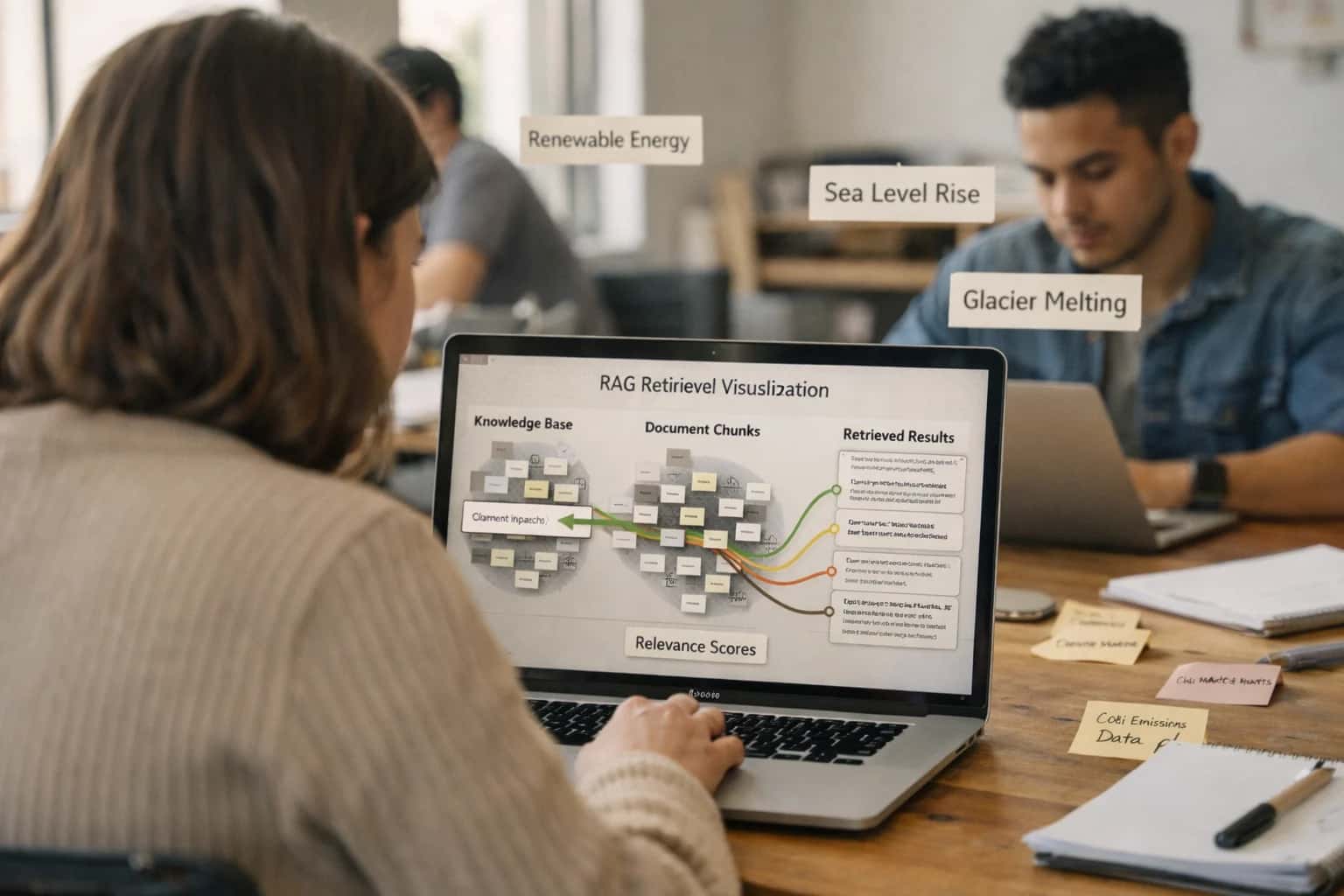
Developer working on RAG retrieval system, document chunks visible on screen, technical workspace with code editor.
GLOSSARY

What is Edge RAG?

Edge RAG (Retrieval-Augmented Generation) is an architectural paradigm that deploys the full RAG pipeline—retrieval, ranking, and generation—directly onto edge devices to enable private, low-latency, and offline-capable AI applications.

Edge RAG is a specialized deployment of the Retrieval-Augmented Generation architecture where all computational components, including the embedding model, vector index, and small language model (SLM), run locally on constrained hardware like smartphones, IoT devices, or on-premise servers. This design prioritizes data sovereignty by keeping sensitive queries and proprietary knowledge bases on-device, eliminates network latency for real-time responses, and ensures functionality without cloud connectivity. The core engineering challenge involves extreme model compression, efficient retrieval algorithms like Approximate Nearest Neighbor (ANN) search, and hardware-aware optimization to fit within strict memory, power, and compute budgets.

Key optimizations for Edge RAG include embedding quantization and binary embeddings to shrink vector storage, indices like HNSW graphs or Product Quantization (PQ) for fast similarity search, and knowledge distillation to create compact, high-quality retriever and generator models. The system often employs a lightweight RAG orchestrator to manage the pipeline and may use strategies like semantic caching or compute offloading to dynamic resources. This architecture is foundational for applications requiring privacy-preserving machine learning, such as confidential document analysis on personal devices, real-time assistant in vehicles, or federated RAG updates across a decentralized device fleet.

ARCHITECTURE

Core Components of an Edge RAG System

Edge RAG systems decompose the traditional cloud-based pipeline into specialized, optimized components that can run efficiently on local hardware. Each component is engineered for low latency, minimal resource consumption, and operational independence.

01

Lightweight Embedding Model

The embedding model converts queries and documents into numerical vectors (embeddings) for semantic search. On the edge, this model is a highly compressed, quantized version of a larger teacher model, often achieved via knowledge distillation. Key optimizations include:

  • Architecture choice: Using efficient models like all-MiniLM-L-v2 or distilled BERT variants.
  • Quantization: Reducing precision from 32-bit floats to 8-bit integers (INT8) or 4-bit (NF4) to slash memory and compute.
  • Hardware-aware kernels: Using ops optimized for the target NPU or CPU (e.g., ARM NEON). Its efficiency directly dictates retrieval speed and power consumption.
02

Optimized Vector Index & Search

This is the searchable database of document embeddings. For edge deployment, the index must be small, fast, and updateable. Core techniques include:

  • Approximate Nearest Neighbor (ANN) Algorithms: HNSW graphs offer excellent speed/recall trade-offs. IVF indices reduce search scope via clustering.
  • Vector Compression: Product Quantization (PQ) compresses embeddings by encoding sub-vectors into compact codes, reducing index size by 10-50x.
  • Binary Embeddings: In extreme cases, embeddings are binarized, enabling bitwise Hamming distance calculations for ultra-fast search. The index is often stored in a memory-mapped file for fast loading with a minimal RAM footprint.
03

Small Language Model (Generator)

The SLM is the on-device component that synthesizes the final answer using retrieved context. It is distinct from cloud-based LLMs by being:

  • Architecturally Efficient: Often a decoder-only model under 3B parameters, like Phi-3-mini or Gemma 2B.
  • Heavily Optimized: Employing weight quantization (e.g., GPTQ, AWQ), pruning, and compiled execution via engines like TensorRT-LLM or ONNX Runtime.
  • Context-Aware: Designed to work effectively with the limited context windows (e.g., 4K-8K tokens) typical of edge deployments, integrating retrieved passages efficiently.
04

Local Knowledge Base Chunker

This preprocessing component prepares documents for indexing. For edge systems, chunking is adaptive and semantic to maximize retrieval quality from a limited corpus.

  • Semantic Chunking: Uses model-based sentence boundaries or topic segmentation to create coherent chunks, superior to fixed-size sliding windows.
  • Metadata Enrichment: Tags chunks with source, date, or entity information to enable pre-retrieval metadata filtering, reducing search load.
  • Incremental Updates: Capable of adding new documents to the index without a full rebuild, crucial for devices that periodically sync new data.
05

Lightweight RAG Orchestrator

The orchestrator is the control plane that sequences the retrieval-generation pipeline. Its edge-specific duties include:

  • Flow Management: Executing the retriever, optionally a reranker, and the SLM in sequence.
  • Resource-Aware Scheduling: Monitoring available memory and CPU to potentially offload the most intensive step (e.g., generation) to a nearby server if resources are critically low.
  • Semantic Caching: Checking an in-memory cache of past Q&A pairs using embedding similarity to bypass the full pipeline for repeated or similar queries, drastically cutting latency and power use.
06

Privacy & Security Enclave

A critical hardware/software layer that ensures data never leaves the device in plaintext. This isn't a single model but an integrated subsystem.

  • Trusted Execution Environment (TEE): A secure, isolated processor zone (e.g., Intel SGX, ARM TrustZone) where the embedding model, index, and SLM can run, protecting them from the host OS.
  • On-Device Encryption: The local knowledge base and vector index are encrypted at rest, only decrypted within the TEE for processing.
  • Private Retrieval: Techniques like query encryption or differential privacy for embeddings can be applied to prevent information leakage from the retrieval pattern itself.
ARCHITECTURE OVERVIEW

How Edge RAG Works: The Optimized Pipeline

Edge RAG (Retrieval-Augmented Generation) is an architecture that deploys the retrieval and generation components of a RAG system directly onto edge devices to enable low-latency, private, and offline-capable AI applications.

Edge RAG operates via a locally executed pipeline that begins with query encoding, where a user's input is converted into a dense vector embedding by a lightweight, on-device encoder model. This embedding is then used to perform an Approximate Nearest Neighbor (ANN) search against a pre-loaded, compressed vector index of document chunks stored locally. To manage constrained resources, the system employs optimizations like hybrid search, combining efficient sparse retrieval with dense semantic search, and semantic caching to bypass redundant processing.

The top-k retrieved document chunks are passed to a small, optimized language model (SLM) for generation. The entire pipeline is managed by a lightweight RAG orchestrator that may employ strategies like compute offloading for balance. Critical optimizations include model pipelining for concurrent execution, incremental indexing for knowledge updates, and hardware-aware acceleration using NPUs or frameworks like TensorRT-LLM and TFLite Micro to maximize throughput and minimize latency on the edge device.

ARCHITECTURAL DECISION MATRIX

Edge RAG vs. Cloud RAG: A Technical Comparison

A feature-by-feature comparison of the core architectural and operational characteristics of Edge RAG and Cloud RAG systems, highlighting trade-offs relevant to ML and search engineers.

Feature / MetricEdge RAGCloud RAG

Primary Deployment Location

On-device (phone, IoT, gateway)

Centralized cloud data center

Latency (End-to-End Query)

< 100 ms

200-2000 ms

Network Dependency

Fully offline capable

Mandatory for operation

Data Privacy Posture

Data never leaves device

Data transmitted to cloud provider

Operational Cost (Inference)

$0.001-0.01 per 1k queries

$0.01-0.10 per 1k queries

Upfront Infrastructure Cost

Higher (specialized edge hardware)

Lower (pay-as-you-go cloud)

Scalability Model

Horizontal (add more devices)

Vertical & Horizontal (scale cloud instances)

Knowledge Base Update Mechanism

Incremental indexing, federated updates

Full or incremental re-indexing

Typical Vector Index Size

10k - 1M chunks (highly compressed)

1M - 1B+ chunks

Retrieval Model Architecture

Quantized dual-encoder, binary embeddings

Large cross-encoders, dense embeddings

Generation Model Size

1B - 7B parameters (heavily quantized)

7B - 70B+ parameters

Hardware Acceleration

NPU, GPU, DSP (device-specific)

Cloud GPU/TPU clusters

Fault Tolerance

Device-level failure domain

Cloud provider redundancy

Development & Debugging Complexity

High (heterogeneous hardware)

Lower (standardized cloud environment)

APPLICATION DOMAINS

Primary Use Cases for Edge RAG

Edge RAG (Retrieval-Augmented Generation) enables AI applications that require low latency, data privacy, and offline operation by running retrieval and generation directly on local devices. Its primary use cases exploit these core architectural advantages.

02

Low-Latency Customer Support & Field Service

Powering real-time diagnostic and support tools on field technicians' devices or in-store kiosks.

  • Sub-second response times for querying device manuals, error code databases, or repair histories without network dependency.
  • Robust operation in areas with poor or no connectivity (e.g., factory floors, remote sites).
  • Integration with on-device sensors; a technician can photograph a part, use a vision model to identify it, and the Edge RAG system retrieves the relevant installation guide.
03

Personalized AI on Consumer Devices

Enabling truly private, personalized AI assistants on smartphones, laptops, and IoT devices.

  • Learning from personal data (emails, notes, local files) without sending it to a central server, aligning with privacy regulations like GDPR.
  • Continuous personalization via on-device fine-tuning or continual learning loops based on user interaction.
  • Efficient retrieval from a user's personal data corpus using quantized embeddings and binary embedding search to minimize memory and CPU impact.
04

Industrial IoT & Predictive Maintenance

Providing contextual intelligence for machinery and industrial systems at the network edge.

  • A sensor anomaly triggers a local RAG query against a compressed knowledge base of service manuals, historical logs, and failure modes.
  • The system retrieves relevant procedures and generates a recommended action for the operator or an autonomous system.
  • Operates within the latency constraints of real-time control systems, using NPU-accelerated retrieval for embedding generation and search.
05

Healthcare Diagnostics & Clinical Support

Supporting diagnostic decisions and treatment planning with immediate access to medical literature and patient history on secure, certified devices.

  • HIPAA/GDPR compliance by processing patient data locally on the hospital workstation or portable diagnostic tool.
  • Offline capability in operating rooms or ambulances where network access is restricted or unreliable.
  • Retrieval from a local, updated index of medical journals, drug databases, and institutional protocols using a hybrid search of clinical keywords and semantic concepts.
06

Defense & Intelligence in Disconnected Environments

Enabling mission-critical intelligence analysis and decision support in fully disconnected, contested, or low-bandwidth environments.

  • Air-gapped operation on tactical hardware, querying against embedded intelligence summaries, maps, and equipment databases.
  • Minimized electromagnetic signature by eliminating constant cloud communication.
  • Leverages extreme model compression (TFLite Micro, binary embeddings) and secure execution within a Trusted Execution Environment (TEE) to protect models and data integrity.

EDGE RAG

Frequently Asked Questions

Edge RAG (Retrieval-Augmented Generation) deploys the full RAG pipeline—retrieval, ranking, and generation—directly onto edge devices like smartphones, IoT sensors, and embedded systems. This architecture enables low-latency, private, and offline-capable AI applications by processing data locally without relying on cloud connectivity.

Edge RAG is an architectural pattern that runs a Retrieval-Augmented Generation system entirely on local, resource-constrained hardware. It works by deploying three core components on the edge device: a vector index containing document embeddings, a retriever model (often a lightweight dual-encoder) to find relevant context, and a small language model (SLM) to generate the final answer. The process is fully local: a user query is encoded into an embedding, a fast approximate nearest neighbor (ANN) search is performed against the on-device index, and the retrieved context is fed to the SLM, which synthesizes a response without any data leaving the device.

Prasad Kumkar

About the author

Prasad Kumkar

CEO & MD, Inference Systems

Prasad Kumkar is the CEO & MD of Inference Systems and writes about AI systems architecture, LLM infrastructure, model serving, evaluation, and production deployment. Over 5+ years, he has worked across computer vision models, L5 autonomous vehicle systems, and LLM research, with a focus on taking complex AI ideas into real-world engineering systems.

His work and writing cover AI systems, large language models, AI agents, multimodal systems, autonomous systems, inference optimization, RAG, evaluation, and production AI engineering.



