Dynamic batching is an inference optimization technique that groups incoming queries of varying lengths into a single batch in real-time to maximize hardware utilization and throughput on edge servers or devices. Unlike static batching, which waits for a fixed batch size, it dynamically forms batches based on arrival time and computational cost, often using an iteration-level or continuous batching strategy to add new requests as others finish. This is critical for edge RAG systems where latency and efficient GPU/NPU use are paramount.

Glossary
Dynamic Batching (Edge Inference)
Dynamic batching is an inference optimization technique that groups incoming queries of varying lengths into a single batch in real-time to maximize hardware utilization and throughput on edge servers or devices.
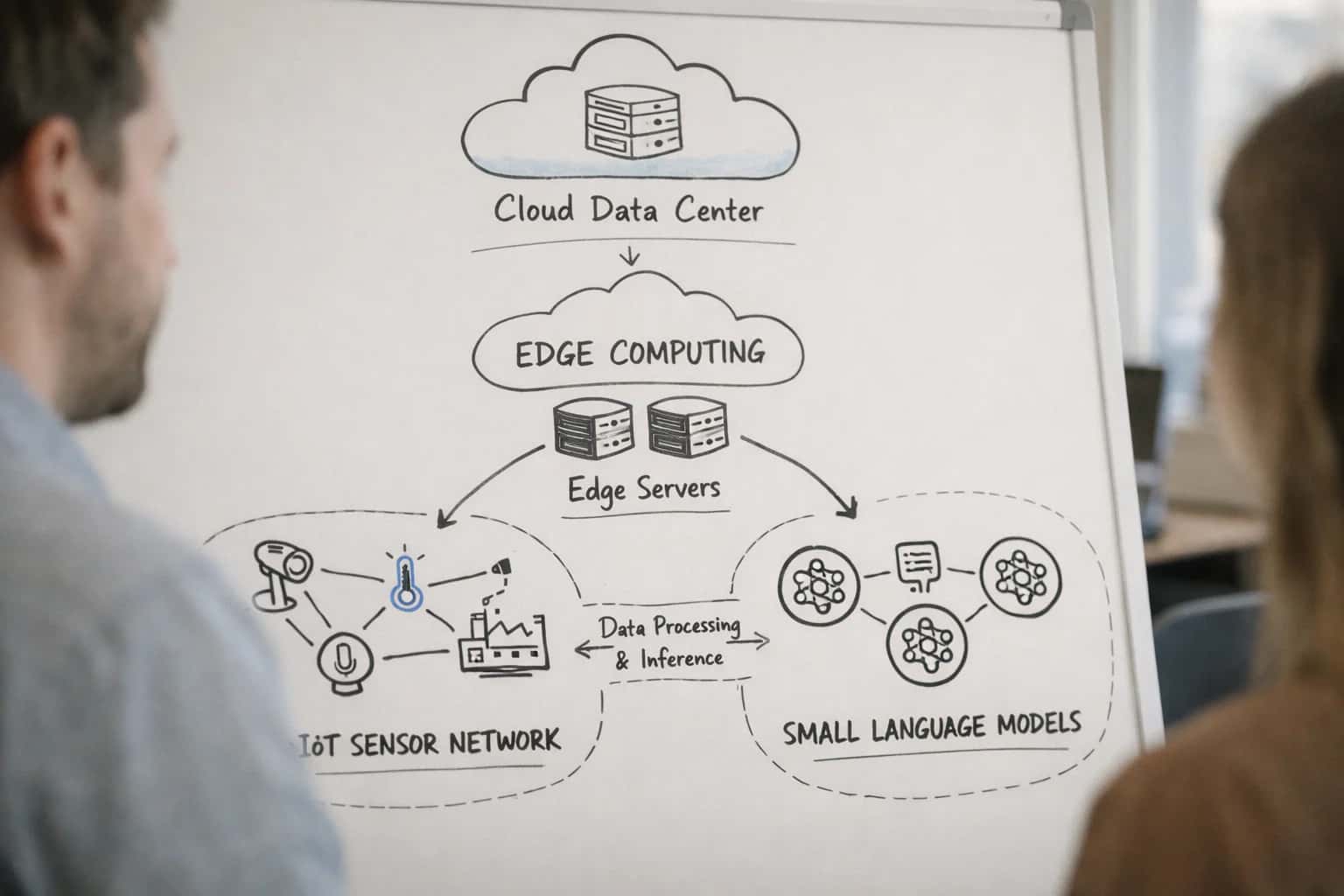
INFERENCE OPTIMIZATION
What is Dynamic Batching (Edge Inference)?
A core technique for maximizing throughput on constrained hardware by grouping real-time queries.
The technique directly addresses the inference optimization pillar by reducing idle compute cycles and amortizing the fixed cost of loading model weights. On edge hardware, it is often paired with model pipelining and PagedAttention for memory efficiency. It contrasts with continuous batching, a more advanced form where batches are updated per decoding step, and is a foundational method for achieving cost-effective, high-performance edge artificial intelligence deployments.
INFERENCE OPTIMIZATION
Key Features of Edge Dynamic Batching
Dynamic batching is a critical inference optimization technique that groups incoming queries of varying lengths into a single batch in real-time. On edge hardware, this technique is adapted to maximize throughput and hardware utilization despite constrained memory, variable latency requirements, and unpredictable request patterns.
01
Variable-Length Sequence Packing
This is the core mechanism of dynamic batching. Instead of padding all sequences in a batch to the length of the longest one—which wastes compute on padding tokens—the system packs sequences of different lengths together into a contiguous memory block. This is often visualized as a ragged tensor or managed via specialized kernels that track sequence boundaries, ensuring the model's attention mechanism only operates on real tokens. This maximizes the effective tokens per second processed by the GPU or NPU.
02
Real-Time Request Queue Management
An edge dynamic batcher maintains a pending request queue. It does not wait for a fixed batch size or a fixed time window. Instead, it uses a configurable latency budget (e.g., < 100ms p95) and a maximum batch size (constrained by device memory). The scheduler continuously evaluates the queue, batching together requests that have arrived, balancing the trade-off between inference latency and hardware utilization. This is crucial for interactive edge applications where request patterns are bursty and unpredictable.
03
Memory-Aware Scheduling
On edge devices with limited VRAM or SRAM, memory is the primary constraint. The batcher must account for:
- Model Weights: The footprint of the loaded model.
- KV Cache: The growing memory of the Key-Value cache for each sequence in a batch during autoregressive generation.
- Activation Memory: Intermediate tensors during the forward pass.
The scheduler estimates the peak memory consumption of a candidate batch and rejects configurations that would cause out-of-memory (OOM) errors, often preferring smaller, more frequent batches over large, memory-exhausting ones.
04
Continuous (Iteration-Level) Batching
Also known as rolling batching, this advanced form is essential for text generation (LLMs) in edge RAG. In a standard batch, all sequences must finish generation together, forcing fast sequences to wait for slow ones. With continuous batching:
- New requests are inserted into the batch as soon as previous requests finish and free up space.
- The system manages a complex state for each sequence (its position, KV cache).
- This leads to near-100% GPU/NPU utilization during generation, dramatically improving throughput for conversational or streaming edge AI applications.
06
Latency-Throughput Trade-off Control
The batcher exposes key knobs that system operators tune for their specific edge deployment:
- Max Batch Size: Larger batches increase throughput (tokens/sec) but also increase latency for the first request in the batch.
- Batch Timeout: The maximum time to wait for new requests before executing the current batch. A shorter timeout favors latency; a longer timeout favors throughput.
- Preferred Batch Size: A target size that the scheduler aims for, optimizing for the hardware's most efficient operating point. On edge devices, this is often small (e.g., 2, 4, or 8) due to memory limits.
EDGE INFERENCE OPTIMIZATION
Dynamic Batching vs. Other Batching Strategies
A comparison of batching methodologies for executing machine learning models on edge hardware, focusing on throughput, latency, and hardware utilization trade-offs.
| Feature / Metric | Dynamic Batching | Static Batching | No Batching (Online) |
|---|---|---|---|
Core Mechanism | Groups queries of varying lengths in real-time as they arrive | Groups a fixed number of queries before processing | Processes each query individually as it arrives |
Hardware Utilization | |||
Optimal For | Variable, real-time request streams | Predictable, high-volume request streams | Ultra-low latency, single-request scenarios |
Average Latency | Low to Moderate | High (due to wait times) | Very Low (for single request) |
Tail Latency (P99) | Consistent | High (batch completion time) | Variable (subject to queue delays) |
Throughput Maximization | |||
Memory Efficiency | Moderate (requires KV cache management) | High (predictable allocation) | Low (inefficient per-request overhead) |
Implementation Complexity | High (requires scheduler & padding logic) | Low | Very Low |
Use Case Example | Interactive edge chatbot server | Scheduled bulk document processing | Real-time sensor anomaly detection |
INFERENCE OPTIMIZATION
Frameworks and Tools for Dynamic Batching
Dynamic batching is a critical inference optimization technique for edge AI. The following frameworks and tools are engineered to implement it efficiently, maximizing hardware utilization for real-time query processing on constrained devices.
05
SambaNova
SambaNova provides a full-stack solution, including specialized Reconfigurable Dataflow Units (RDUs) and the SambaFlow software suite. Its architecture is designed for sequential batching, a form of dynamic batching where new tokens are generated for multiple sequences in parallel within a single batch. This is ideal for edge inference of decoder-only models common in RAG, as it maintains high compute utilization even during the sequential nature of text generation, significantly improving tokens/sec/watt.
DYNAMIC BATCHING
Frequently Asked Questions
Dynamic batching is a critical inference optimization technique for maximizing hardware utilization and throughput on edge servers and devices. These questions address its core mechanisms, trade-offs, and implementation.
Dynamic batching is an inference optimization technique that groups incoming queries of varying sequence lengths into a single, consolidated batch in real-time to maximize hardware utilization and throughput on edge servers or devices. Unlike static batching, which waits for a fixed number of requests, dynamic batching continuously forms a batch from a queue of pending requests. A scheduler determines the optimal batch composition based on a configured maximum batch size or latency budget, padding shorter sequences to match the longest one in the batch. This allows the underlying hardware—such as a GPU, NPU, or CPU—to process multiple requests in parallel, dramatically improving computational efficiency and reducing per-request latency by amortizing the fixed overhead of loading the model and transferring data.
Key components include:
- A request queue that holds incoming queries.
- A batching scheduler that decides when to form and execute a batch.
- A padding mechanism to align variable-length sequences for parallel processing.
This technique is fundamental to serving frameworks like NVIDIA's TensorRT-LLM and the open-source vLLM, enabling them to handle the bursty, heterogeneous request patterns typical of edge inference.
Enabling Efficiency, Speed & Accuracy
Intelligent Analysis, Decision & Execution
We build AI systems for teams that need search across company data, workflow automation across tools, or AI features inside products and internal software.
Talk to Us
Search across company data
Give teams answers from docs, tickets, runbooks, and product data with sources and permissions.
Useful when people spend too long searching or get different answers from different systems.
Enterprise searchRAGPermissions
Read more
Automate internal workflows
Use AI to route work, draft outputs, trigger actions, and keep approvals and logs in place.
Useful when repetitive work moves across multiple tools and teams.
AI agentsWorkflow automationGovernance
Read more
Add AI to products and internal tools
Build assistants, guided actions, or decision support into the software your team or customers already use.
Useful when AI needs to be part of the product, not a separate tool.
AI integrationDecision supportModel routing
Read more
About the author
Prasad Kumkar
CEO & MD, Inference Systems
Prasad Kumkar is the CEO & MD of Inference Systems and writes about AI systems architecture, LLM infrastructure, model serving, evaluation, and production deployment. Over 5+ years, he has worked across computer vision models, L5 autonomous vehicle systems, and LLM research, with a focus on taking complex AI ideas into real-world engineering systems.
His work and writing cover AI systems, large language models, AI agents, multimodal systems, autonomous systems, inference optimization, RAG, evaluation, and production AI engineering.
LinkedIn
Limited slotsGet a Free AI Consultation
Partnered with leading AI, data, and software stack.





How We Work
Custom AI workflows for your Business
One-fit-all AI don't work for modern businesses. At Inferensys, we aim to understand your business & custom requirements; which we use to define most efficient agentic workflows, the data, and the tools for your business.
01
Review the use case
We understand the task, the users, and where AI can actually help.
Read more02
Pick the right approach
We define what needs search, automation, or product integration.
Read more03
Build the first useful version
We implement the part that proves the value first.
Read more04
Improve from there
We add the checks and visibility needed to keep it useful.
Read moreThe first call is a practical review of your use case and the right next step.
Talk to Us