Zero-touch provisioning is an automated methodology for configuring and onboarding new hardware into a management system without manual intervention. Upon first boot, a device uses pre-configured bootstrapping data (like a serial number) to securely contact a provisioning server. The server then authenticates the device and delivers its specific configuration payload, which includes security credentials, network settings, and initial software, establishing its operational state entirely automatically.

Glossary
Zero-Touch Provisioning
Zero-touch provisioning is an automated process for configuring and onboarding new edge devices into a management system without manual intervention.
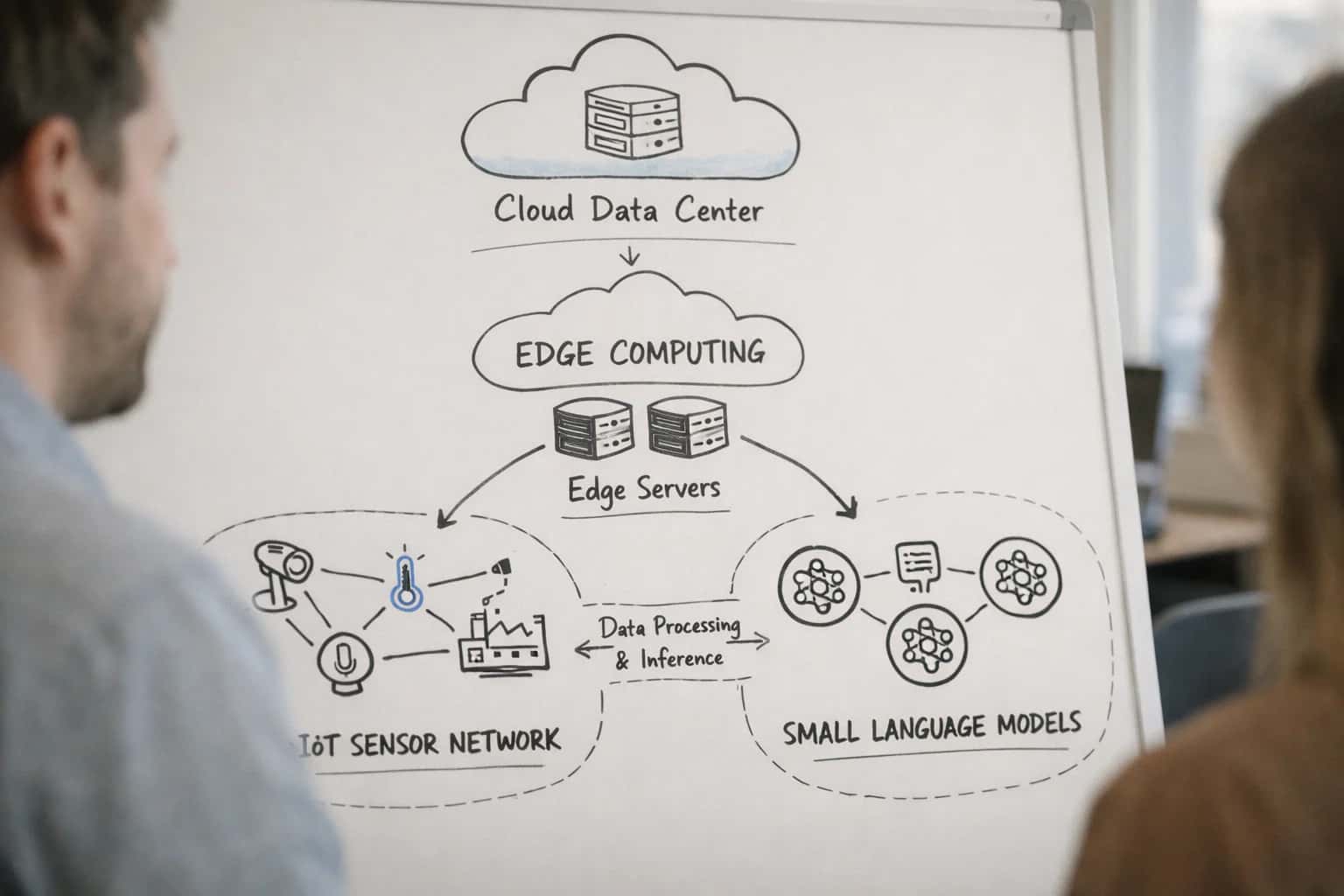
EDGE DEPLOYMENT AND MANAGEMENT
What is Zero-Touch Provisioning?
Zero-touch provisioning (ZTP) is the automated process for configuring and onboarding new edge devices into a management system without manual intervention.
This process is foundational for scalable edge AI and IoT deployments, enabling the mass rollout of devices like sensors, gateways, and inference appliances. It integrates with device attestation for hardware integrity verification and relies on protocols like DHCP options or OAuth 2.0 Device Authorization Grant for initial network discovery. ZTP ensures consistency, reduces human error, and is a prerequisite for declarative management systems like GitOps, where the device's desired state is defined in version control.
ZERO-TOUCH PROVISIONING
Core Components of a ZTP System
Zero-touch provisioning automates the secure onboarding and initial configuration of edge devices. Its efficacy depends on several integrated technical components working in concert.
01
Bootstrap Configuration
The bootstrap configuration is the minimal set of instructions a device uses to initiate contact with a management service. This is typically a small, static file or a set of environment variables that provides the device with its initial identity and network parameters.
- Common methods: DHCP options, USB drives, or pre-flashed firmware.
- Key data: The URL of the provisioning server, a unique device identifier (e.g., serial number), and initial security credentials.
- Purpose: Enables the device to perform its first authenticated network request without manual IP configuration.
02
Device Identity & Attestation
Device attestation is the cryptographic process where a device proves its hardware identity and software integrity to a remote provisioning service. This establishes a root of trust before any sensitive configuration is delivered.
- Hardware Roots of Trust: Uses a Trusted Platform Module or hardware security module to generate unforgeable credentials.
- Process: The device sends a signed attestation report containing its unique identifier and measurements of its boot firmware.
- Outcome: The provisioning server validates this report. Only verified, uncompromised devices proceed to the next stage, preventing rogue devices from joining the network.
03
Provisioning Server & Policy Engine
The provisioning server is the central orchestration point that authenticates devices, evaluates policies, and delivers the final configuration payload. Its policy engine is the decision-making core.
- Functions: Receives the device's attestation, maps the device identity to a predefined configuration policy based on device type, location, or other attributes.
- Policy Definition: Policies are declarative specifications (often YAML/JSON) defining the desired state: which OS image to install, network settings, security certificates, and which AI models or containers to deploy.
- Integration: Typically interfaces with a model registry for AI artifacts and an identity and access management system for credential issuance.
04
Declarative Configuration Payload
The declarative configuration payload is the complete set of instructions and artifacts sent from the provisioning server to the device to achieve its desired operational state. It describes the what, not the how.
- Content: May include OS images, container manifests (e.g., Docker Compose or Kubernetes Pod specs), environment variables, secrets, and references to model files in a registry.
- Format: Often uses infrastructure-as-code formats like cloud-init, Ignition (for CoreOS), or a custom JSON schema.
- Execution: An agent on the device (e.g., a reconciliation loop) applies this payload, pulling necessary containers and models, setting up networking, and starting services until the actual state matches the declared state.
05
Secure Delivery & Integrity Verification
Secure delivery ensures the configuration payload is transmitted confidentially and its integrity is verified before application. This prevents man-in-the-middle attacks and corruption.
- Channel Security: All communication is encrypted using mutual TLS, where both the device and server authenticate each other with certificates established during attestation.
- Integrity Checks: Payloads are cryptographically signed by the provisioning server. The device verifies this signature using a trusted public key before applying any changes.
- Artifact Security: References to external artifacts (like model files) include cryptographic hashes, so the device can verify the downloaded content matches the intended, unaltered version.
06
Post-Provisioning Telemetry & Health Reporting
Once provisioned, the device must report its status back to the management plane. This telemetry feedback loop confirms successful deployment and enables ongoing monitoring.
- Initial Handshake: The device sends a success/failure message after applying the configuration.
- Continuous Reporting: Emits heartbeat signals and health metrics (e.g., system resource usage, model inference P99 latency, liveness probe status) to a central observability platform.
- Purpose: Provides visibility for canary deployment analysis, triggers alerts for failed deployments, and supplies data for model drift detection. This closes the loop, turning a one-time provisioning event into the start of continuous lifecycle management.
EDGE DEPLOYMENT AND MANAGEMENT
How Zero-Touch Provisioning Works for Edge AI
Zero-touch provisioning automates the secure onboarding of edge devices into a management fleet, a critical process for scaling AI deployments.
Zero-touch provisioning (ZTP) is an automated process for configuring and onboarding new edge devices into a management system without manual intervention. It uses pre-defined policies to establish a device's identity, apply security credentials, and install its initial software stack, including the operating system and AI inference runtime. This is foundational for deploying and managing small language models (SLMs) and other AI workloads at scale across thousands of distributed nodes.
The workflow begins when a new device boots and performs device attestation, cryptographically proving its hardware integrity to a bootstrap server. Using a unique identifier, it retrieves its configuration manifest from a central model registry or Git repository, a core practice of GitOps. The system then orchestrates the deployment of containerized applications, often using lightweight tools like K3s, and applies security policies like mutual TLS (mTLS). This entire reconciliation loop ensures the device autonomously achieves its desired state, ready to execute AI tasks.
ZERO-TOUCH PROVISIONING
Key Benefits for Edge AI Deployments
Zero-touch provisioning automates the secure onboarding and initial configuration of edge devices, eliminating manual setup and enabling scalable, consistent fleet management for AI workloads.
01
Massive Operational Scalability
Zero-touch provisioning enables the deployment of thousands of edge devices without proportional increases in IT staff. By automating the initial boot, network configuration, and software installation, it removes the primary bottleneck in scaling edge AI fleets.
- Key Mechanism: Devices authenticate via a unique hardware identity (e.g., TPM module) and pull a configuration manifest from a bootstrap server.
- Impact: Reduces device onboarding time from hours to minutes, allowing rapid geographic expansion of AI inference networks for applications like smart cities or distributed retail analytics.
02
Enhanced Security Posture
Automated provisioning enforces security-by-design from first boot, minimizing human error and ensuring every device enters the network in a known, hardened state.
- Key Mechanism: Integrates with device attestation to cryptographically verify hardware and firmware integrity before granting network access or deploying sensitive AI models.
- Security Outcomes:
- Automatic application of security policies and certificates.
- Ensures encrypted communication channels (e.g., mutual TLS) are established immediately.
- Prevents 'rogue' or misconfigured devices from joining the managed fleet.
03
Guaranteed Configuration Consistency
Eliminates configuration drift by applying a single, version-controlled source of truth to all provisioned devices, which is critical for reproducible AI inference behavior.
- Key Mechanism: Uses GitOps principles, where device state declarations (OS version, container runtime, model registry endpoint) are stored in a Git repository. The provisioning process applies these declarations exactly.
- AI-Specific Benefit: Ensures every edge node has the identical software stack, library versions, and model-serving environment, making inference latency and accuracy predictable across the entire deployment.
04
Accelerated Time-to-Value for AI Models
Directly integrates model deployment into the device lifecycle, allowing the latest AI model to be part of the initial software payload or deployed immediately after provisioning.
- Key Mechanism: Provisioning policies can reference a model registry to pull a specific, approved model version and its inference server container as part of the baseline configuration.
- Result: A new device becomes an active, inferencing node as soon as it powers on and connects, bypassing separate manual model deployment steps. This is essential for use cases like deploying updated fraud detection models to thousands of payment terminals.
05
Simplified Fleet Lifecycle Management
Creates a foundation for fully automated lifecycle operations, including updates, rollbacks, and decommissioning, by establishing a secure management channel from day zero.
- Key Mechanism: Once provisioned, the device is enrolled in a fleet management platform (e.g., lightweight Kubernetes edge distribution like K3s), enabling subsequent OTA updates and health monitoring via liveness and readiness probes.
- Operational Benefit: Enables safe canary deployments and blue-green deployment strategies for updating the AI model or the underlying edge OS across the fleet with minimal downtime and risk.
06
Cost Reduction and Resource Optimization
Dramatically lowers the total cost of ownership for edge AI deployments by reducing manual labor, minimizing device downtime during setup, and preventing costly misconfigurations.
- Quantifiable Impact:
- Eliminates Site Visits: No need for technicians to manually configure devices on-site, saving significant travel and labor costs.
- Reduces Error Remediation: Automated scripts prevent configuration errors that lead to failed inference jobs or security incidents.
- Optimizes Hardware Utilization: Devices are productive immediately, improving the return on investment for edge hardware deployed at scale.
COMPARISON
Zero-Touch vs. Traditional Manual Provisioning
A feature-by-feature comparison of automated zero-touch provisioning against traditional manual methods for onboarding edge AI devices.
| Provisioning Feature / Metric | Zero-Touch Provisioning (ZTP) | Traditional Manual Provisioning |
|---|---|---|
Initial Setup Time per Device | < 1 minute | 15-60 minutes |
Required On-Site Technician | ||
Scalability (Devices per Hour) |
| < 10 |
Configuration Error Rate | < 0.1% | ~5-15% |
Initial Security Posture | Policy-defined at boot | Manual, post-setup |
Device Identity & Attestation | Automated cryptographic enrollment | Manual certificate/credential loading |
Initial Software/Firmware Load | OTA from central repository | Local media (USB/SD card) |
Integration with CI/CD Pipeline | ||
Audit Trail for Compliance | Automatic, immutable log | Manual spreadsheet/logbook |
Rollback Capability | Automated via version pinning | Manual re-imaging |
Total Cost of Ownership (TCO) for 1000 devices | Low (OpEx-heavy, automated) | High (CapEx/OpEx-heavy, labor-intensive) |
ZERO-TOUCH PROVISIONING
Frequently Asked Questions
Zero-touch provisioning (ZTP) automates the initial setup and integration of new edge devices into a management system, eliminating manual configuration. This is critical for deploying and managing AI models at scale in distributed environments.
Zero-touch provisioning (ZTP) is an automated process for configuring, authenticating, and onboarding new hardware devices into a management system without manual intervention. It works through a predefined, policy-driven workflow: a new device boots, establishes a minimal network connection (e.g., via DHCP), and contacts a provisioning server. The server authenticates the device (often via a unique identifier like a serial number or hardware security module), then delivers a configuration payload that defines its identity, security credentials, software stack, and initial operational state, fully integrating it into the fleet.
Enabling Efficiency, Speed & Accuracy
Intelligent Analysis, Decision & Execution
We build AI systems for teams that need search across company data, workflow automation across tools, or AI features inside products and internal software.
Talk to Us
Search across company data
Give teams answers from docs, tickets, runbooks, and product data with sources and permissions.
Useful when people spend too long searching or get different answers from different systems.
Enterprise searchRAGPermissions
Read more
Automate internal workflows
Use AI to route work, draft outputs, trigger actions, and keep approvals and logs in place.
Useful when repetitive work moves across multiple tools and teams.
AI agentsWorkflow automationGovernance
Read more
Add AI to products and internal tools
Build assistants, guided actions, or decision support into the software your team or customers already use.
Useful when AI needs to be part of the product, not a separate tool.
AI integrationDecision supportModel routing
Read more
About the author
Prasad Kumkar
CEO & MD, Inference Systems
Prasad Kumkar is the CEO & MD of Inference Systems and writes about AI systems architecture, LLM infrastructure, model serving, evaluation, and production deployment. Over 5+ years, he has worked across computer vision models, L5 autonomous vehicle systems, and LLM research, with a focus on taking complex AI ideas into real-world engineering systems.
His work and writing cover AI systems, large language models, AI agents, multimodal systems, autonomous systems, inference optimization, RAG, evaluation, and production AI engineering.
LinkedIn
Limited slotsGet a Free AI Consultation
Partnered with leading AI, data, and software stack.





How We Work
Custom AI workflows for your Business
One-fit-all AI don't work for modern businesses. At Inferensys, we aim to understand your business & custom requirements; which we use to define most efficient agentic workflows, the data, and the tools for your business.
01
Review the use case
We understand the task, the users, and where AI can actually help.
Read more02
Pick the right approach
We define what needs search, automation, or product integration.
Read more03
Build the first useful version
We implement the part that proves the value first.
Read more04
Improve from there
We add the checks and visibility needed to keep it useful.
Read moreThe first call is a practical review of your use case and the right next step.
Talk to Us