A WebAssembly (Wasm) runtime is a secure, sandboxed execution environment that loads and runs portable Wasm bytecode modules. It provides the foundational system interface, memory management, and sandboxing necessary to execute code compiled from languages like C, C++, Rust, or Go outside a web browser. In edge AI, runtimes like Wasmtime or WASI enable deploying lightweight, language-agnostic inference logic or data preprocessing functions directly on constrained devices with near-native speed.

Glossary
WebAssembly (Wasm) Runtime
A WebAssembly runtime is an execution environment that runs portable, sandboxed Wasm bytecode, enabling high-performance, secure, and language-agnostic deployment of inference logic on edge devices.
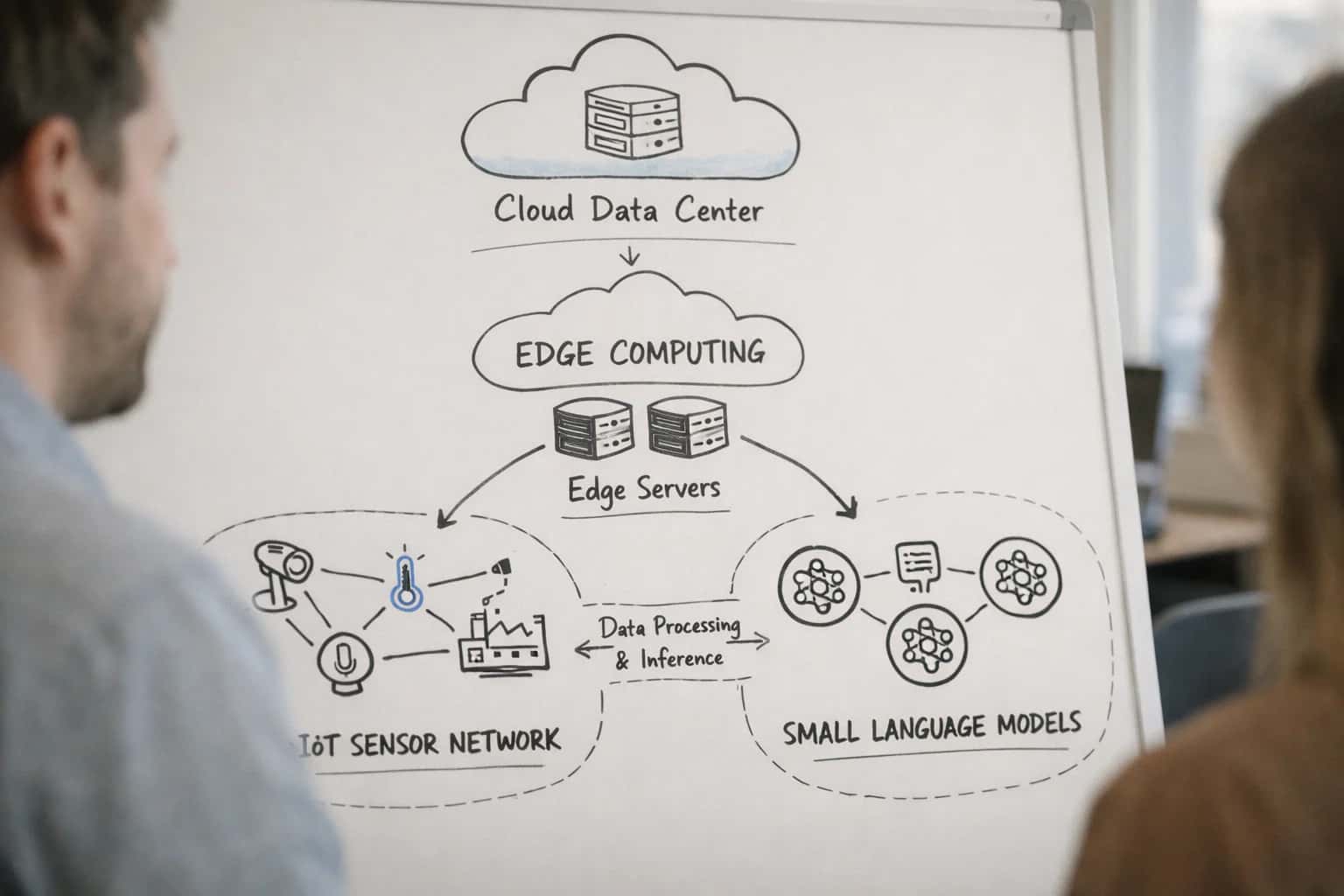
EDGE DEPLOYMENT AND MANAGEMENT
What is a WebAssembly (Wasm) Runtime?
A WebAssembly runtime is the core execution environment for deploying portable, high-performance code on edge devices.
For edge deployment, a Wasm runtime's key value lies in its portability and security. The same compiled .wasm module can run on any hardware or operating system with a compatible runtime, simplifying fleet management. Its strict capability-based security model and linear memory isolate functions, preventing them from accessing unauthorized host resources. This makes it ideal for executing untrusted, third-party AI inference workloads or plugins securely on edge infrastructure within a controlled permissions system.
ARCHITECTURAL PILLARS
Key Features of a Wasm Runtime for Edge AI
A WebAssembly runtime provides the foundational execution environment for deploying portable, high-performance AI workloads on edge devices. Its core features address the unique constraints and requirements of distributed, resource-limited hardware.
01
Deterministic Sandboxing
A Wasm runtime executes code within a strict, capability-based security sandbox. This provides memory safety and control-flow integrity by design, isolating the AI workload from the host system and other modules.
- No implicit system calls: Modules can only interact with the host environment via explicitly imported functions.
- Linear memory model: All memory access is bounds-checked, preventing buffer overflows.
- Deterministic execution: The same bytecode produces identical results on any compliant runtime, crucial for reproducible inference.
This sandboxing is fundamental for running untrusted third-party models or preprocessing functions on shared edge infrastructure.
02
Near-Native Performance
Wasm is designed as a compilation target, producing dense bytecode that is Just-In-Time (JIT) compiled or Ahead-Of-Time (AOT) compiled to near-native machine code.
- Efficient execution: Modern runtimes like Wasmtime and WAMR use tiered JIT compilers for fast startup and peak throughput.
- Predictable performance: The lack of a garbage collector eliminates unpredictable pauses, which is critical for real-time inference latency (P99).
- Hardware acceleration: Runtimes can leverage CPU features like SIMD (Single Instruction, Multiple Data) for parallel tensor operations, significantly speeding up linear algebra common in neural networks.
03
Language & Framework Agnosticism
Wasm serves as a universal portable binary format, decoupling the model development framework from the deployment target.
- Write in any language: Models or preprocessing logic can be authored in Rust, C/C++, Python (via Pyodide), Go, or others, then compiled to Wasm.
- Framework interoperability: A runtime can execute models converted from TensorFlow, PyTorch, or ONNX using compilers like TVM or ONNX Runtime WebAssembly backend.
- Unified deployment: This allows a single runtime on an edge device to host models and functions from diverse toolchains, simplifying the model registry and deployment pipeline.
04
Minimal Footprint & Fast Startup
Wasm modules are compact and designed for fast loading, which is essential for cold start performance on edge devices with limited memory.
- Small binary size: The bytecode format is dense, reducing network transfer time for OTA updates.
- Streaming compilation: Runtimes can begin compiling and executing code before the entire module is downloaded.
- Low runtime overhead: A lightweight Wasm runtime like WASM3 (interpreter) or WAMR (AOT) can run in under 1 MB of memory, making it suitable for microcontrollers and TinyML scenarios.
This enables efficient multi-tenancy, where many small models or functions can coexist on a single device.
05
Controlled Host Integration
While sandboxed, Wasm modules can securely interact with the host edge environment through a well-defined WebAssembly System Interface (WASI) or custom host functions.
- System access: WASI provides standardized, capability-based APIs for filesystem, networking, and clock access.
- Hardware abstraction: The runtime can expose custom "imports" for device-specific sensors, NPU accelerators, or TPU drivers, allowing the Wasm module to perform efficient inference.
- Orchestration hooks: The host can expose functions for logging, metrics export (for SLOs), and configuration management, integrating the module into broader edge orchestration platforms like K3s.
06
Facilitates Secure Composition
A Wasm runtime enables the secure composition of multiple AI workloads and traditional software components into a single application.
- Module linking: Multiple Wasm modules (e.g., a preprocessor, a model, a post-processor) can be linked together, communicating via fast, in-process calls.
- Fine-grained resource limits: The runtime can impose constraints on CPU cycles, memory allocation, and execution time for each module.
- Trusted Execution Environment (TEE) integration: Wasm's sandboxing complements hardware TEEs like Intel SGX, where the runtime itself can run inside an enclave for an additional layer of security for sensitive models and data.
This compositional model is key for building complex agentic pipelines on the edge.
EXECUTION ENVIRONMENT
How a WebAssembly Runtime Executes Edge AI Workloads
A WebAssembly runtime provides a portable, high-performance, and secure sandbox for executing compiled AI inference logic directly on edge devices, independent of the original programming language.
A WebAssembly (Wasm) runtime is a software environment that loads, validates, and executes portable Wasm bytecode modules. For edge AI, this bytecode typically contains compiled inference logic or data preprocessing functions. The runtime operates within a strict sandbox, isolating the AI workload from the host system for security and stability. It provides a language-agnostic execution layer, allowing models originally written in frameworks like PyTorch (via compilers) or Rust to run uniformly on diverse edge hardware.
Execution begins with the runtime performing ahead-of-time (AOT) or just-in-time (JIT) compilation of the Wasm bytecode into the host machine's native instructions. It manages linear memory for the model's weights and activations and provides controlled access to host system capabilities, such as sensors or accelerators, via a secure WebAssembly System Interface (WASI). This enables deterministic, low-latency inference by minimizing overhead and providing direct, sandboxed access to hardware resources without the bulk of a full operating system or language runtime.
PRACTICAL APPLICATIONS
Examples of Wasm Runtime Use in Edge AI Systems
WebAssembly runtimes are deployed in edge AI systems to execute portable, sandboxed inference logic, data preprocessing, and orchestration functions. These examples illustrate their role in creating secure, high-performance, and language-agnostic applications on constrained hardware.
01
Portable Model Inference Engine
A Wasm runtime acts as a universal inference engine, allowing models trained in frameworks like PyTorch or TensorFlow to be compiled to Wasm via tools like ONNX Runtime WebAssembly or TVM. This enables a single, lightweight binary to perform tasks like object detection or anomaly classification across diverse edge hardware (x86, ARM, RISC-V) without recompilation. The sandbox provides security isolation for proprietary models, and the near-native speed is critical for real-time video analytics on smart cameras or industrial IoT gateways.
02
Secure Data Preprocessing & Feature Extraction
Raw sensor data (e.g., audio, images, vibration telemetry) often requires normalization, filtering, or feature extraction before model inference. Writing these pipelines in Rust or C++ and compiling to Wasm allows them to run in a sandboxed environment alongside the model. This prevents malicious or buggy preprocessing code from accessing the host filesystem or network. For example, a Wasm module can decode an image from a camera stream, apply augmentations, and convert it to a tensor format, all within a deterministic memory boundary before passing it to the inference runtime.
03
Dynamic Plugin System for Edge Orchestration
Edge orchestration platforms (e.g., K3s, OpenYurt) use Wasm runtimes to support dynamic, user-defined business logic. Instead of deploying full container images, operators can upload small Wasm modules as plugins or filters. Examples include:
- Custom telemetry aggregation for device metrics.
- Rule-based decision engines that trigger alerts or actions based on inference results.
- Data anonymization modules that scrub PII before data is sent upstream. This plugin architecture allows for secure, rapid updates and multi-tenancy on shared edge hardware.
04
Unified Runtime for Heterogeneous Device Fleets
Managing a fleet of edge devices with varying OS versions, libraries, and CPU architectures is a major DevOps challenge. Deploying AI logic as Wasm binaries provides a consistent application binary interface (ABI) across all devices. A central management system can push the same .wasm file to devices running Linux, Windows, or a real-time operating system. The runtime handles the final compilation to the device's native instructions. This drastically simplifies OTA updates, versioning, and rollbacks, as the deployment artifact is identical for an NVIDIA Jetson, a Raspberry Pi, and an industrial PC.
05
Privacy-Preserving Federated Learning Client
In federated learning, models are trained locally on edge devices. A Wasm runtime can execute the local training step, ensuring the raw user data never leaves the device. The training algorithm (e.g., SGD) is compiled into a Wasm module. The runtime's sandbox guarantees the code cannot exfiltrate data, and its performance allows efficient computation on resource-constrained devices. Only the encrypted model update (gradients) is sent to the aggregation server. This use case is critical for healthcare, finance, and other industries with strict data sovereignty requirements.
06
Lightweight RAG Pipeline for On-Device Q&A
For Retrieval-Augmented Generation on edge devices, a Wasm runtime can manage the retrieval and ranking steps. A compressed vector database (e.g., a FAISS index) and the embedding model can be packaged as Wasm modules. When a user query arrives, the runtime executes the semantic search against the local knowledge base to find relevant context, which is then passed to a small, quantized LLM for answer generation. This entire pipeline runs offline, eliminating cloud latency and cost, making it ideal for field service manuals, offline customer support, or secure document analysis.
DEPLOYMENT ARCHITECTURE COMPARISON
Wasm Runtime vs. Traditional Edge Deployment Methods
This table compares the core operational characteristics of deploying AI inference workloads using a WebAssembly runtime versus traditional container-based and monolithic methods on edge devices.
| Feature / Metric | Wasm Runtime | Container (e.g., Docker) | Monolithic Binary |
|---|---|---|---|
Deployment Unit Size | < 10 MB | 50-500 MB | Varies widely |
Cold Start Latency | < 100 ms | 1-10 seconds | < 50 ms |
Memory Overhead | ~5 MB | ~50 MB | Minimal |
Isolation & Security | Capability-based sandbox | OS-level namespace | Process/None |
Cross-Platform Portability | True (Wasm bytecode) | High (OS/arch-specific image) | Low (compile per target) |
Language Agnosticism | True (C/C++, Rust, Go, etc.) | True (any language in container) | False (single language) |
Deterministic Execution | True (sandboxed, no syscalls) | False (depends on host kernel) | False (full system access) |
OTA Update Granularity | Per-function / model | Per-container image | Full application rebuild |
WEBASSEMBLY RUNTIME
Frequently Asked Questions
A WebAssembly (Wasm) runtime is a foundational technology for deploying portable, high-performance code on edge devices. This FAQ addresses common technical questions about its role in edge AI and small language model deployment.
A WebAssembly (Wasm) runtime is an execution environment that loads, validates, compiles, and runs portable Wasm bytecode modules outside of a web browser. It provides a secure, sandboxed, and language-agnostic platform for deploying high-performance code, making it ideal for running inference logic or data preprocessing functions on edge devices. Unlike a traditional operating system process, a Wasm runtime enforces strict memory and CPU isolation, preventing the hosted module from accessing system resources without explicit permission. This makes it a key component for edge AI deployments where security, portability, and predictable performance are critical.
Enabling Efficiency, Speed & Accuracy
Intelligent Analysis, Decision & Execution
We build AI systems for teams that need search across company data, workflow automation across tools, or AI features inside products and internal software.
Talk to Us
Search across company data
Give teams answers from docs, tickets, runbooks, and product data with sources and permissions.
Useful when people spend too long searching or get different answers from different systems.
Enterprise searchRAGPermissions
Read more
Automate internal workflows
Use AI to route work, draft outputs, trigger actions, and keep approvals and logs in place.
Useful when repetitive work moves across multiple tools and teams.
AI agentsWorkflow automationGovernance
Read more
Add AI to products and internal tools
Build assistants, guided actions, or decision support into the software your team or customers already use.
Useful when AI needs to be part of the product, not a separate tool.
AI integrationDecision supportModel routing
Read more
About the author
Prasad Kumkar
CEO & MD, Inference Systems
Prasad Kumkar is the CEO & MD of Inference Systems and writes about AI systems architecture, LLM infrastructure, model serving, evaluation, and production deployment. Over 5+ years, he has worked across computer vision models, L5 autonomous vehicle systems, and LLM research, with a focus on taking complex AI ideas into real-world engineering systems.
His work and writing cover AI systems, large language models, AI agents, multimodal systems, autonomous systems, inference optimization, RAG, evaluation, and production AI engineering.
LinkedIn
Limited slotsGet a Free AI Consultation
Partnered with leading AI, data, and software stack.





How We Work
Custom AI workflows for your Business
One-fit-all AI don't work for modern businesses. At Inferensys, we aim to understand your business & custom requirements; which we use to define most efficient agentic workflows, the data, and the tools for your business.
01
Review the use case
We understand the task, the users, and where AI can actually help.
Read more02
Pick the right approach
We define what needs search, automation, or product integration.
Read more03
Build the first useful version
We implement the part that proves the value first.
Read more04
Improve from there
We add the checks and visibility needed to keep it useful.
Read moreThe first call is a practical review of your use case and the right next step.
Talk to Us