A service mesh (edge) is a dedicated infrastructure layer for managing secure, observable, and reliable communication between microservices (e.g., AI model endpoints) in a distributed edge computing environment. It decouples communication logic from application code using a sidecar proxy pattern, providing a unified control plane for managing a fleet of heterogeneous edge devices. This enables critical operational capabilities like traffic routing, load balancing, and failure recovery across low-bandwidth, high-latency networks.

Glossary
Service Mesh (Edge)
A service mesh for edge computing is a dedicated infrastructure layer that manages service-to-service communication between microservices (like model endpoints) in distributed edge deployments.
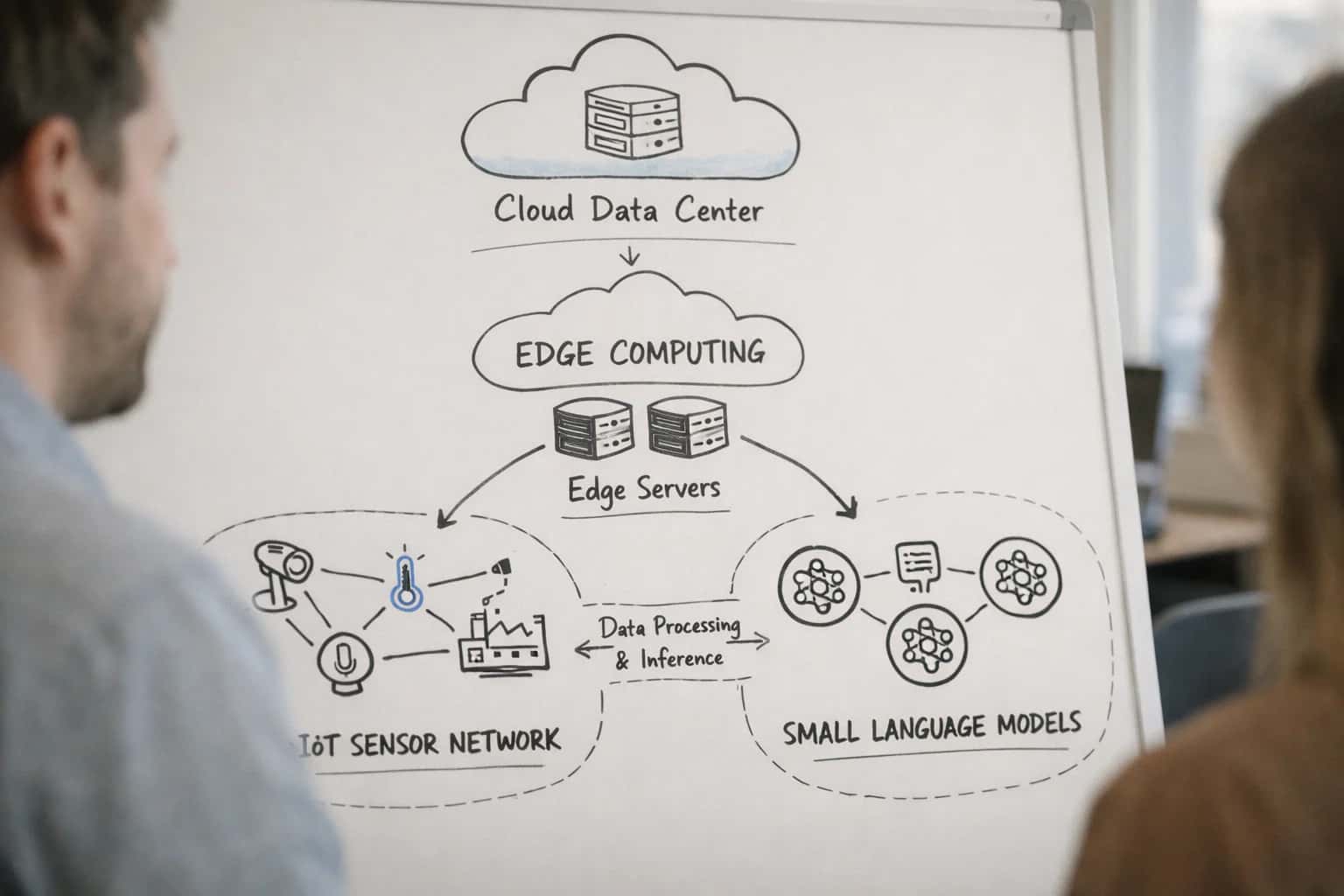
EDGE DEPLOYMENT AND MANAGEMENT
What is Service Mesh (Edge)?
A service mesh for edge computing is a dedicated infrastructure layer that manages service-to-service communication between microservices (like model endpoints) in a distributed edge deployment, providing observability, security, and traffic control.
In edge AI deployments, a service mesh provides zero-trust security via mutual TLS (mTLS) for all inter-service traffic, observability through distributed tracing and metrics for model inference calls, and fine-grained traffic management for strategies like canary deployments of new model versions. It abstracts the complexity of the underlying network, allowing DevOps teams to consistently enforce policies for resilience (retries, timeouts, circuit breakers) and security across thousands of remote devices from a central control plane.
SERVICE MESH (EDGE)
Core Capabilities of an Edge Service Mesh
An edge service mesh provides the foundational control plane for managing microservices, such as AI model endpoints, across distributed, resource-constrained environments. Its core capabilities focus on observability, security, and resilient traffic management without a centralized cloud dependency.
01
Zero-Trust Security & mTLS
An edge service mesh enforces a zero-trust security model by default. It automatically provisions and rotates certificates to enable mutual TLS (mTLS) for all service-to-service communication. This ensures strong authentication and encryption between model inference endpoints, even on untrusted networks, without requiring application code changes.
- Key Benefit: Provides cryptographic identity for every service (pod/container), preventing spoofing and man-in-the-middle attacks.
- Edge Consideration: Must operate efficiently with low overhead on devices with limited CPU for cryptographic operations.
02
Traffic Management & Canary Routing
The mesh provides fine-grained control over request flow between services using declarative rules. This is critical for canary deployments and A/B testing of new model versions on the edge.
- Traffic Splitting: Route a precise percentage of inference requests (e.g., 5%) to a new model version while monitoring for performance regressions or errors.
- Fault Injection: Deliberately introduce delays or HTTP errors to test the resilience of dependent services.
- Retry Logic & Timeouts: Automatically retry failed requests to another healthy instance and enforce request timeouts to prevent cascading failures.
03
Observability & Telemetry
It automatically collects a rich set of telemetry data—metrics, logs, and traces—for all inter-service communication without instrumentation. This is foundational for monitoring edge AI performance.
- Golden Signals: Tracks latency, traffic, errors, and saturation for every model endpoint.
- Distributed Tracing: Follows a single inference request as it traverses multiple microservices (e.g., pre-processing → model A → model B → post-processing).
- Integration: Exports data to tools like Prometheus for monitoring and Grafana for dashboards, enabling detection of model drift or latency spikes (P99 latency).
04
Resilience Patterns & Circuit Breaking
The mesh implements resilience patterns that prevent localized failures from bringing down the entire edge deployment. This is essential for maintaining uptime when dependencies are unreliable.
- Circuit Breaker: Temporarily stops sending requests to a failing model endpoint (e.g., one experiencing high latency or errors), allowing it to recover and preventing resource exhaustion in calling services.
- Load Balancing: Distributes requests across multiple identical model instances using algorithms like least connections.
- Health Checks: Uses liveness and readiness probes to automatically determine if a service instance is healthy and ready to receive traffic.
05
Policy Enforcement & Access Control
Centralized policy definition allows operators to enforce security and operational rules across the entire edge fleet from a single control plane.
- Authorization Policies: Define which services can communicate (e.g., "only the API gateway can call the vision model").
- Rate Limiting: Enforce quotas on how many requests a service can make to another, protecting critical resources from being overwhelmed.
- Protocol Compliance: Ensure all communication uses approved protocols (e.g., HTTP/2, gRPC) for efficiency.
06
Unified Service Discovery
The mesh provides a dynamic service registry that automatically tracks the location (IP/port) and health of every service instance in the distributed edge environment. This eliminates the need for hard-coded configurations or external DNS lookups.
- Dynamic Updates: As containers are orchestrated (e.g., by K3s) and move across edge nodes, the mesh updates the registry in real-time.
- Load-Aware Routing: Traffic is automatically routed only to healthy, available instances, supporting seamless scaling and failover.
- Abstraction: Services communicate using logical names (e.g.,
llm-inference-service) rather than network addresses, simplifying application logic.
EDGE DEPLOYMENT AND MANAGEMENT
How an Edge Service Mesh Works
An edge service mesh is a dedicated infrastructure layer that manages secure, observable, and reliable communication between microservices (like AI model endpoints) deployed across distributed edge devices.
An edge service mesh operates by deploying a lightweight data plane proxy (like Envoy) as a sidecar container alongside each service instance on an edge node. This proxy intercepts all network traffic, enabling the mesh to provide transparent traffic management (load balancing, retries), observability (metrics, tracing), and security (mTLS, policy enforcement) without requiring changes to the application code. A separate control plane (e.g., Istio, Linkerd) running centrally or on edge gateways configures and manages these proxies.
In edge AI contexts, the mesh manages communication between model inference endpoints, feature stores, and RAG components. It handles critical operations like canary deployments for model updates, circuit breaking to prevent cascading failures, and collecting P99 latency metrics. By abstracting network complexity, it allows DevOps teams to consistently enforce SLOs and security policies across thousands of heterogeneous devices from a single declarative configuration, often managed via GitOps principles.
SERVICE MESH (EDGE)
Use Cases for Edge Service Mesh in AI
An edge service mesh provides the critical infrastructure layer for managing microservices in distributed AI deployments. These are its primary operational applications.
01
Intelligent Traffic Management for Model Endpoints
An edge service mesh enables fine-grained traffic control between different versions of AI models and microservices. This is foundational for deployment strategies like canary releases and A/B testing, allowing operators to route a percentage of inference requests to a new model version while monitoring for performance regressions or drift. It also facilitates load balancing across multiple model replicas on different edge nodes, ensuring optimal resource utilization and preventing hotspots that could degrade latency.
02
Secure, Zero-Trust Communication
In distributed edge environments, every service-to-service call is a potential attack vector. A service mesh automates the enforcement of a zero-trust security model by:
- Automatically provisioning and rotating mTLS certificates for all services, ensuring all east-west traffic (e.g., between a pre-processing service and the model inference endpoint) is encrypted and mutually authenticated.
- Implementing identity-based access policies to define which services can communicate, preventing unauthorized lateral movement.
- Providing a consistent security posture across heterogeneous edge hardware and locations, managed centrally.
03
Unified Observability & Telemetry
Gaining visibility into the performance and health of distributed AI workloads is a major challenge. A service mesh provides a uniform telemetry data plane that automatically collects golden signals:
- Latency metrics (including P99) for inference calls between services.
- Traffic volume and error rates for each model endpoint.
- Distributed tracing to visualize the entire request path, from ingress through multiple microservices to the final model inference. This data is exported to monitoring tools, enabling proactive detection of issues like model drift, cold start delays, or failing nodes.
04
Resilience and Fault Tolerance
Edge networks are inherently unreliable. A service mesh builds resilience directly into the communication layer with patterns like:
- Automatic retries with configurable back-off for transient failures.
- Circuit breakers to fail fast when a dependent service (e.g., a feature store or another model) is unhealthy, preventing cascading failures and resource exhaustion.
- Timeout and deadline enforcement to ensure requests don't hang indefinitely.
- Failure injection for testing system robustness via chaos engineering principles. This ensures AI services remain responsive despite network partitions or hardware failures.
05
Policy Enforcement & Governance
A service mesh acts as a policy enforcement point for operational and compliance requirements across the edge fleet. Administrators can declaratively define and apply rules such as:
- Rate limiting to protect model inference endpoints from being overwhelmed by excessive requests.
- Quota management to ensure fair resource usage across different teams or applications.
- Audit logging of all service interactions for compliance (e.g., GDPR, EU AI Act).
- Protocol translation (e.g., HTTP to gRPC) between services, simplifying integration of legacy components with modern AI microservices.
06
Simplified Multi-Cluster & Hybrid Management
AI deployments often span edge clusters, on-premises data centers, and the cloud. A service mesh abstracts network complexity by:
- Creating a secure, virtual network overlay that connects services across these disparate environments as if they were on a single network.
- Enabling location-aware routing, so requests from an edge device can be processed by the nearest available model replica, minimizing latency.
- Providing a single control plane to manage connectivity, security, and observability policies for the entire distributed system, reducing operational overhead for DevOps teams managing Kubernetes (Edge) or K3s clusters.
ARCHITECTURAL COMPARISON
Edge Service Mesh vs. Cloud Service Mesh
A comparison of the core architectural and operational characteristics of service meshes designed for distributed edge computing versus those optimized for centralized cloud environments.
| Feature / Characteristic | Edge Service Mesh | Cloud Service Mesh |
|---|---|---|
Primary Deployment Environment | Distributed edge devices, gateways, micro-data centers | Centralized cloud regions and availability zones |
Network Assumption & Topology | High-latency, intermittent, low-bandwidth (e.g., cellular, satellite) | Low-latency, high-bandwidth, stable backbone networks |
Control Plane Location | Often distributed or hybrid; can be hosted in a regional edge cluster | Centralized within a cloud provider's managed service |
Data Plane Footprint | Extremely lightweight; minimal CPU/memory overhead (e.g., < 50MB RAM) | Moderate to heavy; optimized for feature richness over minimalism |
Node Autonomy & Air-Gap Operation | High; designed for extended periods of disconnection from central control | Low; assumes persistent, reliable connectivity to the control plane |
Primary Security Model | Identity-based with mutual TLS (mTLS), zero-trust at the device level | Identity and network-based, often integrated with cloud IAM and VPCs |
Configuration & Policy Sync | Eventual consistency; batched updates tolerant of network partitions | Strong consistency; near real-time synchronization |
Telemetry & Observability Data | Aggregated locally, filtered, and sent upstream in batches to conserve bandwidth | Streamed continuously to centralized monitoring and logging services |
Typical Scale | 10s to 100,000s of heterogeneous nodes (devices, servers) | 100s to 10,000s of homogeneous virtual machines or containers |
Lifecycle Management Pattern | GitOps with pull-based reconciliation; OTA update mechanisms | Push-based deployments via CI/CD pipelines to managed clusters |
SERVICE MESH (EDGE)
Frequently Asked Questions
A service mesh for edge computing is a dedicated infrastructure layer that manages service-to-service communication between microservices (like model endpoints) in a distributed edge deployment. This FAQ addresses its core functions, components, and role in deploying and managing small language models on edge hardware.
A service mesh for edge computing is a dedicated infrastructure layer that manages service-to-service communication between microservices, such as AI model inference endpoints, in a distributed edge deployment. It abstracts the network into a configurable, observable, and secure layer, typically implemented as a set of lightweight network proxies (sidecars) deployed alongside each service instance. This decouples complex networking logic—like service discovery, load balancing, and encryption—from the application code, allowing developers to focus on business logic while the mesh handles cross-cutting concerns. In an edge context, it must be lightweight, resilient to intermittent connectivity, and capable of operating with minimal central coordination.
Enabling Efficiency, Speed & Accuracy
Intelligent Analysis, Decision & Execution
We build AI systems for teams that need search across company data, workflow automation across tools, or AI features inside products and internal software.
Talk to Us
Search across company data
Give teams answers from docs, tickets, runbooks, and product data with sources and permissions.
Useful when people spend too long searching or get different answers from different systems.
Enterprise searchRAGPermissions
Read more
Automate internal workflows
Use AI to route work, draft outputs, trigger actions, and keep approvals and logs in place.
Useful when repetitive work moves across multiple tools and teams.
AI agentsWorkflow automationGovernance
Read more
Add AI to products and internal tools
Build assistants, guided actions, or decision support into the software your team or customers already use.
Useful when AI needs to be part of the product, not a separate tool.
AI integrationDecision supportModel routing
Read more
About the author
Prasad Kumkar
CEO & MD, Inference Systems
Prasad Kumkar is the CEO & MD of Inference Systems and writes about AI systems architecture, LLM infrastructure, model serving, evaluation, and production deployment. Over 5+ years, he has worked across computer vision models, L5 autonomous vehicle systems, and LLM research, with a focus on taking complex AI ideas into real-world engineering systems.
His work and writing cover AI systems, large language models, AI agents, multimodal systems, autonomous systems, inference optimization, RAG, evaluation, and production AI engineering.
LinkedIn
Limited slotsGet a Free AI Consultation
Partnered with leading AI, data, and software stack.





How We Work
Custom AI workflows for your Business
One-fit-all AI don't work for modern businesses. At Inferensys, we aim to understand your business & custom requirements; which we use to define most efficient agentic workflows, the data, and the tools for your business.
01
Review the use case
We understand the task, the users, and where AI can actually help.
Read more02
Pick the right approach
We define what needs search, automation, or product integration.
Read more03
Build the first useful version
We implement the part that proves the value first.
Read more04
Improve from there
We add the checks and visibility needed to keep it useful.
Read moreThe first call is a practical review of your use case and the right next step.
Talk to Us