Federated learning (edge) is a privacy-preserving, decentralized machine learning approach where a global model is trained across multiple edge devices or servers, each using its own local dataset. Instead of sending sensitive raw data to a central cloud server, devices compute model updates (typically gradients or weight deltas) from their local data and send only these encrypted mathematical summaries to a central aggregation server. This server, often using an algorithm like Federated Averaging (FedAvg), securely combines these updates to improve the global model, which is then redistributed to the devices. This cycle repeats, enabling continuous learning while data remains on-premises, addressing critical concerns for data privacy, regulatory compliance (like GDPR or HIPAA), and bandwidth efficiency in distributed systems.

Glossary
Federated Learning (Edge)
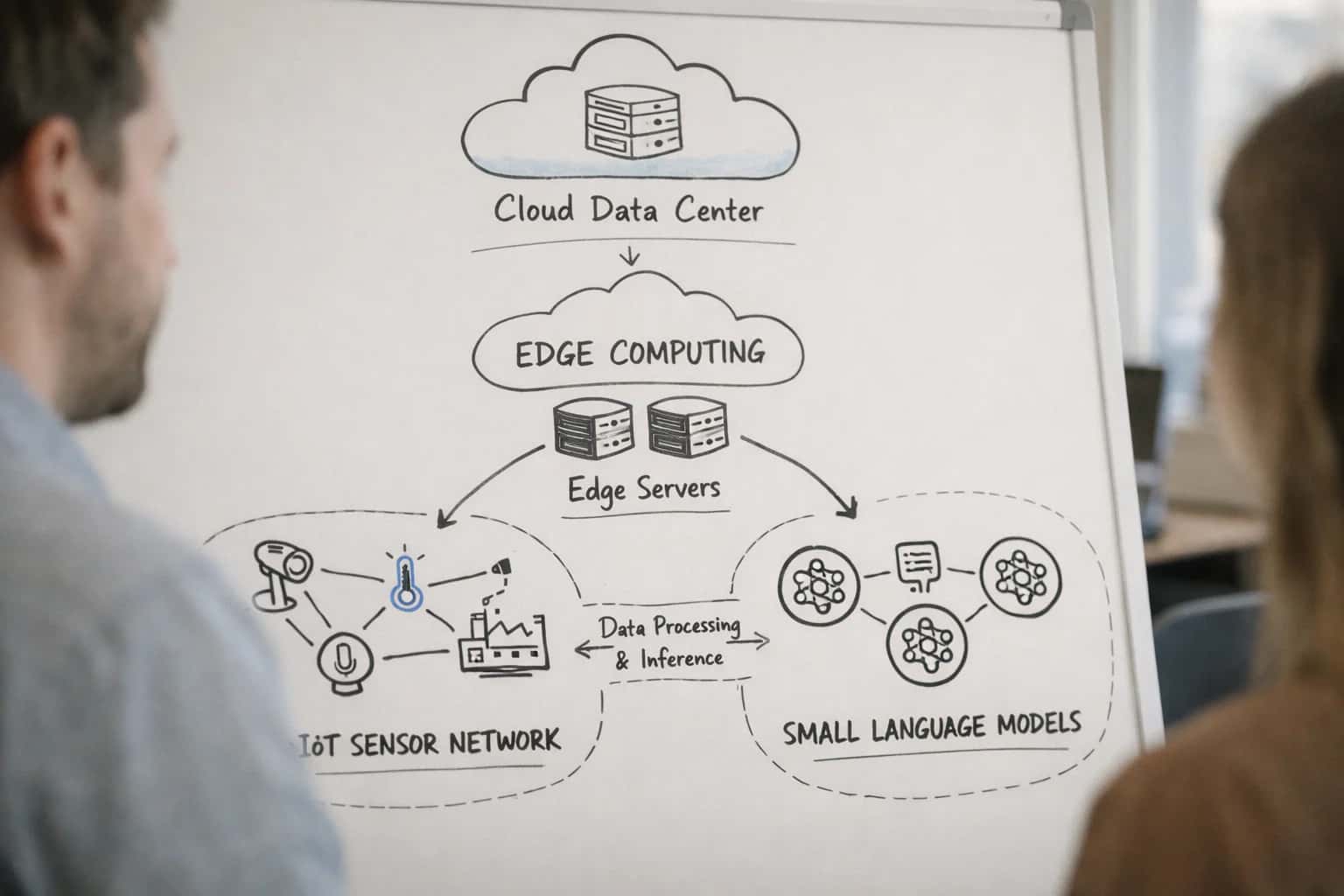
What is Federated Learning (Edge)?
Federated learning is a decentralized machine learning paradigm designed for edge computing, where a global model is collaboratively trained across a network of distributed devices without centralizing raw data.
In an edge AI context, this paradigm is specifically engineered for the constraints of remote hardware. Training occurs on-device, leveraging local NPU or GPU acceleration, and must contend with limited compute, intermittent connectivity, and heterogeneous data distributions (non-IID data). Key architectural components include a secure aggregation protocol to prevent the server from inspecting individual updates, differential privacy mechanisms to add statistical noise, and robust client selection strategies to manage stragglers. This makes federated learning foundational for applications like predictive keyboard suggestions, healthcare diagnostics across hospitals, and real-time anomaly detection in industrial IoT, where data sovereignty and low-latency inference are paramount.
Core Characteristics of Edge Federated Learning
Edge Federated Learning is a decentralized machine learning paradigm where a global model is collaboratively trained across a massive, distributed network of edge devices (e.g., smartphones, IoT sensors) using their local data, with only model updates—never raw data—shared with a central coordinator.
Decentralized Data Sovereignty
The fundamental principle where raw training data never leaves the edge device. Each device computes a model update (e.g., gradient) on its local dataset. Only these compact, mathematical updates are transmitted to a central server for aggregation. This preserves data privacy and compliance with regulations like GDPR and HIPAA by design, as sensitive information remains under the user's physical control.
Communication-Efficient Aggregation
The core algorithmic challenge is minimizing the bandwidth and frequency of updates from potentially millions of resource-constrained devices. Key techniques include:
- Federated Averaging (FedAvg): The canonical algorithm that performs multiple local training steps on each device before averaging the resulting model parameters.
- Compression: Applying methods like quantization and sparsification to shrink the size of transmitted model updates.
- Asynchronous Updates: Allowing devices to report updates on variable schedules, accommodating heterogeneous device availability and network conditions.
Statistical Heterogeneity (Non-IID Data)
A defining technical challenge where the data distribution across edge devices is non-independent and identically distributed (non-IID). For example, a user's typing patterns on a smartphone are unique. This violates the standard IID assumption of centralized ML, causing convergence issues and model bias. Advanced algorithms like FedProx or SCAFFOLD are designed to handle this by adding regularization terms or correcting for client 'drift'.
System Heterogeneity & Partial Participation
The practical reality that the federated network is composed of devices with vastly different capabilities (compute, memory, battery) and availability (network connectivity, power state). Characteristics include:
- Partial Participation: Only a subset of devices is available for training in any given communication round.
- Straggler Mitigation: Techniques to prevent slow devices from bottlenecking the entire training process, such as setting deadlines for update submissions.
- Dropout Resilience: The system must be robust to devices that join, contribute, and leave the training process unpredictably.
Privacy-Preserving Aggregation
Mechanisms to prevent the central server from inferring individual user data from the aggregated model updates, which can still be vulnerable to reconstruction attacks. Core techniques include:
- Secure Aggregation: A cryptographic protocol that allows the server to compute the sum of model updates from many clients without being able to inspect any individual update.
- Differential Privacy: Adding carefully calibrated statistical noise to the local updates before they are sent, providing a mathematical guarantee of privacy at the cost of some model accuracy.
- Homomorphic Encryption: Enabling computation on encrypted model updates, though this is often too computationally expensive for edge devices.
Cross-Device vs. Cross-Silo Federations
Two primary deployment archetypes:
- Cross-Device FL: Involves a massive number of consumer devices (e.g., >10,000 smartphones) with unreliable connectivity. The focus is on scalability, efficiency, and handling extreme statistical and system heterogeneity.
- Cross-Silo FL: Involves a smaller number of reliable, organizational clients (e.g., 2-100 hospitals or banks). Each 'silo' has a large, curated dataset. The focus shifts to higher model performance, more complex tasks, and aligning incentives between participating organizations.
Federated Learning (Edge) vs. Centralized Training
A technical comparison of the core operational and security characteristics between decentralized federated learning on edge devices and traditional centralized model training.
| Feature | Federated Learning (Edge) | Centralized Training |
|---|---|---|
Data Location & Movement | Data remains on local edge devices. Only encrypted model updates (gradients) are shared. | All raw training data is collected and transmitted to a central server or cloud data center. |
Primary Privacy Mechanism | Data never leaves the device. Privacy is enforced by architecture, often enhanced with techniques like differential privacy or secure aggregation. | Relies on perimeter security, access controls, and data anonymization techniques applied to the centralized dataset. |
Communication Pattern | Iterative, many-to-one. Many devices send small model updates to a central aggregator. High communication rounds, low bandwidth per round. | One-to-many. Central server distributes the model (or data) to training nodes. Low communication rounds, high initial data transfer. |
Network Dependency & Resilience | Operates with intermittent connectivity. Devices train locally and synchronize updates when possible. Tolerant to high latency and device dropout. | Requires stable, high-bandwidth connectivity for initial data ingestion and often for distributed training coordination. Sensitive to latency. |
Compute & Memory Profile per Device | Optimized for on-device training. Uses efficient architectures (e.g., SLMs) and techniques like quantization. Must fit within device power and memory constraints. | Centralized training leverages powerful, scalable cloud/on-premise hardware (GPUs/TPUs). Device constraints are not a primary concern for the core training loop. |
Statistical Challenges | Data is non-IID (not independently and identically distributed) across devices. Requires robust aggregation (e.g., FedAvg, FedProx) to handle client drift and bias. | Assumes a consolidated, (often) IID dataset. Standard optimization techniques (SGD, Adam) are directly applicable. |
Security Threat Model | Threats include malicious clients (data poisoning on local updates), inference attacks on shared updates, and privacy leakage from aggregated updates. | Threats focus on securing the central data repository (breaches, insider threats) and the integrity of the training pipeline. |
Model Personalization Potential | High. Global model can be fine-tuned on local device data, creating personalized variants without sharing user-specific patterns. | Low for the base model. Personalization requires sending user data to the server or deploying a separate fine-tuning pipeline. |
Operational Overhead | High coordination complexity: device selection, update scheduling, aggregation logic, and handling stragglers. Requires robust edge management software. | Lower coordination complexity. Focus is on managing centralized compute resources, data pipelines, and experiment tracking. |
Regulatory Compliance (e.g., GDPR, HIPAA) | Architecturally aligned with data minimization and purpose limitation. Reduces legal exposure by avoiding central data collection. | Requires extensive legal agreements, data processing safeguards, and often explicit user consent for data collection and central processing. |
Frequently Asked Questions
Federated learning is a decentralized machine learning approach where a global model is trained across multiple edge devices using their local data, with only model updates (not raw data) shared with a central server, preserving data privacy. These FAQs address its core mechanisms, benefits, and challenges for edge deployment.
Federated Learning (FL) is a decentralized machine learning paradigm where a global model is collaboratively trained across multiple edge devices or clients without centralizing their raw data. It works through a cyclical process: 1) A central server initializes a global model and distributes it to selected clients. 2) Each client trains the model locally on its private data. 3) Clients send only the computed model updates (e.g., gradients or weights) back to the server. 4) The server aggregates these updates (typically via algorithms like Federated Averaging (FedAvg)) to form an improved global model. This cycle repeats, enabling learning from distributed data while keeping sensitive information on-device.
Enabling Efficiency, Speed & Accuracy
Intelligent Analysis, Decision & Execution
We build AI systems for teams that need search across company data, workflow automation across tools, or AI features inside products and internal software.
Talk to Us
Search across company data
Give teams answers from docs, tickets, runbooks, and product data with sources and permissions.
Useful when people spend too long searching or get different answers from different systems.

Automate internal workflows
Use AI to route work, draft outputs, trigger actions, and keep approvals and logs in place.
Useful when repetitive work moves across multiple tools and teams.

Add AI to products and internal tools
Build assistants, guided actions, or decision support into the software your team or customers already use.
Useful when AI needs to be part of the product, not a separate tool.

About the author
Prasad Kumkar
CEO & MD, Inference Systems
Prasad Kumkar is the CEO & MD of Inference Systems and writes about AI systems architecture, LLM infrastructure, model serving, evaluation, and production deployment. Over 5+ years, he has worked across computer vision models, L5 autonomous vehicle systems, and LLM research, with a focus on taking complex AI ideas into real-world engineering systems.
His work and writing cover AI systems, large language models, AI agents, multimodal systems, autonomous systems, inference optimization, RAG, evaluation, and production AI engineering.
Partnered with leading AI, data, and software stack.





How We Work
Custom AI workflows for your Business
One-fit-all AI don't work for modern businesses. At Inferensys, we aim to understand your business & custom requirements; which we use to define most efficient agentic workflows, the data, and the tools for your business.
01
Review the use case
We understand the task, the users, and where AI can actually help.
Read more02
Pick the right approach
We define what needs search, automation, or product integration.
Read more03
Build the first useful version
We implement the part that proves the value first.
Read more04
Improve from there
We add the checks and visibility needed to keep it useful.
Read moreThe first call is a practical review of your use case and the right next step.
Talk to Us