Runtime monitoring is a proactive safety technique that involves the continuous, real-time observation of a system's execution to detect violations of predefined safety properties or operational constraints. It acts as a protective layer, comparing live sensor data, internal states, and actuator commands against a formal safety specification. When a potential violation is detected, the monitor can trigger mitigation actions such as issuing warnings, invoking a recovery policy, or forcing the system into a fail-safe mode to prevent harm.

Glossary
Runtime Monitoring
Runtime monitoring is a safety technique that involves continuously observing a system's execution to detect violations of specified safety properties or constraints in real-time.
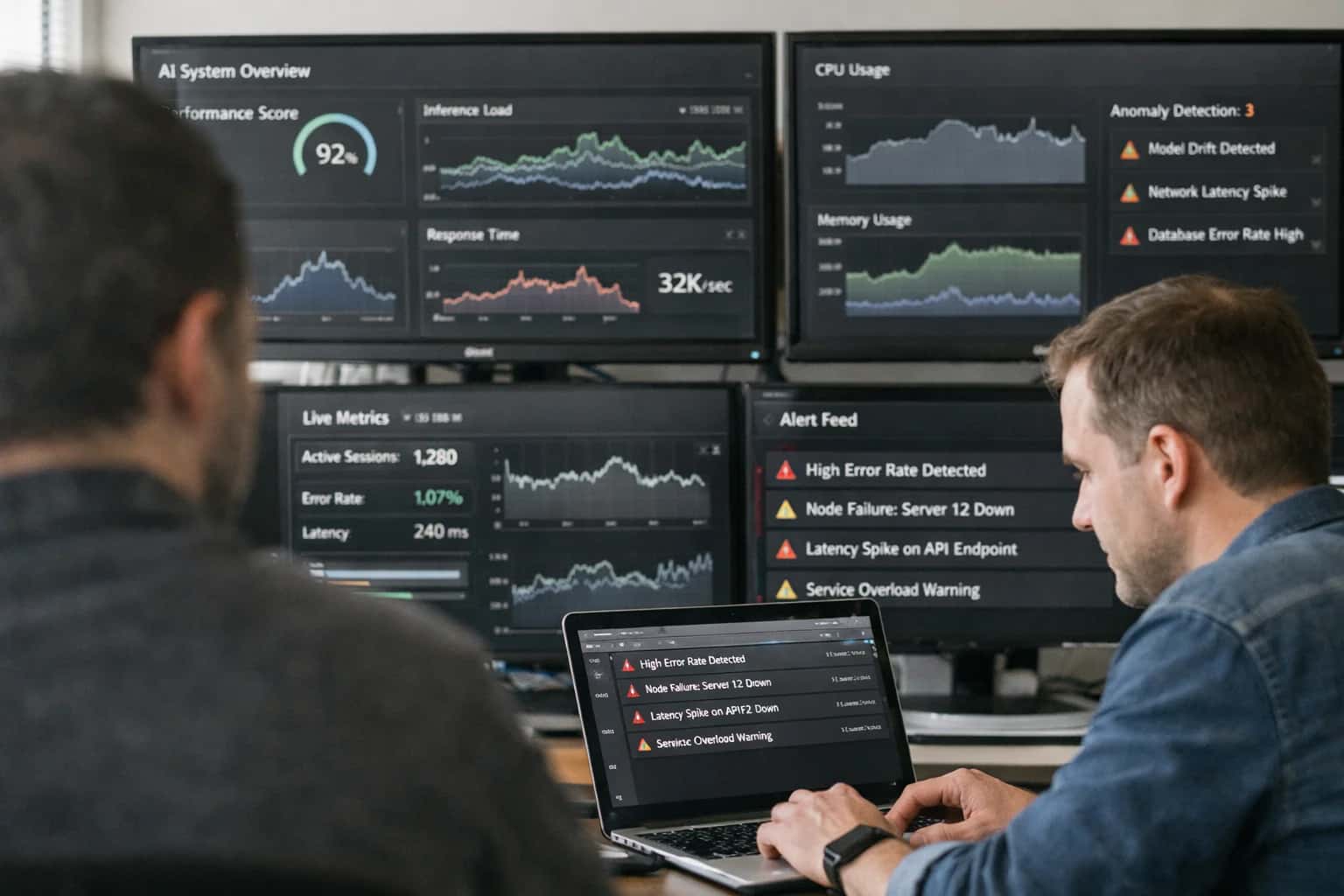
SAFETY AND FAILURE MODE SIMULATION
What is Runtime Monitoring?
Runtime monitoring is a critical safety engineering technique for autonomous systems, involving the continuous, real-time observation of a system's execution to detect violations of predefined safety properties or operational constraints.
In robotics and Safe Reinforcement Learning (Safe RL), runtime monitors are often synthesized from formal models like Control Barrier Functions (CBFs) or temporal logic specifications. This technique is closely related to shielded learning, where the monitor acts as a 'shield' to override unsafe agent actions. It provides a deterministic safety guarantee complementary to statistical methods like uncertainty quantification, forming a core component of a defense-in-depth strategy for autonomous systems operating in the physical world.
SAFETY AND FAILURE MODE SIMULATION
Core Characteristics of Runtime Monitoring
Runtime monitoring is a proactive safety technique that continuously observes a system's execution in real-time to detect violations of specified safety properties or operational constraints.
01
Real-Time Constraint Verification
The primary function is the continuous, low-latency evaluation of the system's state and actions against a formal set of safety constraints or invariants. These are often expressed as logical predicates (e.g., joint_angle < max_limit, collision_distance > 0). The monitor acts as a gatekeeper, verifying each proposed action or checking the resulting state before or immediately after execution to prevent physical harm or system damage.
02
Formal Specification of Safety Properties
Effective monitoring relies on unambiguous, mathematically defined safety rules. These properties are derived from techniques like Failure Mode and Effects Analysis (FMEA) or Hazard and Operability Study (HAZOP). Common formalisms include:
- Temporal Logic (e.g., Linear Temporal Logic - LTL): Specifies conditions over time ("the robot gripper must always be open when moving over a human").
- Control Barrier Functions (CBFs): Define a safe set of states; the monitor ensures the system's dynamics do not leave this set.
- Signal Temporal Logic (STL): Extends temporal logic for continuous-time signals from sensors.
03
Intervention and Mitigation Strategies
Upon detecting a constraint violation, the monitor must enact a predefined mitigation strategy. This is not merely an alert system. Interventions are hierarchical and context-dependent:
- Action Override: Substituting an unsafe proposed action with a verified safe one (a core component of Shielded Learning).
- Graceful Degradation: Reducing system performance to a minimal, guaranteed-safe operational mode.
- Initiation of a Recovery Policy: Executing a specialized sequence to return the system to a safe state (e.g., stopping all actuators, moving to a home position).
- Fail-Safe Mode Activation: Triggering a full system halt in a pre-configured safe condition.
04
Integration with Learning Systems
In Safe Reinforcement Learning (Safe RL) and autonomous agents, runtime monitors interact closely with the learning policy. They enforce safety during both training and deployment, preventing the agent from exploring catastrophic actions. This integration can be implemented via:
- Action Masking: Preventing the learning agent from selecting actions flagged as unsafe by the monitor.
- Safety Critic Guidance: Using a separate safety critic network to predict long-term risk, which the monitor uses for its evaluations.
- Reward Shaping: Penalizing the agent for states or actions that trigger monitor interventions.
05
Distinction from Traditional Observability
Runtime monitoring for safety is fundamentally different from performance observability and telemetry.
- Goal: Safety monitors aim to prevent harm; observability aims to explain performance for debugging.
- Latency Tolerance: Safety monitoring requires hard real-time guarantees (e.g., microseconds to milliseconds); observability can tolerate higher latencies.
- Actionability: A safety monitor must be connected to an actuator override; observability feeds dashboards and alerts for human operators.
- Formal Basis: Safety properties are formally specified; observability metrics are often empirically defined.
06
Implementation in Sim-to-Real Pipelines
In robotics and Sim-to-Real Transfer Learning, runtime monitors are first developed and rigorously tested in simulation. This allows for:
- Fault Injection: Deliberately testing the monitor's response to simulated sensor failures, actuator jams, and environmental anomalies.
- Adversarial Robustness Testing: Challenging the monitor with edge-case scenarios and out-of-distribution (OOD) inputs.
- Benchmarking: Establishing performance baselines for detection latency and intervention correctness before costly physical deployment. The monitor itself often becomes a critical component of the Digital Twin, used for ongoing Hardware-in-the-Loop Testing.
SAFETY AND FAILURE MODE SIMULATION
How Runtime Monitoring Works
Runtime monitoring is a critical safety technique for autonomous systems, providing a real-time safety net by continuously checking system execution against predefined rules.
Runtime monitoring is a safety technique that involves the continuous, real-time observation of a system's execution to detect violations of specified safety properties or operational constraints. It acts as a protective safety layer, intercepting and potentially overriding unsafe actions before they are executed by the primary control policy, such as a reinforcement learning agent. This is often implemented using a safety shield or runtime verifier that applies formal logic or learned models to assess risk.
The monitor operates by comparing the system's current state and proposed actions against a set of safety rules or barrier functions derived from hazard analysis. When a potential constraint violation is predicted, the system can invoke a fail-safe response, such as executing a predefined recovery policy or entering a minimal-risk state. This approach is fundamental to Safe Reinforcement Learning (Safe RL) and shielded learning, ensuring robust operation even when the primary policy encounters out-of-distribution (OOD) scenarios or attempts reward hacking.
SAFETY AND FAILURE MODE SIMULATION
Runtime Monitoring Use Cases
Runtime monitoring is a proactive safety technique that continuously validates a system's execution against formal safety properties. These are its primary applications for ensuring robust, deterministic behavior in autonomous and robotic systems.
01
Constraint Violation Detection
The core function of runtime monitoring is to detect violations of hard safety constraints in real-time. These constraints are formally specified properties that define the system's safe operational envelope.
- Examples: Checking that a robotic arm's joint angles stay within mechanical limits, verifying that an autonomous vehicle maintains a safe following distance, or ensuring a drone stays within a geofenced airspace.
- Mechanism: The monitor receives the system's state (e.g., sensor readings, planned actions) and evaluates it against a set of pre-defined logical rules or mathematical functions, such as Control Barrier Functions (CBFs). A violation triggers a pre-programmed mitigation response.
02
Enforcing Action Masks in Reinforcement Learning
Runtime monitors act as a safety layer for Reinforcement Learning (RL) agents, particularly during deployment. They enforce action masking by filtering out actions that would lead to constraint violations before the agent executes them.
- Process: The learning agent proposes an action. The monitor evaluates the action against the current state and a model of the environment. If the action is deemed unsafe, the monitor overrides it with a safe alternative or a null command, a technique known as shielded learning.
- Benefit: This allows RL policies trained in simulation to operate safely on physical hardware, even if they occasionally propose risky actions due to distributional shift or reward hacking.
03
Triggering Fail-Safe and Recovery Policies
When a monitor detects an impending or actual violation, it initiates a fail-safe mode or executes a specialized recovery policy. This is critical for achieving graceful degradation.
- Fail-Safe Mode: The system transitions to a minimal-risk state (e.g., a robot stops all movement, a vehicle performs a minimal-risk maneuver).
- Recovery Policy: A pre-computed or learned policy designed to actively guide the system from an unsafe state back into the safe region of operation. For example, a monitor detecting a bipedal robot beginning to fall could trigger a balance recovery controller.
04
Validating Digital Twin Predictions
In Hardware-in-the-Loop (HIL) testing and live operation, runtime monitors compare the real system's behavior against the predictions of its digital twin. Significant discrepancies indicate a simulation-to-reality gap or an emerging system fault.
- Use Case: The digital twin runs a few milliseconds ahead of reality. The monitor compares the predicted next state from the twin with the actual sensor data. A large deviation can trigger an alert for diagnostic checks or a switch to a more conservative control mode.
- Link to System ID: Persistent deviations provide valuable data for simulation fidelity assessment and system identification, helping to calibrate the digital model.
05
Monitoring for Adversarial and OOD Inputs
Runtime monitors can screen inputs to perception systems (e.g., cameras, LiDAR) to flag potential adversarial examples or Out-of-Distribution (OOD) data that could cause erroneous model predictions.
- Techniques: This may involve checking for physical impossibilities in sensor data, using a separate safety critic network to estimate uncertainty, or applying statistical tests for data distribution shifts.
- Response: Upon detection, the system can disregard the suspect input, switch to an alternative sensor modality, or request human intervention, thereby enhancing adversarial robustness.
06
Providing Telemetry for Safety Assurance
Beyond immediate intervention, runtime monitors generate a continuous stream of safety telemetry. This log of constraint evaluations, near-misses, and interventions is essential for post-hoc analysis and safety certification.
- Purpose: This data feeds into Failure Mode and Effects Analysis (FMEA), supports Sim-to-Real Benchmarking, and provides evidence for Safety Integrity Level (SIL) claims.
- Integration: This telemetry is a core component of Agentic Observability platforms, giving engineers visibility into how often safety boundaries are approached and how the system's risk-sensitive behavior evolves over time.
COMPARISON
Runtime Monitoring vs. Other Safety Techniques
A comparison of runtime monitoring with other key safety and verification methodologies used in autonomous systems and robotics, highlighting their operational phase, guarantees, and computational characteristics.
| Feature / Characteristic | Runtime Monitoring | Formal Verification | Safe Reinforcement Learning (Safe RL) | Robust Control (e.g., CBFs) |
|---|---|---|---|---|
Primary Operational Phase | Deployment (Runtime) | Design & Verification | Training | Deployment (Controller) |
Core Guarantee Type | Detection & Intervention | Mathematical Proof | Probabilistic Constraint Satisfaction | Formal Safety (for modeled dynamics) |
Handles Unknown Environments | ||||
Requires Full System Model | ||||
Adapts to Distributional Shift | ||||
Computational Overhead at Runtime | Moderate to High (continuous evaluation) | None (pre-computed) | Low (policy inference only) | Low to Moderate (solving online constraints) |
Primary Output | Safety violation alert / Override signal | Proof certificate or counterexample | Trained policy | Safe control input |
Example Technique | Predicate checking on sensor streams | Model checking, Theorem proving | Constrained Policy Optimization (CPO) | Control Barrier Function (CBF) synthesis |
RUNTIME MONITORING
Frequently Asked Questions
Runtime monitoring is a critical safety layer for autonomous systems, providing real-time oversight to enforce constraints and prevent failures. These questions address its core mechanisms, implementation, and relationship to other safety disciplines.
Runtime monitoring is a safety technique that involves the continuous, real-time observation of a system's execution to detect violations of formally specified safety properties or constraints. It works by deploying a parallel monitor—often a lightweight classifier, state machine, or logic-based verifier—that observes the system's inputs, internal states, and outputs. The monitor compares this stream of data against a set of safety invariants (e.g., "joint torque must never exceed X Nm" or "agent must not enter a geofenced area"). Upon detecting an impending violation, the monitor can trigger a mitigation action, such as overriding an unsafe command, executing a recovery policy, or initiating a controlled shutdown into a fail-safe mode.
Enabling Efficiency, Speed & Accuracy
Intelligent Analysis, Decision & Execution
We build AI systems for teams that need search across company data, workflow automation across tools, or AI features inside products and internal software.
Talk to Us
Search across company data
Give teams answers from docs, tickets, runbooks, and product data with sources and permissions.
Useful when people spend too long searching or get different answers from different systems.
Enterprise searchRAGPermissions
Read more
Automate internal workflows
Use AI to route work, draft outputs, trigger actions, and keep approvals and logs in place.
Useful when repetitive work moves across multiple tools and teams.
AI agentsWorkflow automationGovernance
Read more
Add AI to products and internal tools
Build assistants, guided actions, or decision support into the software your team or customers already use.
Useful when AI needs to be part of the product, not a separate tool.
AI integrationDecision supportModel routing
Read more
About the author
Prasad Kumkar
CEO & MD, Inference Systems
Prasad Kumkar is the CEO & MD of Inference Systems and writes about AI systems architecture, LLM infrastructure, model serving, evaluation, and production deployment. Over 5+ years, he has worked across computer vision models, L5 autonomous vehicle systems, and LLM research, with a focus on taking complex AI ideas into real-world engineering systems.
His work and writing cover AI systems, large language models, AI agents, multimodal systems, autonomous systems, inference optimization, RAG, evaluation, and production AI engineering.
LinkedIn
Limited slotsGet a Free AI Consultation
Partnered with leading AI, data, and software stack.





How We Work
Custom AI workflows for your Business
One-fit-all AI don't work for modern businesses. At Inferensys, we aim to understand your business & custom requirements; which we use to define most efficient agentic workflows, the data, and the tools for your business.
01
Review the use case
We understand the task, the users, and where AI can actually help.
Read more02
Pick the right approach
We define what needs search, automation, or product integration.
Read more03
Build the first useful version
We implement the part that proves the value first.
Read more04
Improve from there
We add the checks and visibility needed to keep it useful.
Read moreThe first call is a practical review of your use case and the right next step.
Talk to Us