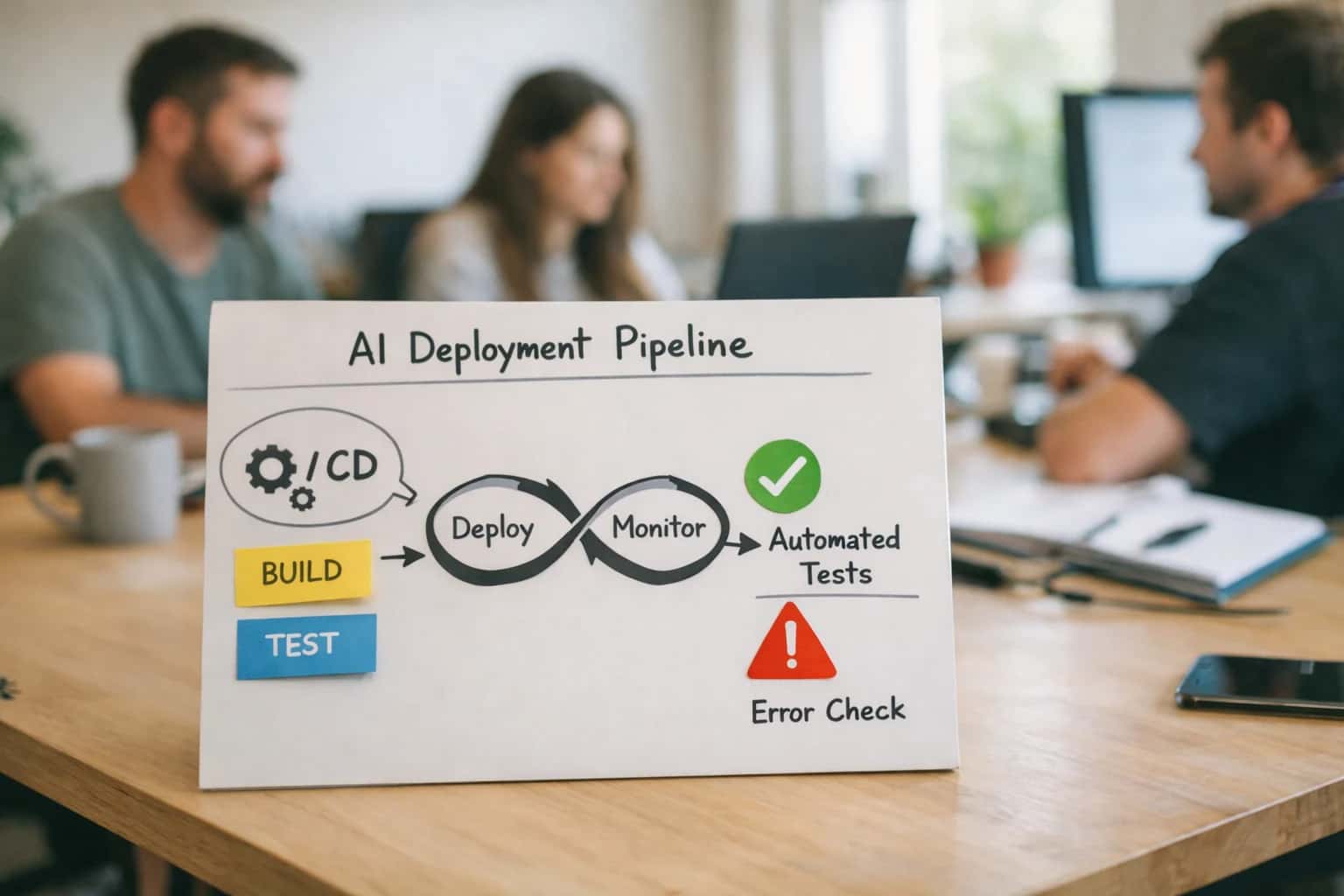
Continuous Integration/Continuous Deployment (CI/CD) is a set of automated practices and toolchains that enable development teams to integrate code changes frequently, test them rigorously, and deploy software updates reliably and rapidly. The core principle is automating the software delivery pipeline from code commit to production release, reducing manual effort and human error. This creates a fast, consistent, and repeatable process for delivering value.

Glossary
Continuous Integration/Continuous Deployment (CI/CD)
CI/CD is a set of practices that automate the software delivery pipeline, enabling frequent and reliable code changes from integration through deployment.
PARALLELIZED SIMULATION INFRASTRUCTURE
What is Continuous Integration/Continuous Deployment (CI/CD)?
A foundational practice for modern software and AI system development, CI/CD automates the build, test, and release pipeline.
In the context of parallelized simulation infrastructure for robotics and AI, CI/CD is critical for managing complex codebases for physics engines, training scripts, and deployment artifacts. It ensures that changes to simulation logic, reinforcement learning policies, or system configurations are automatically validated through extensive test suites in simulated environments before being promoted. This automation is essential for maintaining the integrity and performance of systems used for Sim-to-Real Transfer Learning, where even minor regressions can invalidate thousands of hours of virtual training.
PARALLELIZED SIMULATION INFRASTRUCTURE
Core Principles of CI/CD
Continuous Integration/Continuous Deployment (CI/CD) is a set of operating principles and practices that enable development teams to deliver code changes more frequently and reliably by automating the stages of the software delivery pipeline. In the context of parallelized simulation for robotics, CI/CD ensures that new models, policies, and simulation environments are rigorously tested and safely deployed to massive compute clusters.
01
Continuous Integration (CI)
Continuous Integration is the practice of automatically building and testing every code change committed to a shared repository. For simulation infrastructure, this means:
- Automatically triggering a build and test suite for every new commit to a physics engine, robot controller, or training algorithm.
- Running unit and integration tests within containerized environments that mirror production clusters.
- Using Infrastructure as Code (IaC) tools like Terraform to provision identical test environments, ensuring consistency.
- The goal is to detect integration errors early, often in minutes, preventing 'integration hell' where changes from multiple developers conflict.
02
Continuous Delivery (CD)
Continuous Delivery extends CI by automatically preparing code changes for a release to a production-like environment. In simulation training, this involves:
- Automatically deploying validated simulation builds or trained neural network policies to a staging cluster after CI passes.
- Performing additional integration tests and performance benchmarks in this environment.
- Ensuring the artifact (e.g., a Docker container with a new simulation version) is always in a deployable state.
- This principle enables reliable, on-demand releases of new simulation capabilities or robot policies, decoupling deployment from the final release decision.
03
Continuous Deployment
Continuous Deployment goes one step further than Continuous Delivery by automatically releasing every change that passes the pipeline to production. For a live training cluster, this means:
- A fully automated pipeline where a successful merge to the main branch triggers deployment to the production compute cluster.
- Utilizing advanced deployment strategies like blue-green deployments or canary releases to update simulation workers with zero downtime.
- Relying on comprehensive automated testing (unit, integration, performance) and robust rollback mechanisms.
- This maximizes the speed of innovation but requires extremely high confidence in the test suite and monitoring.
04
Pipeline as Code
Pipeline as Code is the practice of defining the CI/CD pipeline stages, jobs, and workflows in version-controlled configuration files. This is critical for reproducible and scalable simulation infrastructure.
- Pipeline definitions (e.g., for Jenkins, GitLab CI, GitHub Actions) are stored in Git alongside application code.
- Allows for code review, versioning, and reuse of pipeline logic across different simulation projects.
- Enables the use of container orchestration platforms like Kubernetes to dynamically provision ephemeral runners for each pipeline job, efficiently scaling to match the workload.
- Provides a single source of truth for the build, test, and deployment process.
05
Automated Testing & Quality Gates
A robust CI/CD pipeline is built on a foundation of automated testing that acts as quality gates. For physics-based simulation, this includes:
- Unit Tests: Validating individual functions of a physics engine or control algorithm.
- Integration Tests: Ensuring different components (e.g., sensor simulation, rigid body dynamics) work together correctly.
- Performance Tests: Benchmarking simulation step time and memory usage to prevent regressions.
- Validation Tests: Comparing simulation outputs against known-good results or real-world data (System ID).
- A change only progresses to the next stage if it passes all required tests, enforcing quality before deployment.
06
Infrastructure & Environment Management
CI/CD for HPC and simulation requires treating infrastructure identically to application code. Key practices include:
- Infrastructure as Code (IaC): Using tools like Terraform to declaratively define and provision cluster nodes, network configs, and parallel file systems.
- Immutable Infrastructure: Deploying pre-built, versioned machine images or containers rather than modifying live systems, ensuring consistency from development to production.
- Containerization: Packaging simulation environments, dependencies, and training scripts into Docker containers for portable, reproducible execution across job schedulers like Slurm or Kubernetes.
- GitOps: Using Git as the single source of truth for both application and infrastructure state, with automated operators reconciling the live cluster to the declared state.
COMPARISON
CI vs. CD: Understanding the Distinction
A feature-by-feature breakdown of Continuous Integration (CI) and Continuous Delivery/Deployment (CD), two core but distinct practices within the CI/CD pipeline.
| Feature / Metric | Continuous Integration (CI) | Continuous Delivery (CDel) | Continuous Deployment (CDep) |
|---|---|---|---|
Primary Goal | Automatically verify code changes | Automatically prepare release candidates | Automatically release to production |
Core Trigger | Code commit or merge to main branch | Successful completion of CI pipeline | Successful completion of Continuous Delivery pipeline |
Key Automation Focus | Build compilation, unit testing, integration testing | Additional environment testing, security scans, performance tests | Final deployment to production infrastructure |
Human Approval Gate | Not required for merge; automated gates only | Required before final production deployment | Not required; fully automated release |
Typical Output | A verified, merged codebase and build artifacts | A production-ready release candidate in a staging environment | Live software update in the production environment |
Failure Response | Immediate feedback to developer; merge blocked | Release candidate is not promoted; team is alerted | Automated rollback may be triggered; alerts are fired |
Deployment Frequency Implication | Enables frequent integration, multiple times per day | Enables reliable, on-demand releases (e.g., weekly) | Enables multiple, automated production deployments per day |
Risk Profile | Low; isolates integration issues early | Moderate; requires final human validation | Higher; relies entirely on automated test suite quality |
CI/CD
Frequently Asked Questions
Continuous Integration and Continuous Deployment (CI/CD) is the core engineering practice for automating the software delivery pipeline, enabling rapid, reliable, and frequent releases. This FAQ addresses its core principles, implementation, and role in modern machine learning and simulation infrastructure.
Continuous Integration/Continuous Deployment (CI/CD) is a set of automated practices and principles that streamline the software delivery lifecycle from code commit to production deployment. It works through a pipeline—a series of automated stages triggered by a code change. Continuous Integration (CI) involves developers frequently merging code changes into a shared repository, where each merge triggers an automated build and test sequence to detect integration errors early. Continuous Deployment (CD) automatically deploys every change that passes the CI stages directly to a production-like environment or to production itself, ensuring software is always in a deployable state. The pipeline is typically defined as code (e.g., in a Jenkinsfile or .github/workflows YAML) and managed by a CI/CD server or orchestrator like Jenkins, GitLab CI, GitHub Actions, or ArgoCD.
Enabling Efficiency, Speed & Accuracy
Intelligent Analysis, Decision & Execution
We build AI systems for teams that need search across company data, workflow automation across tools, or AI features inside products and internal software.
Talk to Us
Search across company data
Give teams answers from docs, tickets, runbooks, and product data with sources and permissions.
Useful when people spend too long searching or get different answers from different systems.
Enterprise searchRAGPermissions
Read more
Automate internal workflows
Use AI to route work, draft outputs, trigger actions, and keep approvals and logs in place.
Useful when repetitive work moves across multiple tools and teams.
AI agentsWorkflow automationGovernance
Read more
Add AI to products and internal tools
Build assistants, guided actions, or decision support into the software your team or customers already use.
Useful when AI needs to be part of the product, not a separate tool.
AI integrationDecision supportModel routing
Read more
About the author
Prasad Kumkar
CEO & MD, Inference Systems
Prasad Kumkar is the CEO & MD of Inference Systems and writes about AI systems architecture, LLM infrastructure, model serving, evaluation, and production deployment. Over 5+ years, he has worked across computer vision models, L5 autonomous vehicle systems, and LLM research, with a focus on taking complex AI ideas into real-world engineering systems.
His work and writing cover AI systems, large language models, AI agents, multimodal systems, autonomous systems, inference optimization, RAG, evaluation, and production AI engineering.
LinkedIn
Limited slotsGet a Free AI Consultation
Partnered with leading AI, data, and software stack.





How We Work
Custom AI workflows for your Business
One-fit-all AI don't work for modern businesses. At Inferensys, we aim to understand your business & custom requirements; which we use to define most efficient agentic workflows, the data, and the tools for your business.
01
Review the use case
We understand the task, the users, and where AI can actually help.
Read more02
Pick the right approach
We define what needs search, automation, or product integration.
Read more03
Build the first useful version
We implement the part that proves the value first.
Read more04
Improve from there
We add the checks and visibility needed to keep it useful.
Read moreThe first call is a practical review of your use case and the right next step.
Talk to Us