
Inferensys

Glossary

Container Orchestration

Container orchestration is the automated process of managing the lifecycle of containerized applications, including deployment, scaling, networking, and availability, across a cluster of machines.
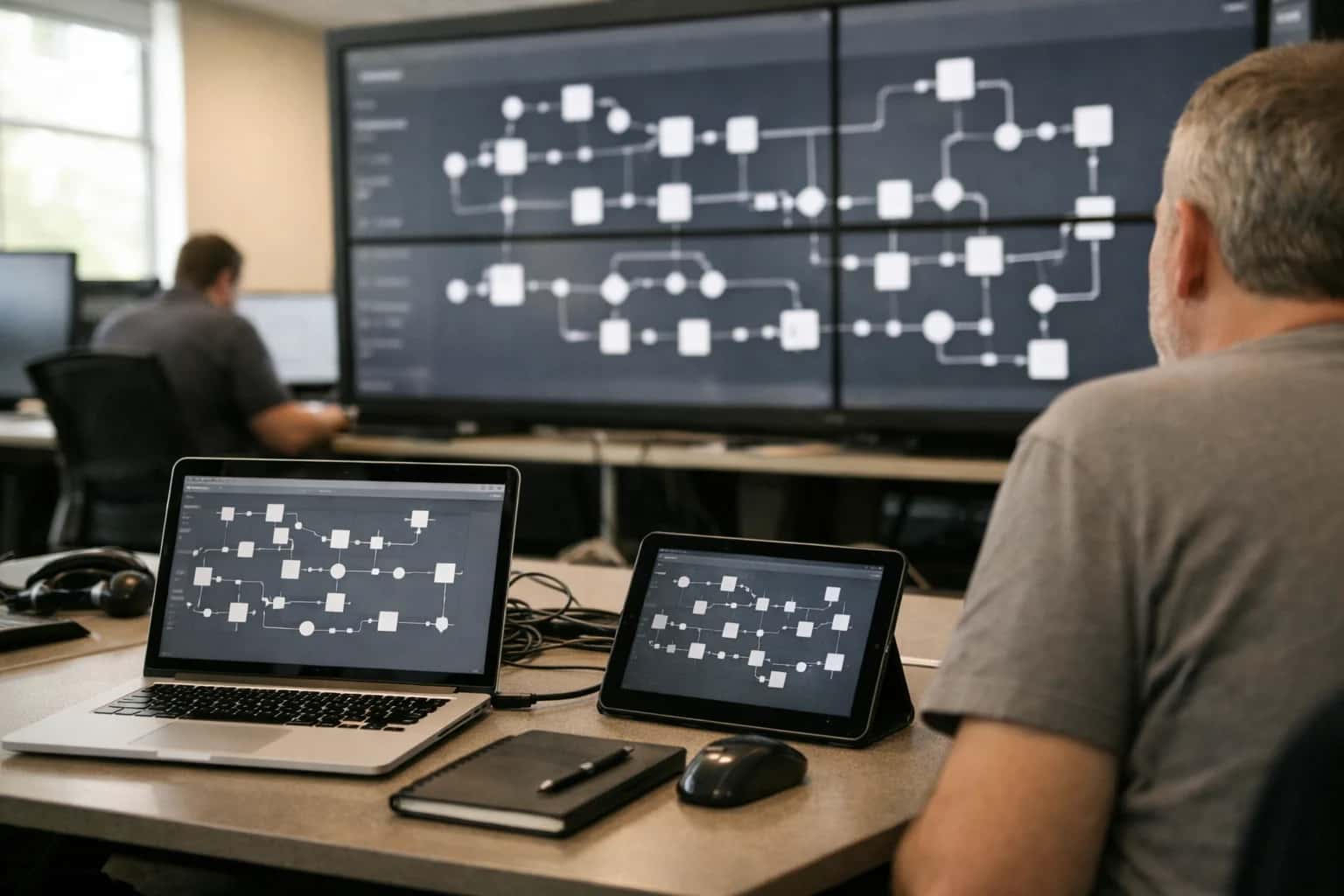
Control room desk with laptops and a large orchestration network display.
PARALLELIZED SIMULATION INFRASTRUCTURE

What is Container Orchestration?

Container orchestration is the automated management of containerized applications across a cluster of machines, essential for deploying scalable, resilient simulation and AI training workloads.

Container orchestration is the automated deployment, scaling, networking, and management of containerized applications across a cluster of hosts. In the context of parallelized simulation infrastructure, it is the critical control plane that schedules thousands of concurrent simulation jobs, manages their resource allocation (CPU, GPU, memory), and ensures high availability despite individual node failures. Platforms like Kubernetes and high-performance computing (HPC) schedulers like Slurm are primary examples, abstracting the underlying compute cluster complexity.

This automation enables the reliable execution of massive, compute-bound workloads like physics-based robotic training. Orchestrators handle lifecycle operations—automatically restarting failed containers, scaling replicas to meet demand via autoscaling, and facilitating service discovery. For simulation pipelines, this ensures efficient utilization of GPU partitioning and high-performance networking (e.g., InfiniBand) while providing a declarative model for defining complex application stacks through Infrastructure as Code (IaC) principles and tools like the Operator Pattern.

CONTAINER ORCHESTRATION

Core Capabilities of Orchestration Platforms

Container orchestration automates the deployment, management, scaling, and networking of containerized applications across a cluster of machines. These platforms provide the essential control plane for modern, distributed applications.

CORE MECHANISM

How Container Orchestration Works: The Control Loop

The fundamental automation engine that maintains the desired state of containerized applications across a cluster.

Container orchestration operates on a control loop, a continuous process where a central controller observes the cluster's current state, compares it to a user-defined desired state, and executes corrective actions to reconcile any differences. This declarative model, where users specify what they want (e.g., 'five replicas of this service') rather than how to achieve it, is the core of platforms like Kubernetes. The controller's reconciliation loop constantly works to ensure the actual running environment matches this declared configuration.

The loop's key phases are Observe, Diff, and Act. The controller observes via API Server queries and health checks from kubelets. It then diffs the observed state against the desired state defined in objects like Deployments or StatefulSets. Finally, it acts by issuing commands through the scheduler to create, destroy, or reschedule Pods on worker nodes. This automated, self-healing mechanism is what enables reliable scaling, rolling updates, and fault tolerance for distributed applications.

PARALLELIZED SIMULATION INFRASTRUCTURE

Primary Use Cases for Container Orchestration

Container orchestration automates the deployment, scaling, networking, and management of containerized applications across a cluster of compute nodes. In the context of parallelized simulation for robotics, it is the foundational layer that enables massively scalable, resilient, and efficient training workloads.

02

Dynamic Resource Scaling (Autoscaling)

Orchestration platforms enable autoscaling to match computational demand with available resources.

  • Cluster Autoscaler: Adds or removes entire worker nodes from the cluster based on pending job queues.
  • Horizontal Pod Autoscaler: Scales the number of identical simulation runner pods based on CPU/GPU utilization or custom metrics.
  • Cloud Bursting: Seamlessly extends an on-premises cluster into a public cloud (e.g., AWS, GCP) during peak training periods, then scales back down to control costs.
03

Unified Service Networking & Discovery

Orchestrators provide a virtual network that abstracts away the physical topology of the cluster.

  • Service Discovery: Simulation workers, parameter servers, and logging services automatically find each other via DNS or environment variables, regardless of which node they run on.
  • Load Balancing: Ingress controllers distribute external traffic (e.g., for monitoring dashboards, API endpoints) across multiple service instances.
  • Network Policies: Enforce security rules to isolate sensitive training data stores from general compute pods.
05

Lifecycle Automation & CI/CD for ML

Orchestrators automate the entire machine learning pipeline through integration with CI/CD tools.

  • GitOps: Declarative manifests in a Git repository define the desired state of the training cluster. Tools like ArgoCD automatically apply changes, ensuring environment consistency.
  • Canary Deployments: Safely roll out new simulation environment versions or updated training algorithms to a subset of workers before full deployment.
  • Job Orchestration: Sequence complex workflows—e.g., 1) launch parallel data generation jobs, 2) train a model, 3) run evaluation batches—using workflow managers like Argo Workflows or Kubeflow Pipelines.

PLATFORM OVERVIEW

Container Orchestration Platform Comparison

A feature and capability comparison of leading platforms for managing containerized applications in parallelized simulation and high-performance computing environments.

Feature / CapabilityKubernetesSlurmHashiCorp Nomad

Primary Architecture Model

Declarative, desired-state management

Batch-oriented, job-centric scheduling

Flexible, application-centric scheduler

Native Workload Type

Long-running services (microservices)

Batch HPC & MPI jobs

Mixed: batch, services, system tasks

Integrated Service Discovery

Yes (via CoreDNS & Services)

Limited (often external)

Yes (integrated)

Integrated Load Balancing

Yes (via Services & Ingress)

No

Yes (integrated)

Auto-Scaling Support

Yes (Horizontal Pod Autoscaler)

No (static partitions)

Yes (scaling policies)

GPU Resource Management

Yes (via device plugins & nvidia-docker)

Yes (native GPU scheduling)

Yes (via device plugins)

Multi-Tenancy & Namespace Isolation

Strong (Namespaces, RBAC, Network Policies)

Moderate (via partitions/accounts)

Moderate (via namespaces & quotas)

Infrastructure as Code (IaC) Integration

Strong (Terraform, Pulumi, Crossplane)

Weak (manual/config file driven)

Strong (Terraform provider)

CI/CD Pipeline Integration

Extensive (ArgoCD, Flux, Jenkins X)

Minimal

Good (via APIs and Terraform)

Stateful Workload Management

Strong (StatefulSets, PersistentVolumes)

Weak (user-managed storage)

Good (volume management)

High-Performance Networking (e.g., RDMA)

Possible (via CNI plugins & device plugins)

Native (integrated with batch launch)

Possible (via CNI plugins)

Parallel Job Launch (e.g., MPI)

Complex (requires Operators like mpi-operator)

Native and core strength

Supported (via task groups)

Checkpoint/Restart for Long-Running Jobs

No (application-level responsibility)

Yes (native Slurm support)

Limited (depends on task driver)

Cost-Optimized Spot/Preemptible Instance Management

Yes (via cluster autoscaler & priorities)

No

Yes (integrated with major clouds)

Observability & Monitoring Integration

Extensive (Prometheus, Grafana, OpenTelemetry)

Basic (job accounting, Ganglia)

Good (integrated metrics, Prometheus)

Learning Curve & Operational Overhead

High (complex ecosystem)

Moderate (focused on HPC)

Lower (simpler design)

CONTAINER ORCHESTRATION

Frequently Asked Questions

Container orchestration automates the deployment, management, scaling, and networking of containerized applications across clusters of machines. This FAQ addresses core concepts and their role in powering modern, scalable infrastructure for applications like parallelized robotic simulation.

Container orchestration is the automated process of managing the lifecycle of containerized applications across a cluster of machines. It works by using a central control plane (the orchestrator) that receives declarative descriptions of the desired application state—such as which container images to run, how many replicas are needed, and their network configuration. The orchestrator's scheduler then places containers (packaged as Pods in Kubernetes) onto available worker nodes, continuously monitors their health, and reconciles the actual state with the declared state, automatically restarting failed containers or rescheduling them if a node goes down. Key automated functions include service discovery, load balancing, storage orchestration, and automated rollouts and rollbacks.

In the context of Parallelized Simulation Infrastructure, an orchestrator like Kubernetes manages thousands of simulation worker pods, efficiently packing them onto GPU-equipped nodes, scaling the cluster based on queue depth, and ensuring high availability for continuous training jobs.

Prasad Kumkar

About the author

Prasad Kumkar

CEO & MD, Inference Systems

Prasad Kumkar is the CEO & MD of Inference Systems and writes about AI systems architecture, LLM infrastructure, model serving, evaluation, and production deployment. Over 5+ years, he has worked across computer vision models, L5 autonomous vehicle systems, and LLM research, with a focus on taking complex AI ideas into real-world engineering systems.

His work and writing cover AI systems, large language models, AI agents, multimodal systems, autonomous systems, inference optimization, RAG, evaluation, and production AI engineering.



