A context window is the maximum number of tokens a language model can process in a single forward pass, defining the upper limit of text it can attend to for generating a response. It is the model's working memory, measured in tokens rather than words, and strictly bounds the input plus output length.

Glossary
Context Window
The maximum number of tokens a language model can process in a single forward pass, defining the upper limit of text it can attend to for generating a response.
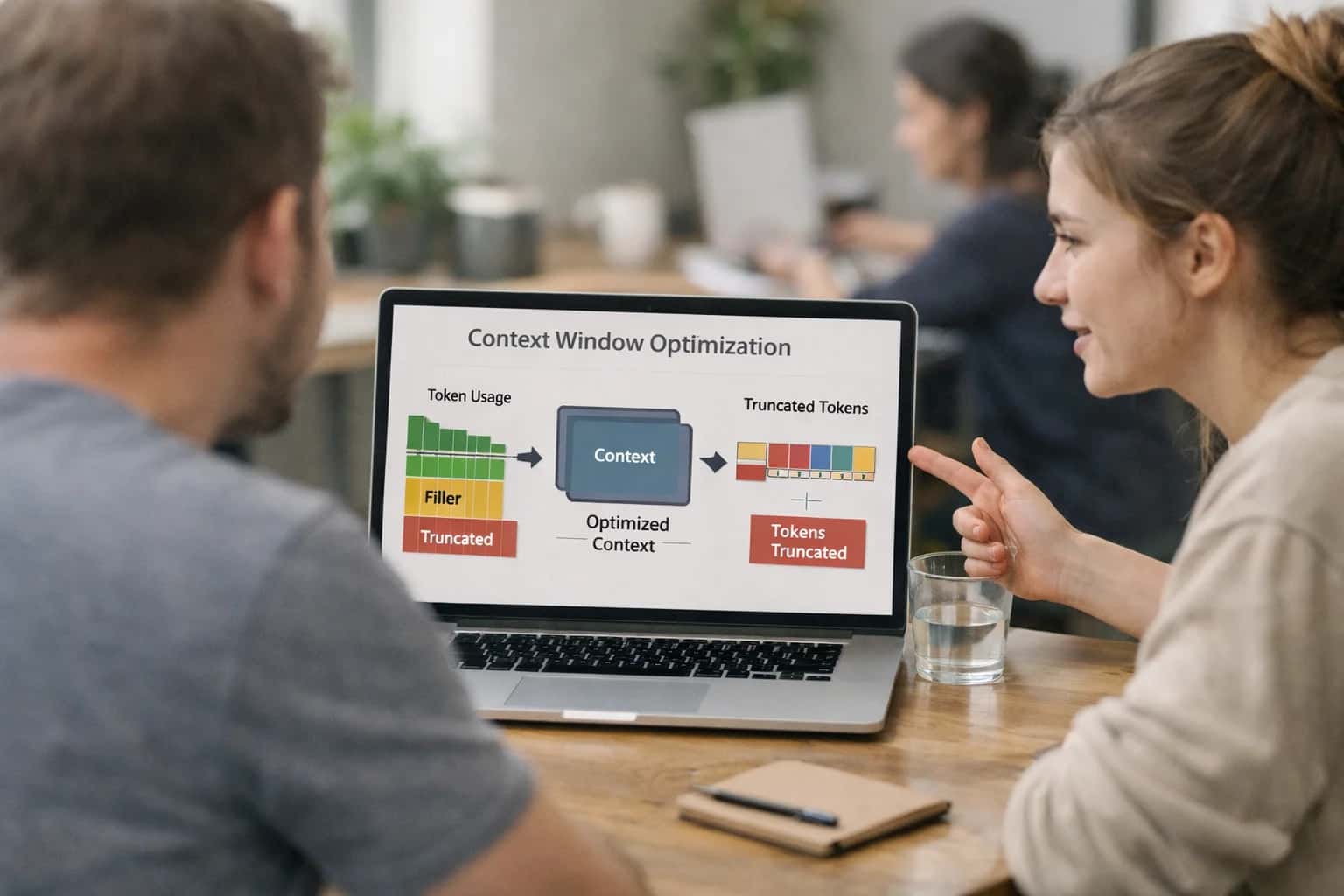
MAXIMUM INPUT LENGTH
What is Context Window?
The context window defines the upper limit of text a model can process in a single pass, directly impacting its ability to maintain coherence over long documents.
Exceeding the context window forces truncation of earlier text, causing the model to 'forget' initial instructions or facts. This quadratic complexity bottleneck makes large windows computationally expensive, driving research into sparse attention and KV cache optimization to extend effective memory without prohibitive cost.
FUNDAMENTAL CONSTRAINTS
Key Characteristics of Context Windows
The context window defines the maximum token capacity a model can attend to, directly impacting its ability to process long documents, maintain conversational history, and perform complex reasoning over extended text.
01
Token Capacity & Limits
The context window is measured in tokens, not words or characters. A token is roughly 0.75 words in English. A model with a 128K context window can process approximately 96,000 words in a single forward pass. Exceeding this limit requires chunking strategies or summarization, as tokens beyond the window are simply ignored by the attention mechanism.
128K tokens
GPT-4 Turbo context
1M tokens
Gemini 1.5 Pro context
02
Quadratic Complexity Bottleneck
The computational cost of self-attention scales quadratically with sequence length. Doubling the context window quadruples the memory and compute required for the attention score matrix. This is why extremely long context windows require architectural innovations like sparse attention, FlashAttention, or state-space models to remain computationally feasible.
03
Positional Encoding Dependency
Since self-attention is permutation-invariant, models rely on positional encodings to understand token order. Context window extensions require positional encoding schemes that can generalize beyond their training length. Rotary Position Embedding (RoPE) with interpolation techniques like NTK-aware scaling allows models to extrapolate to longer sequences than those seen during training.
05
KV Cache Memory Trade-off
During autoregressive generation, the Key-Value (KV) cache stores attention states for all previous tokens to avoid recomputation. The cache size grows linearly with context length and batch size. For a 70B parameter model with a 128K context, the KV cache can consume over 100GB of GPU memory, making it the dominant bottleneck for long-context inference.
100GB+
KV cache for 128K context
06
Effective vs. Advertised Context
A model's advertised context window often exceeds its effective context. Needle-in-a-Haystack evaluations reveal that many models fail to reliably retrieve information distributed across the full advertised length. True long-context capability requires both architectural support and training on long sequences, not just positional interpolation at inference time.
TOKEN CAPACITY BENCHMARK
Context Window Size Comparison Across Models
A comparison of the maximum context window sizes (in tokens) supported by prominent large language model families, illustrating the rapid expansion of sequence length capabilities in recent architectures.
| Model Family | Max Context Window | Attention Mechanism | Year Introduced |
|---|---|---|---|
GPT-3 (OpenAI) | 2,049 tokens | Sparse Attention | 2020 |
GPT-3.5-Turbo (OpenAI) | 4,096 tokens | Multi-Head Attention | 2022 |
Claude 1 (Anthropic) | 9,000 tokens | Sparse Attention | 2023 |
GPT-4 (OpenAI) | 8,192 tokens | Multi-Head Attention | 2023 |
Claude 2 (Anthropic) | 100,000 tokens | Sparse Attention | 2023 |
GPT-4 Turbo (OpenAI) | 128,000 tokens | Multi-Head Attention | 2023 |
Claude 3 (Anthropic) | 200,000 tokens | Sparse Attention | 2024 |
Gemini 1.5 Pro (Google) | 1,000,000 tokens | Mixture-of-Experts with Hybrid Attention | 2024 |
CONTEXT WINDOW
Frequently Asked Questions
Clear, technical answers to the most common questions about the context window—the maximum token limit that defines a language model's working memory in a single forward pass.
A context window is the maximum number of tokens a language model can process in a single forward pass, defining the upper limit of text it can attend to for generating a response. It functions as the model's working memory, encompassing both the input prompt and the generated output. The mechanism relies on the self-attention operation, where each token computes its representation by attending to all other tokens within this fixed-size window. If the total token count exceeds the window, the model loses visibility of the earliest tokens, a phenomenon often called the recency bias. Architecturally, the window size is determined during pre-training by the positional encoding scheme and the quadratic memory complexity of the attention score matrix.
Enabling Efficiency, Speed & Accuracy
Intelligent Analysis, Decision & Execution
We build AI systems for teams that need search across company data, workflow automation across tools, or AI features inside products and internal software.
Talk to Us
Search across company data
Give teams answers from docs, tickets, runbooks, and product data with sources and permissions.
Useful when people spend too long searching or get different answers from different systems.
Enterprise searchRAGPermissions
Read more
Automate internal workflows
Use AI to route work, draft outputs, trigger actions, and keep approvals and logs in place.
Useful when repetitive work moves across multiple tools and teams.
AI agentsWorkflow automationGovernance
Read more
Add AI to products and internal tools
Build assistants, guided actions, or decision support into the software your team or customers already use.
Useful when AI needs to be part of the product, not a separate tool.
AI integrationDecision supportModel routing
Read more
About the author
Prasad Kumkar
CEO & MD, Inference Systems
Prasad Kumkar is the CEO & MD of Inference Systems and writes about AI systems architecture, LLM infrastructure, model serving, evaluation, and production deployment. Over 5+ years, he has worked across computer vision models, L5 autonomous vehicle systems, and LLM research, with a focus on taking complex AI ideas into real-world engineering systems.
His work and writing cover AI systems, large language models, AI agents, multimodal systems, autonomous systems, inference optimization, RAG, evaluation, and production AI engineering.
LinkedIn
Limited slotsGet a Free AI Consultation
Partnered with leading AI, data, and software stack.





How We Work
Custom AI workflows for your Business
One-fit-all AI don't work for modern businesses. At Inferensys, we aim to understand your business & custom requirements; which we use to define most efficient agentic workflows, the data, and the tools for your business.
01
Review the use case
We understand the task, the users, and where AI can actually help.
Read more02
Pick the right approach
We define what needs search, automation, or product integration.
Read more03
Build the first useful version
We implement the part that proves the value first.
Read more04
Improve from there
We add the checks and visibility needed to keep it useful.
Read moreThe first call is a practical review of your use case and the right next step.
Talk to Us