An immutable audit log is a write-once, read-many (WORM) data structure that cryptographically guarantees the integrity of every recorded event. Unlike standard logs that can be modified by administrators, each entry is hashed and chained to the previous record, making retroactive alteration computationally infeasible. This provides a definitive chain of custody for tracking how third-party foundation models access proprietary data.

Glossary
Immutable Audit Log
A chronological record of system events that cannot be altered or deleted, providing tamper-proof evidence for compliance investigations and security forensics.
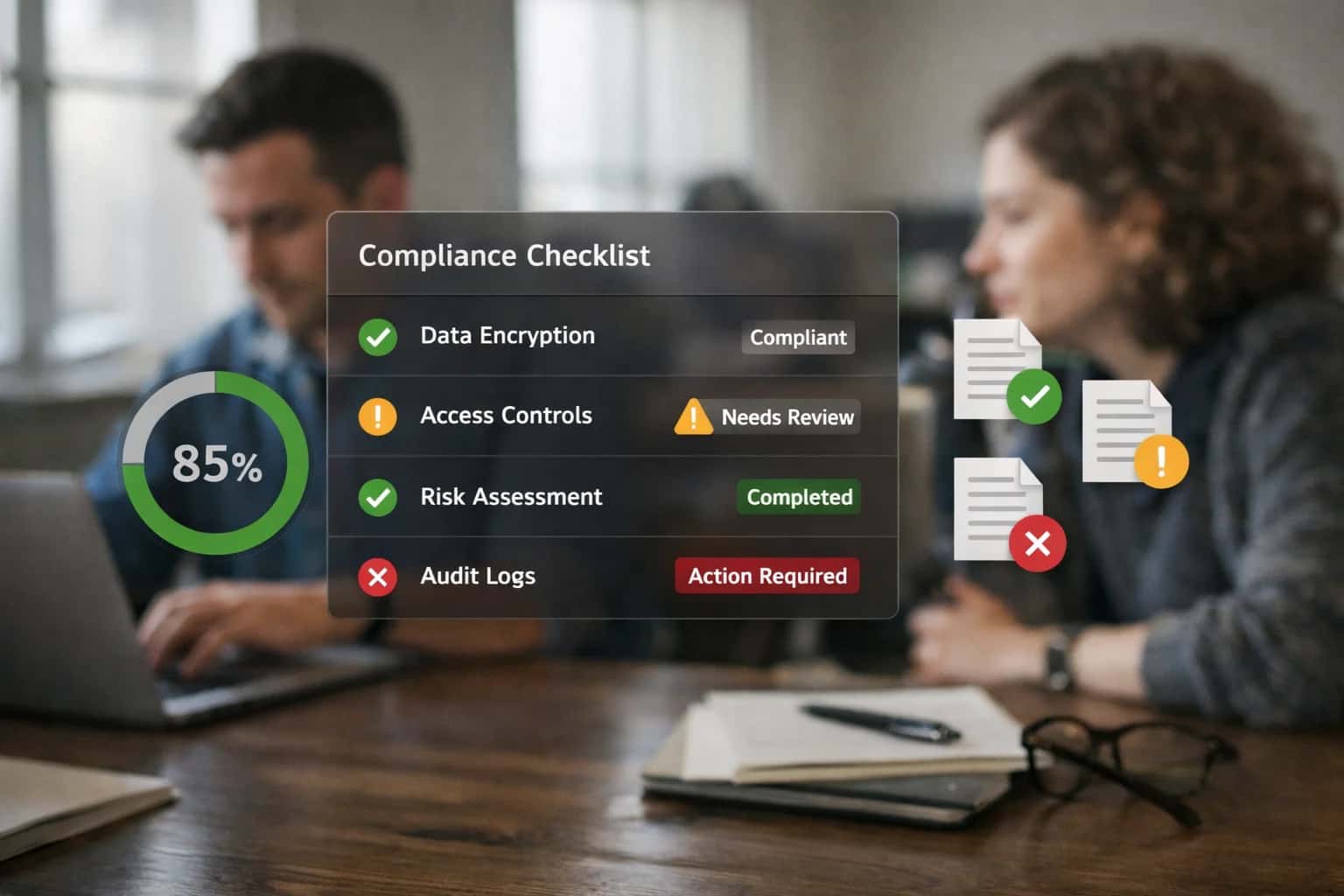
TAMPER-PROOF RECORD
What is Immutable Audit Log?
An immutable audit log is a chronological record of system events that cannot be altered, deleted, or overwritten, providing tamper-proof evidence for compliance investigations and security forensics.
In the context of data sovereignty enforcement, these logs capture every retrieval event, including the agent's identity, the exact data accessed, and the jurisdictional location of the processing node. By integrating with compliance-as-code frameworks, the system automatically generates non-repudiable evidence required for Transfer Impact Assessments (TIAs) and regulatory audits, proving that data never left authorized geographic boundaries.
TAMPER-PROOF COMPLIANCE
Key Features of Immutable Audit Logs
Immutable audit logs provide a cryptographically verifiable and unalterable record of all system events, ensuring forensic integrity for regulatory investigations and zero-trust architectures.
02
Cryptographic Chaining (Merkle Trees)
Each log entry contains a cryptographic hash of the previous entry, forming a Merkle tree structure. Any alteration to a single record invalidates the hash chain, making tampering immediately evident.
- Hash Function: Typically SHA-256 or SHA-3, generating a fixed-size digest of the log data.
- Root Hash: A single hash representing the entire state of the log, which can be published to a public blockchain for non-repudiation.
- Verification: Auditors can re-compute the chain to prove no records have been inserted, deleted, or modified retroactively.
03
Append-Only Data Structures
The log is implemented as an append-only ledger, where new events are added sequentially but existing records are never modified. This is distinct from a standard database which supports UPDATE and DELETE operations.
- Event Sourcing: The log becomes the single source of truth; the current state of a system is derived by replaying the log.
- Conflict Resolution: In distributed systems, the append-only log provides a total order of events, resolving conflicts deterministically.
- Kafka/Distributed Logs: Technologies like Apache Kafka use this paradigm for high-throughput, durable event streaming.
04
Granular, Attribute-Based Access
Strict Attribute-Based Access Control (ABAC) policies govern who can read logs, ensuring separation of duties. No single actor should have both write access to a system and delete access to its logs.
- IAM Policies: Cloud-native policies restrict
logs:DeleteLogGrouporstorage.objects.deleteto a distinct, highly audited security account. - Just-in-Time Access: Temporary, elevated credentials are granted for specific forensic investigations and automatically expire.
- Break-Glass Procedures: Emergency access protocols that trigger immediate, high-severity alerts to security operations centers.
05
Real-Time Integrity Monitoring
Automated systems continuously scan the log stream to detect integrity violations and anomalous access patterns, triggering alerts before compliance reports are generated.
- File Integrity Monitoring (FIM): Agents detect changes to log file checksums at the OS level.
- SIEM Integration: Logs are streamed to a Security Information and Event Management system for correlation with other security telemetry.
- Canary Records: Decoy log entries are inserted; if they are ever accessed or modified, it signals a breach of the audit system itself.
06
Verifiable Timestamping
Each event is bound to a trusted, non-repudiable timestamp from a third-party Time Stamping Authority (TSA) using protocols like RFC 3161. This proves data existed at a specific point in time and has not been backdated.
- NTP/PTP Synchronization: All system clocks are synchronized to a highly accurate stratum-1 time source.
- Timestamp Tokens: A cryptographic signature from the TSA binds the log entry's hash to the official time.
- Legal Admissibility: A verified timestamp chain is critical for proving the sequence of events in a court of law.
IMMUTABLE AUDIT LOGS
Frequently Asked Questions
Explore the foundational concepts behind tamper-proof logging systems that provide irrefutable evidence for compliance, security investigations, and AI data sovereignty enforcement.
An immutable audit log is a chronological record of system events that cannot be altered, deleted, or tampered with after creation, providing tamper-proof evidence for compliance investigations. Unlike traditional logs that can be modified by administrators, immutable logs use write-once, read-many (WORM) storage architectures. The mechanism relies on cryptographic chaining—each new log entry contains a hash of the previous entry, creating a Merkle tree structure. Any attempt to modify a historical entry would break the hash chain, immediately alerting security teams. In AI data sovereignty contexts, these logs capture every access event where a third-party model ingests proprietary data, creating an unalterable chain of custody for regulatory audits under frameworks like GDPR and the EU AI Act.
COMPLIANCE & FORENSIC COMPARISON
Immutable Audit Log vs. Standard Logging
A technical comparison of tamper-proof logging architectures versus conventional logging systems for regulatory compliance and security investigations.
| Feature | Immutable Audit Log | Standard Logging |
|---|---|---|
Tamper Resistance | ||
Deletion Capability | ||
Modification After Write | ||
Cryptographic Verification | ||
Chain of Custody Integrity | ||
Regulatory Admissibility | High (prima facie evidence) | Conditional (requires corroboration) |
Storage Overhead | Higher (WORM media, hashing) | Lower (standard disk I/O) |
Typical Retention Enforcement | Policy-locked, automated | Manual, override possible |
Enabling Efficiency, Speed & Accuracy
Intelligent Analysis, Decision & Execution
We build AI systems for teams that need search across company data, workflow automation across tools, or AI features inside products and internal software.
Talk to Us
Search across company data
Give teams answers from docs, tickets, runbooks, and product data with sources and permissions.
Useful when people spend too long searching or get different answers from different systems.
Enterprise searchRAGPermissions
Read more
Automate internal workflows
Use AI to route work, draft outputs, trigger actions, and keep approvals and logs in place.
Useful when repetitive work moves across multiple tools and teams.
AI agentsWorkflow automationGovernance
Read more
Add AI to products and internal tools
Build assistants, guided actions, or decision support into the software your team or customers already use.
Useful when AI needs to be part of the product, not a separate tool.
AI integrationDecision supportModel routing
Read more
About the author
Prasad Kumkar
CEO & MD, Inference Systems
Prasad Kumkar is the CEO & MD of Inference Systems and writes about AI systems architecture, LLM infrastructure, model serving, evaluation, and production deployment. Over 5+ years, he has worked across computer vision models, L5 autonomous vehicle systems, and LLM research, with a focus on taking complex AI ideas into real-world engineering systems.
His work and writing cover AI systems, large language models, AI agents, multimodal systems, autonomous systems, inference optimization, RAG, evaluation, and production AI engineering.
LinkedIn
Limited slotsGet a Free AI Consultation
Partnered with leading AI, data, and software stack.





How We Work
Custom AI workflows for your Business
One-fit-all AI don't work for modern businesses. At Inferensys, we aim to understand your business & custom requirements; which we use to define most efficient agentic workflows, the data, and the tools for your business.
01
Review the use case
We understand the task, the users, and where AI can actually help.
Read more02
Pick the right approach
We define what needs search, automation, or product integration.
Read more03
Build the first useful version
We implement the part that proves the value first.
Read more04
Improve from there
We add the checks and visibility needed to keep it useful.
Read moreThe first call is a practical review of your use case and the right next step.
Talk to Us