An indemnification clause is a contractual provision in AI service agreements where the model provider assumes legal and financial liability for third-party copyright infringement claims arising from the customer's authorized use of the provider's generative outputs. This mechanism contractually shifts the risk of an infringement lawsuit from the enterprise user to the AI developer, provided the user has not misused the service or combined outputs with infringing materials.

Glossary
Indemnification Clause
A contractual provision in AI service agreements where the model provider assumes liability for copyright infringement claims resulting from the use of their generative outputs.
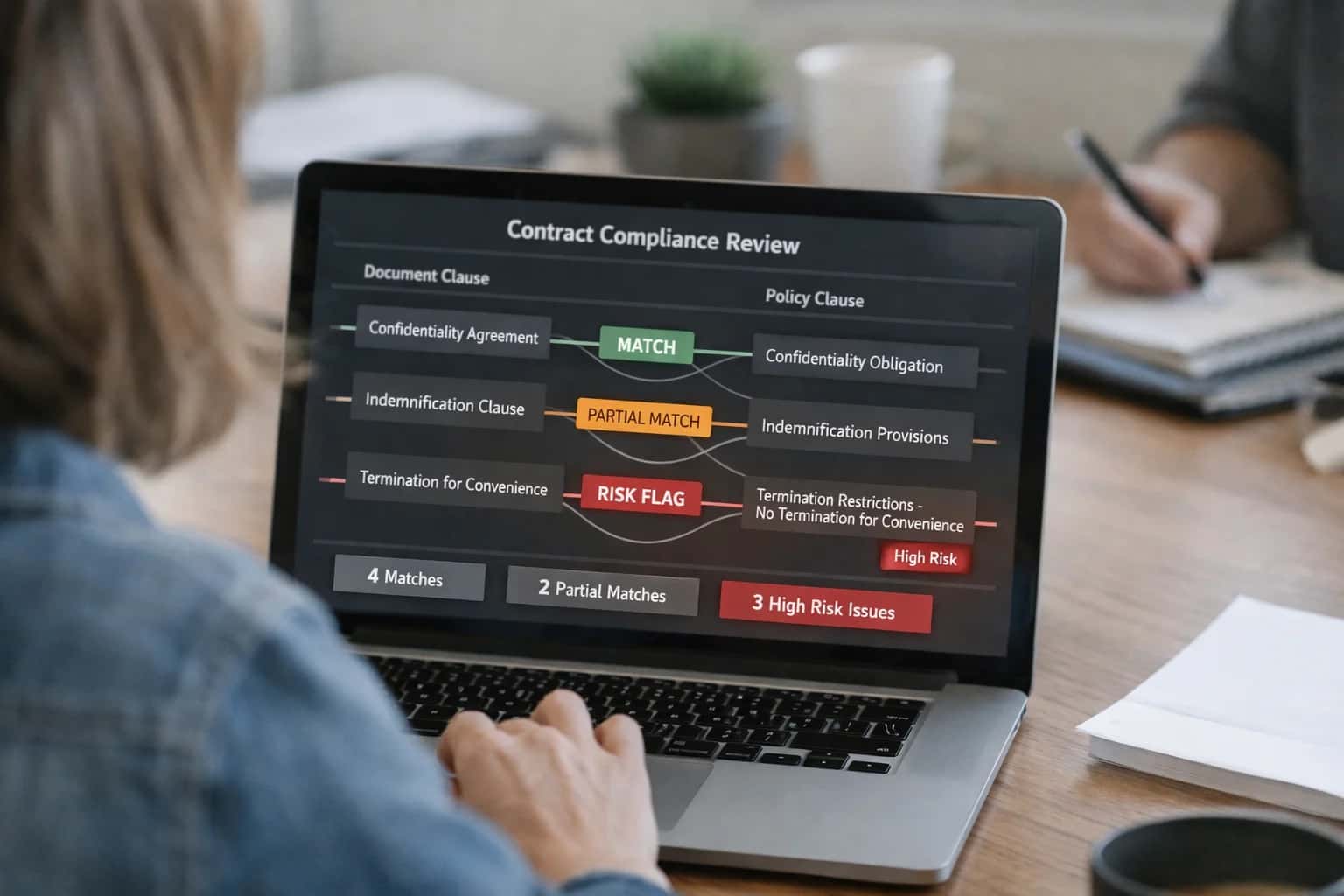
CONTRACTUAL RISK TRANSFER
What is an Indemnification Clause?
A contractual provision in AI service agreements where the model provider assumes liability for copyright infringement claims resulting from the use of their generative outputs.
The scope of these clauses is often tightly scoped to outputs from specific, unmodified models and typically excludes claims arising from fine-tuned models, customer-provided prompts containing copyrighted material, or outputs used in high-risk commercial contexts. Legal teams scrutinize the clause's exclusions, the provider's financial capacity to satisfy a judgment, and whether the remedy is limited to defense costs or includes full damages and algorithmic disgorgement.
CONTRACTUAL RISK TRANSFER
Key Features of an AI Indemnification Clause
An indemnification clause in an AI service agreement shifts liability for third-party claims—primarily copyright infringement—from the enterprise customer to the model provider. These provisions define the scope of covered claims, the provider's defense obligations, and critical exclusions that legal teams must scrutinize.
01
Scope of Covered Claims
Defines the specific third-party legal actions the provider will defend and settle. A strong clause explicitly covers copyright infringement claims arising from the use of the model's generative outputs as intended. Weaker clauses may limit coverage to claims alleging the model's training data infringed copyright, excluding claims about the output itself. Scrutinize whether the clause covers trademark dilution, trade secret misappropriation, or right of publicity violations if those risks are material to your use case.
02
Defense and Control Obligations
Specifies who controls the litigation strategy. A robust clause mandates that the provider assumes the defense and has the right to select counsel. Critically, it should require the provider to keep the customer informed and obtain consent before entering into any settlement that admits fault or imposes non-monetary obligations on the customer. Without this, a provider could settle a claim by agreeing to an injunction that halts the customer's use of the service.
03
Mitigation and Cure Provisions
Outlines the provider's obligations upon receiving a claim. Standard remedies include:
- Modifying the service to make it non-infringing without materially degrading functionality.
- Procuring a license for the allegedly infringing content or technology.
- Terminating the service and refunding prepaid fees as a last resort. Evaluate whether the provider can unilaterally degrade or discontinue a mission-critical service to satisfy a minor claim.
04
Critical Exclusions and Carve-Outs
Identifies scenarios where the provider's indemnity obligation is voided. Common exclusions include claims arising from:
- Customer modifications to the model's outputs.
- Combination of the output with non-provider products or data.
- Use in prohibited high-risk domains explicitly forbidden in the acceptable use policy.
- Failure to use available filtering or citation tools provided by the vendor.
- Willful infringement by the customer despite knowledge of the risk. These carve-outs place a direct operational burden on the customer's engineering and compliance teams.
05
IP Infringement Safe Harbors
Some providers offer a copyright shield or IP indemnity as a standalone program, separate from the master service agreement. These programs often cap liability at a specific dollar amount and require the customer to use specific citation filters or output provenance tools. Verify whether the safe harbor is a contractual right or a revocable marketing policy. A contractual right is enforceable; a policy can be changed unilaterally.
06
Financial Caps and Insurance
Examines the monetary limits of the indemnity. The clause should specify whether the indemnity is subject to the agreement's general liability cap or a super-cap (a higher, dedicated limit). For enterprise customers, a super-cap is essential, as copyright statutory damages can reach $150,000 per work infringed. Confirm the provider carries cyber insurance that explicitly covers copyright infringement claims arising from generative AI, and request to be named as an additional insured if possible.
INDEMNIFICATION CLAUSE
Frequently Asked Questions
Clear answers to the most common legal and technical questions surrounding AI service provider indemnification against copyright infringement claims.
An indemnification clause is a contractual provision where the AI model provider agrees to assume legal liability and cover the costs—including settlements, judgments, and attorney's fees—arising from third-party copyright infringement claims against the enterprise customer for using the provider's generative outputs. This clause effectively shifts the financial risk of an infringement lawsuit from the user to the model creator. These provisions are a direct response to the legal uncertainty surrounding the fair use doctrine and the ingestion of copyrighted material into training data. The scope typically covers outputs generated by the service, but exclusions often apply if the customer intentionally prompts the model to reproduce infringing content or uses outputs in a manner that violates the provider's acceptable use policy.
Enabling Efficiency, Speed & Accuracy
Intelligent Analysis, Decision & Execution
We build AI systems for teams that need search across company data, workflow automation across tools, or AI features inside products and internal software.
Talk to Us
Search across company data
Give teams answers from docs, tickets, runbooks, and product data with sources and permissions.
Useful when people spend too long searching or get different answers from different systems.
Enterprise searchRAGPermissions
Read more
Automate internal workflows
Use AI to route work, draft outputs, trigger actions, and keep approvals and logs in place.
Useful when repetitive work moves across multiple tools and teams.
AI agentsWorkflow automationGovernance
Read more
Add AI to products and internal tools
Build assistants, guided actions, or decision support into the software your team or customers already use.
Useful when AI needs to be part of the product, not a separate tool.
AI integrationDecision supportModel routing
Read more
About the author
Prasad Kumkar
CEO & MD, Inference Systems
Prasad Kumkar is the CEO & MD of Inference Systems and writes about AI systems architecture, LLM infrastructure, model serving, evaluation, and production deployment. Over 5+ years, he has worked across computer vision models, L5 autonomous vehicle systems, and LLM research, with a focus on taking complex AI ideas into real-world engineering systems.
His work and writing cover AI systems, large language models, AI agents, multimodal systems, autonomous systems, inference optimization, RAG, evaluation, and production AI engineering.
LinkedIn
Limited slotsGet a Free AI Consultation
Partnered with leading AI, data, and software stack.





How We Work
Custom AI workflows for your Business
One-fit-all AI don't work for modern businesses. At Inferensys, we aim to understand your business & custom requirements; which we use to define most efficient agentic workflows, the data, and the tools for your business.
01
Review the use case
We understand the task, the users, and where AI can actually help.
Read more02
Pick the right approach
We define what needs search, automation, or product integration.
Read more03
Build the first useful version
We implement the part that proves the value first.
Read more04
Improve from there
We add the checks and visibility needed to keep it useful.
Read moreThe first call is a practical review of your use case and the right next step.
Talk to Us