A data retention policy is an organization's established protocol for retaining information for operational or regulatory compliance needs, defining the lifecycle of audit logs from active storage to secure destruction. It balances legal requirements, storage costs, and privacy principles by specifying exact durations for different data classes before triggering automated deletion or anonymization.

Glossary
Data Retention Policy
An organization's established protocol for retaining information for operational or regulatory compliance needs, defining the lifecycle of audit logs from active storage to secure destruction.
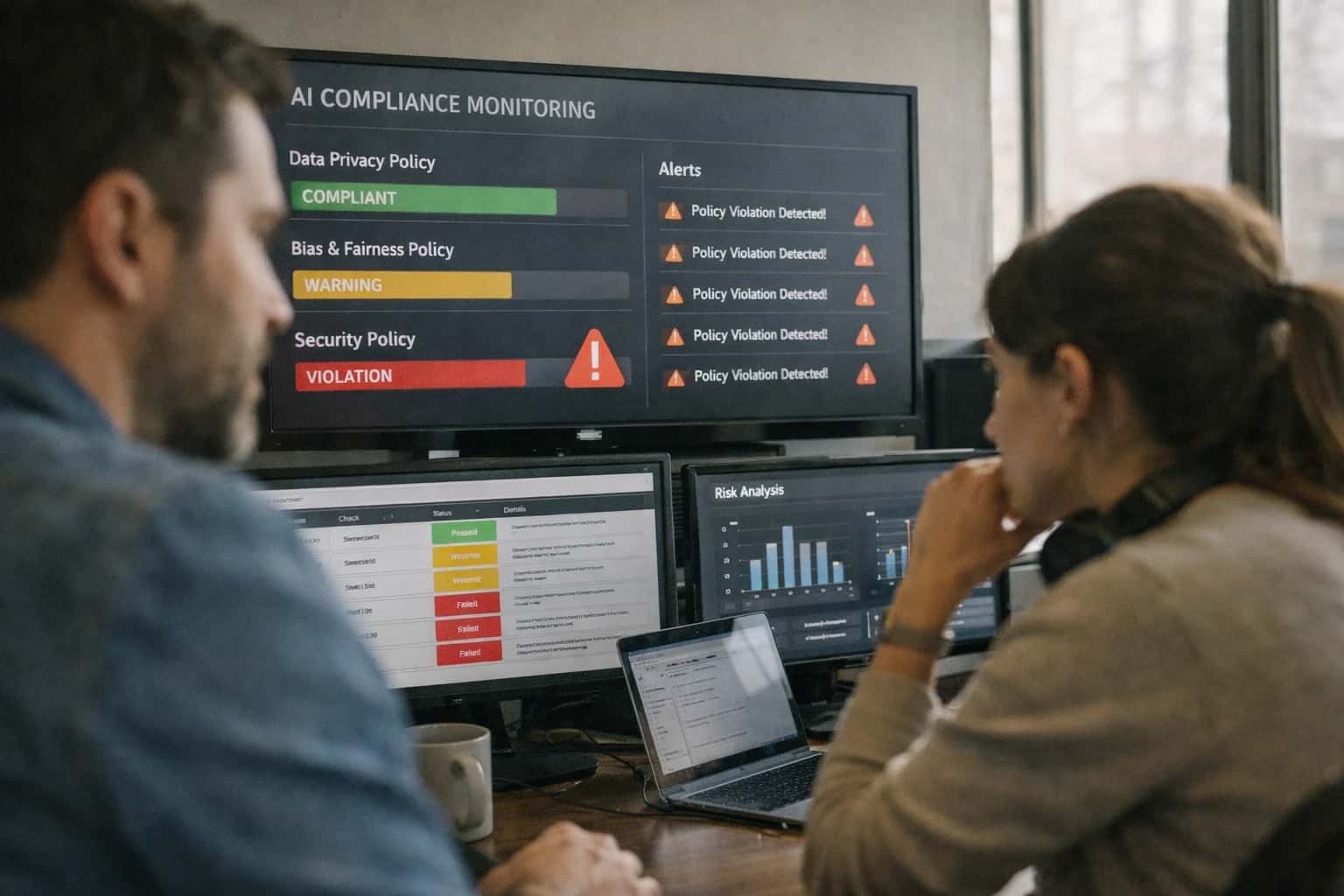
LIFECYCLE GOVERNANCE
What is a Data Retention Policy?
A formal protocol dictating how long audit records are kept and when they are securely destroyed.
In AI audit logging, the policy must reconcile the need for long-term forensic evidence with data minimization mandates. It governs the transition of logs from high-performance, queryable storage to cold archives, and ultimately to cryptographic erasure, ensuring that expired data is rendered irrecoverable to maintain compliance with frameworks like GDPR and SOC 2.
DATA RETENTION POLICY
Core Components of an AI Audit Retention Policy
A data retention policy defines the lifecycle of audit logs from active storage to secure destruction, balancing operational needs with regulatory compliance. These core components ensure your policy is defensible, automated, and aligned with privacy principles.
01
Retention Period Definition
The specific duration for which different classes of audit logs must be preserved. This is driven by regulatory mandates, business needs, and legal risk.
- Regulatory Mapping: Align periods with specific laws (e.g., GDPR's storage limitation, HIPAA's 6-year requirement, SOC 2's 90-day minimum).
- Data Classification: Tie retention to data sensitivity. Model access logs containing PII may have shorter lifespans than system-level security events.
- Granularity: Define periods per log type, not a single blanket rule. A chain of custody log may be kept longer than a performance metric.
02
Storage Tiering Strategy
A multi-layered storage architecture that balances access speed with cost efficiency over the log's lifecycle.
- Hot Storage: Real-time indexed logs (e.g., Elasticsearch) for immediate continuous auditing and alerting. Retention: days to weeks.
- Warm Storage: Searchable object stores (e.g., S3) for periodic analysis and e-discovery. Retention: months to a year.
- Cold Storage: Immutable archives (e.g., AWS Glacier, tape) for long-term compliance. Access latency is high, but cost is minimal. Often uses WORM technology.
03
Secure Destruction Protocols
The verifiable process of permanently deleting logs once their retention period expires, ensuring data minimization.
- Cryptographic Erasure: Destroy the encryption keys for a specific dataset, rendering it irrecoverable without needing to overwrite every bit.
- Physical Destruction: For end-of-life cold storage media, use degaussing or shredding.
- Certificate of Destruction: Generate a cryptographically signed, time-stamped record proving the deletion occurred, maintaining non-repudiation for the destruction event itself.
04
Legal Hold Management
A mechanism to suspend the normal retention and destruction policy for specific logs when litigation or an investigation is reasonably anticipated.
- Automated Flagging: Integrate with legal systems to apply holds via metadata tags, not manual file copies.
- Immutability Override: A legal hold must prevent any automated deletion job from removing the targeted immutable audit trail entries.
- Chain of Custody Preservation: The hold process itself must be logged, documenting who initiated it, the scope, and the authorization, to withstand judicial scrutiny.
05
Policy Automation & Compliance as Code
Implementing the retention policy through automated scripts and infrastructure-as-code, not manual runbooks.
- Lifecycle Policies: Use cloud-native lifecycle rules to automatically transition logs between storage tiers and trigger deletion.
- Policy as Code: Define retention rules in version-controlled files (e.g., Open Policy Agent) that are tested and deployed via CI/CD pipelines.
- Drift Detection: Continuously monitor configurations to ensure no bucket or database has been manually modified to violate the codified policy, a core tenet of compliance as code.
06
Privacy-Enhancing Technologies
Techniques applied to retained logs to enable analysis while protecting sensitive personal data.
- Data Masking: Apply static or dynamic masking to fields like IP addresses or user IDs in warm storage copies used for analytics.
- Differential Privacy: Inject calibrated noise into aggregate queries run against audit logs, ensuring individual user behavior cannot be re-identified.
- Pseudonymization: Replace direct identifiers with pseudonyms, storing the mapping key separately with a stricter retention policy and tighter access control.
DATA RETENTION POLICY
Frequently Asked Questions
Clear answers to the most common questions about establishing, enforcing, and auditing data retention policies for AI audit logs and model access records.
A data retention policy is an organization's established protocol for retaining information for operational or regulatory compliance needs, defining the lifecycle of audit logs from active storage to secure destruction. In the context of AI audit logging, this policy dictates exactly how long model access logs, inference records, and immutable audit trails must be preserved before they are eligible for deletion. The policy is critical because it balances two competing demands: the legal requirement to maintain forensic evidence for investigations and e-discovery against the operational cost and privacy risk of hoarding data indefinitely. A well-defined policy specifies distinct retention periods for different data classes—for example, retaining raw structured logging events in hot storage for 90 days for real-time SIEM analysis, while archiving tamper-evident WORM copies for seven years to satisfy regulatory mandates. Without a codified policy, organizations face uncontrolled storage costs, increased exposure during litigation, and non-compliance with frameworks like GDPR's storage limitation principle.
SCOPE AND FUNCTION
Retention Policy vs. Log Lifecycle Management
Distinguishing the governance mandate from the operational mechanics of audit log data
| Feature | Data Retention Policy | Log Lifecycle Management | Continuous Auditing |
|---|---|---|---|
Primary Focus | Legal and compliance mandate | Operational data handling | Real-time control verification |
Defines | How long logs must be kept | How logs are rotated, archived, and deleted | Frequency of policy adherence checks |
Key Driver | Regulatory requirements (GDPR, SOC 2) | Storage cost and system performance | Risk mitigation and anomaly detection |
Ownership | Data Governance Officer / Legal | Platform Engineering / DevOps | IT Audit / Security Operations |
Immutability Enforcement | |||
Automated Deletion | |||
Typical Time Horizon | 7-10 years for legal hold | 30-90 days hot, 1-7 years cold | Sub-second to hourly intervals |
Output Artifact | Policy document and retention schedule | Archived WORM volumes and deletion certificates | Compliance dashboards and alerts |
Enabling Efficiency, Speed & Accuracy
Intelligent Analysis, Decision & Execution
We build AI systems for teams that need search across company data, workflow automation across tools, or AI features inside products and internal software.
Talk to Us
Search across company data
Give teams answers from docs, tickets, runbooks, and product data with sources and permissions.
Useful when people spend too long searching or get different answers from different systems.
Enterprise searchRAGPermissions
Read more
Automate internal workflows
Use AI to route work, draft outputs, trigger actions, and keep approvals and logs in place.
Useful when repetitive work moves across multiple tools and teams.
AI agentsWorkflow automationGovernance
Read more
Add AI to products and internal tools
Build assistants, guided actions, or decision support into the software your team or customers already use.
Useful when AI needs to be part of the product, not a separate tool.
AI integrationDecision supportModel routing
Read more
About the author
Prasad Kumkar
CEO & MD, Inference Systems
Prasad Kumkar is the CEO & MD of Inference Systems and writes about AI systems architecture, LLM infrastructure, model serving, evaluation, and production deployment. Over 5+ years, he has worked across computer vision models, L5 autonomous vehicle systems, and LLM research, with a focus on taking complex AI ideas into real-world engineering systems.
His work and writing cover AI systems, large language models, AI agents, multimodal systems, autonomous systems, inference optimization, RAG, evaluation, and production AI engineering.
LinkedIn
Limited slotsGet a Free AI Consultation
Partnered with leading AI, data, and software stack.





How We Work
Custom AI workflows for your Business
One-fit-all AI don't work for modern businesses. At Inferensys, we aim to understand your business & custom requirements; which we use to define most efficient agentic workflows, the data, and the tools for your business.
01
Review the use case
We understand the task, the users, and where AI can actually help.
Read more02
Pick the right approach
We define what needs search, automation, or product integration.
Read more03
Build the first useful version
We implement the part that proves the value first.
Read more04
Improve from there
We add the checks and visibility needed to keep it useful.
Read moreThe first call is a practical review of your use case and the right next step.
Talk to Us