Compliance as Code translates manual audit controls and regulatory requirements into executable scripts and version-controlled policy definitions. By codifying standards like SOC 2 or HIPAA, organizations replace periodic manual reviews with continuous, automated checks that run alongside application code in CI/CD pipelines, ensuring that infrastructure provisioning and application deployments are non-compliant by default unless proven otherwise.

Glossary
Compliance as Code
The practice of defining regulatory and security policies in a machine-readable format that can be automatically tested and enforced within the software development lifecycle, ensuring audit configurations meet standards like SOC 2.
AUTOMATED GOVERNANCE
What is Compliance as Code?
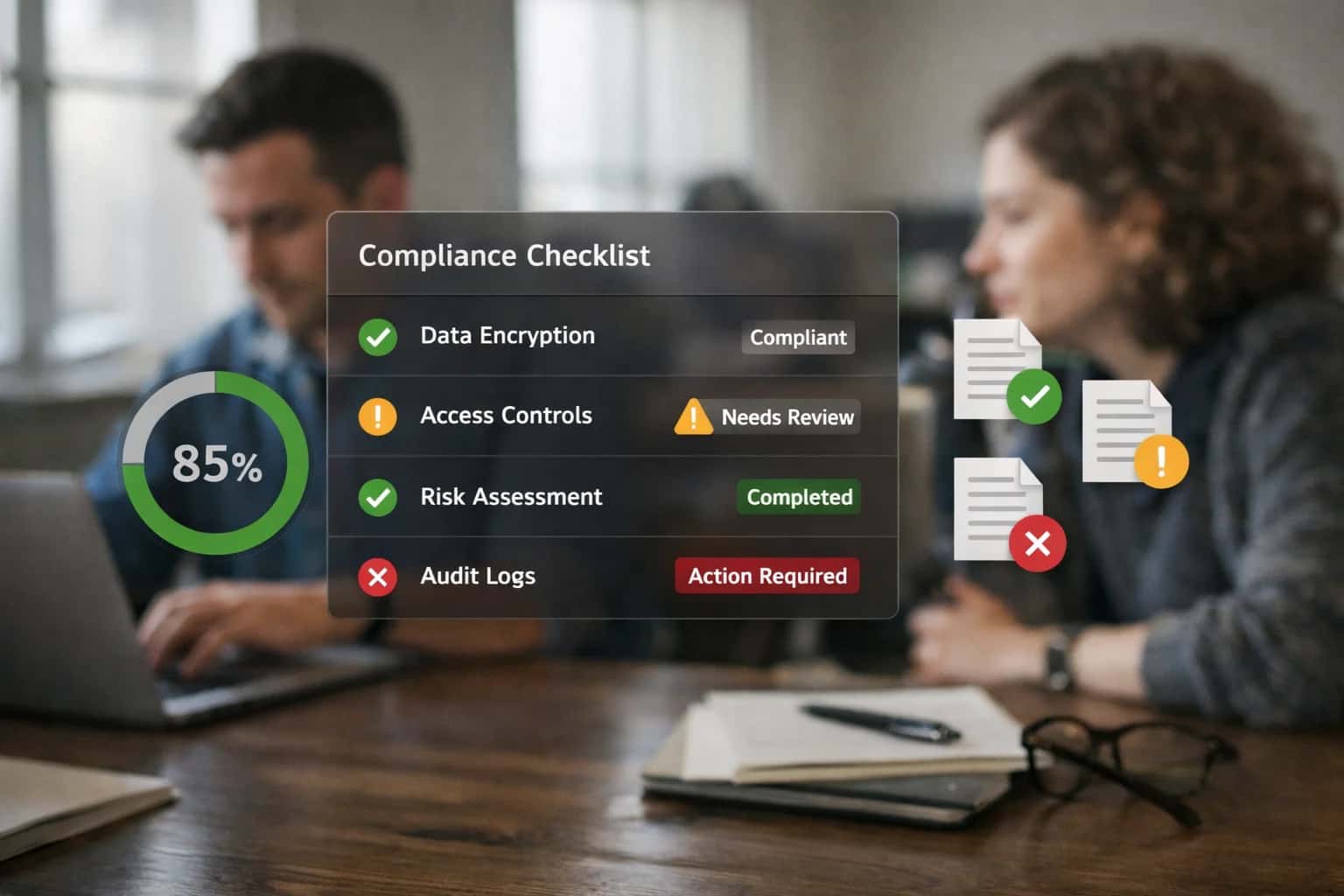
Compliance as Code is the methodology of defining regulatory and security policies in a machine-readable format that can be automatically tested, validated, and enforced within the software development lifecycle.
This practice leverages tools like Open Policy Agent and InSpec to create a single source of truth for governance. It bridges the gap between security auditors and DevOps engineers by providing immediate, automated feedback on configuration drift, access control violations, and encryption standards, effectively turning compliance from a bottleneck into a real-time engineering function.
AUTOMATED GOVERNANCE
Core Characteristics of Compliance as Code
Compliance as Code transforms static policy documents into executable, testable artifacts that integrate directly into CI/CD pipelines, ensuring continuous verification against regulatory standards.
01
Policy as Machine-Readable Artifacts
Regulatory requirements are codified into declarative configuration files using languages like Open Policy Agent's Rego or HashiCorp Sentinel. These artifacts define the desired state of compliance, replacing ambiguous human-readable documents with precise, executable logic.
- Policies are stored in version control alongside application code
- Changes undergo the same peer review and testing as software features
- Eliminates interpretation drift between auditors and engineers
02
Automated Testing and Validation
Compliance checks are executed as automated test suites within the build pipeline. Every commit triggers a battery of policy evaluations that verify configurations against standards like SOC 2, HIPAA, or ISO 27001 before deployment.
- Failed checks block the pipeline, preventing non-compliant releases
- Test results generate auditable evidence artifacts automatically
- Drift detection continuously monitors production against the declared policy state
03
Immutable Audit Evidence Generation
Each policy evaluation produces a cryptographically signed attestation containing the policy version, target resource, evaluation result, and timestamp. These artifacts are stored in append-only, tamper-evident storage for downstream auditor consumption.
- Integrates with WORM-compliant storage systems
- Enables continuous auditing rather than point-in-time sampling
- Provides non-repudiable proof of control effectiveness
04
Infrastructure as Code Integration
Compliance policies are embedded directly into Terraform, Pulumi, or CloudFormation templates, ensuring that provisioned infrastructure is compliant by default. Security groups, encryption settings, and access controls are defined as code parameters rather than manual console configurations.
- Prevents configuration drift between environments
- Enforces encryption-at-rest and encryption-in-transit by default
- Standardizes resource tagging for cost allocation and ownership tracking
05
Remediation as Code
Beyond detection, Compliance as Code defines automated remediation playbooks that execute corrective actions when drift is identified. A non-compliant S3 bucket policy, for example, triggers an automatic correction to enforce private access.
- Reduces mean time to remediation from days to seconds
- Playbooks are version-controlled and tested in staging environments
- Exception management workflows handle cases requiring human approval
06
Continuous Compliance Dashboards
Real-time visibility into the organization's compliance posture is provided through live dashboards that aggregate policy evaluation results across all environments. Stakeholders from engineering to executive leadership access a single source of truth.
- Heatmaps identify non-compliant resources by severity and environment
- Trend analysis tracks compliance drift over time
- API-accessible data integrates with GRC platforms for board reporting
COMPLIANCE AS CODE
Frequently Asked Questions
Explore the core concepts of defining and automating regulatory and security policies as machine-readable code, enabling continuous verification and enforcement within your software delivery pipelines.
Compliance as Code (CaC) is the practice of defining regulatory, security, and operational policies in a machine-readable, executable format that can be automatically tested, validated, and enforced within the software development lifecycle (SDLC). It transforms static, document-based compliance requirements into dynamic, programmable rules. This works by codifying controls—such as encryption standards, access restrictions, or audit log retention periods—into scripts, configuration files, or policy definitions using languages like Rego for Open Policy Agent (OPA) or HCL for Sentinel. These codified policies are then integrated into CI/CD pipelines, where they act as automated gates. For example, before a Terraform configuration is deployed, a CaC tool can automatically check if the defined storage bucket is private and reject the build if it violates a SOC 2 control, providing instant, auditable feedback to developers.
AUTOMATED GOVERNANCE
Real-World Compliance as Code Use Cases
Practical implementations where machine-readable policies automatically enforce regulatory standards across the software development lifecycle, eliminating manual audit bottlenecks.
01
Automated SOC 2 Control Validation
Organizations embed SOC 2 trust services criteria directly into CI/CD pipelines using policy-as-code frameworks. Open Policy Agent (OPA) rules automatically validate that infrastructure-as-code templates enforce encryption at rest, multi-factor authentication, and least-privilege access before deployment. A failed check blocks the merge request and generates an immutable audit artifact, proving the control was tested at the exact commit hash and timestamp.
100%
Control Test Coverage
< 2 min
Validation Latency
02
HIPAA-Compliant Infrastructure Provisioning
Healthcare platforms use Terraform Sentinel policies to codify HIPAA technical safeguards. Before any cloud resource is provisioned, the compliance engine verifies:
- Encryption in transit: TLS 1.2+ enforced on all load balancers
- Audit logging: AWS CloudTrail and VPC Flow Logs enabled with WORM storage
- Network segmentation: No public subnets for PHI-processing instances Non-compliant configurations are automatically rejected with a detailed remediation message.
03
GDPR Data Residency Enforcement
Multinational enterprises codify GDPR Article 44-49 transfer restrictions into Kubernetes admission controllers. A Kyverno policy inspects every pod scheduling request and rejects deployments targeting clusters outside approved EU data centers. The policy engine cross-references the cluster's geolocation metadata against a machine-readable data residency map, generating a cryptographically signed admission audit event for regulatory reporting.
04
PCI DSS Secret Rotation Automation
Financial services firms implement HashiCorp Vault policies that codify PCI DSS Requirement 3.6 for cryptographic key rotation. The policy engine automatically:
- Revokes API keys older than 90 days
- Rotates database credentials post-deployment
- Generates a tamper-evident rotation log with the key's fingerprint and rotation timestamp Any service attempting to use an expired secret is denied and the attempt is flagged for the security operations center.
05
FedRAMP Continuous Monitoring
Cloud service providers pursuing FedRAMP authorization deploy InSpec profiles that translate NIST SP 800-53 controls into executable compliance tests. These profiles run continuously against production environments, validating:
- Vulnerability scan frequency: Scans completed within mandated windows
- Patch latency: Critical patches applied within 30 days
- Configuration drift: No unauthorized changes to hardened baselines Results stream to a centralized dashboard, providing real-time Plan of Action and Milestones (POA&M) tracking.
06
ISO 27001 Supplier Risk Assessment
Procurement platforms codify ISO 27001 Annex A.15 supplier security requirements into machine-readable assessment templates. Before onboarding, a compliance engine automatically evaluates a vendor's SOC 2 report against predefined control thresholds. If the vendor lacks required certifications, the system triggers a compensating control workflow—such as network micro-segmentation—and documents the risk acceptance decision with an auditable digital signature from the responsible officer.
Enabling Efficiency, Speed & Accuracy
Intelligent Analysis, Decision & Execution
We build AI systems for teams that need search across company data, workflow automation across tools, or AI features inside products and internal software.
Talk to Us
Search across company data
Give teams answers from docs, tickets, runbooks, and product data with sources and permissions.
Useful when people spend too long searching or get different answers from different systems.
Enterprise searchRAGPermissions
Read more
Automate internal workflows
Use AI to route work, draft outputs, trigger actions, and keep approvals and logs in place.
Useful when repetitive work moves across multiple tools and teams.
AI agentsWorkflow automationGovernance
Read more
Add AI to products and internal tools
Build assistants, guided actions, or decision support into the software your team or customers already use.
Useful when AI needs to be part of the product, not a separate tool.
AI integrationDecision supportModel routing
Read moreAUDIT METHODOLOGY COMPARISON
Compliance as Code vs. Traditional Compliance
A feature-by-feature comparison of automated, machine-readable compliance enforcement versus manual, document-centric audit processes.
| Feature | Compliance as Code | Traditional Compliance |
|---|---|---|
Policy Definition Format | Machine-readable code (YAML, JSON, Rego) | Human-readable documents (PDF, Word, spreadsheets) |
Verification Method | Automated continuous testing in CI/CD pipeline | Manual periodic audits and sampling |
Audit Frequency | Continuous (every commit) | Point-in-time (quarterly/annual) |
Remediation Speed | < 1 hour | Weeks to months |
Human Error Risk | Low (enforcement is deterministic) | High (manual interpretation and checking) |
Drift Detection | Immediate automated alert | Discovered during next audit cycle |
Evidence Collection | Automated immutable logs with cryptographic hashing | Manual screenshot and report compilation |
Scalability Across Environments | High (policy as code is reusable and version-controlled) | Low (requires manual re-validation per environment) |

About the author
Prasad Kumkar
CEO & MD, Inference Systems
Prasad Kumkar is the CEO & MD of Inference Systems and writes about AI systems architecture, LLM infrastructure, model serving, evaluation, and production deployment. Over 5+ years, he has worked across computer vision models, L5 autonomous vehicle systems, and LLM research, with a focus on taking complex AI ideas into real-world engineering systems.
His work and writing cover AI systems, large language models, AI agents, multimodal systems, autonomous systems, inference optimization, RAG, evaluation, and production AI engineering.
LinkedIn
Limited slotsGet a Free AI Consultation
Partnered with leading AI, data, and software stack.





How We Work
Custom AI workflows for your Business
One-fit-all AI don't work for modern businesses. At Inferensys, we aim to understand your business & custom requirements; which we use to define most efficient agentic workflows, the data, and the tools for your business.
01
Review the use case
We understand the task, the users, and where AI can actually help.
Read more02
Pick the right approach
We define what needs search, automation, or product integration.
Read more03
Build the first useful version
We implement the part that proves the value first.
Read more04
Improve from there
We add the checks and visibility needed to keep it useful.
Read moreThe first call is a practical review of your use case and the right next step.
Talk to Us