Multi-stage retrieval is a cascaded search architecture where a fast, approximate first-stage retriever (e.g., using Approximate Nearest Neighbor (ANN) search) fetches a broad set of candidate documents, which are then re-ranked by a slower, more accurate second-stage model (e.g., a cross-encoder) to produce the final results. This design explicitly separates the high-recall, low-latency initial fetch from the high-precision, computationally intensive re-ranking step, optimizing overall system efficiency. The first stage, often a vector database using algorithms like HNSW or IVFPQ, rapidly scans billions of vectors to return hundreds of candidates.

Glossary
Multi-Stage Retrieval
Multi-stage retrieval is a cascaded search architecture that combines fast, approximate retrieval with slower, precise re-ranking to optimize the precision-latency trade-off in RAG systems.
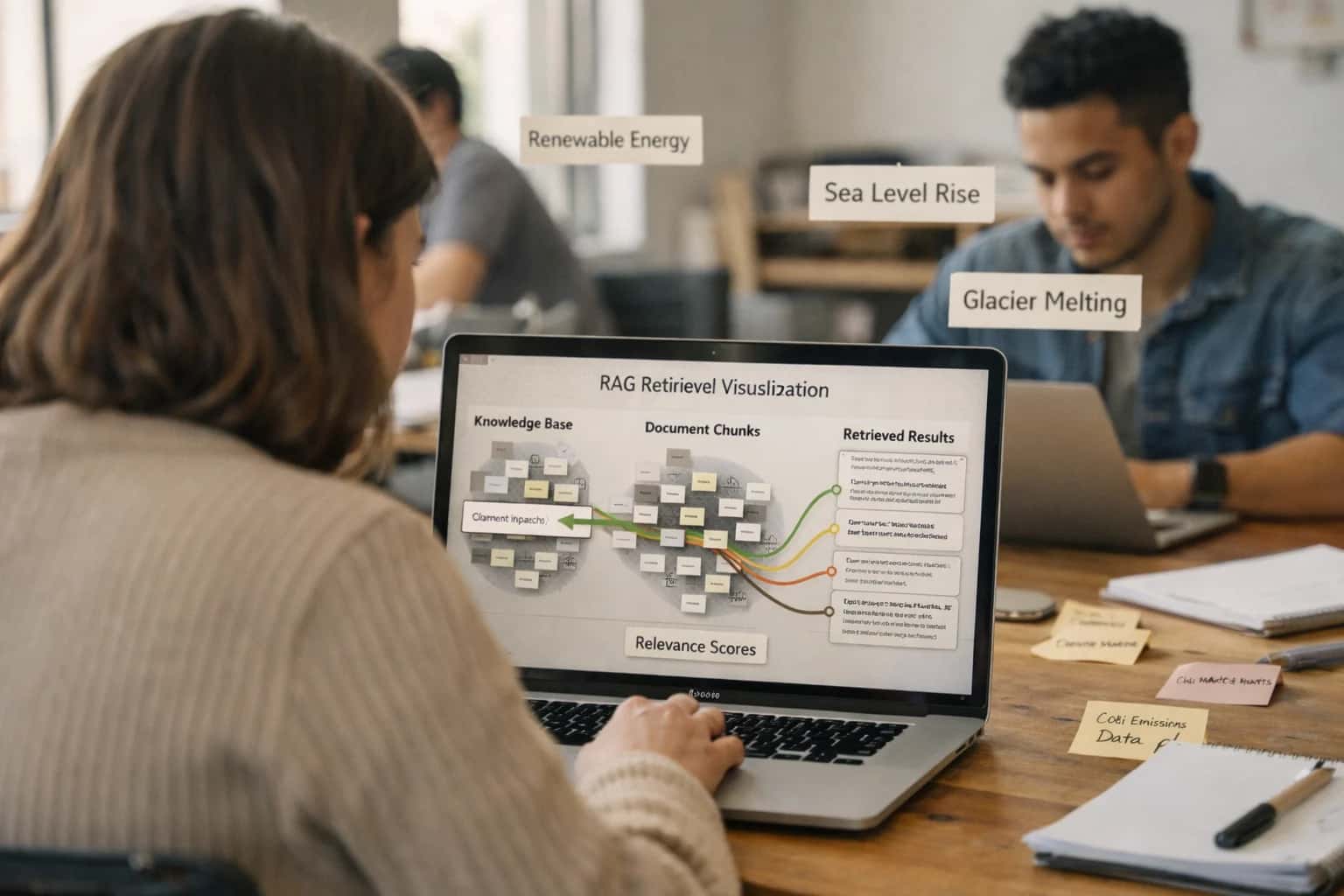
RETRIEVAL LATENCY OPTIMIZATION
What is Multi-Stage Retrieval?
A cascaded architecture that optimizes the precision-latency trade-off in retrieval-augmented generation (RAG) systems.
The second-stage re-ranker, typically a neural model that performs deep contextual analysis between the query and each candidate, computes a precise relevance score to order the final list. This stage resolves the semantic nuances and term mismatches that fast retrievers miss. By applying the expensive model to only a small subset of data, multi-stage retrieval achieves near the accuracy of a full cross-encoder search at a fraction of the latency and computational cost, making it essential for production RAG systems where both speed and answer quality are critical.
ARCHITECTURE
Key Components of a Multi-Stage Pipeline
A multi-stage retrieval pipeline is a cascaded system designed to optimize the precision-latency trade-off. It uses a fast, approximate first stage to fetch a broad candidate set, which is then refined by slower, more accurate subsequent stages.
01
First-Stage Retriever (Candidate Generation)
The first-stage retriever is a fast, high-recall component that rapidly fetches a broad set of potentially relevant documents from a large corpus. Its primary goal is to reduce the search space for more expensive downstream models.
- Common Implementations: Approximate Nearest Neighbor (ANN) search using algorithms like HNSW or IVFPQ via libraries such as Faiss or ScaNN.
- Key Metric: High recall@K, ensuring the truly relevant documents are within the initial candidate pool.
- Latency Target: Typically sub-10ms to maintain overall pipeline responsiveness.
02
Reranker (Precision Stage)
The reranker is a computationally intensive model that reorders and scores the candidates from the first stage to maximize precision. It performs a deeper, pairwise analysis between the query and each candidate.
- Model Type: Typically a cross-encoder architecture (e.g., a BERT model fine-tuned for relevance scoring) that jointly processes the query and document text.
- Function: Computes a fine-grained relevance score, allowing the pipeline to return the most pertinent documents from the candidate set.
- Trade-off: While much slower than the first stage, it operates on a small subset (e.g., 100-1000 items), keeping total latency manageable.
03
Query Understanding & Transformation
This component processes the raw user query to improve retrieval effectiveness before it reaches the vector search stage. It ensures the query is in an optimal form for the retriever's embedding space.
- Common Techniques:
- Query Expansion: Adding synonyms or related terms.
- Query Reformulation: Rephrasing using a lightweight language model.
- Hybrid Query Creation: Generating both a sparse (e.g., BM25) and a dense vector representation for hybrid retrieval.
- Purpose: Bridges the vocabulary gap between user language and document corpus, improving first-stage recall.
04
Metadata Filtering & Pre/Post-Processing
Metadata filtering applies hard constraints based on document attributes to narrow the search space, acting as a precision filter that operates alongside semantic search.
- Pre-filtering: Applied before vector search to limit the index to a relevant subset (e.g.,
date >= 2023,department = 'legal'). Reduces search latency and improves relevance. - Post-filtering: Applied after vector search to filter results that don't meet criteria. Simpler but can reduce final result count.
- Metadata: Includes publication date, author, source system, access permissions, or custom tags.
05
Embedding Models & Caches
The embedding model converts queries and documents into the vector representations used for similarity search. Its quality dictates the upper bound of retrieval performance.
- Dual-Encoder Architecture: Standard for retrieval; encodes queries and documents independently for fast ANN search.
- Latency Optimization:
- Embedding Cache: Stores pre-computed document vectors in memory to avoid recomputation.
- Model Distillation: A smaller, faster student model is trained to mimic a larger teacher model.
- Binary Embeddings: Use 1-bit dimensions for extremely fast, memory-efficient search.
06
Orchestration & Latency Budgeting
The orchestration layer manages the flow between stages, handles errors, and enforces strict latency budgets to meet service-level agreements (SLAs).
- Key Function: Dynamically allocates time to each stage. For example, if the first stage uses 15ms of a 50ms total budget, 35ms remains for reranking and synthesis.
- Parallel Execution: May run independent sub-queries or filters concurrently.
- Fallback Mechanisms: Defines behavior if a stage times out (e.g., return first-stage results only).
- Monitoring: Tracks critical metrics like P99 latency and recall at each stage for continuous optimization.
MULTI-STAGE RETRIEVAL ARCHITECTURE
First-Stage vs. Second-Stage Retrieval: A Comparison
This table compares the distinct roles, technologies, and performance characteristics of the initial and re-ranking stages in a cascaded retrieval pipeline.
| Feature | First-Stage Retrieval | Second-Stage Retrieval |
|---|---|---|
Primary Objective | Maximize Recall | Maximize Precision |
Core Technology | Approximate Nearest Neighbor (ANN) Search | Cross-Encoder or Dense Reranker |
Typical Model | Bi-Encoder (e.g., Sentence-BERT) | Cross-Encoder (e.g., BERT for Reranking) |
Search Latency | < 10 ms | 50-500 ms |
Candidate Set Size | Entire corpus (e.g., 1M+ docs) | Narrowed set (e.g., 100-1000 docs) |
Query-Doc Interaction | Shallow (independent encoding) | Deep (full attention across pair) |
Indexing Overhead | High (requires vector index build) | Low (model inference only) |
Scalability Focus | Horizontal scaling for massive datasets | Vertical scaling for compute-intensive scoring |
ARCHITECTURAL PATTERNS
Common Use Cases for Multi-Stage Retrieval
Multi-stage retrieval is a cascaded architecture that optimizes the precision-latency trade-off. These are its most prevalent applications in production RAG systems.
01
High-Throughput Question Answering
Used in customer support chatbots and enterprise knowledge bases where low-latency responses are critical. A fast first-stage retriever (e.g., BM25 or a lightweight bi-encoder) fetches 100-200 candidate passages. A powerful cross-encoder re-ranker then evaluates the top candidates for precise answer selection.
- Example: A support bot uses an ANN index for sub-50ms initial fetch, then a BERT-based cross-encoder to select the single most relevant FAQ paragraph.
- Benefit: Maintains user-perceived speed while drastically improving answer accuracy over single-stage retrieval.
02
Legal & Compliance Document Review
Critical for e-discovery and contract analysis where recall is paramount. The first stage uses a hybrid retrieval system (combining dense and sparse vectors) to ensure no relevant clause is missed from a corpus of millions of documents. Subsequent stages employ specialized re-rankers trained on legal entailment to surface the most pertinent precedents or clauses.
- Example: In a merger review, stage one retrieves 1,000 potentially relevant contract sections; stage two uses a legal-BERT re-ranker to identify the 50 sections concerning 'change of control' provisions.
- Benefit: Manages the computational infeasibility of applying the most accurate model to the entire corpus.
03
E-Commerce & Product Search
Powers product discovery engines that must balance semantic understanding with filtering by hard attributes. A vector search finds semantically similar items (e.g., "comfortable running shoes"). A second stage applies strict metadata filtering (size, color, price) and business logic re-ranking (profit margin, stock levels, promotion status).
- Example: A query for "warm winter jacket" retrieves 500 products via embedding similarity. A rule-based re-ranker prioritizes in-stock items, then a learning-to-rank model orders them by predicted conversion likelihood.
- Benefit: Decouples complex business rules from the core semantic search, enabling agile optimization.
04
Academic Literature Search
Enables researchers to navigate vast paper repositories. The first stage performs broad keyword and citation graph search. The second stage uses a scientific claim similarity model to re-rank papers based on the methodological or conceptual relevance to the query, far beyond simple keyword matching.
- Example: A search for "contrastive learning in vision" retrieves papers via TF-IDF. A re-ranker fine-tuned on COLIEE legal entailment data identifies papers that specifically advance the theory, not just mention the term.
- Benefit: Surfaces semantically nuanced connections that pure lexical or citation-based search misses.
05
Long-Context RAG Optimization
Addresses the context window limit of Large Language Models. Instead of retrieving a few large chunks, a multi-stage system retrieves many small chunks initially. A re-ranker then performs cross-document deduplication and relevance fusion to select the optimal, non-redundant set of chunks that fit within the LLM's context budget.
- Example: For a complex query, 30 small chunks are retrieved. The re-ranker scores them, removes redundant information, and selects the top 10 most diverse and relevant chunks for the final LLM prompt.
- Benefit: Maximizes the informational density and relevance of the context passed to the LLM, reducing noise and improving answer quality.
06
Multi-Modal Retrieval Systems
Used when queries and documents span text, images, and audio. A first stage may use a CLIP-like embedding to retrieve cross-modal candidates (e.g., text query to images). A second, more expensive stage employs a fusion encoder that jointly reasons over the different modalities of the candidate to assess fine-grained alignment with the query intent.
- Example: Query: "Find diagrams showing neural network architectures." Stage one retrieves 100 slides and PDFs containing images. Stage two uses a layout-aware model to re-rank, prioritizing clean, annotated architecture diagrams over generic graphs.
- Benefit: Makes sophisticated multi-modal understanding computationally tractable for real-time applications.
MULTI-STAGE RETRIEVAL
Frequently Asked Questions
Multi-stage retrieval is a cascaded architecture designed to optimize the precision-latency trade-off in retrieval-augmented generation (RAG) systems. This FAQ addresses common technical questions about its implementation, benefits, and key components.
Multi-stage retrieval is a cascaded search architecture where a fast, approximate first-stage retriever fetches a broad set of candidate documents, which are then re-ranked by a slower, more accurate second-stage model. The first stage, often using an Approximate Nearest Neighbor (ANN) index like HNSW or IVFPQ, prioritizes low latency and high recall. The second stage, typically a cross-encoder or another computationally intensive re-ranker, evaluates the candidates for precise relevance, optimizing the final precision delivered to the language model. This two-phase approach balances speed and accuracy, preventing the bottleneck of applying the heavy re-ranker to the entire corpus.
Enabling Efficiency, Speed & Accuracy
Intelligent Analysis, Decision & Execution
We build AI systems for teams that need search across company data, workflow automation across tools, or AI features inside products and internal software.
Talk to Us
Search across company data
Give teams answers from docs, tickets, runbooks, and product data with sources and permissions.
Useful when people spend too long searching or get different answers from different systems.
Enterprise searchRAGPermissions
Read more
Automate internal workflows
Use AI to route work, draft outputs, trigger actions, and keep approvals and logs in place.
Useful when repetitive work moves across multiple tools and teams.
AI agentsWorkflow automationGovernance
Read more
Add AI to products and internal tools
Build assistants, guided actions, or decision support into the software your team or customers already use.
Useful when AI needs to be part of the product, not a separate tool.
AI integrationDecision supportModel routing
Read more
About the author
Prasad Kumkar
CEO & MD, Inference Systems
Prasad Kumkar is the CEO & MD of Inference Systems and writes about AI systems architecture, LLM infrastructure, model serving, evaluation, and production deployment. Over 5+ years, he has worked across computer vision models, L5 autonomous vehicle systems, and LLM research, with a focus on taking complex AI ideas into real-world engineering systems.
His work and writing cover AI systems, large language models, AI agents, multimodal systems, autonomous systems, inference optimization, RAG, evaluation, and production AI engineering.
LinkedIn
Limited slotsGet a Free AI Consultation
Partnered with leading AI, data, and software stack.





How We Work
Custom AI workflows for your Business
One-fit-all AI don't work for modern businesses. At Inferensys, we aim to understand your business & custom requirements; which we use to define most efficient agentic workflows, the data, and the tools for your business.
01
Review the use case
We understand the task, the users, and where AI can actually help.
Read more02
Pick the right approach
We define what needs search, automation, or product integration.
Read more03
Build the first useful version
We implement the part that proves the value first.
Read more04
Improve from there
We add the checks and visibility needed to keep it useful.
Read moreThe first call is a practical review of your use case and the right next step.
Talk to Us