Data orchestration is the automated coordination, scheduling, and management of complex data workflows and pipelines across disparate systems. It involves defining tasks, managing dependencies, handling errors, and allocating resources to ensure data moves reliably from sources to destinations. In modern architectures like Retrieval-Augmented Generation (RAG), orchestration is critical for automating the ingestion, processing, and indexing of enterprise data into vector databases and knowledge graphs to provide factual grounding for AI models.

Glossary
Data Orchestration
Data orchestration is the automated coordination and management of complex data workflows across disparate systems to ensure reliable and efficient execution of data pipelines.
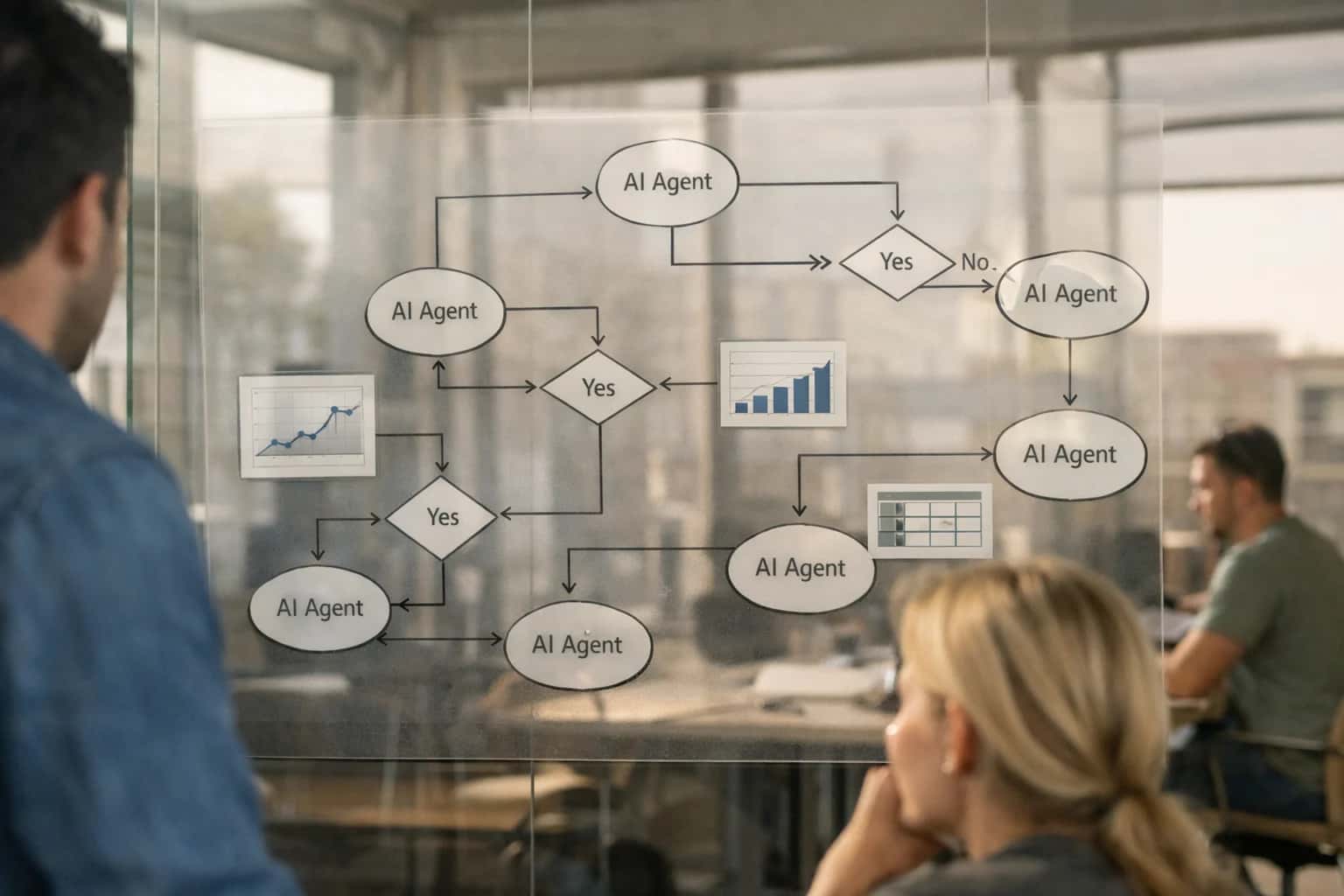
ENTERPRISE DATA CONNECTORS
What is Data Orchestration?
Data orchestration is the automated coordination and management of complex data workflows, ensuring reliable and efficient execution of data pipelines across disparate systems.
Core orchestration functions include scheduling batch jobs or triggering event-driven pipelines, monitoring execution and data quality, and managing state across distributed systems. Tools like Apache Airflow or Prefect implement these functions using Directed Acyclic Graphs (DAGs). For enterprise AI, effective orchestration connects ETL/ELT processes, Change Data Capture (CDC), and unstructured data ingestion to create a continuous, observable flow of fresh, prepared data into AI-ready storage systems, forming the backbone of reliable data infrastructure.
ENTERPRISE DATA CONNECTORS
Core Capabilities of Data Orchestration
Data orchestration automates the coordination of complex data workflows across disparate systems. Its core capabilities ensure reliable, efficient, and observable execution of data pipelines for analytics and machine learning.
01
Workflow Scheduling & Dependency Management
Data orchestration platforms define workflows as Directed Acyclic Graphs (DAGs), where nodes are tasks and edges are dependencies. This enables:
- Deterministic execution order: Tasks run only when their upstream dependencies are satisfied.
- Complex scheduling: Supports time-based (cron), event-based (file arrival), and manual triggers.
- Dynamic task generation: Creates tasks at runtime based on parameters or data discovery.
Tools like Apache Airflow and Prefect use this paradigm to manage dependencies for batch ETL/ELT pipelines, ensuring data is transformed in the correct sequence.
02
Error Handling & Automatic Retries
Robust orchestration implements fault tolerance through declarative failure policies. Key mechanisms include:
- Task-level retries: Automatically re-executes a failed task with exponential backoff.
- Alerting & notifications: Sends alerts via Slack, PagerDuty, or email upon pipeline failure.
- Conditional branching: Defines alternate execution paths (e.g., run a cleanup task if the main transformation fails).
- Dead-letter queues: Captures and stores data from failed events for later reprocessing.
This capability is critical for maintaining data pipeline SLAs and minimizing manual intervention for transient network or system failures.
03
Resource Allocation & Execution Management
Orchestrators abstract compute infrastructure to optimize resource utilization:
- Executor patterns: Uses local, Celery, Kubernetes, or Dask executors to distribute tasks across workers.
- Dynamic resource provisioning: Scales worker pools up or down based on queue depth.
- Resource constraints: Assigns CPU, memory, and GPU quotas to specific tasks to prevent resource starvation.
- Environment isolation: Executes tasks in dedicated containers or virtual environments to ensure dependency consistency.
This allows a single pipeline to trigger a Spark job on EMR, run a Python script in a Kubernetes pod, and execute a dbt model in Snowflake, all with managed resources.
04
Data Lineage & Observability
Orchestration provides a centralized view of data movement and transformation, which is essential for data governance and debugging.
- Automatic lineage tracking: Maps dependencies between datasets, tasks, and pipelines.
- Operational monitoring: Offers dashboards for real-time views of task duration, success rates, and queue status.
- Audit logging: Records every task execution, parameter, and outcome for compliance.
- Data quality checks: Integrates with frameworks like Great Expectations or Soda Core to run validation tasks within the workflow.
This transforms pipelines from opaque scripts into auditable, observable systems where the impact of a schema change can be traced instantly.
05
Cross-System Coordination & Event-Driven Triggers
Modern orchestration reacts to events across the entire data stack, moving beyond simple cron schedules.
- Event-based triggering: Listens for events from message queues (Apache Kafka), cloud storage (S3 object creation), or database CDC streams (Debezium).
- API & webhook integration: Triggers pipelines via REST API calls or webhooks from external SaaS applications.
- Multi-tool orchestration: Coordinates handoffs between specialized tools (e.g., trigger a dbt Cloud job after an Airflow task completes, then run a Databricks notebook).
This enables real-time data pipelines and cohesive workflows across a polyglot persistence architecture.
06
Parameterization & Dynamic Configuration
Pipelines are designed to be reusable templates, with behavior controlled by runtime parameters.
- Runtime variables: Passes execution dates, environment flags (dev/prod), or business logic parameters into tasks.
- Secrets management: Integrates with vaults like HashiCorp Vault or AWS Secrets Manager to inject credentials securely, avoiding hard-coded secrets.
- Configuration as code: Stores pipeline definitions (DAGs) in version control (Git) for CI/CD and peer review.
- Template inheritance: Allows creation of base pipeline templates for common patterns, ensuring consistency.
This capability is foundational for Evaluation-Driven Development and deploying the same pipeline logic across multiple tenants or data domains.
ARCHITECTURAL PATTERNS
Data Orchestration vs. Related Concepts
A technical comparison of Data Orchestration with adjacent data pipeline and integration patterns, highlighting their primary purpose, execution model, and typical use cases.
| Feature / Dimension | Data Orchestration | Data Pipeline (ETL/ELT) | Change Data Capture (CDC) | Stream Processing |
|---|---|---|---|---|
Primary Purpose | Automated coordination, scheduling, and dependency management of complex, multi-step workflows across disparate systems. | Movement and transformation of data from source(s) to a target destination (e.g., warehouse). | Real-time identification and streaming of incremental data changes (inserts, updates, deletes). | Continuous, stateful computation on unbounded streams of event data in real-time. |
Execution Model | Directed Acyclic Graph (DAG) of tasks with conditional logic, retries, and error handling. | Linear or branched sequence of Extract, Transform, and Load operations. | Log-based tailing or trigger-based capture, emitting a stream of change events. | Windowed operations (tumbling, sliding, session) on a continuous event stream. |
State Management | Manages workflow state (success/failure of tasks); data state is external. | Transient; data is in-flight. State is typically the data in the target system. | Minimal; tracks log position. Change events are stateless facts. | Maintains internal state (e.g., aggregates, counters) for windowed computations. |
Temporal Granularity | Scheduled (cron), event-triggered, or manually triggered. Often batch-oriented. | Batch (scheduled) or micro-batch. ELT can be more frequent. | Real-time or near-real-time, event-by-event. | Real-time, with millisecond to second latency. |
Key Technologies | Apache Airflow, Dagster, Prefect, Kubernetes Operators. | dbt, Apache Spark, Fivetran, Stitch, Informatica. | Debezium, AWS DMS, Oracle GoldenGate. | Apache Flink, Apache Kafka Streams, Apache Spark Structured Streaming. |
Typical Use Case in RAG | Orchestrating the full ingestion, embedding, and index refresh pipeline: run OCR, chunk documents, generate embeddings, update vector DB. | Extracting raw documents from sources (S3, DB), cleaning text, loading into a document store. | Streaming new or updated source documents from a database to trigger an embedding update. | Continuously processing a live feed of user query logs to compute retrieval performance metrics. |
Error Handling Focus | Workflow-level: task retries, alerting, and conditional branching on failure. | Data-level: row validation, transformation failures, and load rejections. | Capture-level: log connectivity, schema change handling, and event delivery guarantees. | Processing-level: fault tolerance via checkpointing, and handling of late-arriving data. |
Dependency Complexity | High: Manages dependencies between heterogeneous tasks (API calls, SQL jobs, Spark jobs). | Medium: Primarily linear dependencies between transformation stages. | Low: Dependency is on the source database's transaction log. | Medium: Dependencies defined within the streaming topology and windowing logic. |
DATA ORCHESTRATION
Frequently Asked Questions
Data orchestration automates the coordination of complex data workflows across disparate systems. These questions address its core mechanisms, tools, and role in modern AI architectures like Retrieval-Augmented Generation (RAG).
Data orchestration is the automated coordination and management of complex data workflows, including scheduling, dependency resolution, error handling, and resource allocation across disparate systems. It works by defining workflows as sequences of tasks, often modeled as Directed Acyclic Graphs (DAGs), where each node represents a data operation (e.g., extract, transform, load) and edges define execution order and dependencies. An orchestration engine (like Apache Airflow or Prefect) schedules these tasks, monitors their execution, handles retries on failure, and ensures the entire pipeline runs reliably from source to destination. This is critical for maintaining data freshness in systems like RAG, where retrieval indexes must be continuously updated with new enterprise data.
Enabling Efficiency, Speed & Accuracy
Intelligent Analysis, Decision & Execution
We build AI systems for teams that need search across company data, workflow automation across tools, or AI features inside products and internal software.
Talk to Us
Search across company data
Give teams answers from docs, tickets, runbooks, and product data with sources and permissions.
Useful when people spend too long searching or get different answers from different systems.
Enterprise searchRAGPermissions
Read more
Automate internal workflows
Use AI to route work, draft outputs, trigger actions, and keep approvals and logs in place.
Useful when repetitive work moves across multiple tools and teams.
AI agentsWorkflow automationGovernance
Read more
Add AI to products and internal tools
Build assistants, guided actions, or decision support into the software your team or customers already use.
Useful when AI needs to be part of the product, not a separate tool.
AI integrationDecision supportModel routing
Read more
About the author
Prasad Kumkar
CEO & MD, Inference Systems
Prasad Kumkar is the CEO & MD of Inference Systems and writes about AI systems architecture, LLM infrastructure, model serving, evaluation, and production deployment. Over 5+ years, he has worked across computer vision models, L5 autonomous vehicle systems, and LLM research, with a focus on taking complex AI ideas into real-world engineering systems.
His work and writing cover AI systems, large language models, AI agents, multimodal systems, autonomous systems, inference optimization, RAG, evaluation, and production AI engineering.
LinkedIn
Limited slotsGet a Free AI Consultation
Partnered with leading AI, data, and software stack.





How We Work
Custom AI workflows for your Business
One-fit-all AI don't work for modern businesses. At Inferensys, we aim to understand your business & custom requirements; which we use to define most efficient agentic workflows, the data, and the tools for your business.
01
Review the use case
We understand the task, the users, and where AI can actually help.
Read more02
Pick the right approach
We define what needs search, automation, or product integration.
Read more03
Build the first useful version
We implement the part that proves the value first.
Read more04
Improve from there
We add the checks and visibility needed to keep it useful.
Read moreThe first call is a practical review of your use case and the right next step.
Talk to Us