Target domain alignment is the process of calibrating a retrieval model's internal representations and similarity metrics to the specific content, vocabulary, and query patterns of a specialized enterprise domain. The goal is to overcome the distribution shift between the model's original training data and the target corpus, ensuring that semantic search returns context that is genuinely relevant within the new domain's unique framework. This is foundational for effective Retrieval-Augmented Generation (RAG) in specialized fields like law, medicine, or finance.

Glossary
Target Domain Alignment
Target domain alignment is the process of adapting a general-purpose retrieval model so its internal representations and similarity metrics are calibrated to a specialized domain's content and query patterns.
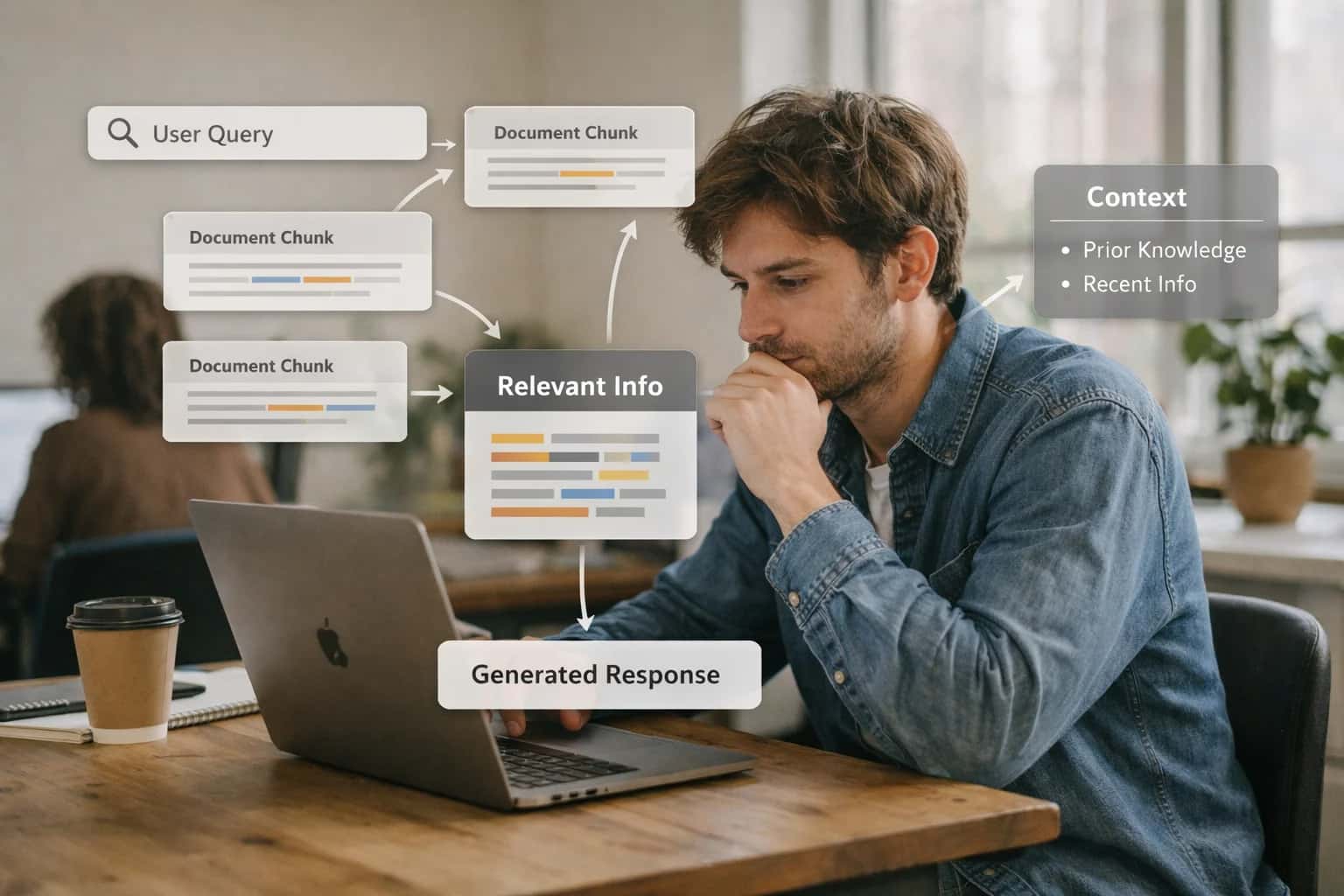
DOMAIN-ADAPTIVE RETRIEVAL
What is Target Domain Alignment?
Target domain alignment is the core objective in adapting a general-purpose retrieval model to a specialized enterprise domain.
Achieving alignment typically involves techniques like domain-adaptive fine-tuning of embedders or retrievers on in-domain data, vocabulary expansion for specialized terminology, and in-domain negative sampling to teach the model to distinguish between subtly different concepts. A successfully aligned system ensures that a query for "PCI compliance" retrieves passages about payment card industry standards, not peripheral component interconnect buses, dramatically improving the factual grounding and reducing hallucinations in the final generated output.
DOMAIN-ADAPTIVE RETRIEVAL
Key Techniques for Target Domain Alignment
Target domain alignment is achieved through a suite of specialized techniques that adapt general-purpose retrieval models to the unique vocabulary, semantics, and data distributions of a specialized field.
01
Domain-Adaptive Fine-Tuning
This core technique involves further training a pre-trained retriever or encoder model on a corpus of domain-specific text and query-document pairs. The model's parameters are updated so its internal representations (embeddings) and similarity metrics become calibrated to the target domain's semantics.
- Process: Uses contrastive learning with in-domain positive and hard negative examples.
- Outcome: The model learns that, for example, 'AML' in finance refers to 'Anti-Money Laundering' and is semantically distinct from 'AML' in biology ('Acute Myeloid Leukemia').
- Example Models: Fine-tuning a Dense Passage Retriever (DPR) or a Sentence Transformer like
all-mpnet-base-v2on legal case documents.
02
In-Domain Embedding Training
Instead of adapting a general model, this technique trains an embedding model from scratch or continues pre-training a base transformer exclusively on a large, high-quality domain corpus. This builds a foundational understanding of the domain's language from the ground up.
- Advantage: Captures deep, intrinsic semantic relationships unique to the field, often leading to superior performance over adapted general models.
- Use Case: Critical for fields with highly specialized, non-standard vocabulary, such as molecular biology (e.g., gene names, chemical compounds) or legacy engineering schematics.
- Consideration: Requires significant computational resources and a large, clean domain corpus.
03
Vocabulary & Tokenizer Expansion
General-purpose tokenizers often split critical domain terms into meaningless subwords, destroying their semantic integrity. This technique expands the model's tokenizer vocabulary with domain-specific tokens.
- Method: Add key domain entities, acronyms, and compound terms as single tokens to the tokenizer's vocabulary and resize the model's embedding layer accordingly.
- Impact: Prevents terms like 'TransformerAttention' from being split into ['Transform', 'er', 'Att', 'ention'], allowing the model to treat them as coherent concepts.
- Synergy: Often performed before or in conjunction with domain-adaptive fine-tuning for maximum alignment.
04
Adaptive Hybrid Retrieval
Aligns both dense vector search and sparse lexical search components to the domain. A domain-aware sparse encoder (e.g., fine-tuned SPLADE) learns to weight domain-specific terms more heavily, while a fine-tuned dense encoder handles semantic similarity.
- Dense Alignment: Manages conceptual queries (e.g., 'treatment for refractory condition').
- Sparse Alignment: Excels at precise keyword and entity searches (e.g., 'PD-1 inhibitor pembrolizumab').
- Result: The hybrid system leverages the aligned strengths of both methods for superior recall and precision within the domain.
05
In-Domain Hard Negative Mining
A critical training data strategy for fine-tuning retrievers. Hard negatives are documents that are semantically similar to the query but are not relevant. Mining these from the target domain corpus forces the model to learn fine-grained distinctions.
- Techniques: Use an initial retriever to fetch top-ranked non-relevant passages, or employ techniques like BM25 to find lexically similar but incorrect documents.
- Example: For a medical query about 'myocardial infarction,' a hard negative might be a passage discussing 'cardiac arrest'—related but not the correct answer.
- Outcome: Dramatically improves the retriever's precision by teaching it to reject plausible but incorrect information.
06
Domain-Adaptive Reranking
Aligns the final precision stage of retrieval. A fine-tuned cross-encoder model is trained on labeled in-domain query-document pairs to reorder the top candidates (e.g., from 100 to 10) from the initial retriever.
- Mechanism: The cross-encoder performs deep, computationally expensive attention across the full query and document text, producing a highly accurate relevance score.
- Alignment Benefit: The reranker learns domain-specific notions of relevance, such as prioritizing regulatory compliance clauses in legal documents or specific experimental results in research papers.
- Result: Delivers the highest possible precision for the final context passed to the LLM, directly reducing hallucinations.
COMPARATIVE ANALYSIS
Target Domain Alignment vs. Related Concepts
A technical comparison of the objective of Target Domain Alignment against common related techniques and paradigms in domain-adaptive retrieval.
| Feature / Metric | Target Domain Alignment | Domain-Adaptive Fine-Tuning | In-Domain Embedding Training | Vocabulary Expansion |
|---|---|---|---|---|
Primary Objective | Calibrate model representations & similarity metrics to a specialized domain | Improve model performance on a specific downstream task within a domain | Create embeddings that capture unique semantic relationships of a field | Add domain-specific tokens to a model's tokenizer |
Core Methodology | Adaptation of retrieval components (encoder, index, scorer) to domain data & query patterns | Supervised fine-tuning of a pre-trained model on labeled in-domain data | Training or continued pre-training of an embedding model on a domain corpus | Modifying tokenizer vocabulary with new tokens or subwords |
Typical Starting Point | General-purpose retriever (e.g., DPR, sentence transformer) | Pre-trained language model or retriever | Pre-trained model checkpoint or random initialization | Existing tokenizer (e.g., from BERT, GPT) |
Output Artifact | Aligned retrieval system (encoder + optionally index) | Task-specific fine-tuned model | New or adapted embedding model (e.g., sentence transformer) | Updated tokenizer vocabulary file |
Requires In-Domain Labels? | ||||
Directly Optimizes Retrieval Metrics? | ||||
Modifies Tokenizer? | ||||
Computational Cost | Medium (fine-tuning, indexing) | Medium to High (task-specific fine-tuning) | High (training from scratch or continued pre-training) | Low (vocabulary analysis and addition) |
Primary Benefit | Improved recall & precision for domain queries | High accuracy on a specific labeled task | Superior semantic similarity for domain texts | Prevents splitting of domain terms, improves token efficiency |
Key Challenge | Mitigating distribution shift without extensive labels | Requiring high-quality, task-specific labeled data | Needing large volumes of high-quality domain text | Balancing vocabulary size with model performance |
IMPLEMENTATION PATTERNS
Examples of Target Domain Alignment
Target domain alignment is achieved through specific technical interventions on the retrieval model, its embeddings, and its supporting infrastructure. These examples illustrate the primary methods for calibrating a general-purpose system to a specialized domain.
01
Fine-Tuning a Dense Retriever
This involves taking a pre-trained Dense Passage Retriever (DPR) or a bi-encoder model and continuing its training on in-domain question-passage pairs. The model learns to map domain-specific jargon and query patterns to the correct document vectors.
- Process: Use a dataset of
(query, positive_document, hard_negative_documents)from the target domain. - Outcome: The model's similarity metric becomes calibrated to the domain's semantic relationships, significantly improving hit rate for technical queries.
- Example: Fine-tuning a general DPR model on a corpus of legal case summaries and corresponding legal questions.
02
Training a Custom Embedding Model
Instead of adapting an existing model, a new sentence transformer is trained from scratch or from an early checkpoint using a massive corpus of domain text. This creates a vector space whose geometry is fundamentally shaped by the domain.
- Process: Employ contrastive learning (e.g., Multiple Negatives Ranking loss) on pairs of semantically similar domain sentences.
- Outcome: Produces domain-native embeddings where specialized terms have distinct, meaningful vector positions.
- Example: Training an embedder on millions of biomedical research papers to create vectors for a pharmaceutical RAG system.
03
Domain-Adaptive Vocabulary Expansion
General tokenizers often split critical domain terms, destroying their semantic unity. This technique adds domain-specific tokens to the model's subword vocabulary.
- Process: Analyze the domain corpus to identify frequent n-grams or compound terms (e.g.,
"non-small cell lung carcinoma"). Add these as single tokens to the tokenizer and expand the model's embedding layer. - Outcome: The model processes key entities as single units, leading to more accurate token embeddings and improved understanding.
- Example: Adding medical codes (ICD-10), chemical formulas, and proprietary product names to a healthcare assistant's tokenizer.
04
Adapting a Sparse Lexical Retriever
Aligning sparse retrieval (e.g., BM25, SPLADE) involves tuning its parameters and lexicons to the domain's terminology, moving beyond simple keyword matching.
- Key Techniques:
- Domain-Specific Stop Words: Filter out common but non-discriminatory domain terms.
- Synonym Expansion: Use a domain ontology to expand queries with related technical terms.
- Term Weighting: Adjust IDF (Inverse Document Frequency) values based on the domain corpus statistics.
- Outcome: Improved recall for queries that use synonyms or different phrasings of core domain concepts.
05
Fine-Tuning a Cross-Encoder Reranker
A cross-encoder provides a precise relevance score for a (query, document) pair. Fine-tuning it on domain-specific relevance judgments aligns its final precision layer.
- Process: After initial retrieval, a cross-encoder reorders candidates. Training it on labeled in-domain data teaches it nuanced relevance cues.
- Outcome: Dramatically improves the precision@k of the final retrieved list, filtering out documents that are lexically similar but contextually irrelevant to the domain.
- Example: Fine-tuning a
cross-encoder/ms-marco-MiniLM-L-6-v2model on labeled data from financial compliance documents.
06
In-Domain Hard Negative Mining
A critical step for effective fine-tuning. Hard negatives are documents that are semantically similar to the query but are not correct answers, forcing the model to learn finer distinctions.
- Methods:
- Lexical Overlap: Retrieve documents with high keyword match but different intent.
- Embedding Similarity: Use an off-the-shelf embedder to find topically similar but irrelevant passages.
- Adversarial Mining: Use a previous model iteration's mistakes as negatives.
- Outcome: The retriever develops robust decision boundaries, reducing false positives for technically adjacent queries.
TARGET DOMAIN ALIGNMENT
Frequently Asked Questions
Target domain alignment is the core engineering objective of adapting a general-purpose retrieval model to a specialized field. This FAQ addresses the key techniques, benefits, and implementation challenges for CTOs and engineers building production-grade RAG systems.
Target domain alignment is the process of adapting a general-purpose retrieval model—including its embedding space and similarity metrics—to the specific vocabulary, semantics, and query patterns of a specialized domain, such as legal, medical, or proprietary enterprise data. The goal is to calibrate the model's internal representations so that semantically similar concepts within the target domain are positioned closer together in the vector space, dramatically improving retrieval precision and recall. Without alignment, a model trained on general web text may fail to recognize that 'MI' means myocardial infarction in a medical context or that a specific product code refers to a critical component, leading to irrelevant retrieved context and poor RAG performance.
Enabling Efficiency, Speed & Accuracy
Intelligent Analysis, Decision & Execution
We build AI systems for teams that need search across company data, workflow automation across tools, or AI features inside products and internal software.
Talk to Us
Search across company data
Give teams answers from docs, tickets, runbooks, and product data with sources and permissions.
Useful when people spend too long searching or get different answers from different systems.
Enterprise searchRAGPermissions
Read more
Automate internal workflows
Use AI to route work, draft outputs, trigger actions, and keep approvals and logs in place.
Useful when repetitive work moves across multiple tools and teams.
AI agentsWorkflow automationGovernance
Read more
Add AI to products and internal tools
Build assistants, guided actions, or decision support into the software your team or customers already use.
Useful when AI needs to be part of the product, not a separate tool.
AI integrationDecision supportModel routing
Read more
About the author
Prasad Kumkar
CEO & MD, Inference Systems
Prasad Kumkar is the CEO & MD of Inference Systems and writes about AI systems architecture, LLM infrastructure, model serving, evaluation, and production deployment. Over 5+ years, he has worked across computer vision models, L5 autonomous vehicle systems, and LLM research, with a focus on taking complex AI ideas into real-world engineering systems.
His work and writing cover AI systems, large language models, AI agents, multimodal systems, autonomous systems, inference optimization, RAG, evaluation, and production AI engineering.
LinkedIn
Limited slotsGet a Free AI Consultation
Partnered with leading AI, data, and software stack.





How We Work
Custom AI workflows for your Business
One-fit-all AI don't work for modern businesses. At Inferensys, we aim to understand your business & custom requirements; which we use to define most efficient agentic workflows, the data, and the tools for your business.
01
Review the use case
We understand the task, the users, and where AI can actually help.
Read more02
Pick the right approach
We define what needs search, automation, or product integration.
Read more03
Build the first useful version
We implement the part that proves the value first.
Read more04
Improve from there
We add the checks and visibility needed to keep it useful.
Read moreThe first call is a practical review of your use case and the right next step.
Talk to Us