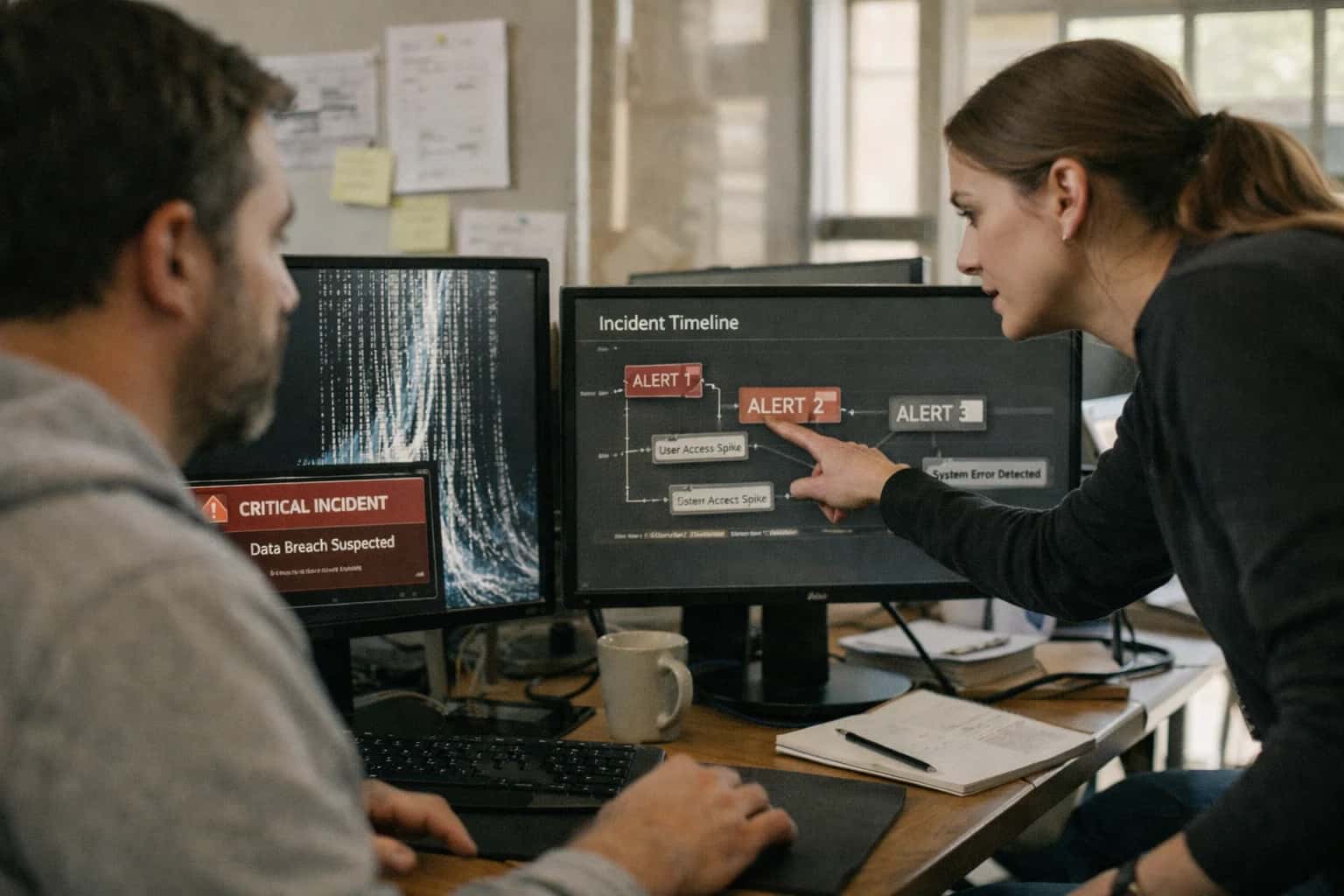
Incident autoresolution is an advanced self-healing software capability where an autonomous system automatically detects a failure, diagnoses its root cause, and executes a predefined remediation to restore service, closing the incident without human intervention. It is a core component of autonomous debugging and recursive error correction, moving beyond simple alerting to automated action. This process relies on a closed-loop feedback system that maps specific error signatures to verified corrective procedures.

Glossary
Incident Autoresolution
Incident autoresolution is the capability of a system to automatically detect, diagnose, and execute a remediation action for a known failure pattern, thereby closing an incident ticket without human intervention.
AUTONOMOUS DEBUGGING
What is Incident Autoresolution?
Incident autoresolution is the capability of a system to automatically detect, diagnose, and execute a remediation action for a known failure pattern, thereby closing an incident ticket without human intervention.
The mechanism operates by integrating automated root cause analysis with corrective action planning. Upon detecting a metric anomaly or log pattern, the system references a knowledge base of known fixes—such as restarting a service, scaling resources, or rolling back a deployment—and executes the repair via tool calling. This reduces mean time to resolution (MTTR) and operational load, embodying principles of fault-tolerant agent design and agentic observability for resilient production systems.
ARCHITECTURAL PRIMITIVES
Core Components of an Autoresolution System
An incident autoresolution system is an orchestrated assembly of specialized components that work in concert to detect, diagnose, and remediate failures without human intervention. These components form a closed-loop control system for software operations.
01
Anomaly Detection Engine
The Anomaly Detection Engine is the system's sensory layer, responsible for identifying deviations from normal operational baselines. It continuously ingests telemetry—such as logs, metrics (e.g., latency, error rates), and traces—to flag potential incidents.
- Key Techniques: Statistical thresholding, machine learning models (like isolation forests or autoencoders), and rule-based pattern matching.
- Output: Generates a high-fidelity alert or event, minimizing false positives by correlating signals across multiple data sources before declaring an incident.
02
Root Cause Analyzer
The Root Cause Analyzer performs automated diagnostic reasoning to pinpoint the underlying fault. It moves beyond symptoms to identify the specific faulty component, configuration error, or data corruption.
- Methods: Employs techniques like dependency graph traversal, statistical fault localization, and log causality analysis.
- Process: Maps the alert to a topology of services and infrastructure, then executes a series of probabilistic or deterministic checks to isolate the culprit, such as a specific microservice, database node, or network link.
03
Remediation Action Library
The Remediation Action Library is a curated, version-controlled catalog of verified repair procedures. Each action is a deterministic script or workflow designed to fix a specific, known failure pattern.
- Content Examples:
- Restart a hung process.
- Clear a poisoned cache.
- Failover to a healthy database replica.
- Scale a resource-starved service.
- Safety: Actions are tagged with risk levels, preconditions, and rollback procedures. They are rigorously tested in staging environments before being approved for production use.
04
Safe Execution Engine
The Safe Execution Engine is the actuator that carries out remediation plans within strict guardrails. It ensures actions are performed correctly and can be halted or reversed if unexpected side effects occur.
- Core Capabilities:
- Dry-run mode: Simulates action impact before execution.
- Atomicity & Rollback: Ensures actions are completed fully or rolled back completely.
- Permission Scoping: Executes with the principle of least privilege, using narrowly-scoped service accounts.
- Real-time Monitoring: Watches system metrics during execution to abort if conditions worsen.
05
Post-Mortem & Learning Loop
The Post-Mortem & Learning Loop is the system's adaptive component. It analyzes the outcome of each autoresolution attempt—success or failure—to improve future performance.
- Functions:
- Verification: Confirms the incident was truly resolved and did not immediately recur.
- Causal Analysis: Reviews if the correct root cause was identified and the optimal action was taken.
- Feedback Integration: Uses this analysis to retrain detection models, refine diagnostic rules, or add new patterns to the remediation library, closing the autonomous improvement cycle.
06
Orchestration & State Manager
The Orchestration & State Manager is the central coordinator that maintains context and sequence across the entire autoresolution lifecycle. It prevents race conditions and manages the system's workflow state.
- Responsibilities:
- Incident State Tracking: Manages the incident's lifecycle from detection to resolution.
- Concurrency Control: Ensures only one remediation action is attempted for a given incident at a time.
- Dependency Management: Sequences actions when multiple, related failures occur.
- Audit Logging: Creates an immutable record of all decisions and actions taken for compliance and review.
AUTONOMOUS DEBUGGING
How Incident Autoresolution Works
Incident autoresolution is the capability of a system to automatically detect, diagnose, and execute a remediation action for a known failure pattern, thereby closing an incident ticket without human intervention.
Incident autoresolution is an automated workflow that closes the loop between monitoring, root cause analysis, and remediation. It begins with an automated alert from a monitoring system. A diagnostic engine then classifies the failure against a library of known patterns. If a match is found and a safe, predefined corrective action exists—such as restarting a service, scaling resources, or running a script—the system executes it autonomously, resolving the incident and updating the ticket.
This process relies on a playbook of verified remediation steps for specific, repeatable failure signatures. It is a core component of self-healing software systems and autonomous operations, reducing mean time to resolution (MTTR) and operational load. Effective implementation requires rigorous verification pipelines and circuit breaker patterns to prevent harmful actions, ensuring the system only acts on high-confidence diagnoses within its operational boundaries.
AUTONOMOUS DEBUGGING
Common Examples of Incident Autoresolution
Incident autoresolution is a core capability of self-healing systems. The following are established patterns where automated detection, diagnosis, and remediation are applied to known failure modes.
01
Service Restart & Process Recovery
The most fundamental autoresolution action. A health probe (liveness/readiness check) fails, indicating a process is dead or unresponsive. The system automatically executes a restart or scale-up command.
- Example: A web service pod in Kubernetes crashes. The kubelet automatically restarts the container based on its restart policy.
- Mechanism: Orchestrators monitor process status and enforce declarative state, a form of state reconciliation.
02
Configuration Drift Correction
Automatically reverting unintended changes to system configuration. Drift detection tools compare the live state against a source-of-truth (e.g., Git repository, desired manifest) and apply corrections.
- Example: An engineer manually changes a security group rule in AWS. An automated compliance tool detects the drift and reapplies the rule defined in Terraform state.
- Mechanism: This implements a self-correction protocol for infrastructure, ensuring consistency and security posture.
03
Resource Scaling & Throttling
Automatically adjusting compute or memory resources in response to load or error signals. This resolves incidents related to performance degradation and timeouts.
- Example: CPU utilization for a service exceeds 80% for 2 minutes. An autoscaling policy adds two new instances to the pool. Conversely, a spike in 5xx errors triggers request throttling via a circuit breaker pattern.
- Mechanism: Uses metric anomaly correlation to link symptoms (high latency) to a remedial action (scale out).
04
Failover & Traffic Re-routing
Automatically shifting user traffic away from a failing component to a healthy standby. This is critical for high-availability architectures.
- Example: A database primary node in a replicated cluster fails. A database manager agent automatically promotes a replica to primary and updates the connection string for applications.
- Mechanism: Relies on health probes and consensus algorithms to execute a rollback mechanism to a last known good state (the replica).
05
Automated Rollback of Failed Deployments
When a new software deployment triggers a surge in errors, the system automatically reverts to the previous stable version. This is a key practice in continuous deployment.
- Example: A canary release of a new microservice version causes error rates to jump from 0.1% to 5%. The deployment automation system automatically rolls back the canary to the previous version and alerts engineers.
- Mechanism: Implements automated bisection at the deployment level, using error metrics as the test to identify the 'bad' commit (the new deployment).
06
Cache & State Invalidation
Automatically clearing corrupted or stale cached data that is causing application errors or serving incorrect content.
- Example: A user reports seeing outdated pricing information. A monitoring system detects a mismatch between database values and cached values, triggering a full cache flush for the affected keys.
- Mechanism: Uses invariant checking (e.g., cached data should be ≤ 5 minutes old) and executes a corrective action when the invariant is violated.
COMPARISON
Autoresolution vs. Related Concepts
A technical comparison of Incident Autoresolution against adjacent debugging, resilience, and observability concepts within autonomous systems.
| Feature / Mechanism | Incident Autoresolution | Automated Root Cause Analysis | Self-Correction Protocol | Chaos Engineering Autoremediation |
|---|---|---|---|---|
Primary Goal | Automatically close an incident ticket by executing a known fix. | Algorithmically identify the fundamental source of a failure. | Follow a predefined rule set to remediate a detected operational error. | Execute recovery procedures for failures injected during resilience testing. |
Triggering Event | Detection of a known failure pattern or alert. | Occurrence of an incident or system anomaly. | Violation of an invariant or detection of a specified error state. | Manual or scheduled injection of a fault in a chaos experiment. |
Human Intervention Required | ||||
Output | Closed incident; system returned to healthy state. | Diagnostic report pinpointing root cause component or code. | Corrected system state or applied patch. | Validated recovery runbook; system restored after test failure. |
Relies on Predefined Playbooks | ||||
Involves Code/State Modification | ||||
Operational Scope | Production incident management. | Post-incident debugging and analysis. | Runtime error handling within an agent or system. | Pre-production resilience validation. |
Key Enabling Technology | Pattern matching, runbook automation. | Statistical debugging, causal inference. | Invariant checking, state reconciliation. | Fault injection platforms, orchestration. |
INCIDENT AUTORESOLUTION
Frequently Asked Questions
Incident autoresolution is a core capability of autonomous systems, enabling them to detect, diagnose, and fix operational failures without human intervention. This FAQ addresses common questions about how this self-healing technology works.
Incident autoresolution is the capability of a software system to automatically detect a known failure pattern, diagnose its root cause, and execute a predefined remediation action, thereby closing an incident ticket without human intervention. It is a key component of self-healing software systems and operates within a closed-loop feedback system. The process typically follows a sequence: monitoring and detection via alerts or metric anomalies, root cause inference using rules or machine learning models, corrective action planning to select a remediation script, and execution and verification to apply the fix and confirm system recovery. This capability reduces mean time to resolution (MTTR), minimizes operational toil, and is foundational for autonomous DevOps and Site Reliability Engineering (SRE) practices.
Enabling Efficiency, Speed & Accuracy
Intelligent Analysis, Decision & Execution
We build AI systems for teams that need search across company data, workflow automation across tools, or AI features inside products and internal software.
Talk to Us
Search across company data
Give teams answers from docs, tickets, runbooks, and product data with sources and permissions.
Useful when people spend too long searching or get different answers from different systems.
Enterprise searchRAGPermissions
Read more
Automate internal workflows
Use AI to route work, draft outputs, trigger actions, and keep approvals and logs in place.
Useful when repetitive work moves across multiple tools and teams.
AI agentsWorkflow automationGovernance
Read more
Add AI to products and internal tools
Build assistants, guided actions, or decision support into the software your team or customers already use.
Useful when AI needs to be part of the product, not a separate tool.
AI integrationDecision supportModel routing
Read more
About the author
Prasad Kumkar
CEO & MD, Inference Systems
Prasad Kumkar is the CEO & MD of Inference Systems and writes about AI systems architecture, LLM infrastructure, model serving, evaluation, and production deployment. Over 5+ years, he has worked across computer vision models, L5 autonomous vehicle systems, and LLM research, with a focus on taking complex AI ideas into real-world engineering systems.
His work and writing cover AI systems, large language models, AI agents, multimodal systems, autonomous systems, inference optimization, RAG, evaluation, and production AI engineering.
LinkedIn
Limited slotsGet a Free AI Consultation
Partnered with leading AI, data, and software stack.





How We Work
Custom AI workflows for your Business
One-fit-all AI don't work for modern businesses. At Inferensys, we aim to understand your business & custom requirements; which we use to define most efficient agentic workflows, the data, and the tools for your business.
01
Review the use case
We understand the task, the users, and where AI can actually help.
Read more02
Pick the right approach
We define what needs search, automation, or product integration.
Read more03
Build the first useful version
We implement the part that proves the value first.
Read more04
Improve from there
We add the checks and visibility needed to keep it useful.
Read moreThe first call is a practical review of your use case and the right next step.
Talk to Us