Dynamic instrumentation is the runtime insertion of monitoring or debugging code into a running process to observe its behavior without requiring source code modification or restart. This technique is fundamental to autonomous debugging, allowing agents to introspect their own execution. It enables real-time data collection on control flow, function calls, and memory states, providing the telemetry necessary for automated root cause analysis and self-correction protocols.

Glossary
Dynamic Instrumentation
Dynamic instrumentation is the runtime insertion of monitoring or debugging code into a running process to observe its behavior without requiring source code modification or restart.
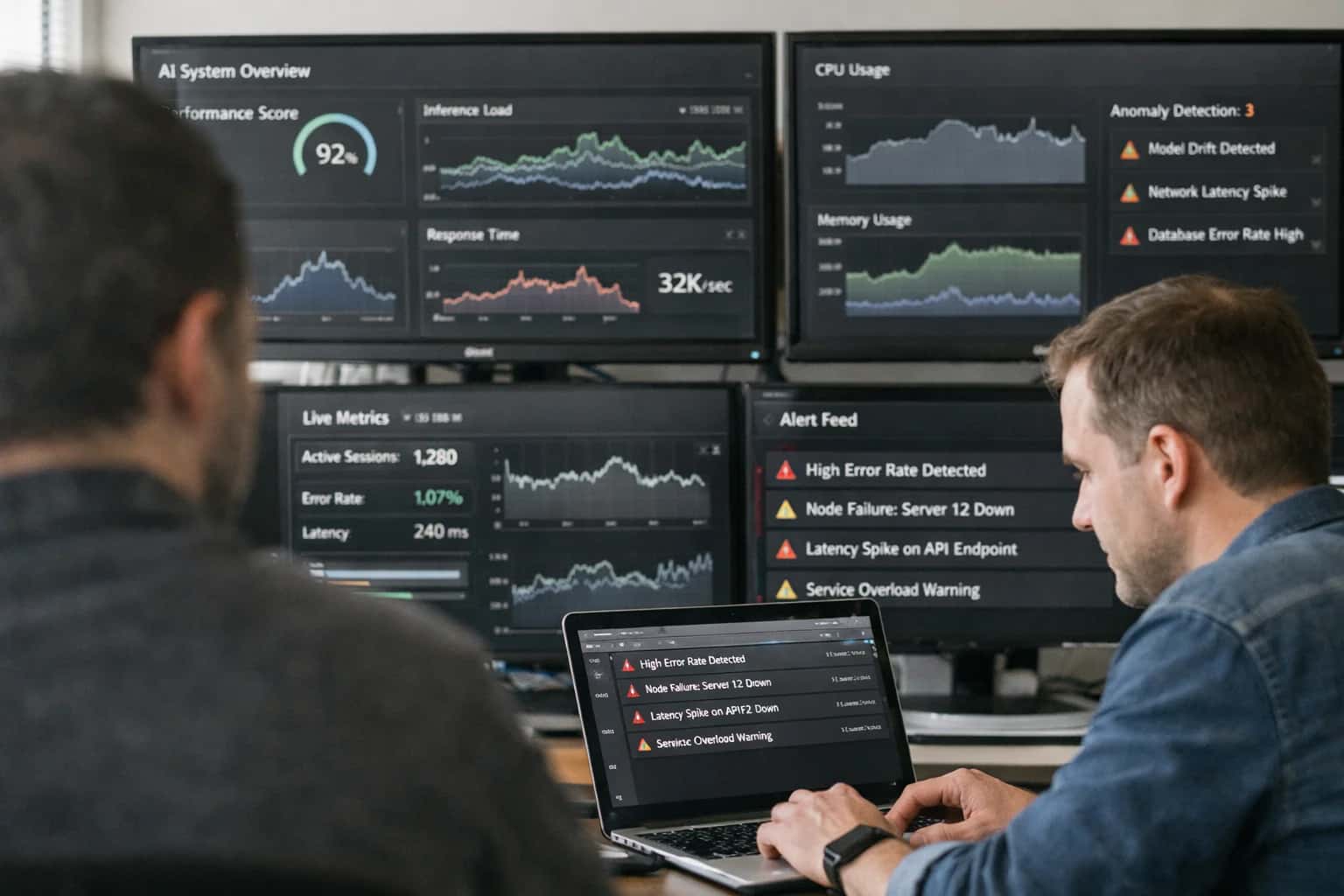
AUTONOMOUS DEBUGGING
What is Dynamic Instrumentation?
Dynamic instrumentation is a core technique in autonomous debugging, enabling runtime observation and modification of software behavior without source code changes or restarts.
Unlike static instrumentation applied at compile time, dynamic instrumentation offers flexibility and minimal overhead, crucial for production systems. It is implemented using frameworks like eBPF or runtime manipulation APIs. This capability allows autonomous agents to perform live state snapshotting, set automated watchpoints, and trace exception propagation, forming the observational backbone for recursive error correction loops where agents iteratively diagnose and fix their own faults.
AUTONOMOUS DEBUGGING
Key Features of Dynamic Instrumentation
Dynamic instrumentation enables the runtime insertion of monitoring and debugging code into a live process, allowing for detailed observation without source code changes or restarts. This is a cornerstone technique for autonomous debugging and recursive error correction.
01
Runtime Code Injection
The core mechanism of dynamic instrumentation is the ability to inject monitoring probes directly into the memory space of a running process. This is achieved by modifying the process's machine code or bytecode in real-time.
- No Restart Required: Unlike static instrumentation, the target application does not need to be stopped, recompiled, or redeployed.
- Targeted Observation: Code can be inserted at specific function entry/exit points, basic blocks, or even individual instructions to capture precise execution data.
- Common Tools: Frameworks like eBPF (extended Berkeley Packet Filter) on Linux and DTrace on Unix-like systems exemplify this capability at the kernel and user-space level.
02
Zero Source Code Modification
Dynamic instrumentation operates on the compiled binary or intermediate representation (e.g., Java bytecode, .NET IL), completely bypassing the need for source code access or changes.
- Legacy & Third-Party Analysis: Enables deep debugging and performance profiling of closed-source libraries, proprietary software, or legacy systems where source is unavailable.
- Non-Invasive: The original source code remains pristine, eliminating the risk of introducing bugs through instrumentation-specific modifications.
- Production-Safe Introspection: Allows for low-overhead monitoring in production environments where modifying and redeploying source code is impractical or risky.
03
Low-Overhead Sampling & Tracing
Advanced dynamic instrumentation systems use efficient techniques to minimize performance impact (overhead) while collecting detailed execution data.
- Selective Tracing: Instead of logging every event, instrumentation can be triggered by specific conditions (e.g., a function argument value, a latency threshold).
- Statistical Sampling: Periodically captures snapshots of the call stack or CPU registers to construct a representative profile with minimal cost (e.g., < 2% overhead).
- Buffered Event Collection: Probes write data to in-memory ring buffers that are asynchronously consumed by an agent, preventing the instrumentation itself from blocking application threads.
04
State Capture & Snapshotting
Beyond tracing control flow, dynamic instrumentation can capture the application state at the moment of probe execution.
- Variable Inspection: Read the values of local variables, function arguments, object fields, and global state without a traditional debugger halt.
- Memory Access Tracking: Set watchpoints to log all reads/writes to a specific memory address, enabling the detection of data corruption or race conditions.
- Checkpoint Creation: For advanced autonomous debugging, an agent can trigger a full state snapshot of the process upon a specific error condition, preserving the exact context for later root cause analysis.
05
Integration with Autonomous Agents
In the context of recursive error correction, dynamic instrumentation provides the sensory input for an autonomous debugging agent.
- Real-Time Telemetry: Supplies the agent with a continuous stream of execution traces, metric anomalies, and invariant violations.
- Feedback Loop: The agent analyzes this data to form hypotheses about root causes (e.g., fault localization), then can dynamically adjust the instrumentation—adding new probes or changing sampling rates—to test its hypotheses.
- Corrective Action: In sophisticated systems, the agent may use instrumentation to apply dynamic code repair, such as hot-patching a faulty function or enabling a circuit breaker pattern for a misbehaving service.
06
Platform & Language Agnosticism
The conceptual framework of dynamic instrumentation is applied across the entire software stack, though implementation details vary.
- System Level (eBPF/DTrace): Instruments kernel system calls, network packets, and scheduler events.
- Managed Runtimes (JVM, .NET CLR): Uses Just-In-Time (JIT) compiler hooks and profiling APIs (e.g., Java Instrumentation API, .NET Profiling API) to inject into bytecode.
- Native Binaries: Uses techniques like trampolines and code caching to safely rewrite machine code instructions in memory.
- This universality makes it a foundational tool for agentic observability across heterogeneous systems.
COMPARISON
Dynamic vs. Static Instrumentation
A technical comparison of runtime and compile-time approaches to inserting monitoring and debugging code into software systems.
| Feature / Characteristic | Dynamic Instrumentation | Static Instrumentation |
|---|---|---|
Modification Time | Runtime | Compile-time or Link-time |
Requires Restart | ||
Requires Source Code | ||
Overhead | Low to moderate (runtime patching) | Consistent (baked into binary) |
Granularity | Function, basic block, instruction | Source line, function, variable |
Primary Use Case | Production debugging, live profiling, security monitoring | Development debugging, code coverage, static analysis |
Tool Examples | eBPF, DTrace, Frida, JVMTI agents | Compiler flags (e.g., -pg), AspectJ, LLVM sanitizers |
Portability | High (often OS/kernel specific) | High (compiled into portable binary) |
Persistence | Lost on process termination | Persists in executable |
DYNAMIC INSTRUMENTATION
Frequently Asked Questions
Dynamic instrumentation is a core technique in autonomous debugging, enabling runtime observation and modification of software behavior without source code changes or restarts. These FAQs address its mechanisms, applications, and role in building self-healing systems.
Dynamic instrumentation is the runtime insertion of monitoring, debugging, or corrective code into a running process's memory space to observe or alter its execution without requiring source code modification, recompilation, or a restart. It works by using a trampoline mechanism: the instrumentation tool (e.g., using eBPF, DynamoRIO, or Frida) intercepts a target function in memory, redirects its execution to a small stub of injected code that performs logging, analysis, or patching, and then returns control to the original or modified program flow. This allows for real-time telemetry collection, fault injection, performance profiling, and hot-patching of bugs in production systems, forming the observational backbone for autonomous debugging agents.
Enabling Efficiency, Speed & Accuracy
Intelligent Analysis, Decision & Execution
We build AI systems for teams that need search across company data, workflow automation across tools, or AI features inside products and internal software.
Talk to Us
Search across company data
Give teams answers from docs, tickets, runbooks, and product data with sources and permissions.
Useful when people spend too long searching or get different answers from different systems.
Enterprise searchRAGPermissions
Read more
Automate internal workflows
Use AI to route work, draft outputs, trigger actions, and keep approvals and logs in place.
Useful when repetitive work moves across multiple tools and teams.
AI agentsWorkflow automationGovernance
Read more
Add AI to products and internal tools
Build assistants, guided actions, or decision support into the software your team or customers already use.
Useful when AI needs to be part of the product, not a separate tool.
AI integrationDecision supportModel routing
Read more
About the author
Prasad Kumkar
CEO & MD, Inference Systems
Prasad Kumkar is the CEO & MD of Inference Systems and writes about AI systems architecture, LLM infrastructure, model serving, evaluation, and production deployment. Over 5+ years, he has worked across computer vision models, L5 autonomous vehicle systems, and LLM research, with a focus on taking complex AI ideas into real-world engineering systems.
His work and writing cover AI systems, large language models, AI agents, multimodal systems, autonomous systems, inference optimization, RAG, evaluation, and production AI engineering.
LinkedIn
Limited slotsGet a Free AI Consultation
Partnered with leading AI, data, and software stack.





How We Work
Custom AI workflows for your Business
One-fit-all AI don't work for modern businesses. At Inferensys, we aim to understand your business & custom requirements; which we use to define most efficient agentic workflows, the data, and the tools for your business.
01
Review the use case
We understand the task, the users, and where AI can actually help.
Read more02
Pick the right approach
We define what needs search, automation, or product integration.
Read more03
Build the first useful version
We implement the part that proves the value first.
Read more04
Improve from there
We add the checks and visibility needed to keep it useful.
Read moreThe first call is a practical review of your use case and the right next step.
Talk to Us