Control flow analysis is a static or dynamic program analysis technique that models the order in which statements, instructions, or function calls are executed within a program or agent. It constructs a control flow graph (CFG) where nodes represent basic blocks of code and edges represent possible jumps, branches, or calls. This structural model is essential for identifying unreachable code, infinite loops, and unexpected execution paths that could lead to logical errors or security vulnerabilities in autonomous systems.

Glossary
Control Flow Analysis
Control flow analysis is a static or dynamic program analysis technique that examines the order in which statements, instructions, or function calls are executed to identify anomalies or unexpected paths.
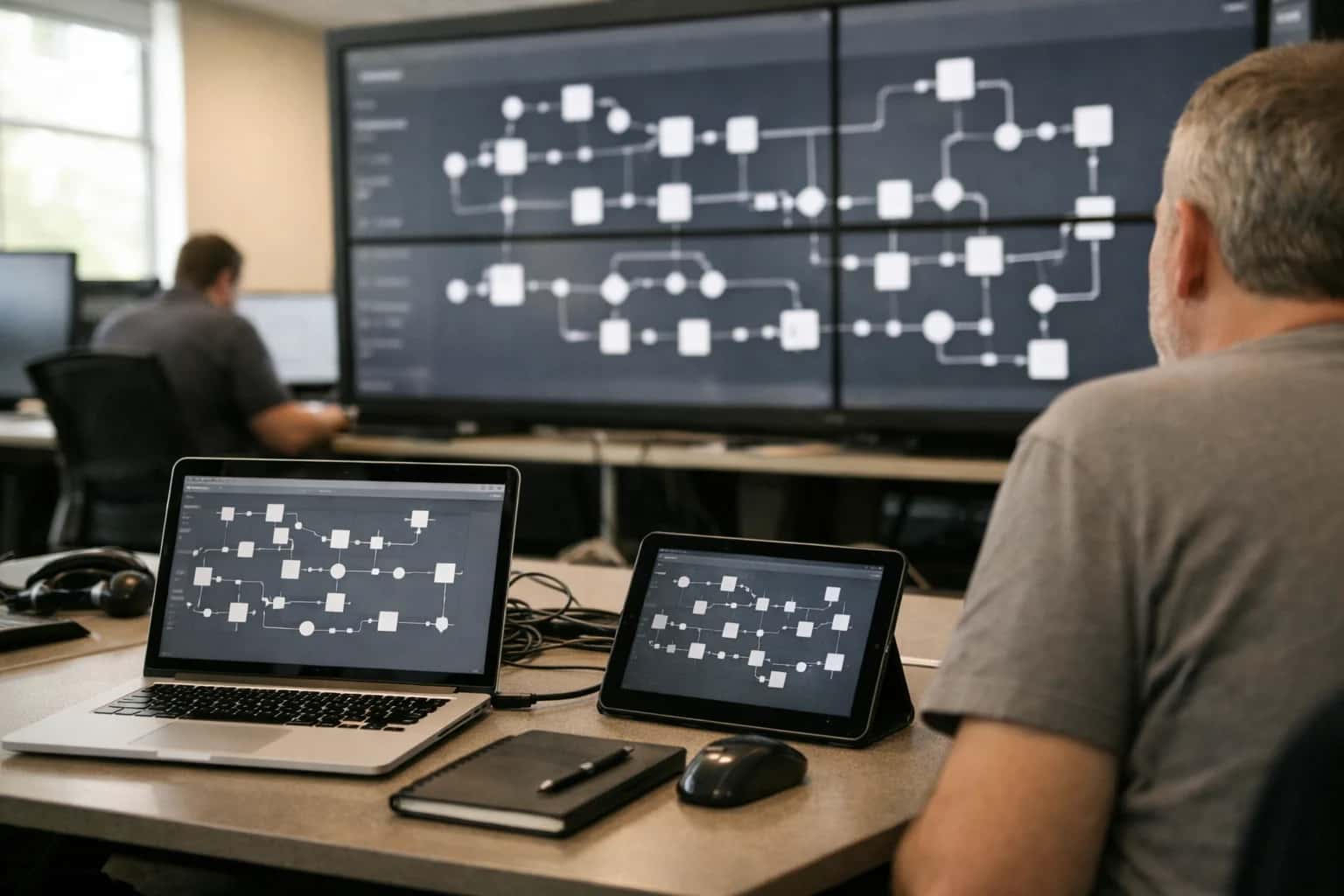
AUTONOMOUS DEBUGGING
What is Control Flow Analysis?
Control flow analysis is a foundational technique in autonomous debugging, enabling agents to understand and verify the logical sequence of their own execution.
In the context of recursive error correction, control flow analysis enables an agent to perform self-evaluation by comparing its actual execution trace against an expected or valid CFG. This allows for automated root cause analysis when an anomaly is detected, pinpointing where the flow diverged. The analysis supports dynamic code repair and execution path adjustment by providing the structural understanding needed to safely reroute logic or apply corrective patches, forming a core component of self-healing software systems.
AUTONOMOUS DEBUGGING
Core Techniques of Control Flow Analysis
Control flow analysis is a foundational program analysis technique for autonomous debugging. It examines the order of execution to identify anomalies, dead code, and unexpected paths, enabling agents to reason about their own logic.
01
Static Control Flow Analysis
Static control flow analysis examines a program's source code or bytecode without executing it. It constructs a Control Flow Graph (CFG) where nodes represent basic blocks (sequences of instructions with a single entry and exit) and edges represent possible jumps, branches, or calls.
- Purpose: To identify unreachable code, infinite loops, and potential execution paths.
- Key Construct: The CFG is the primary data structure, enabling algorithms to compute dominance relationships and natural loops.
- Use in Autonomous Debugging: An agent can statically analyze its own planned action sequence to predict logical dead-ends before execution.
02
Dynamic Control Flow Analysis
Dynamic control flow analysis instruments and monitors a program during its execution. It captures the actual path taken, which is a single trace through the vast space of all possible static paths.
- Core Mechanism: Uses execution tracing or program profiling to record function calls, branches taken, and loop iterations.
- Output: Produces a concrete execution trace, which is vital for post-mortem debugging and understanding the exact conditions that led to a runtime fault.
- Agent Application: An autonomous agent can use dynamic traces from failed runs to compare intended vs. actual control flow, pinpointing where its reasoning diverged.
03
Control Flow Graphs (CFG)
A Control Flow Graph (CFG) is a directed graph representation of all paths that might be traversed during a program's execution.
- Nodes: Represent basic blocks—straight-line code sequences with no branches.
- Edges: Represent control flow transfers between blocks (e.g., jumps, conditional branches, function returns).
- Critical Analyses Enabled:
- Dominator Analysis: Finding nodes through which all paths to a given node must pass.
- Natural Loop Detection: Identifying cycles in the graph for optimization and understanding iterative behavior.
- Reachability Analysis: Determining which code is potentially executable.
04
Interprocedural Analysis
Interprocedural control flow analysis extends beyond single functions to model calls and returns across an entire program or module. It connects the CFGs of individual functions into a larger Call Graph.
- Call Graph: A directed graph where nodes are functions and edges represent possible callsites.
- Challenge: Accurately resolving dynamic dispatch (e.g., virtual method calls, function pointers) is complex and may require conservative approximation.
- Debugging Value: For an agent, this technique is essential to trace an error's propagation across tool calls or internal subroutines, moving from symptom to root cause.
05
Exception & Interrupt Flow
This technique specifically models non-local control flow caused by exceptions, signals, and interrupts. These constructs create implicit, often unseen edges in the CFG.
- Analysis Goal: To understand all possible handlers for a thrown exception and the cleanup (stack unwinding) that occurs.
- Exception Propagation Mapping: Charts how an error bubbles up through the call stack, which is critical for automated root cause analysis.
- Agent Relevance: Autonomous systems must model their own error-handling pathways to implement correct rollback mechanisms and self-correction protocols.
06
Path-Sensitive Analysis
Path-sensitive analysis refines general control flow analysis by tracking the specific boolean conditions that hold true along different execution paths. It prunes infeasible paths from consideration.
- Mechanism: Uses symbolic execution or constraint solving to reason about the predicates governing branches.
- Benefit: Dramatically reduces false positives by proving certain code is unreachable under any valid input, leading to more precise fault localization.
- Advanced Debugging: Enables agents to perform hypothetical reasoning ('If I had taken the other branch, what would have happened?'), a key component of recursive reasoning loops.
METHODOLOGY COMPARISON
Static vs. Dynamic Control Flow Analysis
A comparison of the two primary techniques for analyzing the order of execution in a program, used in autonomous debugging to identify anomalous or unexpected paths.
| Analysis Dimension | Static Control Flow Analysis | Dynamic Control Flow Analysis |
|---|---|---|
Analysis Timing | Performed without executing the program. | Performed during or after program execution. |
Input Dependence | Analyzes all possible paths, independent of specific inputs. | Analyzes a single, concrete execution path for a given input. |
Completeness | Theoretically complete for path discovery but may produce false positives. | Concrete and precise for the observed path but path-incomplete. |
Primary Output | Control Flow Graph (CFG) representing all possible execution paths. | Execution Trace or Call Stack representing one actual path. |
Key Technique | Abstract interpretation of source code or bytecode. | Runtime instrumentation (e.g., eBPF, debuggers). |
Use in Autonomous Debugging | Proactively identifies potential dead code, unreachable states, or logical anomalies. | Reactively diagnoses the actual path taken during a failure for root cause inference. |
Integration with Pillar | Foundational for preemptive error detection in Self-Healing Software Systems. | Core to Automated Root Cause Analysis and State Snapshotting. |
Overhead | Zero runtime overhead; cost is upfront compute. | Adds runtime instrumentation overhead (typically 5-30%). |
Path Coverage | 100% of syntactically possible paths. | Coverage limited to the paths triggered by test inputs or runtime traffic. |
CONTROL FLOW ANALYSIS
Applications in Autonomous Debugging
Control flow analysis provides the foundational map for autonomous debugging agents, enabling them to trace execution paths, identify deviations, and pinpoint the logical origin of failures.
01
Anomalous Path Detection
By constructing a Control Flow Graph (CFG), an autonomous agent can compare the expected sequence of basic blocks against the actual runtime trace. This allows it to flag unexpected loops, unreachable code that was executed, or missing branches that should have been taken. For example, if a function designed to handle an error state is never called despite an exception being thrown, the agent identifies this as a control flow anomaly requiring investigation.
02
Root Cause Isolation for Crashes
When an agent encounters a segmentation fault or unhandled exception, control flow analysis helps isolate the faulting instruction within the broader execution context. The agent analyzes the call stack and reconstructs the path of function calls leading to the crash. By correlating this with the CFG, it can determine if the crash resulted from:
- A null pointer dereference on a predictable branch.
- An infinite recursion that breached stack limits.
- A violated precondition in a library function. This precise localization is the first step in automated repair.
03
Dynamic Invariant Violation
Autonomous debuggers use control flow analysis to infer and monitor program invariants—conditions that must hold true at specific points in the execution. For instance, a variable should only be modified within a certain loop, or a resource handle must be closed before a function returns. By instrumenting the CFG, the agent can:
- Insert runtime checks at critical nodes (e.g., function entries/exits, loop headers).
- Detect when the actual flow violates these inferred rules, signaling a logic error or state corruption.
- This is more precise than generic assertion checking, as it's guided by the program's structure.
04
Concurrency Bug Identification
In multi-threaded environments, control flow analysis extends to concurrent control flow, examining interleavings of threads. Autonomous agents use it to identify classic concurrency bugs:
- Data races: Detecting parallel flows accessing a shared variable without synchronization where at least one access is a write.
- Deadlocks: Identifying circular wait conditions in the resource allocation graph superimposed on the CFG.
- Atomicity violations: Finding critical sections where the intended atomic flow was interrupted by a context switch. Tools like ThreadSanitizer and dynamic analysis frameworks leverage this principle.
05
Guiding Automated Test Generation
To explore and validate fixes, autonomous systems need to generate new test cases. Control flow analysis provides the code coverage targets. An agent can:
- Identify untested branches or MC/DC (Modified Condition/Decision Coverage) conditions in its CFG.
- Use symbolic execution to compute input values that will traverse a newly proposed corrective path.
- Generate fuzzing inputs aimed at covering specific, hard-to-reach nodes, ensuring the repaired code is exercised. This creates a self-reinforcing validation loop where analysis guides testing, and testing feedback refines the analysis.
06
Integration with Data Flow for Fault Localization
Control flow analysis is rarely used in isolation. In autonomous debugging, it is tightly coupled with Data Flow Analysis to perform spectrum-based fault localization. The agent collects:
- Execution spectra: Which CFG nodes (statements/branches) were executed in passing vs. failing runs.
- Data dependence edges: How variables' values flow between nodes. By combining these, the agent can compute suspiciousness scores for each node, dramatically narrowing the search for the faulty line of code. This hybrid approach is fundamental to tools like Delta Debugging and automated Root Cause Inference engines.
CONTROL FLOW ANALYSIS
Frequently Asked Questions
Control flow analysis is a fundamental technique in autonomous debugging, enabling systems to understand and verify the logical sequence of their own operations. These FAQs address its core mechanisms, applications, and relationship to other resilience patterns.
Control flow analysis is a program analysis technique, either static or dynamic, that examines the order in which statements, instructions, or function calls are executed to identify anomalies or unexpected paths. It works by constructing a control flow graph (CFG), where nodes represent basic blocks of code (sequences with no jumps) and edges represent the possible jumps, branches, or calls between them. In static analysis, the CFG is derived from the source code without execution, using algorithms to identify unreachable code, infinite loops, or potential execution paths. In dynamic analysis, the system instruments the running program to trace the actual sequence of executed instructions, comparing it against an expected model to detect deviations, such as illegal state transitions or violations of invariants. For autonomous agents, this analysis is often performed introspectively, where the agent models its own planned action sequence and monitors its execution in real-time for logical errors.
Enabling Efficiency, Speed & Accuracy
Intelligent Analysis, Decision & Execution
We build AI systems for teams that need search across company data, workflow automation across tools, or AI features inside products and internal software.
Talk to Us
Search across company data
Give teams answers from docs, tickets, runbooks, and product data with sources and permissions.
Useful when people spend too long searching or get different answers from different systems.
Enterprise searchRAGPermissions
Read more
Automate internal workflows
Use AI to route work, draft outputs, trigger actions, and keep approvals and logs in place.
Useful when repetitive work moves across multiple tools and teams.
AI agentsWorkflow automationGovernance
Read more
Add AI to products and internal tools
Build assistants, guided actions, or decision support into the software your team or customers already use.
Useful when AI needs to be part of the product, not a separate tool.
AI integrationDecision supportModel routing
Read more
About the author
Prasad Kumkar
CEO & MD, Inference Systems
Prasad Kumkar is the CEO & MD of Inference Systems and writes about AI systems architecture, LLM infrastructure, model serving, evaluation, and production deployment. Over 5+ years, he has worked across computer vision models, L5 autonomous vehicle systems, and LLM research, with a focus on taking complex AI ideas into real-world engineering systems.
His work and writing cover AI systems, large language models, AI agents, multimodal systems, autonomous systems, inference optimization, RAG, evaluation, and production AI engineering.
LinkedIn
Limited slotsGet a Free AI Consultation
Partnered with leading AI, data, and software stack.





How We Work
Custom AI workflows for your Business
One-fit-all AI don't work for modern businesses. At Inferensys, we aim to understand your business & custom requirements; which we use to define most efficient agentic workflows, the data, and the tools for your business.
01
Review the use case
We understand the task, the users, and where AI can actually help.
Read more02
Pick the right approach
We define what needs search, automation, or product integration.
Read more03
Build the first useful version
We implement the part that proves the value first.
Read more04
Improve from there
We add the checks and visibility needed to keep it useful.
Read moreThe first call is a practical review of your use case and the right next step.
Talk to Us