Semantic Split Computing is an architectural paradigm that partitions a deep neural network at an optimal intermediate layer, executing the initial semantic feature extraction on a local edge device and offloading the remaining computation to a centralized server. This split transmits a compact, task-relevant latent representation rather than raw sensor data, balancing on-device compute load, transmission bandwidth, and inference accuracy.

Glossary
Semantic Split Computing
An architecture that partitions a deep semantic model between an edge device and a network server, transmitting compact, intermediate semantic features instead of raw data to balance compute load and privacy.
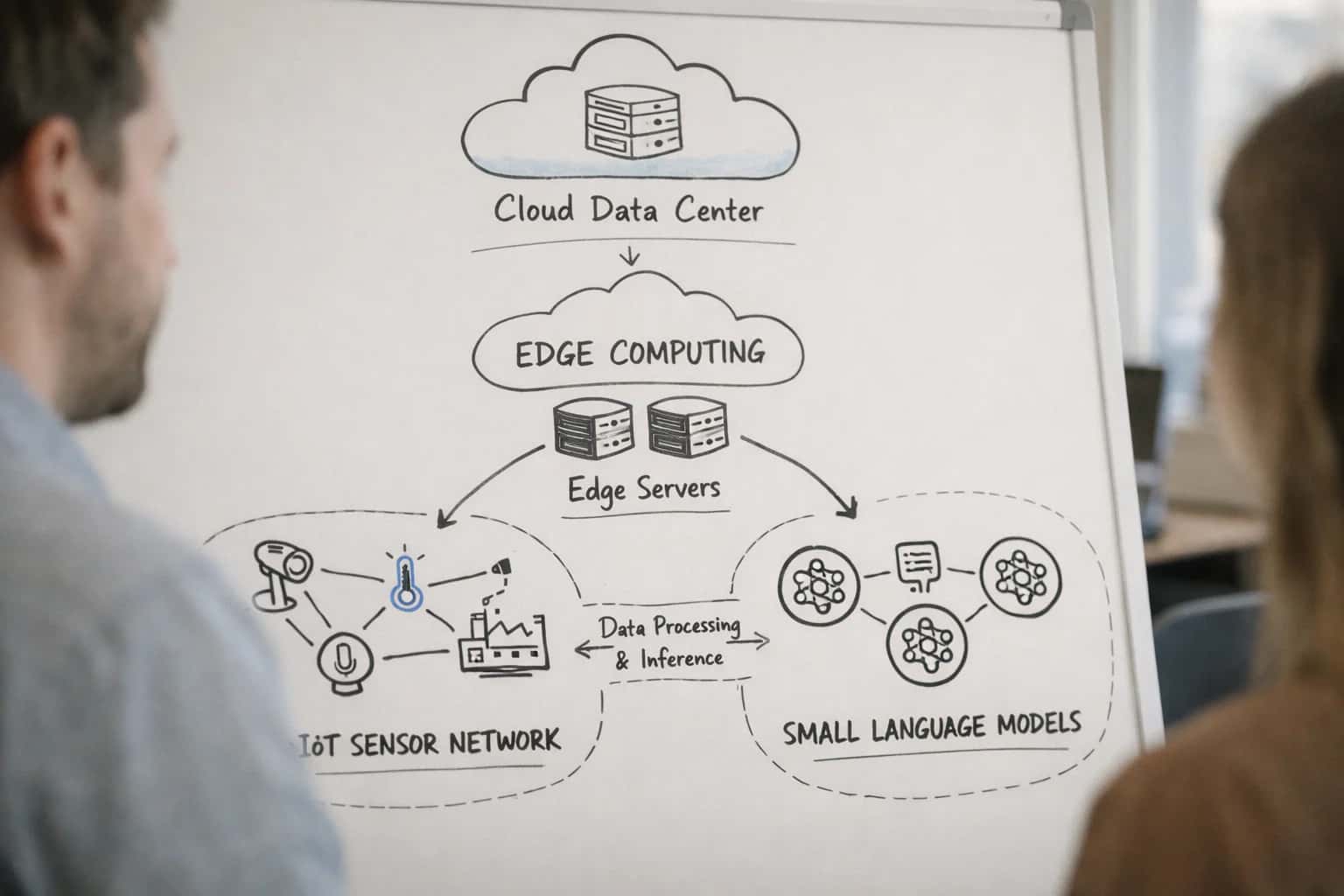
EDGE-NATIVE AI ARCHITECTURE
What is Semantic Split Computing?
A distributed inference architecture that partitions a deep semantic model between a resource-constrained edge device and a powerful network server, transmitting compact intermediate features instead of raw data.
The split point is strategically chosen using an information bottleneck principle, ensuring the transmitted features contain maximal task-relevant meaning while discarding irrelevant or private raw data. This approach directly addresses the tension between on-device model compression and cloud offloading, enabling low-latency semantic tasks in 6G and IoT environments without exposing sensitive source signals.
ARCHITECTURE PRINCIPLES
Key Features of Semantic Split Computing
Semantic split computing partitions a deep neural model between an edge device and a network server, transmitting compact intermediate features instead of raw data. This architecture balances on-device privacy with cloud-scale compute.
01
Bottleneck Feature Transmission
The core innovation of semantic split computing is transmitting only the latent feature tensor from an intermediate neural network layer, not the raw input. This bottleneck representation is typically 100x to 1000x smaller than the source data. For example, a 224x224 RGB image (150k values) can be compressed to a 7x7x512 feature map (25k values) while preserving task-relevant semantics. The split layer is chosen to balance compression ratio against downstream task accuracy.
02
Privacy-Preserving Architecture
By transmitting abstract feature vectors instead of raw sensor data, semantic split computing provides an inherent privacy barrier. The network operator never receives the original image, audio, or RF waveform. Key properties include:
- Input obfuscation: Raw data stays on-device
- Non-invertibility: Intermediate features cannot be trivially reconstructed into the original input
- Differential privacy guarantees: Noise can be injected at the split layer to provide formal privacy bounds This makes the architecture suitable for GDPR-compliant and HIPAA-compliant deployments.
03
Compute Offloading Strategy
Semantic split computing enables dynamic workload partitioning between resource-constrained edge devices and powerful cloud servers. The edge executes the initial feature extraction layers (often quantized for efficiency), while the cloud handles the computationally intensive semantic reasoning layers. This is critical for:
- TinyML devices: Microcontrollers running only 2-3 initial conv layers
- Mobile AR/VR: Offloading heavy transformer decoders to edge servers
- Autonomous systems: Splitting perception models between onboard NPU and remote inference engines
04
Joint Source-Channel Integration
Unlike traditional systems that separately compress then channel-code data, semantic split computing enables joint optimization of the feature extractor and the wireless transmitter. The split layer's output can be directly mapped to channel symbols using learned constellation designs. This end-to-end training approach maximizes task performance under specific channel conditions (SNR, fading, interference) rather than optimizing for abstract bit-error metrics. Research shows 10-15 dB gain in effective SNR for image classification tasks compared to separate source-channel coding.
05
Task-Adaptive Split Points
The split layer position is not fixed but can be dynamically selected based on:
- Channel quality: Deeper splits (more compression) for poor channel conditions
- Task complexity: Earlier splits for simple classification, later splits for detailed reconstruction
- Available edge compute: More layers on-device when local GPU/NPU capacity permits
- Privacy requirements: Earlier splits when stricter input privacy is needed This adaptability is implemented through multi-exit architectures where the model has multiple potential split points, each trained for different operating regimes.
06
Entropy-Constrained Feature Coding
To maximize transmission efficiency, semantic split computing employs learned entropy models that estimate the probability distribution of feature tensors. This enables arithmetic coding of the bottleneck representation, achieving near-optimal compression rates. Advanced implementations use:
- Hyperprior networks: A secondary autoencoder that transmits side information about feature statistics
- Context-adaptive coding: Exploiting spatial correlations within feature maps
- Variable-rate training: A single model that can operate across a range of bitrates by conditioning on a rate parameter
Enabling Efficiency, Speed & Accuracy
Intelligent Analysis, Decision & Execution
We build AI systems for teams that need search across company data, workflow automation across tools, or AI features inside products and internal software.
Talk to Us
Search across company data
Give teams answers from docs, tickets, runbooks, and product data with sources and permissions.
Useful when people spend too long searching or get different answers from different systems.
Enterprise searchRAGPermissions
Read more
Automate internal workflows
Use AI to route work, draft outputs, trigger actions, and keep approvals and logs in place.
Useful when repetitive work moves across multiple tools and teams.
AI agentsWorkflow automationGovernance
Read more
Add AI to products and internal tools
Build assistants, guided actions, or decision support into the software your team or customers already use.
Useful when AI needs to be part of the product, not a separate tool.
AI integrationDecision supportModel routing
Read moreSEMANTIC SPLIT COMPUTING
Frequently Asked Questions
Explore the architectural principles and operational mechanics of partitioning deep semantic models between edge devices and network servers to optimize compute load, latency, and data privacy.
Semantic split computing is a distributed inference architecture that partitions a deep neural network at an optimal intermediate layer, executing the initial layers on a local edge device and offloading the remaining computation to a powerful network server. Instead of transmitting raw, high-dimensional sensor data, the edge device extracts and transmits a compact, task-relevant semantic feature representation—a compressed bottleneck of meaning. The server then completes the inference using its larger model capacity. This process fundamentally differs from traditional cloud offloading by transmitting what the data means rather than what the data is, drastically reducing bandwidth requirements while preserving privacy, as the raw signal never leaves the local device. The specific split point is dynamically chosen based on network conditions, device compute budget, and the target task's accuracy requirements.

About the author
Prasad Kumkar
CEO & MD, Inference Systems
Prasad Kumkar is the CEO & MD of Inference Systems and writes about AI systems architecture, LLM infrastructure, model serving, evaluation, and production deployment. Over 5+ years, he has worked across computer vision models, L5 autonomous vehicle systems, and LLM research, with a focus on taking complex AI ideas into real-world engineering systems.
His work and writing cover AI systems, large language models, AI agents, multimodal systems, autonomous systems, inference optimization, RAG, evaluation, and production AI engineering.
LinkedIn
Limited slotsGet a Free AI Consultation
Partnered with leading AI, data, and software stack.





How We Work
Custom AI workflows for your Business
One-fit-all AI don't work for modern businesses. At Inferensys, we aim to understand your business & custom requirements; which we use to define most efficient agentic workflows, the data, and the tools for your business.
01
Review the use case
We understand the task, the users, and where AI can actually help.
Read more02
Pick the right approach
We define what needs search, automation, or product integration.
Read more03
Build the first useful version
We implement the part that proves the value first.
Read more04
Improve from there
We add the checks and visibility needed to keep it useful.
Read moreThe first call is a practical review of your use case and the right next step.
Talk to Us