Knowledge distillation is a machine learning compression technique where a smaller, efficient student model is trained to replicate the soft output distributions of a larger, high-capacity teacher model. Rather than training solely on hard labels, the student learns from the teacher's logits, capturing inter-class similarities and dark knowledge that improve generalization beyond standard supervised learning.

Glossary
Knowledge Distillation
A model compression technique where a smaller, efficient student model is trained to replicate the behavior of a larger, more complex teacher model.
MODEL COMPRESSION
What is Knowledge Distillation?
Knowledge distillation is a model compression technique where a compact 'student' model is trained to mimic the behavior of a larger, more complex 'teacher' model, transferring generalization capabilities to a deployment-efficient architecture.
The process uses a temperature parameter in the softmax function to soften the teacher's probability distribution, exposing the nuanced relationships the teacher has learned. The student minimizes a combined loss function of the standard cross-entropy with ground truth and the Kullback-Leibler divergence between its softened outputs and the teacher's, enabling deployment on resource-constrained edge hardware.
MODEL COMPRESSION
Key Characteristics of Knowledge Distillation
A teacher-student training paradigm where a compact model learns to mimic the generalized behavior and 'dark knowledge' of a larger, high-capacity network.
01
The Teacher-Student Architecture
The framework involves two distinct models: a large, pre-trained teacher and a compact, untrained student. The student is optimized using a composite loss function that combines the standard ground-truth loss with a distillation loss, which penalizes the divergence between the student's softened output distribution and the teacher's. Crucially, the teacher's weights are frozen during this process.
Frozen
Teacher Weights
Composite
Loss Function
02
Soft Targets and Temperature
Instead of training only on hard labels, the student learns from soft targets—the teacher's output probability vector. A temperature hyperparameter (T) is applied to the softmax function to soften these probabilities, revealing the relative similarities between incorrect classes. This 'dark knowledge' provides richer information per sample, teaching the student how the teacher generalizes rather than just memorizing final predictions.
T > 1
Softening Factor
03
Distillation Loss Functions
The student is optimized by minimizing the discrepancy between its softened logits and the teacher's. Common loss functions include:
- Kullback-Leibler (KL) Divergence: The standard choice for matching softened probability distributions.
- Mean Squared Error (MSE): Applied directly to the logits before the softmax layer, preserving the teacher's internal representation geometry.
- Cosine Embedding Loss: Used to align the direction of feature vectors in the penultimate layer.
KL Divergence
Standard Loss
04
Offline vs. Online Distillation
Offline distillation is the traditional two-phase process where a large teacher is pre-trained first, and then its knowledge is transferred to a student. Online distillation updates both models simultaneously in a single end-to-end training loop, often using a peer-ensemble strategy where multiple students learn from each other. Self-distillation is a variant where a model uses its own earlier, deeper checkpoints as the teacher.
2-Phase
Offline Mode
End-to-End
Online Mode
05
Feature-Based Distillation
Beyond matching final output probabilities, the student can be trained to replicate the teacher's intermediate feature representations. This involves minimizing the distance between activation maps of corresponding layers. Techniques include:
- Attention Transfer: Forcing the student to mimic the teacher's spatial attention maps.
- Hint-Based Learning: Using a regressor to map the student's narrower hidden layer to the teacher's wider dimension before computing the loss.
Attention Maps
Transfer Target
06
Distillation for Edge Deployment
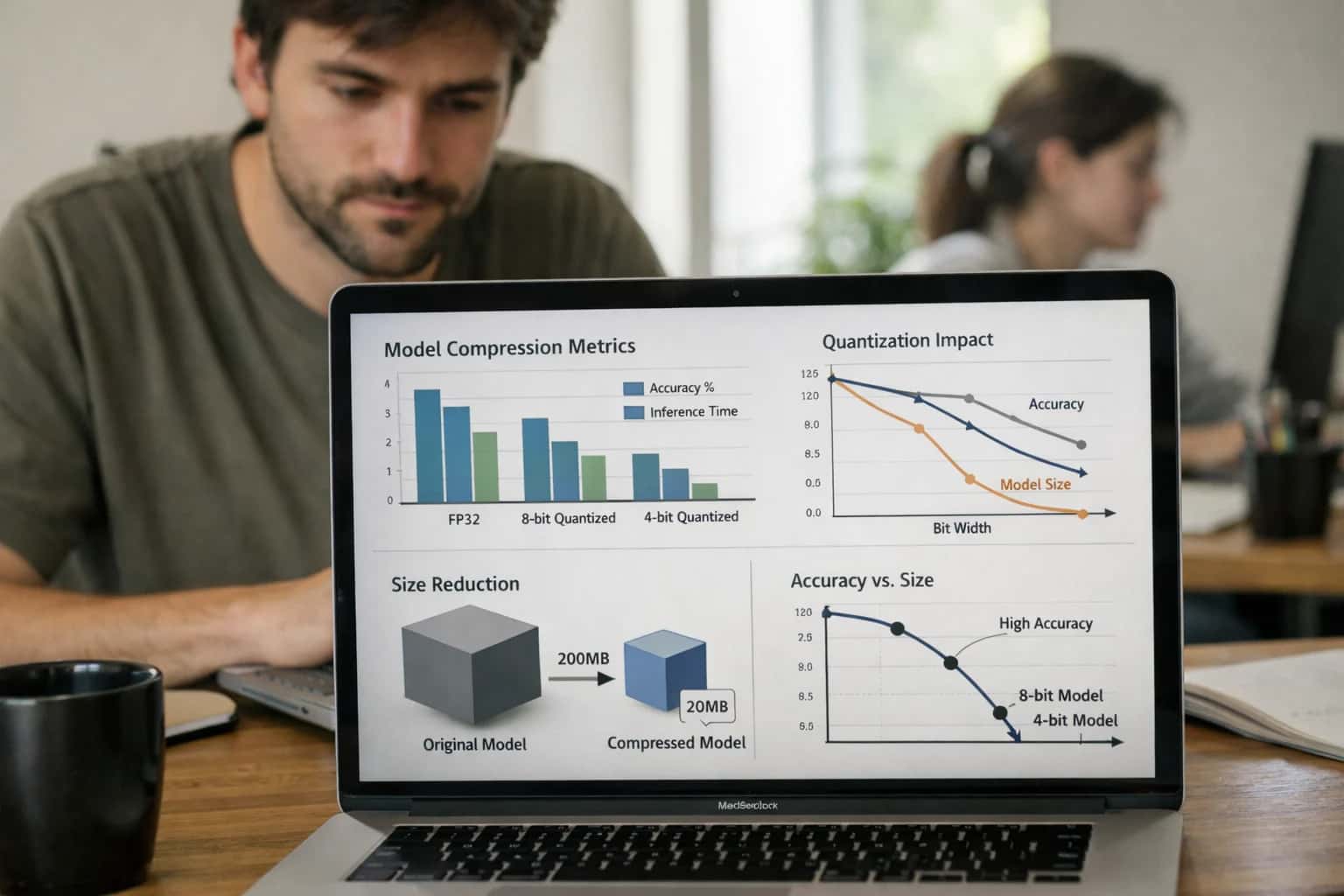
Knowledge distillation is a critical enabler for TinyML and edge AI. It allows a cumbersome cloud-scale model (e.g., a massive transformer) to train a highly efficient model suitable for microcontrollers or mobile GPUs. The student architecture is often a hand-crafted compact CNN or a MobileNet, achieving significant reductions in inference latency and memory footprint without catastrophic accuracy loss compared to direct training on limited data.
10x+
Typical Compression
KNOWLEDGE DISTILLATION
Frequently Asked Questions
Core concepts and mechanisms behind the teacher-student model compression paradigm for efficient edge AI deployment.
Knowledge distillation is a model compression technique where a compact student model is trained to mimic the behavior of a larger, high-capacity teacher model. Instead of learning solely from hard ground-truth labels, the student learns from the teacher's softened output probabilities, known as soft targets. These soft targets contain rich information about inter-class similarities that the teacher has discovered. The process involves minimizing a combined loss function: a distillation loss that matches the student's softened outputs to the teacher's, and a student loss against the true labels. A temperature parameter in the softmax function controls the softness of the probability distribution, revealing the dark knowledge embedded in the teacher's predictions. This transfers the generalization capability of the cumbersome model into a deployment-efficient architecture suitable for edge hardware.
Enabling Efficiency, Speed & Accuracy
Intelligent Analysis, Decision & Execution
We build AI systems for teams that need search across company data, workflow automation across tools, or AI features inside products and internal software.
Talk to Us
Search across company data
Give teams answers from docs, tickets, runbooks, and product data with sources and permissions.
Useful when people spend too long searching or get different answers from different systems.
Enterprise searchRAGPermissions
Read more
Automate internal workflows
Use AI to route work, draft outputs, trigger actions, and keep approvals and logs in place.
Useful when repetitive work moves across multiple tools and teams.
AI agentsWorkflow automationGovernance
Read more
Add AI to products and internal tools
Build assistants, guided actions, or decision support into the software your team or customers already use.
Useful when AI needs to be part of the product, not a separate tool.
AI integrationDecision supportModel routing
Read more
About the author
Prasad Kumkar
CEO & MD, Inference Systems
Prasad Kumkar is the CEO & MD of Inference Systems and writes about AI systems architecture, LLM infrastructure, model serving, evaluation, and production deployment. Over 5+ years, he has worked across computer vision models, L5 autonomous vehicle systems, and LLM research, with a focus on taking complex AI ideas into real-world engineering systems.
His work and writing cover AI systems, large language models, AI agents, multimodal systems, autonomous systems, inference optimization, RAG, evaluation, and production AI engineering.
LinkedIn
Limited slotsGet a Free AI Consultation
Partnered with leading AI, data, and software stack.





How We Work
Custom AI workflows for your Business
One-fit-all AI don't work for modern businesses. At Inferensys, we aim to understand your business & custom requirements; which we use to define most efficient agentic workflows, the data, and the tools for your business.
01
Review the use case
We understand the task, the users, and where AI can actually help.
Read more02
Pick the right approach
We define what needs search, automation, or product integration.
Read more03
Build the first useful version
We implement the part that proves the value first.
Read more04
Improve from there
We add the checks and visibility needed to keep it useful.
Read moreThe first call is a practical review of your use case and the right next step.
Talk to Us