Policy-as-Code is the methodology of codifying governance, security, and compliance rules into executable, version-controlled scripts. By writing policies in a high-level language like Rego or Python, organizations replace manual, error-prone approval workflows with automated, deterministic enforcement points that validate every content operation against a single source of truth.

Glossary
Policy-as-Code
Policy-as-Code is the methodology of defining, managing, and enforcing governance rules, security policies, and compliance checks through machine-readable definition files stored in version control rather than through manual, document-based processes.
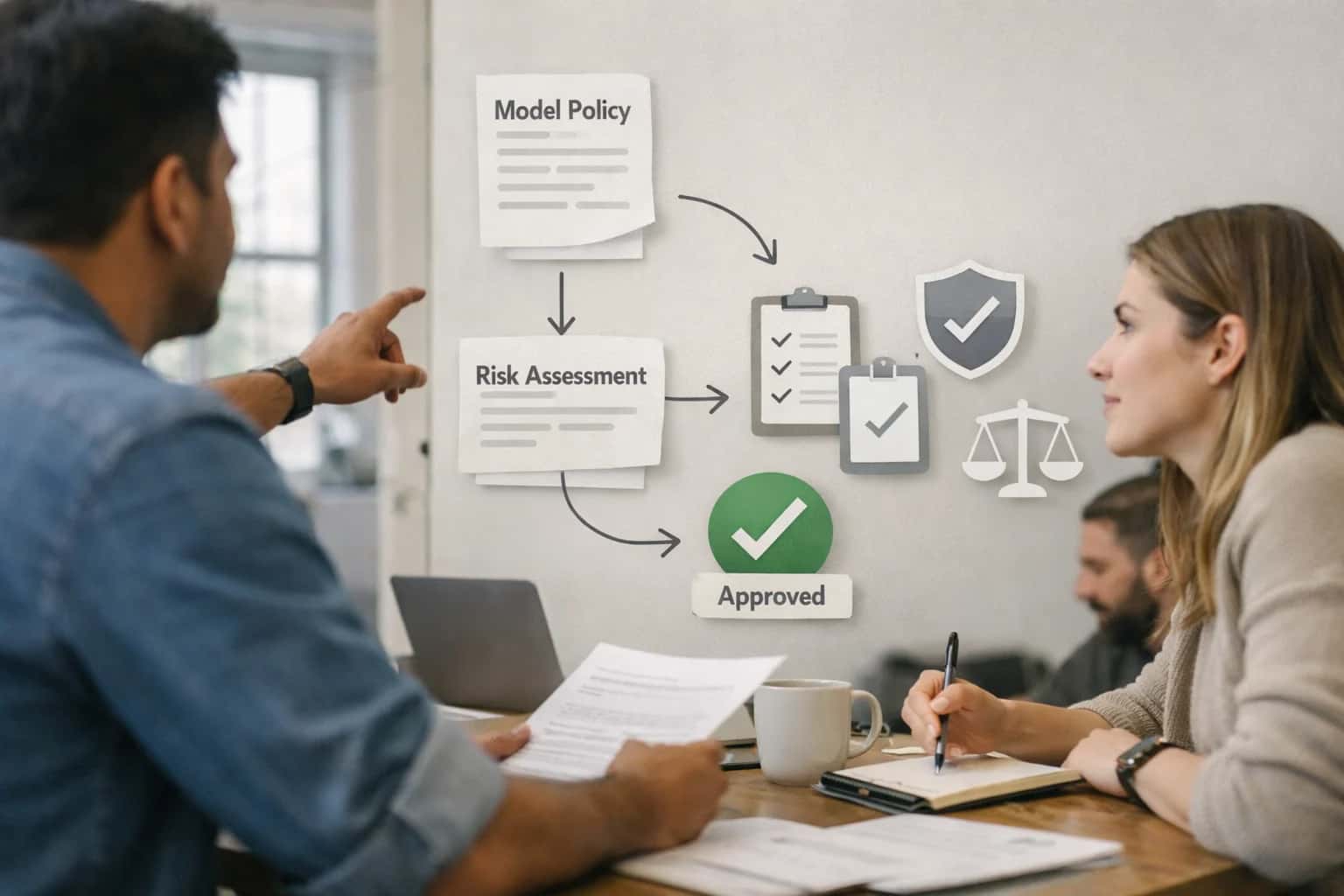
PROGRAMMATIC GOVERNANCE
What is Policy-as-Code?
Policy-as-Code is the practice of defining and managing governance rules, compliance checks, and security policies in a machine-readable, version-controlled programming language rather than through manual processes.
This approach integrates directly into the CI/CD pipeline, enabling shift-left security where violations are caught before deployment. A Policy Decision Point (PDP) evaluates requests against the codified logic, ensuring that automated content generation, access control, and data sovereignty tagging adhere strictly to regulatory requirements without human bottlenecks.
GOVERNANCE ARCHITECTURE
Core Characteristics of Policy-as-Code
Policy-as-Code transforms governance from a human-dependent, error-prone process into a deterministic, automated software function. It applies software development lifecycle best practices—version control, testing, and CI/CD—to the management of compliance, security, and operational rules.
01
Machine-Readable Definition
Policies are authored in high-level declarative languages like Rego (Open Policy Agent) or Sentinel (HashiCorp), not static PDFs or wiki pages. This allows a machine to parse, evaluate, and enforce a rule against structured input data (JSON) to return a binary allow/deny decision. The logic is explicit and unambiguous, eliminating interpretation drift between a human auditor and the system.
02
Version-Controlled Artifact
Policy definitions are stored as text files in a Git repository, granting them the same provenance as application code. This enables:
- Auditability: A complete
git logof who changed a rule, when, and why. - Rollback: Instantaneous reversion to a last-known-good policy state if a new rule causes a production outage.
- Branching: Testing a proposed compliance rule in a staging environment before merging it to production.
03
Automated Testing & Validation
Policy-as-Code mandates unit testing for governance logic. Teams write assertions to verify that a policy correctly denies a non-compliant payload and allows a valid one. These tests run in a CI/CD pipeline, preventing regressions. A policy that passes OPA test is guaranteed to behave deterministically, shifting compliance verification from a periodic audit to a continuous integration gate.
04
Decoupled Decision Engine
The policy decision point is architecturally decoupled from the application. A service queries a policy engine (e.g., OPA running as a sidecar or daemon) via a local API call. This separation of concerns means application developers focus on business logic while the platform team manages authorization logic centrally. The decision is made in microseconds, enabling low-latency enforcement at the API gateway, service mesh, or database proxy layer.
05
Continuous Compliance Monitoring
Beyond admission control, Policy-as-Code enables constant scanning of existing infrastructure state against a desired configuration. Tools like Checkov or tfsec evaluate Terraform plan outputs and live cloud resources against codified security benchmarks (CIS, SOC 2). A violation generates a specific alert with a remediation code, closing the loop between detection and automated drift remediation without a human ticket.
06
Unified Governance Language
A single policy language can enforce rules across heterogeneous stacks. The same Rego module that validates Kubernetes pod security contexts can also authorize an API call, check a Kafka message schema, or verify a SQL query's access scope. This unification collapses the tool sprawl of disparate IAM, firewall, and compliance scanners into a single source of truth for business logic authorization.
Enabling Efficiency, Speed & Accuracy
Intelligent Analysis, Decision & Execution
We build AI systems for teams that need search across company data, workflow automation across tools, or AI features inside products and internal software.
Talk to Us
Search across company data
Give teams answers from docs, tickets, runbooks, and product data with sources and permissions.
Useful when people spend too long searching or get different answers from different systems.
Enterprise searchRAGPermissions
Read more
Automate internal workflows
Use AI to route work, draft outputs, trigger actions, and keep approvals and logs in place.
Useful when repetitive work moves across multiple tools and teams.
AI agentsWorkflow automationGovernance
Read more
Add AI to products and internal tools
Build assistants, guided actions, or decision support into the software your team or customers already use.
Useful when AI needs to be part of the product, not a separate tool.
AI integrationDecision supportModel routing
Read morePOLICY-AS-CODE
Frequently Asked Questions
Clear, technical answers to the most common questions about defining, deploying, and enforcing governance rules as machine-readable code.
Policy-as-Code (PaC) is the methodology of defining and managing governance rules, security policies, and compliance checks in a machine-readable, version-controlled programming language rather than through manual, document-based processes. It works by translating human-readable policy requirements into executable code using specialized policy languages like Rego (for Open Policy Agent), Sentinel (HashiCorp), or general-purpose languages with policy frameworks. These codified policies are stored in a version control system (e.g., Git), allowing for collaborative authoring, peer review, and full audit trails. At runtime, a policy engine evaluates incoming requests or infrastructure states against the defined rules, returning an allow/deny decision or a list of violations. This shifts policy enforcement from a manual gatekeeping function to an automated, continuous, and deterministic software pipeline, ensuring that every content asset, API call, or infrastructure change is validated against the same immutable logic.

About the author
Prasad Kumkar
CEO & MD, Inference Systems
Prasad Kumkar is the CEO & MD of Inference Systems and writes about AI systems architecture, LLM infrastructure, model serving, evaluation, and production deployment. Over 5+ years, he has worked across computer vision models, L5 autonomous vehicle systems, and LLM research, with a focus on taking complex AI ideas into real-world engineering systems.
His work and writing cover AI systems, large language models, AI agents, multimodal systems, autonomous systems, inference optimization, RAG, evaluation, and production AI engineering.
LinkedIn
Limited slotsGet a Free AI Consultation
Partnered with leading AI, data, and software stack.





How We Work
Custom AI workflows for your Business
One-fit-all AI don't work for modern businesses. At Inferensys, we aim to understand your business & custom requirements; which we use to define most efficient agentic workflows, the data, and the tools for your business.
01
Review the use case
We understand the task, the users, and where AI can actually help.
Read more02
Pick the right approach
We define what needs search, automation, or product integration.
Read more03
Build the first useful version
We implement the part that proves the value first.
Read more04
Improve from there
We add the checks and visibility needed to keep it useful.
Read moreThe first call is a practical review of your use case and the right next step.
Talk to Us