Policy-as-Code is the methodology of codifying governance and compliance rules into executable scripts rather than relying on manual review documents. By writing policies in languages like Rego or Sentinel, organizations shift security and regulatory checks left into the development lifecycle, allowing infrastructure-as-code and application configurations to be automatically validated against a central source of truth before deployment.

Glossary
Policy-as-Code
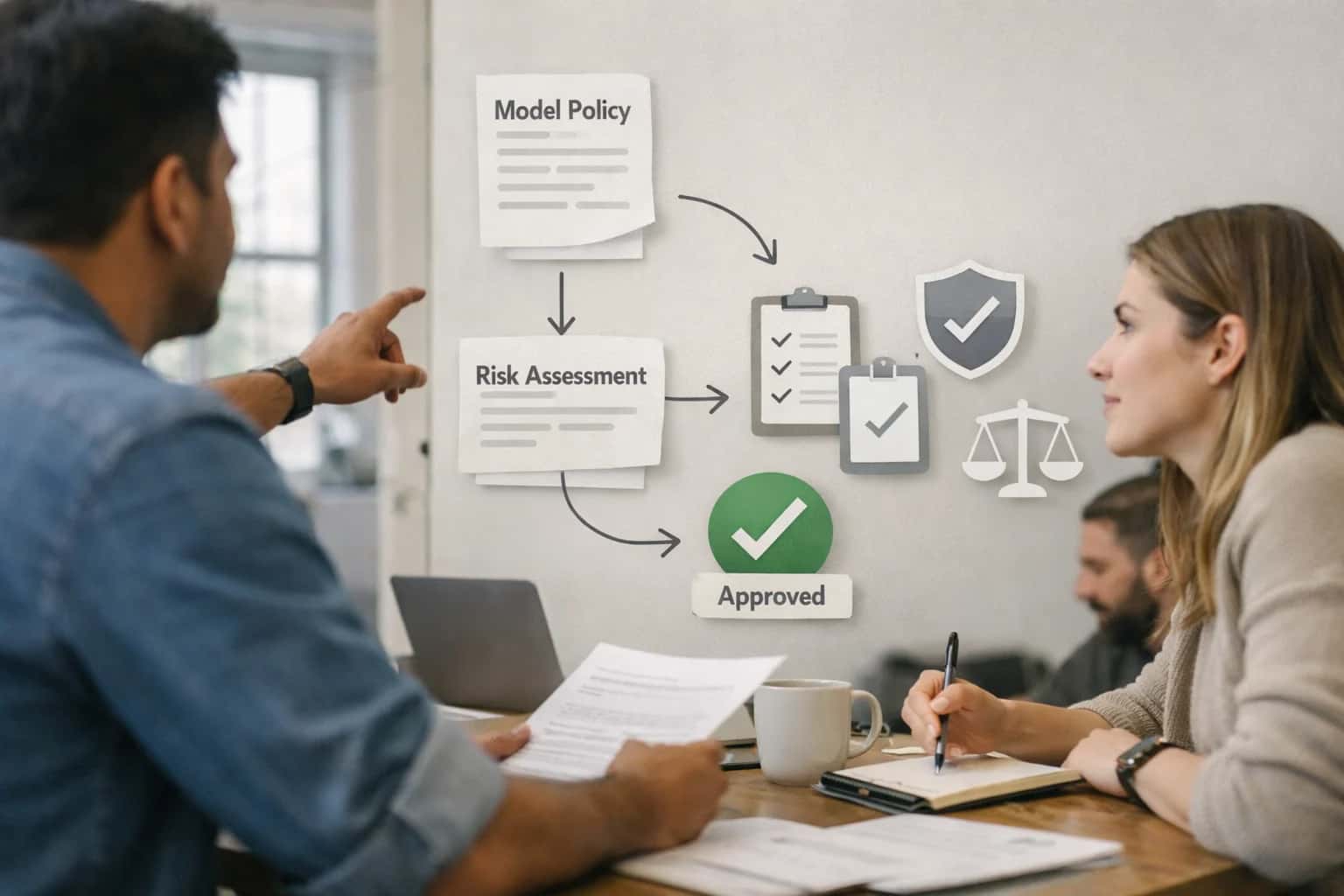
Policy-as-Code is the practice of defining compliance, security, and governance rules in a machine-readable programming language, enabling automated enforcement and validation within CI/CD pipelines.
AUTOMATED GOVERNANCE
What is Policy-as-Code?
Policy-as-Code is the practice of defining compliance, security, and operational rules in a machine-readable programming language, enabling automated enforcement and validation within CI/CD pipelines.
This approach eliminates configuration drift and human error by integrating directly with CI/CD pipelines and version control systems. A git commit triggers an automated policy evaluation, blocking non-compliant changes instantly. This provides a real-time, auditable enforcement mechanism that scales across multi-cloud environments, ensuring every resource adheres to regulatory standards like HIPAA or SOC 2 without manual gating.
AUTOMATED GOVERNANCE
Core Characteristics of Policy-as-Code
Policy-as-Code transforms governance from a manual review process into an automated, verifiable software pipeline. These characteristics define how machine-readable rules enforce compliance at every stage of the development lifecycle.
01
Declarative Rule Definition
Policies are expressed as declarative code rather than procedural instructions. This means you specify the desired end-state of compliance (e.g., 'all S3 buckets must be encrypted') without scripting the step-by-step logic to check it. The policy engine handles the evaluation.
- Separation of concerns: Policy logic is decoupled from application business logic.
- Human-readable intent: Rules written in high-level languages like Rego or Sentinel are auditable by non-engineering stakeholders.
- Idempotency: Evaluating a policy multiple times against the same input always yields the same result.
Rego
Dominant Language (OPA)
02
Version-Controlled Artifact
Policy code is stored in a version control system (like Git) alongside application and infrastructure code. This practice subjects governance rules to the same rigorous software development lifecycle as the systems they protect.
- Audit trail: Every change to a rule is logged with a timestamp, author, and diff.
- Peer review: Policy changes require pull requests and approvals before merging.
- Rollback capability: Faulty policies that cause production blocks can be instantly reverted to a last-known-good state.
Immutable
Change History
03
Automated CI/CD Enforcement
Policy evaluation is integrated directly into Continuous Integration and Continuous Deployment (CI/CD) pipelines. This creates a hard gate that automatically blocks non-compliant infrastructure or application changes before they reach production.
- Shift-left security: Violations are caught at pull request time, not during a post-deployment audit.
- Terraform integration: Tools like HashiCorp Sentinel evaluate Terraform plans pre-apply.
- Kubernetes admission control: OPA Gatekeeper acts as a validating webhook to reject non-conformant API objects in real-time.
Pre-Deploy
Enforcement Point
04
Deterministic Decision-Making
A core tenet of Policy-as-Code is determinism: a specific input combined with a specific policy version will always produce the same binary decision (allow or deny). This removes the ambiguity and inconsistency inherent in human-mediated governance.
- Eliminates interpretation drift: Two different auditors will not reach different conclusions from the same evidence.
- Structured logging: Every decision is accompanied by a structured JSON log explaining the exact rule that triggered the denial.
- Unit testing: Policies can be tested with mock input data to prove correctness before deployment.
Boolean
Output Type
05
Context-Aware Evaluation
Modern policy engines evaluate requests against rich, dynamic contextual data (often called data.json in OPA). This allows rules to consider external factors beyond the immediate request payload, enabling complex, stateful authorization logic.
- External data binding: Policies can query databases or APIs at decision-time to check user roles, IP reputation, or license limits.
- Hierarchical inheritance: Rules can be structured to inherit base policies and override specific parameters for different environments (dev vs. prod).
- Time-based constraints: Policies can enforce rules like 'deployments are blocked during business hours' by checking the current timestamp.
Milliseconds
Decision Latency
06
Unified Governance Plane
Policy-as-Code provides a single pane of glass for managing rules across the entire heterogeneous technology stack. The same policy language and engine can govern Kubernetes clusters, API gateways, SSH access, and CI/CD pipelines.
- Consistent taxonomy: A single definition of 'PII' or 'high-availability' is enforced everywhere.
- Reduced tool sprawl: Replaces a patchwork of cloud-specific IAM rules, custom scripts, and manual checklists.
- Centralized policy distribution: Policy bundles can be signed and distributed to multiple enforcement points from a central registry.
Multi-Cloud
Operational Scope
GOVERNANCE PARADIGM COMPARISON
Policy-as-Code vs. Traditional Policy Management
A feature-level comparison between machine-enforceable policy definitions and conventional manual governance processes.
| Feature | Policy-as-Code | Traditional Policy Management | Hybrid Approach |
|---|---|---|---|
Enforcement mechanism | Automated via CI/CD pipeline gates | Manual review and audit committees | Automated checks with manual override |
Policy definition format | Machine-readable code (Rego, OPA, JSON) | Human-readable documents (PDF, Word) | Structured YAML with prose annotations |
Version control | |||
Audit trail granularity | Per-commit, per-resource | Periodic manual audit reports | Automated with periodic human review |
Policy drift detection | Real-time, < 1 sec | Weeks to months | Near real-time, < 5 min |
Remediation speed | Immediate block or auto-remediate | Manual intervention required | Automated alert, manual fix |
Scalability across environments | Horizontal, infinite | Limited by reviewer bandwidth | High with bottleneck at exceptions |
Compliance reporting | Auto-generated from execution logs | Manually compiled spreadsheets | Auto-generated with manual sign-off |
POLICY-AS-CODE GOVERNANCE
Frequently Asked Questions
Explore the core concepts of defining and enforcing compliance rules through machine-readable code, enabling automated validation within your content generation pipelines.
Policy-as-Code is the practice of defining compliance, governance, and security rules in a machine-readable programming language rather than through manual documentation or human review. It works by translating regulatory requirements into executable scripts that automatically validate infrastructure configurations, data flows, and generated content. These policies are stored in version control systems and executed within CI/CD pipelines, ensuring that every change is audited before deployment. For example, a policy written in Open Policy Agent's Rego language can automatically reject any generated content containing unredacted PII or block a deployment that violates data sovereignty constraints. This shifts governance from a reactive audit to a proactive, automated enforcement mechanism.
Enabling Efficiency, Speed & Accuracy
Intelligent Analysis, Decision & Execution
We build AI systems for teams that need search across company data, workflow automation across tools, or AI features inside products and internal software.
Talk to Us
Search across company data
Give teams answers from docs, tickets, runbooks, and product data with sources and permissions.
Useful when people spend too long searching or get different answers from different systems.
Enterprise searchRAGPermissions
Read more
Automate internal workflows
Use AI to route work, draft outputs, trigger actions, and keep approvals and logs in place.
Useful when repetitive work moves across multiple tools and teams.
AI agentsWorkflow automationGovernance
Read more
Add AI to products and internal tools
Build assistants, guided actions, or decision support into the software your team or customers already use.
Useful when AI needs to be part of the product, not a separate tool.
AI integrationDecision supportModel routing
Read more
About the author
Prasad Kumkar
CEO & MD, Inference Systems
Prasad Kumkar is the CEO & MD of Inference Systems and writes about AI systems architecture, LLM infrastructure, model serving, evaluation, and production deployment. Over 5+ years, he has worked across computer vision models, L5 autonomous vehicle systems, and LLM research, with a focus on taking complex AI ideas into real-world engineering systems.
His work and writing cover AI systems, large language models, AI agents, multimodal systems, autonomous systems, inference optimization, RAG, evaluation, and production AI engineering.
LinkedIn
Limited slotsGet a Free AI Consultation
Partnered with leading AI, data, and software stack.





How We Work
Custom AI workflows for your Business
One-fit-all AI don't work for modern businesses. At Inferensys, we aim to understand your business & custom requirements; which we use to define most efficient agentic workflows, the data, and the tools for your business.
01
Review the use case
We understand the task, the users, and where AI can actually help.
Read more02
Pick the right approach
We define what needs search, automation, or product integration.
Read more03
Build the first useful version
We implement the part that proves the value first.
Read more04
Improve from there
We add the checks and visibility needed to keep it useful.
Read moreThe first call is a practical review of your use case and the right next step.
Talk to Us