A Continuous Compliance Monitor is a real-time auditing engine that persistently validates an organization's technical infrastructure against a predefined set of regulatory controls and internal policy-as-code rules. Unlike periodic manual audits, it operates on streaming telemetry data to detect configuration drift the moment a firewall rule, encryption standard, or access control deviates from its secure baseline, ensuring immediate visibility into the organization's risk posture.

Glossary
Continuous Compliance Monitor
A real-time system that persistently audits infrastructure and data flows against regulatory frameworks, triggering alerts upon detecting configuration drift or policy violations.
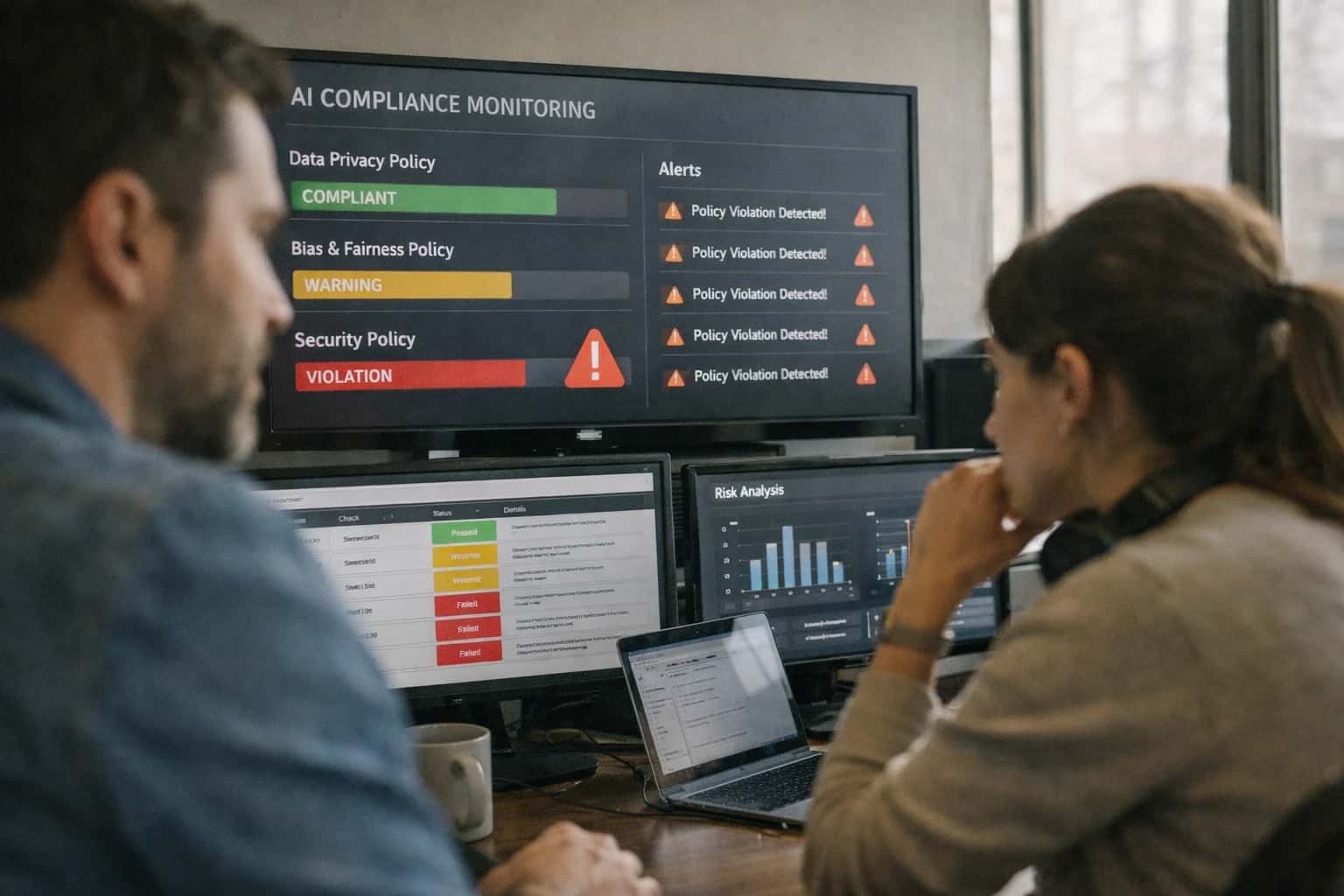
REAL-TIME GOVERNANCE
What is Continuous Compliance Monitor?
A continuous compliance monitor is an automated system that persistently audits infrastructure and data flows against regulatory frameworks, triggering alerts upon detecting configuration drift or policy violations.
These systems integrate directly into CI/CD pipelines and cloud control planes to enforce preventative guardrails, often automatically remediating non-compliant resources or quarantining them into a dead letter queue for review. By mapping technical configurations to specific clauses in frameworks like the EU AI Act or GDPR, the monitor provides a continuous data lineage audit, proving to compliance officers that every automated process remains within the bounds of legal and security mandates.
REAL-TIME GOVERNANCE
Key Features of a Continuous Compliance Monitor
A Continuous Compliance Monitor is not a periodic audit tool; it is a persistent, automated sentinel that validates infrastructure state against codified policy. These are its core architectural components.
01
Policy-as-Code Engine
Transforms human-readable regulatory requirements (GDPR, EU AI Act, SOC 2) into machine-executable rules. Instead of manual checklists, the engine parses structured policy definitions to validate configurations.
- Declarative Syntax: Uses languages like Rego (Open Policy Agent) to define 'desired state'.
- Drift Elimination: Instantly flags any divergence between the declared policy and the live environment.
- Version Control: Policies are stored in Git, enabling audit trails and rollback capabilities.
02
Real-Time Telemetry Ingestion
Continuously consumes high-cardinality event streams from across the entire infrastructure stack without batch processing delays.
- Signal Sources: Ingests logs, metrics, traces, and change events from Kubernetes, Terraform, and CI/CD pipelines.
- Stream Processing: Utilizes platforms like Kafka or Redpanda to handle millions of events per second.
- Contextual Enrichment: Automatically decorates raw telemetry with metadata (region, owner, data classification) for precise policy evaluation.
03
Automated Remediation Loop
Moves beyond passive alerting to actively correct non-compliant configurations, closing the gap between detection and resolution.
- Self-Healing: Triggers a webhook or executes a pre-approved runbook to revert a misconfigured firewall rule or encryption setting.
- Idempotency Guarantees: Uses idempotency keys to ensure that retries of a remediation action do not cause cascading side effects.
- Circuit Breaker Integration: Pauses automated fixes if a downstream service becomes unhealthy, preventing a bad state from worsening.
04
Data Lineage & Provenance Audit
Tracks the origin, movement, and transformation of every data element to verify that information used in decision-making has not been tampered with.
- Immutable Graph: Builds a directed acyclic graph (DAG) of data flow from source to consumption.
- C2PA Alignment: Validates tamper-evident metadata to ensure content authenticity.
- Anomaly Detection: Applies an out-of-distribution detector to lineage patterns, alerting if data suddenly flows to an unregistered sink.
05
Semantic Drift & Hallucination Guard
Specifically monitors AI-generated content and model outputs to ensure they remain factually anchored and contextually relevant over time.
- Cosine Similarity Guard: Compares vector embeddings of generated text against a golden dataset, blocking output that falls below a similarity threshold.
- Entailment Check: Verifies that a generated hypothesis logically follows from the source premise, preventing factual fabrication.
- Calibration Scoring: Continuously measures the alignment between a model's confidence and its actual accuracy to detect silent degradation.
06
Dead Letter Queue & Exception Handling
Ensures zero data loss and complete auditability when compliance checks fail or events cannot be processed.
- Persistent Storage: Non-compliant events are routed to a dead letter queue for forensic analysis, not discarded.
- Manual Intervention Trigger: Alerts a human operator with the full context of the failed event for complex judgment calls.
- Replay Capability: Allows operators to reprocess failed events after a policy update or bug fix, ensuring eventual consistency.
CONTINUOUS COMPLIANCE MONITOR
Frequently Asked Questions
Explore the core mechanisms, architectural patterns, and operational questions surrounding real-time regulatory enforcement in automated content pipelines.
A Continuous Compliance Monitor is an automated system that persistently audits infrastructure configurations, data flows, and generated outputs against a predefined set of regulatory frameworks and internal policies. Unlike periodic manual audits, it operates in real-time by ingesting telemetry data, log streams, and configuration states into a rules engine. The system continuously evaluates the current state against the desired compliance posture defined in Policy-as-Code. When a deviation—such as an open network port, an unencrypted data store, or a PII Redaction failure—is detected, the monitor triggers an immediate alert, creates an immutable audit log entry, and can optionally initiate automated remediation workflows, such as revoking access keys or halting a content generation pipeline.
Enabling Efficiency, Speed & Accuracy
Intelligent Analysis, Decision & Execution
We build AI systems for teams that need search across company data, workflow automation across tools, or AI features inside products and internal software.
Talk to Us
Search across company data
Give teams answers from docs, tickets, runbooks, and product data with sources and permissions.
Useful when people spend too long searching or get different answers from different systems.
Enterprise searchRAGPermissions
Read more
Automate internal workflows
Use AI to route work, draft outputs, trigger actions, and keep approvals and logs in place.
Useful when repetitive work moves across multiple tools and teams.
AI agentsWorkflow automationGovernance
Read more
Add AI to products and internal tools
Build assistants, guided actions, or decision support into the software your team or customers already use.
Useful when AI needs to be part of the product, not a separate tool.
AI integrationDecision supportModel routing
Read more
About the author
Prasad Kumkar
CEO & MD, Inference Systems
Prasad Kumkar is the CEO & MD of Inference Systems and writes about AI systems architecture, LLM infrastructure, model serving, evaluation, and production deployment. Over 5+ years, he has worked across computer vision models, L5 autonomous vehicle systems, and LLM research, with a focus on taking complex AI ideas into real-world engineering systems.
His work and writing cover AI systems, large language models, AI agents, multimodal systems, autonomous systems, inference optimization, RAG, evaluation, and production AI engineering.
LinkedIn
Limited slotsGet a Free AI Consultation
Partnered with leading AI, data, and software stack.





How We Work
Custom AI workflows for your Business
One-fit-all AI don't work for modern businesses. At Inferensys, we aim to understand your business & custom requirements; which we use to define most efficient agentic workflows, the data, and the tools for your business.
01
Review the use case
We understand the task, the users, and where AI can actually help.
Read more02
Pick the right approach
We define what needs search, automation, or product integration.
Read more03
Build the first useful version
We implement the part that proves the value first.
Read more04
Improve from there
We add the checks and visibility needed to keep it useful.
Read moreThe first call is a practical review of your use case and the right next step.
Talk to Us