A context window is the fixed-length span of preceding tokens—measured in tokens, not words—that a large language model (LLM) can attend to when predicting the next token in a sequence. It functions as the model's transient working memory, defining the upper boundary of information available for a single inference pass. Tokens falling outside this window are irretrievably lost for that generation step, making the window size a critical architectural constraint that directly governs the complexity of tasks a model can perform, from long-document summarization to multi-turn agentic reasoning.

Glossary
Context Window
The maximum span of preceding tokens that a language model can access and attend to when generating the next token in a sequence.
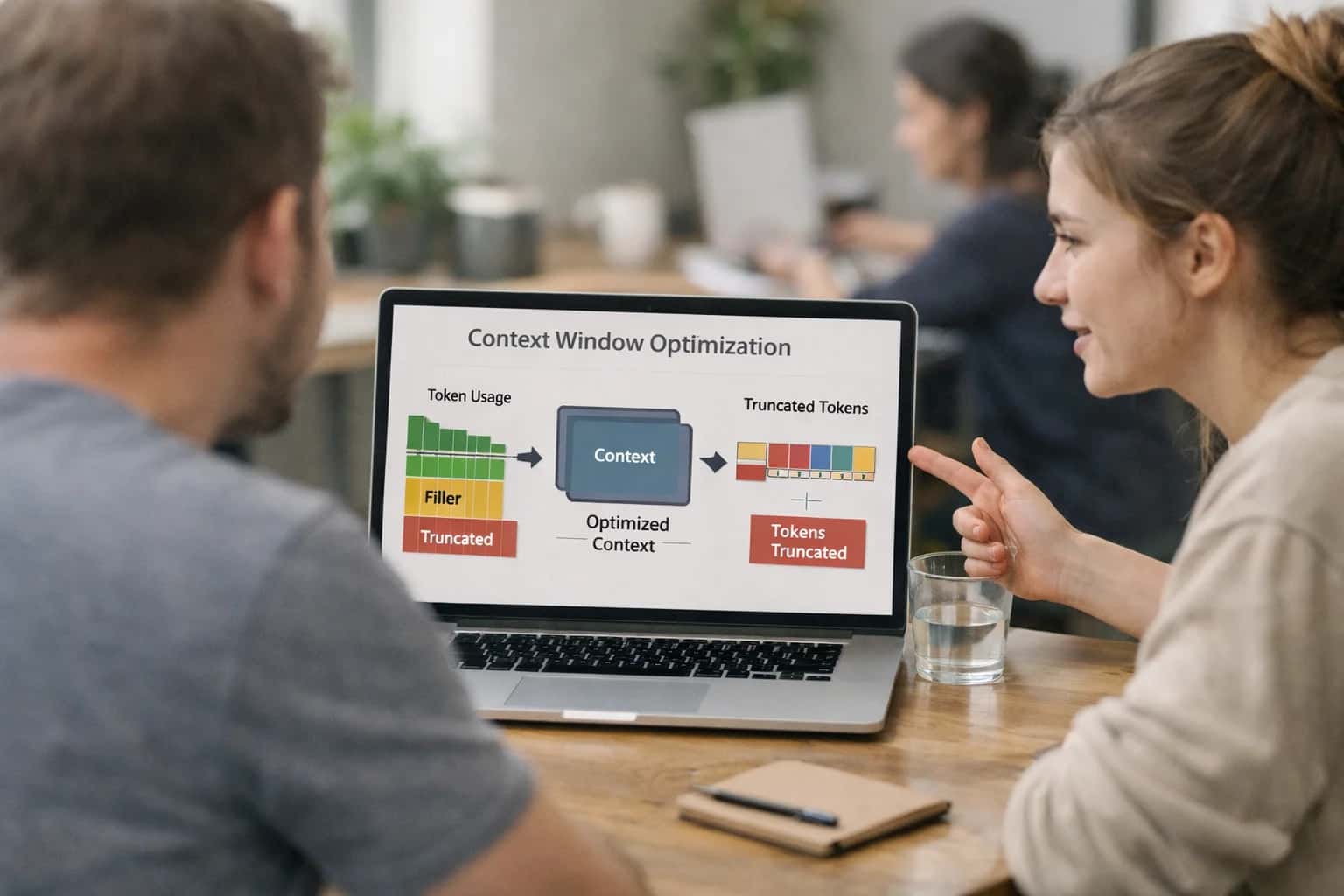
FOUNDATIONAL ARCHITECTURE
What is Context Window?
The context window defines the maximum span of preceding tokens a language model can access when generating the next token, serving as the model's working memory for a single inference.
Expanding the context window involves overcoming the quadratic computational complexity of the standard self-attention mechanism, which scales O(n²) with sequence length. Techniques like FlashAttention, Ring Attention, and positional interpolation (such as RoPE scaling) have enabled windows to grow from 4K tokens to 1M+ tokens in frontier models. However, effective utilization does not scale linearly with size; research reveals a 'lost-in-the-middle' phenomenon where model recall accuracy degrades significantly for information positioned in the center of long contexts, making context engineering and strategic content placement essential for reliable performance.
FUNDAMENTAL MECHANICS
Core Characteristics of Context Windows
The context window defines the operational memory of a language model, dictating how much prior information it can consider when generating the next token. Understanding its characteristics is critical for engineering reliable AI systems.
01
Token-Based Capacity
A context window's size is measured in tokens, not words or characters. A token is a subword unit generated by a tokenizer like Byte-Pair Encoding (BPE). A single English word averages ~1.3 tokens, but complex or agglutinative words can fragment into many more. The model's attention mechanism computes pairwise relationships across all tokens in this window, making the computational cost scale quadratically with window size.
- GPT-4 Turbo: 128,000 tokens (~96,000 words)
- Claude 3 Opus: 200,000 tokens (~150,000 words)
- Gemini 1.5 Pro: Up to 1,000,000 tokens in research preview
- Mistral Large: 32,000 tokens
O(n²)
Attention Complexity
02
The Lost Middle Problem
A well-documented failure mode where models exhibit degraded recall for information positioned in the middle of a long context window. Performance follows a U-shaped curve: the model best remembers the beginning (primacy bias) and the end (recency bias) of the prompt, while the central portion suffers significant attention dropout.
- This is not a token limit issue but an attention distribution failure
- Mitigation strategies include reordering documents by relevance and placing critical instructions at the extremes
- Evaluated using the Needle-in-a-Haystack benchmark, where a random fact is inserted at varying depths
03
Positional Encoding
Since the Transformer architecture is permutation-invariant, it requires a mechanism to inject sequence order into token representations. Positional encodings assign each token a unique vector based on its absolute or relative position in the context window.
- Absolute Positional Encoding: Uses sinusoidal functions or learned embeddings tied to fixed indices (original Transformer)
- Rotary Position Embedding (RoPE): Encodes relative position by rotating query and key vectors, enabling better length extrapolation (used in LLaMA, Mistral, PaLM)
- ALiBi: Adds a linear bias to attention scores based on token distance, penalizing far-away tokens without learned embeddings
04
Attention Masking
The mechanism that controls which tokens can attend to which other tokens. In autoregressive (causal) language models, a triangular mask is applied to the attention matrix, preventing each token from attending to future tokens. This enforces the left-to-right generation constraint.
- Causal Mask: Token at position i can only attend to positions 0 through i
- Padding Mask: Ignores filler tokens in batched inputs of unequal length
- Custom Masks: Can enforce document boundaries, speaker turns, or other structural constraints within the window
- Masking is implemented by adding negative infinity to prohibited attention scores before the softmax
05
Context Window Extension Techniques
Methods to increase the effective context length of a pre-trained model beyond its original training window without full retraining. These techniques modify the attention mechanism or positional encoding to generalize to longer sequences.
- Position Interpolation: Linearly scales down all position indices to fit within the original trained range, then fine-tunes on longer sequences
- NTK-Aware Scaling: Modifies the base frequency of RoPE to prevent high-frequency information loss during interpolation
- YaRN (Yet another RoPE extensioN): Combines NTK-aware interpolation with a temperature factor on attention logits to maintain perplexity at extended lengths
- Self-Extend: Prompts the model to group tokens into chunks, using the original window size for local attention and a larger stride for global context
06
KV-Cache Management
During autoregressive generation, the Key and Value tensors computed for all previous tokens are cached in GPU memory to avoid redundant recomputation. The size of this KV-cache grows linearly with the context window and batch size, becoming the primary memory bottleneck for long-context inference.
- Memory formula:
2 * num_layers * hidden_dim * context_length * batch_size * precision_bytes - Multi-Query Attention (MQA) and Grouped-Query Attention (GQA) reduce KV-cache size by sharing key/value heads across query heads
- PagedAttention (vLLM) manages KV-cache in non-contiguous memory blocks, analogous to virtual memory paging, to minimize fragmentation
- Sliding Window Attention (Mistral) restricts attention to a fixed local window, capping KV-cache growth regardless of total context length
CONTEXT WINDOW
Frequently Asked Questions
Clear, technically precise answers to the most common questions about context windows in large language models, covering mechanics, limitations, and optimization strategies.
A context window is the maximum span of preceding tokens—words, subwords, or characters—that a language model can access and attend to when generating the next token in a sequence. It defines the model's working memory during inference. For example, a model with a 128,000-token context window can "see" and reason over approximately 96,000 words of preceding text before its oldest input is truncated. This window includes the system prompt, conversation history, retrieved documents, and any user input. The mechanism is rooted in the self-attention computation, where each token computes relevance scores against every other token within the window. Tokens outside this boundary are permanently invisible to the model, making the context window a hard architectural constraint that directly governs the complexity of tasks the model can handle—from multi-document summarization to long-form code generation.
TOKEN CAPACITY COMPARISON
Context Window Sizes Across Major Models
A comparison of maximum context window sizes for prominent large language models, measured in tokens.
| Model | Max Tokens | Approx. Words | Release Year | Open Source |
|---|---|---|---|---|
GPT-4o | 128,000 | ~96,000 | 2024 | |
Claude 3.5 Sonnet | 200,000 | ~150,000 | 2024 | |
Gemini 1.5 Pro | 1,000,000 | ~750,000 | 2024 | |
Llama 3.1 405B | 128,000 | ~96,000 | 2024 | |
Mistral Large 2 | 128,000 | ~96,000 | 2024 | |
Command R+ | 128,000 | ~96,000 | 2024 | |
GPT-3.5 Turbo | 16,385 | ~12,000 | 2023 | |
Claude 2.1 | 200,000 | ~150,000 | 2023 |
Enabling Efficiency, Speed & Accuracy
Intelligent Analysis, Decision & Execution
We build AI systems for teams that need search across company data, workflow automation across tools, or AI features inside products and internal software.
Talk to Us
Search across company data
Give teams answers from docs, tickets, runbooks, and product data with sources and permissions.
Useful when people spend too long searching or get different answers from different systems.
Enterprise searchRAGPermissions
Read more
Automate internal workflows
Use AI to route work, draft outputs, trigger actions, and keep approvals and logs in place.
Useful when repetitive work moves across multiple tools and teams.
AI agentsWorkflow automationGovernance
Read more
Add AI to products and internal tools
Build assistants, guided actions, or decision support into the software your team or customers already use.
Useful when AI needs to be part of the product, not a separate tool.
AI integrationDecision supportModel routing
Read more
About the author
Prasad Kumkar
CEO & MD, Inference Systems
Prasad Kumkar is the CEO & MD of Inference Systems and writes about AI systems architecture, LLM infrastructure, model serving, evaluation, and production deployment. Over 5+ years, he has worked across computer vision models, L5 autonomous vehicle systems, and LLM research, with a focus on taking complex AI ideas into real-world engineering systems.
His work and writing cover AI systems, large language models, AI agents, multimodal systems, autonomous systems, inference optimization, RAG, evaluation, and production AI engineering.
LinkedIn
Limited slotsGet a Free AI Consultation
Partnered with leading AI, data, and software stack.





How We Work
Custom AI workflows for your Business
One-fit-all AI don't work for modern businesses. At Inferensys, we aim to understand your business & custom requirements; which we use to define most efficient agentic workflows, the data, and the tools for your business.
01
Review the use case
We understand the task, the users, and where AI can actually help.
Read more02
Pick the right approach
We define what needs search, automation, or product integration.
Read more03
Build the first useful version
We implement the part that proves the value first.
Read more04
Improve from there
We add the checks and visibility needed to keep it useful.
Read moreThe first call is a practical review of your use case and the right next step.
Talk to Us