Synthetic Data Governance is the enterprise-wide framework of policies, technical controls, and lifecycle standards that manage the creation, quality, privacy risk, and ethical use of artificially generated datasets. It ensures that synthetic data, while not containing real records, is treated with the same rigorous data stewardship as production data to prevent statistical leakage, bias amplification, or regulatory non-compliance.

Glossary
Synthetic Data Governance
The framework of policies, standards, and controls for managing the lifecycle, quality, privacy risk, and ethical use of synthetic data within an organization.
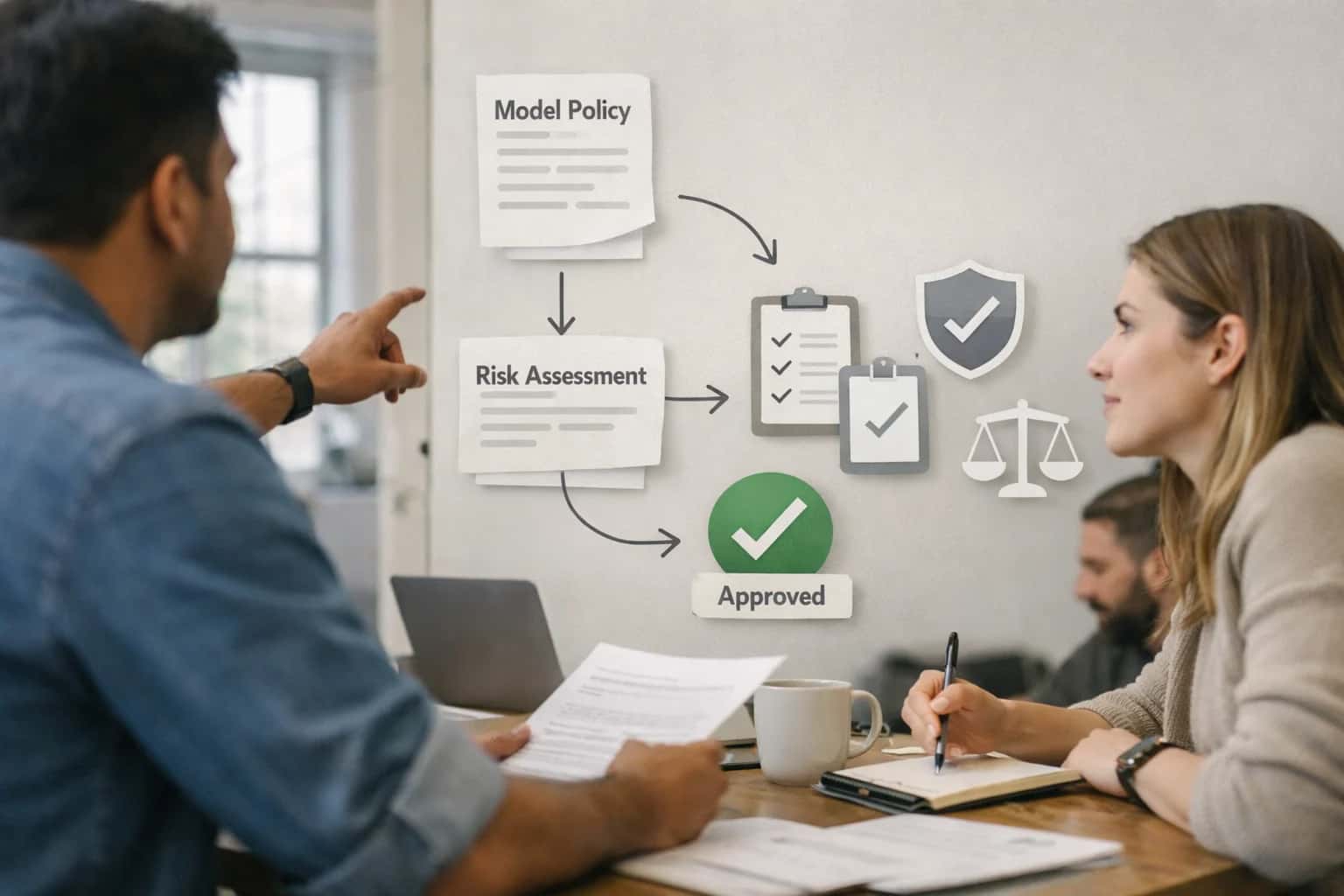
LIFECYCLE MANAGEMENT
What is Synthetic Data Governance?
The structured framework of policies, controls, and standards that governs the creation, validation, deployment, and monitoring of synthetic data to ensure its privacy, quality, and ethical alignment.
A robust governance program enforces privacy-utility trade-off assessments, mandates the use of Synthetic Data Quality Reports and SDMetrics for fidelity validation, and defines strict access controls for generative models. It operationalizes accountability by integrating Model Cards and Data Cards into the pipeline, ensuring that every synthetic asset is auditable, traceable, and aligned with organizational data minimization principles.
LIFECYCLE MANAGEMENT FRAMEWORK
Core Components of Synthetic Data Governance
A robust governance framework ensures synthetic data is not only statistically valid but also legally defensible, ethically sound, and operationally safe for enterprise deployment.
01
Privacy Risk Assessment
The systematic evaluation of re-identification risk and attribute inference risk before synthetic data is released. This involves measuring the similarity between synthetic records and real training data to ensure no individual is exposed.
- Membership Inference Attack testing: Quantifies if an adversary can determine if a specific person was in the training set.
- K-Anonymity validation: Ensures synthetic records do not create unique combinations of quasi-identifiers.
- Distance to Closest Record (DCR): Measures the Euclidean distance between synthetic samples and their nearest real neighbor to flag overfitting.
< 0.01
Target Re-identification Risk Threshold
02
Quality & Fidelity Assurance
The continuous monitoring of statistical fidelity to guarantee the synthetic data is a valid proxy for real-world phenomena. Governance requires automated pipelines that reject low-quality assets.
- Column Shape Analysis: Uses KSComplement and TVComplement metrics to compare univariate distributions.
- Correlation Preservation: Validates that multivariate relationships (e.g., age vs. income) remain intact.
- Boundary Adherence: Confirms synthetic data does not generate impossible values (e.g., negative ages).
> 0.95
Minimum Fidelity Score
03
Provenance & Lineage Tracking
The immutable logging of a synthetic dataset's origin, generation parameters, and approved use cases. This creates an audit trail for regulatory compliance and debugging.
- Data Card integration: Standardized metadata documents detailing the source real data, the generator model version, and preprocessing steps.
- Synthetic Data Watermarking: Embedding imperceptible signals to distinguish synthetic from real data and track unauthorized distribution.
- Model Card linkage: Connecting the synthetic output to the specific GAN or diffusion model checkpoint that created it.
100%
Auditable Lineage Coverage
04
Ethical & Bias Controls
The proactive detection and mitigation of historical biases amplified during the generation process. Governance ensures fairness-aware synthesis rather than replicating societal inequities.
- Demographic Parity checks: Measures if synthetic outcomes are independent of protected attributes like race or gender.
- Equalized Odds validation: Ensures true positive and false positive rates are balanced across subgroups.
- Mode collapse detection: Identifies if the generator failed to model minority subpopulations, erasing edge cases.
05
Access & Usage Policy Enforcement
The technical controls and contractual wrappers that restrict how synthetic data is consumed. This moves beyond simple access control lists to dynamic policy engines.
- Purpose-based restriction: Enforcing that synthetic health data is used only for model training, not marketing.
- Train-Synthetic-Test-Real (TSTR) gatekeeping: Requiring utility benchmarks to be met before deployment authorization.
- Differential Privacy budget tracking: Monitoring the cumulative privacy loss (epsilon) across multiple synthetic releases from the same source.
06
Lifecycle Deprecation & Versioning
The systematic retirement of synthetic assets when the underlying real data distribution shifts or a privacy vulnerability is discovered. Governance treats synthetic data as a living asset, not a static file.
- Drift monitoring: Comparing synthetic data to current production data to detect staleness.
- Semantic versioning: Applying MAJOR.MINOR.PATCH tags to synthetic datasets when regeneration occurs.
- Secure disposal: Cryptographic shredding of deprecated synthetic data to prevent reliance on outdated distributions.
SYNTHETIC DATA GOVERNANCE
Frequently Asked Questions
Clear, technical answers to the most common questions about managing the lifecycle, privacy risk, and ethical use of synthetic data within an enterprise.
Synthetic data governance is the framework of policies, standards, and technical controls that manage the full lifecycle of artificially generated data, from creation and quality validation to privacy risk assessment and ethical use enforcement. It is necessary because, unlike real-world data, synthetic data can inadvertently memorize and regurgitate sensitive training records, introduce novel biases, or degrade model performance if its statistical fidelity is not rigorously measured. A robust governance framework ensures that synthetic data is treated as a critical information asset, subject to the same—if not more stringent—auditability and lineage tracking as the source data it mimics. It operationalizes the privacy-utility trade-off, ensuring that the data is both safe for sharing and useful for downstream machine learning tasks.
Enabling Efficiency, Speed & Accuracy
Intelligent Analysis, Decision & Execution
We build AI systems for teams that need search across company data, workflow automation across tools, or AI features inside products and internal software.
Talk to Us
Search across company data
Give teams answers from docs, tickets, runbooks, and product data with sources and permissions.
Useful when people spend too long searching or get different answers from different systems.
Enterprise searchRAGPermissions
Read more
Automate internal workflows
Use AI to route work, draft outputs, trigger actions, and keep approvals and logs in place.
Useful when repetitive work moves across multiple tools and teams.
AI agentsWorkflow automationGovernance
Read more
Add AI to products and internal tools
Build assistants, guided actions, or decision support into the software your team or customers already use.
Useful when AI needs to be part of the product, not a separate tool.
AI integrationDecision supportModel routing
Read more
About the author
Prasad Kumkar
CEO & MD, Inference Systems
Prasad Kumkar is the CEO & MD of Inference Systems and writes about AI systems architecture, LLM infrastructure, model serving, evaluation, and production deployment. Over 5+ years, he has worked across computer vision models, L5 autonomous vehicle systems, and LLM research, with a focus on taking complex AI ideas into real-world engineering systems.
His work and writing cover AI systems, large language models, AI agents, multimodal systems, autonomous systems, inference optimization, RAG, evaluation, and production AI engineering.
LinkedIn
Limited slotsGet a Free AI Consultation
Partnered with leading AI, data, and software stack.





How We Work
Custom AI workflows for your Business
One-fit-all AI don't work for modern businesses. At Inferensys, we aim to understand your business & custom requirements; which we use to define most efficient agentic workflows, the data, and the tools for your business.
01
Review the use case
We understand the task, the users, and where AI can actually help.
Read more02
Pick the right approach
We define what needs search, automation, or product integration.
Read more03
Build the first useful version
We implement the part that proves the value first.
Read more04
Improve from there
We add the checks and visibility needed to keep it useful.
Read moreThe first call is a practical review of your use case and the right next step.
Talk to Us