Compliance as Code transforms static, manual audit checklists into version-controlled, machine-executable scripts. By codifying rules from frameworks like SOC 2, HIPAA, or GDPR into Open Policy Agent (OPA) policies or Infrastructure as Code (IaC) scanning tests, organizations shift from periodic, point-in-time assessments to continuous, real-time validation of their security posture.

Glossary
Compliance as Code
Compliance as Code (CaC) is the methodology of translating regulatory framework requirements into executable, automated tests and policies that can be continuously validated against cloud infrastructure to prove audit readiness.
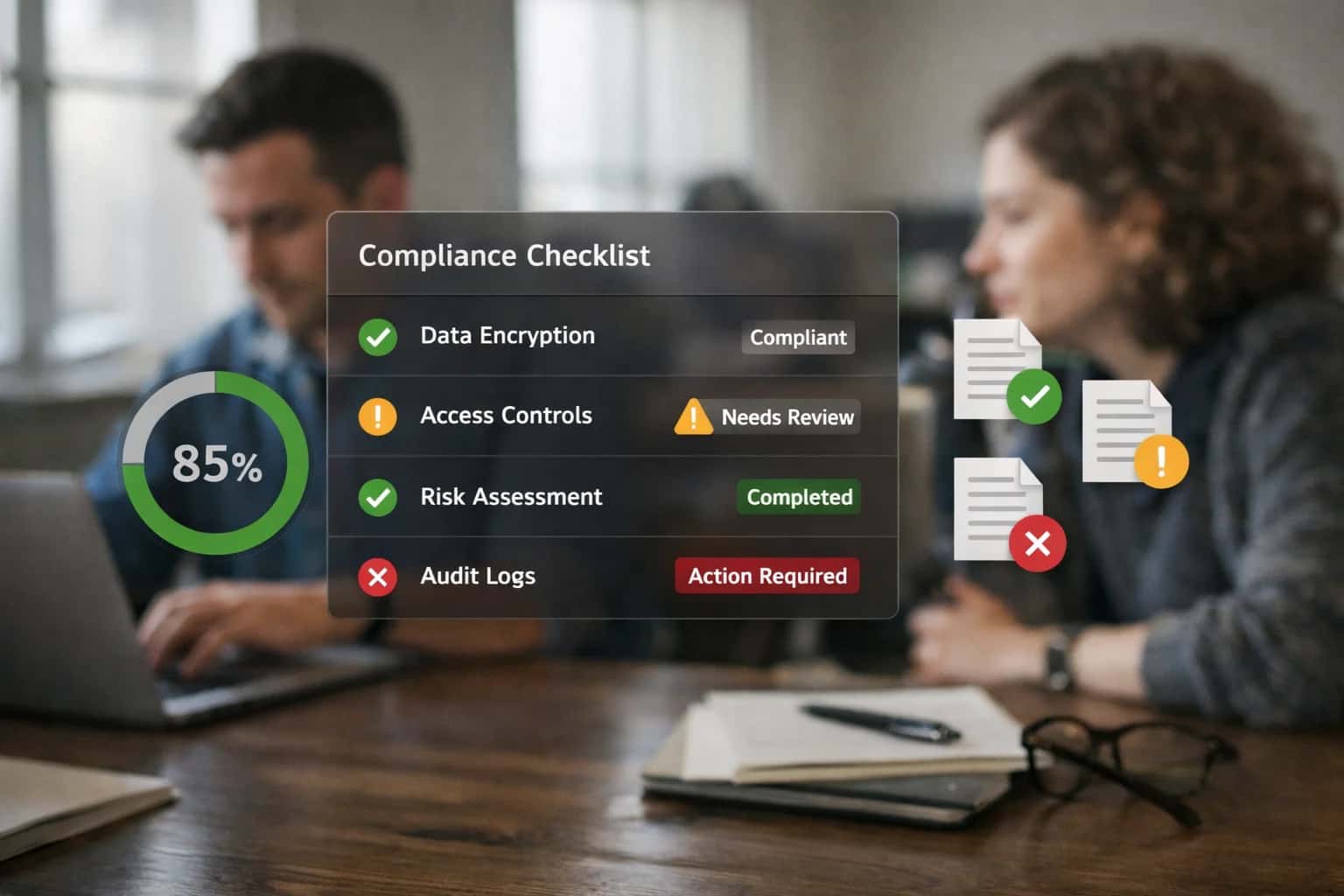
AUTOMATED AUDIT READINESS
What is Compliance as Code?
Compliance as Code is the methodology of translating regulatory framework requirements into executable, automated tests and policies that can be continuously validated against cloud infrastructure to prove audit readiness.
This approach integrates directly into the CI/CD pipeline, preventing the deployment of non-compliant infrastructure. Automated evidence collection and attestation generation provide a verifiable, immutable audit trail, enabling a Continuous Authorization to Operate (cATO) model where compliance is proven programmatically rather than through manual evidence gathering.
AUTOMATED AUDIT READINESS
Key Characteristics of Compliance as Code
Compliance as Code transforms static regulatory frameworks into executable, continuously validated policies that prove audit readiness in real time.
02
Continuous Control Validation
Unlike point-in-time audits, Compliance as Code implements continuous monitoring of security controls. Automated scanners evaluate infrastructure against regulatory frameworks every time a change is proposed, producing:
- Real-time compliance dashboards showing control pass/fail status
- Automated evidence collection for auditor review
- Immediate remediation workflows triggered by control failures
- Integration with CI/CD pipelines to block non-compliant deployments
04
Regulatory Framework Mapping
Compliance as Code translates human-readable regulations into machine-executable tests. Frameworks like SOC 2, PCI DSS, and HIPAA are decomposed into discrete, testable controls:
- Each control maps to a specific automated validation rule
- Control inheritance allows parent policies to cascade to child resources
- Framework cross-walking identifies overlapping requirements across standards
- Evidence mapping links each automated check to specific regulatory clauses
05
Drift Remediation Automation
When infrastructure configuration drifts from its compliant baseline, Compliance as Code triggers automated remediation. This closed-loop system ensures:
- Detection of unauthorized changes within minutes, not audit cycles
- Automatic rollback of non-compliant configurations to known-good states
- Integration with Infrastructure as Code (IaC) tools like Terraform and Pulumi
- Self-healing architectures that maintain compliance without manual intervention
06
Shift-Left Compliance Integration
Compliance validation moves earlier in the development lifecycle through pre-deployment policy checks. Developers receive immediate feedback on compliance violations before code reaches production:
- IaC scanning identifies misconfigurations during pull request review
- Admission controllers enforce policies at the Kubernetes API boundary
- Pre-commit hooks validate compliance rules locally before code is pushed
- Integration with developer workflows reduces the friction of security gates
COMPLIANCE AS CODE
Frequently Asked Questions
Clear, technical answers to the most common questions about translating regulatory frameworks into automated, continuously validated security policies.
Compliance as Code (CaC) is the methodology of translating regulatory framework requirements, industry standards, and internal security policies into executable, automated tests and machine-readable policies that can be continuously validated against cloud infrastructure and software delivery pipelines. It works by codifying compliance rules—such as 'encryption must be enabled at rest' or 'no security group should allow ingress on port 22 from 0.0.0.0/0'—into scripts, policy definitions, and configuration assertions using tools like Open Policy Agent (OPA) with the Rego language, Terraform Sentinel, or AWS Config Rules. These codified policies are stored in version control, subjected to automated testing in CI/CD pipelines, and executed against infrastructure-as-code definitions pre-deployment and against live environments post-deployment. The result is a shift from periodic, manual audits to real-time, evidence-backed compliance verification that produces an immutable audit trail, enabling organizations to achieve Continuous Authorization to Operate (cATO) rather than relying on point-in-time attestations.
AUTOMATED AUDIT READINESS
Compliance as Code in Practice
Translating regulatory frameworks into executable, continuously validated policies that prove compliance without manual evidence collection.
01
Policy Definition & Versioning
Compliance rules are expressed as declarative code using languages like Rego (OPA) or HashiCorp Sentinel, stored in Git repositories alongside application code. This enables:
- Peer review of compliance logic before deployment
- Semantic versioning of policy artifacts
- Audit trails showing exactly who changed which control and when
- Rollback capability if a policy change introduces false positives
Example: A PCI-DSS requirement mandating encryption at rest becomes a Rego rule that denies any Terraform resource lacking encryption blocks.
02
Continuous Control Validation
Instead of quarterly manual audits, automated pipelines execute compliance tests on every infrastructure change. Key mechanisms include:
- Pre-deployment gates: Admission controllers block non-compliant Kubernetes manifests before they reach etcd
- Post-deployment scanning: CSPM tools continuously evaluate live resources against codified benchmarks
- Drift detection: Automated reconciliation identifies when running state diverges from compliant desired state
This shifts compliance from a point-in-time snapshot to a continuous signal, dramatically reducing the window between misconfiguration and detection.
03
Evidence Generation & Attestation
Every policy evaluation produces cryptographically verifiable evidence suitable for auditor review. The pipeline generates:
- In-toto attestations linking each build step to its compliance verification result
- Machine-readable compliance reports in formats like OSCAL (Open Security Controls Assessment Language)
- Immutable logs stored in append-only systems, proving controls were evaluated at specific timestamps
This eliminates the traditional "evidence binder" process where engineers manually screenshot configurations days before an audit.
04
Remediation as Code
When a violation is detected, automated remediation playbooks execute predefined corrective actions without human intervention:
- Auto-remediation: An S3 bucket detected as public triggers an automatic ACL correction
- JIRA ticket creation: Non-critical findings automatically generate assigned tickets with context
- Slack notifications: Channel alerts include the violating resource, policy name, and suggested fix
This closes the loop from detection to resolution, ensuring compliance gaps have minimal mean time to remediation (MTTR).
05
Framework Mapping & Inheritance
Codified controls are tagged and mapped to multiple regulatory frameworks simultaneously, enabling reuse across compliance regimes:
- A single encryption control maps to SOC 2 CC6.1, PCI-DSS 3.4, and HIPAA 164.312(a)(2)(iv)
- Control inheritance: Higher-level policies compose lower-level technical controls
- Framework-specific reporting: Generate auditor-ready evidence packages filtered by regulation
This prevents the duplication of effort when an organization must satisfy multiple overlapping compliance requirements.
06
Testing & Validation Pipelines
Compliance policies themselves undergo rigorous testing before enforcement, treating policy code with the same discipline as application code:
- Unit tests: Verify individual Rego rules return expected decisions for known inputs
- Integration tests: Deploy compliant and non-compliant resources in ephemeral environments to validate policy behavior
- Performance benchmarks: Ensure policy evaluation latency doesn't bottleneck admission control
This prevents brittle policies that generate false positives or miss edge cases, maintaining operator trust in automated enforcement.
AUDIT METHODOLOGY COMPARISON
Compliance as Code vs. Traditional Compliance
A feature-level comparison between automated, policy-driven compliance validation and manual, document-centric audit processes.
| Feature | Compliance as Code | Traditional Compliance |
|---|---|---|
Validation Frequency | Continuous (every commit/deploy) | Periodic (quarterly/annually) |
Evidence Collection | Automated, machine-readable logs | Manual screenshots and spreadsheets |
Human Error Risk | Low (deterministic execution) | High (manual interpretation) |
Audit Cycle Duration | Minutes to hours | Weeks to months |
Policy Drift Detection | Real-time alerting | Discovered at next audit |
Remediation Speed | Automated rollback or blocking | Manual ticket and change window |
Scalability Across Environments | Linear (code replicates instantly) | Degrades (manual effort multiplies) |
Regulatory Mapping | Version-controlled policy-as-code | Static control spreadsheets |
Enabling Efficiency, Speed & Accuracy
Intelligent Analysis, Decision & Execution
We build AI systems for teams that need search across company data, workflow automation across tools, or AI features inside products and internal software.
Talk to Us
Search across company data
Give teams answers from docs, tickets, runbooks, and product data with sources and permissions.
Useful when people spend too long searching or get different answers from different systems.
Enterprise searchRAGPermissions
Read more
Automate internal workflows
Use AI to route work, draft outputs, trigger actions, and keep approvals and logs in place.
Useful when repetitive work moves across multiple tools and teams.
AI agentsWorkflow automationGovernance
Read more
Add AI to products and internal tools
Build assistants, guided actions, or decision support into the software your team or customers already use.
Useful when AI needs to be part of the product, not a separate tool.
AI integrationDecision supportModel routing
Read more
About the author
Prasad Kumkar
CEO & MD, Inference Systems
Prasad Kumkar is the CEO & MD of Inference Systems and writes about AI systems architecture, LLM infrastructure, model serving, evaluation, and production deployment. Over 5+ years, he has worked across computer vision models, L5 autonomous vehicle systems, and LLM research, with a focus on taking complex AI ideas into real-world engineering systems.
His work and writing cover AI systems, large language models, AI agents, multimodal systems, autonomous systems, inference optimization, RAG, evaluation, and production AI engineering.
LinkedIn
Limited slotsGet a Free AI Consultation
Partnered with leading AI, data, and software stack.





How We Work
Custom AI workflows for your Business
One-fit-all AI don't work for modern businesses. At Inferensys, we aim to understand your business & custom requirements; which we use to define most efficient agentic workflows, the data, and the tools for your business.
01
Review the use case
We understand the task, the users, and where AI can actually help.
Read more02
Pick the right approach
We define what needs search, automation, or product integration.
Read more03
Build the first useful version
We implement the part that proves the value first.
Read more04
Improve from there
We add the checks and visibility needed to keep it useful.
Read moreThe first call is a practical review of your use case and the right next step.
Talk to Us