Edge PEFT is the application of parameter-efficient fine-tuning techniques to enable on-device adaptation of machine learning models. It focuses on methods like Low-Rank Adaptation (LoRA), adapters, and sparse tuning that introduce minimal trainable parameters, allowing models to be personalized or updated locally with a low memory footprint and energy-efficient compute. This is critical for edge AI scenarios requiring data privacy, low latency, and operational continuity without cloud connectivity.

Glossary
Edge PEFT
Edge PEFT (Parameter-Efficient Fine-Tuning) encompasses methodologies for adapting pre-trained AI models directly on resource-constrained edge computing devices, prioritizing minimal memory footprint and energy consumption.
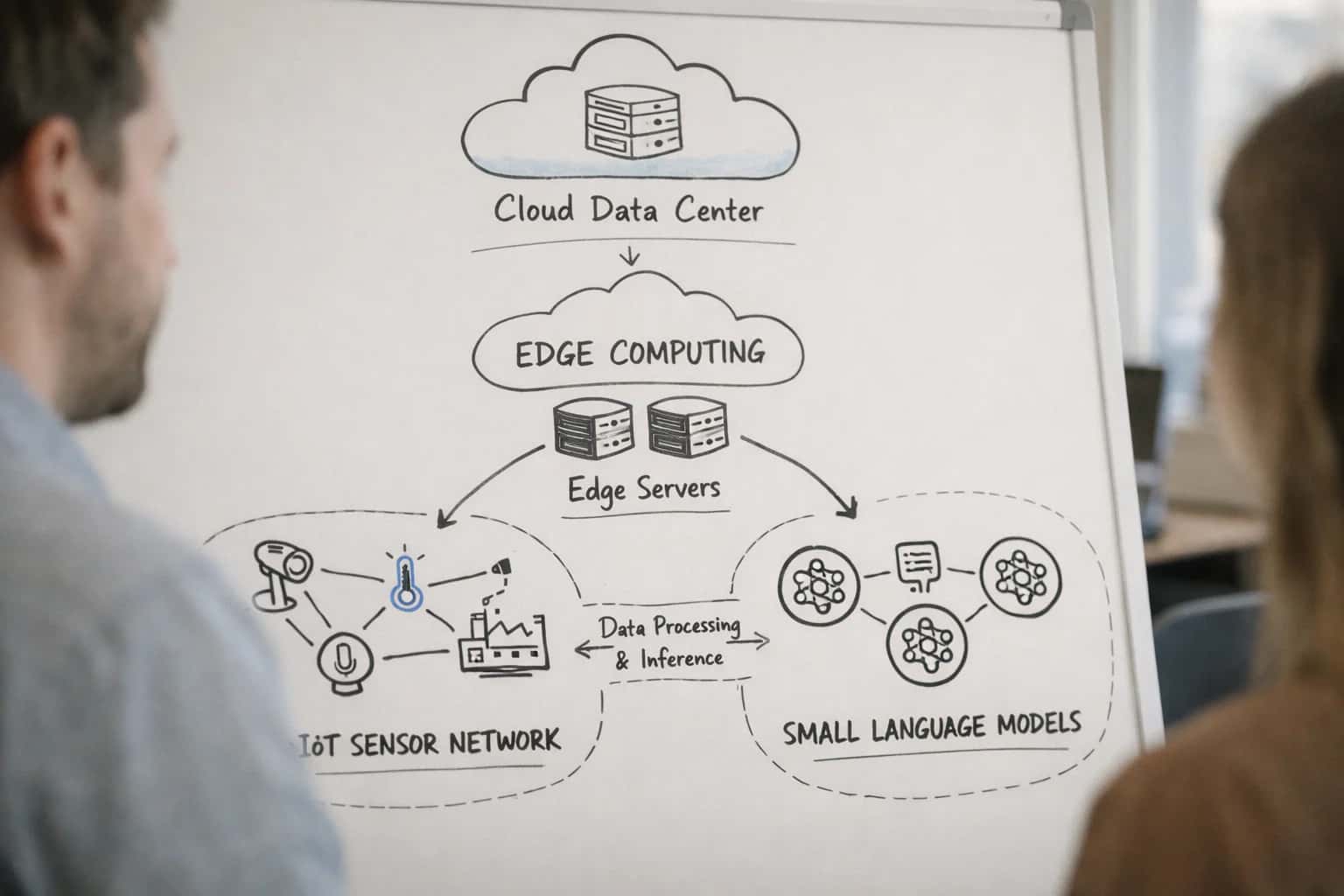
PARAMETER-EFFICIENT FINE-TUNING
What is Edge PEFT?
Edge PEFT (Parameter-Efficient Fine-Tuning) is a specialized adaptation methodology for deploying and updating large pre-trained models directly on resource-constrained edge computing devices.
The core engineering challenge of Edge PEFT is balancing adaptation quality with severe hardware constraints. Techniques are co-designed with model compression strategies like quantization and pruning, and are optimized for execution on specialized neural processing units (NPUs) or microcontrollers. This enables federated learning on edge devices and supports continual learning for applications in IoT, robotics, and mobile systems, where models must evolve without prohibitive data transfer or compute costs.
DEPLOYMENT CONSTRAINTS
Key Technical Characteristics of Edge PEFT
Edge PEFT (Parameter-Efficient Fine-Tuning) refers to methodologies specifically engineered to adapt large pre-trained models for deployment on resource-constrained edge devices, focusing on minimal memory footprint, low energy consumption, and operational autonomy.
01
Extreme Memory Efficiency
Edge PEFT methods are designed to have a negligible memory footprint for both the adapter weights and the optimizer states during training. Techniques like 4-bit QLoRA and BitFit are paramount, as they allow adaptation of billion-parameter models on devices with less than 8GB of RAM. The goal is to keep the total trainable parameter count below 1% of the base model, often in the range of 0.01% to 0.1%, to fit within the SRAM or L3 cache of edge processors.
02
Minimal Energy & Compute Footprint
These methods prioritize operations that are efficient on edge NPUs (Neural Processing Units) and microcontrollers. This involves:
- Using low-rank matrix operations (LoRA) which map well to systolic arrays.
- Avoiding large gradient computations across the full model.
- Leveraging sparse updates (e.g., only biases) to reduce FLOPs. The energy cost of a single adaptation step must be measured in millijoules to be viable for battery-powered IoT devices, making full fine-tuning completely infeasible.
03
On-Device Training Viability
A core characteristic is enabling personalization and continual learning directly on the edge device. This requires:
- Optimizer efficiency: Using memory-light optimizers like 8-bit Adam or SGD without momentum.
- Local data processing: Training on-device sensor data without raw data egress.
- Federated learning compatibility: Generating compact adapter deltas or task vectors that can be aggregated in a privacy-preserving manner. The training loop must be robust to intermittent power and connectivity.
04
Inference Latency Guarantees
The injected PEFT modules must not introduce prohibitive latency during inference. This is achieved through:
- Architectural fusion: Adapters or LoRA matrices are merged into the base model weights post-training via a simple addition operation, resulting in zero inference overhead.
- Selective application: Applying adapters only to critical layers (e.g., layer-wise adaptation) to minimize added operations.
- Compiler-aware design: Structuring adapter operations to leverage hardware-specific kernels and avoid memory bandwidth bottlenecks, crucial for real-time applications.
05
Robustness to Heterogeneous Hardware
Edge PEFT techniques must be portable across diverse and constrained hardware backends, from ARM Cortex-M microcontrollers to mobile GPUs. This necessitates:
- Precision flexibility: Supporting INT8 and FP16 operations for adapters.
- Minimal dependencies: Functioning without large software frameworks.
- Static memory allocation: Avoiding dynamic memory allocation during adaptation to ensure deterministic operation in real-time operating systems (RTOS).
06
Privacy & Security by Design
Edge PEFT inherently supports privacy-preserving machine learning paradigms because sensitive data never leaves the device. Key aspects include:
- Federated Edge Learning: Adapter weights or gradients are the only shared artifacts.
- Secure enclave execution: Adapter training can occur within trusted execution environments (TEEs).
- Defense against model inversion: The extremely small parameter space of the adapter (compared to the full model) offers a reduced attack surface for extracting private training data.
TECHNICAL OVERVIEW
How Edge PEFT Works: The Technical Mechanism
Edge PEFT (Parameter-Efficient Fine-Tuning) is a class of adaptation techniques engineered to modify large pre-trained models for specific tasks directly on resource-constrained edge devices, focusing on minimal memory and energy overhead.
Edge PEFT works by applying a small, trainable parameter delta to a frozen base model. Instead of updating all billions of parameters, methods like Low-Rank Adaptation (LoRA) inject low-rank matrices, or Adapters insert tiny bottleneck modules. Only these injected parameters—often less than 1% of the total model—are optimized during on-device training. This drastically reduces the memory footprint for storing optimizer states and gradients, enabling adaptation within the tight RAM constraints of edge hardware like smartphones or IoT sensors.
The optimization process is designed for efficiency. Techniques like 4-bit QLoRA quantize the base model to 4-bit precision, while the adapters are kept in higher precision (BF16) for effective learning. Selective updating strategies, such as tuning only bias terms (BitFit) or specific layers, further minimize compute. The resulting adapted model merges the small delta with the base weights for inference, maintaining the base model's general capability while adding the new task-specific behavior with negligible latency or storage increase.
EDGE PEFT
Common Edge PEFT Techniques and Methods
These are the primary parameter-efficient fine-tuning methodologies engineered for deployment on resource-constrained edge devices, prioritizing minimal memory footprint, low energy consumption, and on-device adaptability.
02
Extremely Sparse Adaptation (BitFit, Sparse Fine-Tuning)
These methods update only a minuscule, strategic subset of the model's existing parameters, minimizing the checkpoint size for deployment.
- BitFit: Trains only the bias terms within the transformer architecture. For a model with billions of weights, this may update only millions of parameters, resulting in adaptation deltas of just a few megabytes.
- Layer/Head Selection: Techniques that identify and update only the most task-relevant attention heads or feed-forward layers. This leverages the insight that not all model capacities are equally needed for a new edge task.
- Edge Advantage: The resulting tuned model is virtually identical in size and structure to the original, simplifying the deployment pipeline. The tiny 'delta' (change file) can be efficiently distributed and applied on-device.
03
On-Device Incremental Learning with Adapters
Small, modular adapter layers are inserted into a frozen base model and trained directly on the edge device using local data. This enables personalization and continuous adaptation without raw data leaving the device.
- Workflow: A compact base model (e.g., a 100M parameter SLM) is deployed with untrained adapter modules. Using on-device data (e.g., user typing patterns, local sensor readings), only the adapter parameters are updated via lightweight optimization steps.
- Key Features:
- Modularity: Adapters for different tasks or users can be swapped in/out without altering the base model.
- Privacy: Data never leaves the local device, aligning with federated learning principles.
- Efficiency: Avoids the need to transmit large model updates or re-deploy the entire model for minor adaptations.
04
Prompt & Prefix Tuning for Edge Inference
Instead of modifying model weights, these methods optimize a small set of continuous prompt embeddings that condition the frozen model's output. This is ideal for edge inference where weight updates are prohibitive.
- Prompt Tuning: Learns a small set of soft prompt vectors prepended to the input embeddings. The tuned artifact is just this prompt matrix (e.g., 20 tokens x 4096 dimensions ≈ 0.3 MB).
- Prefix Tuning: Learns a sequence of vectors prepended to the hidden states at every transformer layer, offering more control at a slightly higher parameter cost.
- Edge Deployment: The base model remains static. Task-specific behavior is controlled by loading different tiny prompt files, enabling rapid context switching for multi-task edge applications (e.g., a device switching from 'email assistant' to 'code completer' mode).
05
Hardware-Aware Efficient Fine-Tuning
Techniques that co-design the PEFT method with the target edge hardware's architectural constraints, such as memory hierarchy, cache sizes, and NPU capabilities.
- Kernel Fusion for Adapters: Designing adapter operations to be fused with existing transformer kernels to avoid expensive memory reads/writes between layers, critical for power-efficient NPUs.
- Quantization-Aware PEFT Training: Training LoRA matrices or adapters while simulating the quantization that will be applied during on-device inference, ensuring the adapted model remains stable and accurate post-deployment.
- Compiler-Optimized Adapter Graphs: Using compilers like Apache TVM or TensorRT to statically compile the base model + adapter graph into a single, optimized executable that maximizes use of the device's limited SRAM and compute units.
06
Federated Edge PEFT Orchestration
A system-level methodology where thousands of edge devices collaboratively learn a shared PEFT model (e.g., a global LoRA module) without centralizing their private data.
- Process: Each device performs local PEFT training (e.g., LoRA updates) on its data. Only the small adapter updates (deltas), not the data or base model, are sent to a central server.
- Server Aggregation: The server aggregates these updates (e.g., via Federated Averaging) to improve a global adapter, which is then redistributed to the fleet.
- Edge Benefits:
- Enables population-scale model personalization while maintaining strict data privacy.
- Dramatically reduces communication overhead compared to sending full model gradients or raw data.
- Allows the global model to adapt to diverse, real-world edge environments seen across the device fleet.
DEPLOYMENT ARCHITECTURE
Edge PEFT vs. Cloud PEFT: A Critical Comparison
A technical comparison of Parameter-Efficient Fine-Tuning methodologies optimized for edge computing versus traditional cloud-based execution, focusing on constraints, capabilities, and operational trade-offs.
| Feature / Metric | Edge PEFT | Cloud PEFT |
|---|---|---|
Primary Deployment Target | Resource-constrained edge devices (MCUs, smartphones, IoT sensors) | High-performance cloud or data center servers |
Inference Latency | < 100 ms | 100-1000 ms (network-dependent) |
Network Dependency for Inference | None (fully on-device) | Required |
Typical Memory Footprint (Adapter) | < 10 MB | 10-500 MB |
Typical Energy Consumption per Task | 10-100 mJ | 1-10 J |
Data Privacy & Sovereignty | Absolute (data never leaves device) | Governed by cloud provider policies & egress |
Operational Cost Model | Fixed (device cost, no per-query fee) | Variable (compute & egress fees) |
Scalability for Concurrent Users | Limited by local device resources | Effectively unlimited via horizontal scaling |
Model Update & Personalization | On-device adaptation via federated learning or local PEFT | Centralized retraining & deployment pipelines |
Typical Base Model Size Supported | Small Language Models (< 3B params) | Large Language Models (7B - 70B+ params) |
Primary Optimization Techniques | Extreme quantization (INT8/INT4), pruning, hardware-aware compilation | Mixed-precision training (FP16/BF16), continuous batching, kernel fusion |
Fault Tolerance & Offline Operation | Inherent (no connectivity requirement) | Dependent on network & cloud service availability |
EDGE PEFT
Practical Use Cases and Applications
Edge PEFT enables the adaptation of powerful AI models directly on resource-constrained devices. These applications highlight its critical role in enabling private, responsive, and cost-effective intelligence at the edge.
01
On-Device Personalization
Edge PEFT allows models to learn user-specific patterns directly on a smartphone or smart device. Personalization occurs locally, ensuring private data (typing habits, app usage, voice patterns) never leaves the device. This enables features like adaptive keyboards, context-aware assistants, and personalized health monitoring without cloud dependency.
- Key Benefit: Absolute data privacy and reduced latency.
- Example: A language model on a phone uses Low-Rank Adaptation (LoRA) to adapt to a user's unique writing style for better next-word prediction.
02
IoT & Sensor Analytics
In industrial and environmental monitoring, Edge PEFT fine-tunes models on-device to interpret data from local sensors (vibration, temperature, audio). This enables predictive maintenance, anomaly detection, and real-time decision-making without constant cloud connectivity.
- Key Benefit: Operational continuity in bandwidth-limited or offline environments.
- Example: A vibration analysis model on a wind turbine uses a small adapter to adapt to the specific acoustic signature of that turbine, detecting bearing wear early.
03
Robotics & Embodied AI
Robots operating in dynamic, real-world environments require models that can adapt to new objects, terrains, or tasks without full retraining. Edge PEFT allows for efficient on-the-fly learning directly on the robot's onboard computer.
- Key Benefit: Enables continual adaptation with minimal compute footprint.
- Example: A mobile robot uses prefix tuning on its navigation model to quickly learn the layout of a new warehouse, updating only a few thousand parameters.
04
Federated Learning at the Edge
Edge PEFT is a cornerstone of efficient federated learning. Instead of sending raw data, devices train small PEFT modules (e.g., LoRA matrices) locally and send only these tiny parameter updates to a central server for aggregation. This drastically reduces communication overhead.
- Key Benefit: Scalable, privacy-preserving model improvement across millions of devices.
- Example: Thousands of smartphones collaboratively improve a speech recognition model by each training a QLoRA adapter on local voice commands and sharing only the adapter weights.
05
Real-Time Vision & Language Models
Deploying multimodal models (e.g., Vision-Language Models) on edge devices like drones, AR glasses, or security cameras is computationally intensive. Edge PEFT allows these models to be specialized for domain-specific tasks (e.g., identifying manufacturing defects, reading specialized gauges) without prohibitive memory costs.
- Key Benefit: Makes advanced multimodal AI feasible on edge hardware.
- Example: A safety inspection camera uses a BitFit-style update (only tuning biases) to adapt a vision transformer to recognize new types of safety gear without storing a full model copy.
06
Healthcare & Medical Devices
Medical devices (portable ultrasound, continuous glucose monitors) can use Edge PEFT to adapt diagnostic models to a specific patient's physiology or a hospital's unique imaging protocols. This enables personalized medicine and improves accuracy while maintaining strict data sovereignty.
- Key Benefit: Enables compliant, patient-specific model tuning without transferring sensitive health data.
- Example: A wearable ECG monitor uses a sparse fine-tuning technique to personalize its arrhythmia detection algorithm based on a patient's historical data, stored and processed entirely on-device.
EDGE PEFT
Frequently Asked Questions
Edge PEFT (Parameter-Efficient Fine-Tuning) refers to the suite of techniques designed to adapt large pre-trained models for specific tasks directly on resource-constrained edge devices, such as smartphones, IoT sensors, and embedded systems, by updating only a minimal subset of parameters.
Edge PEFT is the application of parameter-efficient fine-tuning methodologies specifically optimized for execution on edge computing devices with limited memory, compute, and power. It works by updating only a tiny fraction of a pre-trained model's parameters—such as injecting low-rank adapters (LoRA), tuning bias terms (BitFit), or optimizing continuous prompts—while keeping the vast majority of the base model frozen. This creates a small, task-specific delta (change) that can be stored and applied on-device, enabling personalization and domain adaptation without the prohibitive cost of full model retraining or reliance on cloud connectivity.
Enabling Efficiency, Speed & Accuracy
Intelligent Analysis, Decision & Execution
We build AI systems for teams that need search across company data, workflow automation across tools, or AI features inside products and internal software.
Talk to Us
Search across company data
Give teams answers from docs, tickets, runbooks, and product data with sources and permissions.
Useful when people spend too long searching or get different answers from different systems.
Enterprise searchRAGPermissions
Read more
Automate internal workflows
Use AI to route work, draft outputs, trigger actions, and keep approvals and logs in place.
Useful when repetitive work moves across multiple tools and teams.
AI agentsWorkflow automationGovernance
Read more
Add AI to products and internal tools
Build assistants, guided actions, or decision support into the software your team or customers already use.
Useful when AI needs to be part of the product, not a separate tool.
AI integrationDecision supportModel routing
Read more
About the author
Prasad Kumkar
CEO & MD, Inference Systems
Prasad Kumkar is the CEO & MD of Inference Systems and writes about AI systems architecture, LLM infrastructure, model serving, evaluation, and production deployment. Over 5+ years, he has worked across computer vision models, L5 autonomous vehicle systems, and LLM research, with a focus on taking complex AI ideas into real-world engineering systems.
His work and writing cover AI systems, large language models, AI agents, multimodal systems, autonomous systems, inference optimization, RAG, evaluation, and production AI engineering.
LinkedIn
Limited slotsGet a Free AI Consultation
Partnered with leading AI, data, and software stack.





How We Work
Custom AI workflows for your Business
One-fit-all AI don't work for modern businesses. At Inferensys, we aim to understand your business & custom requirements; which we use to define most efficient agentic workflows, the data, and the tools for your business.
01
Review the use case
We understand the task, the users, and where AI can actually help.
Read more02
Pick the right approach
We define what needs search, automation, or product integration.
Read more03
Build the first useful version
We implement the part that proves the value first.
Read more04
Improve from there
We add the checks and visibility needed to keep it useful.
Read moreThe first call is a practical review of your use case and the right next step.
Talk to Us