Shadow deployment is a safe deployment pattern where a new model version processes live, incoming requests in parallel with the production model, but its predictions are only logged for analysis and are not returned to end-users. This allows teams to validate the new model's performance, latency, and correctness using real-world data and traffic patterns without any risk of impacting the user experience or business operations. It is a critical technique for continuous deployment for ML (CD4ML).

Glossary
Shadow Deployment
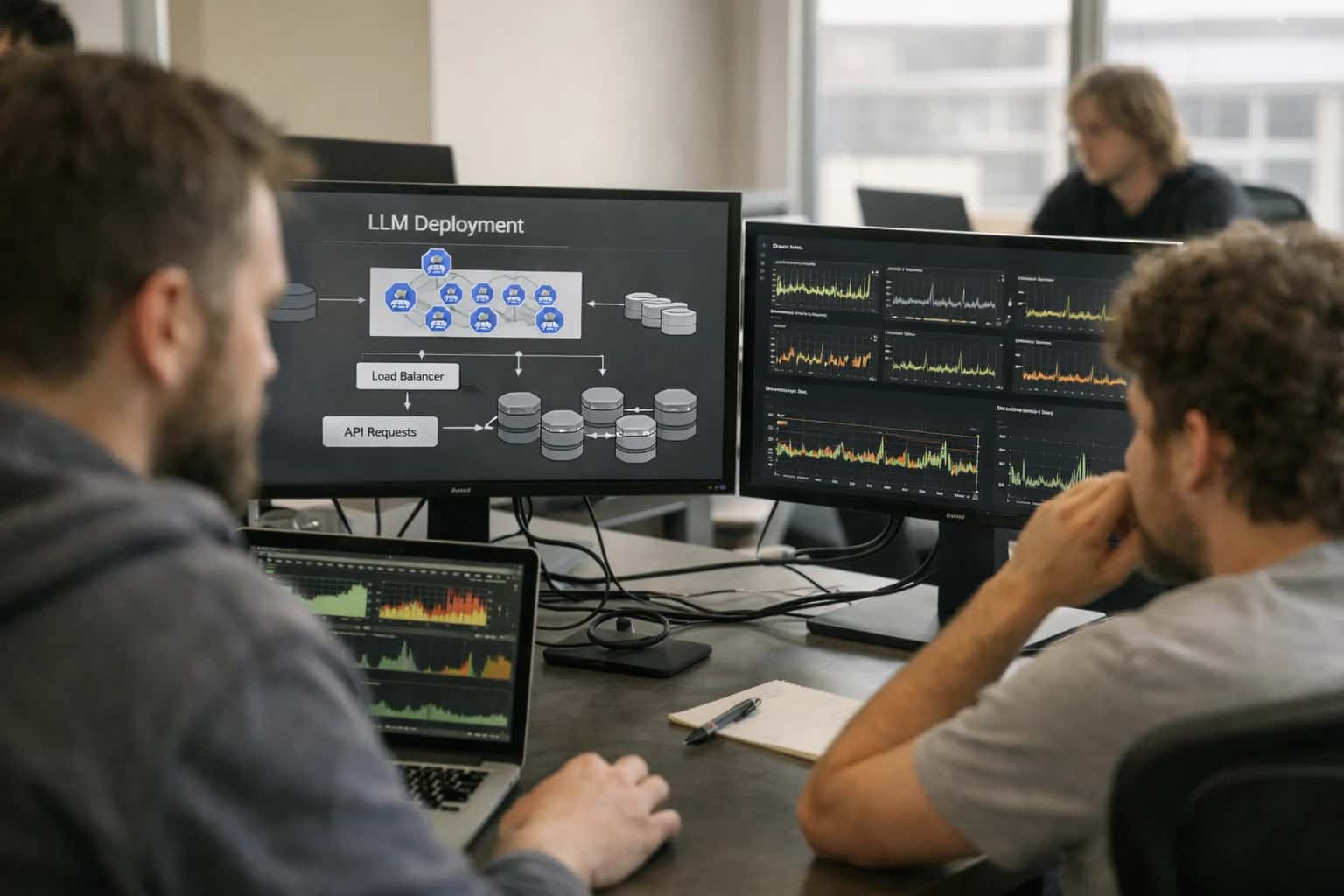
Shadow deployment is a safe MLOps pattern where a new model version processes live requests in parallel with the production model, logging predictions for performance validation without affecting users.
SAFE DEPLOYMENT PATTERN
What is Shadow Deployment?
Shadow deployment is a risk-free validation strategy used in MLOps to test new model versions against live production traffic.
This pattern is especially valuable for validating parameter-efficient fine-tuning (PEFT) adapters, such as LoRA modules, before a full rollout. By comparing logged predictions against the production model's outputs and ground truth (when available), engineers can detect data drift, performance regressions, or unexpected behaviors. Shadow deployment provides a final, real-data validation gate prior to a canary release or A/B testing, ensuring model safety and reliability.
MLOPS DEPLOYMENT PATTERN
Core Characteristics of Shadow Deployment
Shadow deployment is a risk-mitigation strategy for validating new machine learning models in production. It involves parallel execution where the new model's predictions are logged and analyzed, but not acted upon, while the stable production model continues to serve live traffic.
01
Zero-Risk Validation
The primary characteristic of shadow deployment is its zero-risk nature. The new model (the 'shadow') processes identical input data as the production model but its outputs are not returned to the end-user or downstream systems. This allows for performance evaluation against real-world, live data distributions without any impact on user experience, business logic, or revenue. It is the ultimate safety net before a canary or full rollout.
02
Parallel Execution Architecture
Shadow deployment requires a forking mechanism in the inference pipeline. For each incoming request:
- The request is sent to the production model for live serving.
- A copy of the request is simultaneously sent to the shadow model.
- The system logs inputs, both sets of predictions, and the production model's output for later analysis. This architecture demands careful engineering to ensure minimal latency impact on the primary production path and robust logging to avoid data loss.
03
Comprehensive Performance Logging
The value of a shadow deployment is unlocked through detailed, structured logging. For every request, the system must record:
- Input features (or a hashed representation).
- Production model prediction and confidence.
- Shadow model prediction and confidence.
- Request metadata (timestamp, user session ID).
- Ground truth (when it becomes available, e.g., via a later label feedback loop). This dataset enables offline analysis for accuracy, drift, business metric simulation, and fairness evaluations.
04
Ideal for PEFT Model Validation
Shadow deployment is exceptionally well-suited for validating Parameter-Efficient Fine-Tuning (PEFT) models, such as those using LoRA or adapters. Since PEFT models share a frozen base model with the production system, shadow inference can be highly efficient using multi-adapter inference or runtime adapter injection. This allows teams to validate dozens of fine-tuned variants on niche data slices with minimal overhead before promoting the best-performing adapter.
05
Key Validation Metrics
Analysis of shadow deployment logs focuses on several key metrics to gauge the new model's readiness:
- Prediction Divergence: The rate and magnitude of differences between production and shadow model outputs.
- Performance on Delayed Labels: Accuracy, F1-score, or AUC calculated when ground truth is received.
- Inference Latency & Resource Usage: Comparison of compute time and memory footprint.
- Business Metric Simulation: Using shadow predictions to simulate downstream impact on KPIs (e.g., "What would revenue have been if we used the shadow model?").
- Drift Detection: Assessing if the shadow model handles current data drift better than the production model.
06
Transition to Canary Release
A successful shadow deployment is the prerequisite gate for a canary release. The decision to promote a shadow model to a canary is based on quantitative evidence from the shadow logs, confirming:
- Statistical parity or superiority in accuracy metrics.
- Acceptable latency and resource profiles.
- Positive simulated impact on business metrics.
- No regressions on critical data slices. The shadow pattern thus provides the empirical confidence needed to begin exposing the new model to a small percentage of real traffic.
SAFE DEPLOYMENT PATTERN
How Shadow Deployment Works
A technical overview of the shadow deployment pattern for validating new machine learning models in production without user-facing risk.
Shadow deployment is a safe deployment strategy where a new model version processes live production traffic in parallel with the incumbent model, but its predictions are only logged for analysis and are not returned to end-users. This creates a zero-risk production mirror that allows teams to validate the new model's performance, latency, and correctness against real-world data distributions before any user-facing cutover. It is a critical pattern for Parameter-Efficient Fine-Tuning (PEFT) models, where validating the adapter's behavior on live data is essential.
The architecture involves duplicating incoming requests to both the production inference endpoint and a separate shadow endpoint hosting the candidate model. A telemetry pipeline captures the inputs, both sets of predictions, and associated ground truth (if available) for offline evaluation. This enables precise measurement of data drift, concept drift, and business metrics without impacting service-level agreements. It is often a precursor to canary releases or A/B testing for machine learning systems.
SAFETY AND VALIDATION PATTERNS
Shadow Deployment vs. Other Deployment Strategies
A comparison of deployment strategies for machine learning models, focusing on risk mitigation, validation rigor, and operational characteristics.
| Feature / Characteristic | Shadow Deployment | Canary Release | Blue-Green Deployment | A/B Testing |
|---|---|---|---|---|
Primary Objective | Safe performance validation & data collection | Gradual rollout with monitoring | Instant rollback capability | Statistical comparison of variants |
User Exposure to New Model | None (predictions are not returned) | Small, controlled subset (e.g., 5%) | 100% after cutover | Split between variants (e.g., 50/50) |
Risk Level | Minimal (no user-facing impact) | Low (limited blast radius) | Low (fast rollback) | Medium (exposes users to new logic) |
Validation Data Source | Real, live production traffic | Real, live production traffic from canary group | Real, live production traffic after switch | Real, live production traffic from test groups |
Performance Comparison Method | Offline analysis (precision, latency, drift) | Real-time monitoring of canary vs. baseline | Post-switch monitoring vs. old environment | Statistical hypothesis testing on business metrics |
Infrastructure Cost | High (runs two full models) | Moderate (partial duplicate capacity) | High (maintains two full environments) | Moderate (runs multiple model variants) |
Rollback Speed | Instant (stop logging) | Fast (redirect traffic from canary) | Instant (switch traffic back) | Fast (deactivate underperforming variant) |
Best For | Initial validation of high-risk models (PEFT adapters), collecting inference data | Low-risk incremental updates, monitoring new model under real load | Major version upgrades requiring zero-downtime guarantees | Optimizing business metrics (conversion, engagement) between model variants |
VALIDATION PATTERNS
Common Use Cases for Shadow Deployment
Shadow deployment is a critical safety mechanism in MLOps, used to validate new models against live production traffic without exposing users to risk. Its primary applications focus on performance benchmarking, drift detection, and cost analysis.
01
Performance Benchmarking & Validation
The most direct use case is to compare a new candidate model's predictions against the current production model's outputs using live, real-world data. This provides a realistic performance assessment that surpasses offline testing on static datasets.
- Key Metrics: Log prediction discrepancies, compute accuracy/precision/recall, and measure latency on identical requests.
- Real Example: A fintech company shadows a new fraud detection model to compare its fraud flags with the incumbent model on 100% of live transactions before deciding to promote it.
02
Detecting Data & Concept Drift
Shadow deployment acts as a continuous monitoring system for model degradation. By running a freshly trained or retrained model in shadow mode, you can detect if its performance on current traffic has diverged from the production model, signaling potential drift.
- Proactive Alerting: A significant, sustained divergence in shadow model predictions can trigger alerts for investigation before user-facing metrics degrade.
- Ground Truth Lag: Useful when true labels (e.g., loan default) are delayed; the shadow model's behavior on recent data provides an early warning signal.
03
Infrastructure & Cost Validation
Before a full rollout, shadow mode validates the operational footprint of a new model. This is crucial for larger models or those with different hardware requirements.
- Load Testing: Measures the actual compute, memory, and latency impact of the new model under real traffic patterns, informing scaling configurations.
- Cost Forecasting: Provides data to accurately forecast the inference cost per request for the new model version, supporting business case analysis.
04
Safe Testing of PEFT Adapters
In the context of Parameter-Efficient Fine-Tuning (PEFT), shadow deployment is ideal for validating new LoRA or adapter modules. A single base model can load different adapters in shadow mode to test domain-specific adaptations.
- Multi-Tenant Testing: Safely test multiple fine-tuned adapters (e.g., for different customer segments) in parallel against the same live traffic.
- Runtime Validation: Verify the correctness and performance of runtime adapter injection techniques before enabling them for end-users.
05
Compliance & Regulatory Auditing
In regulated industries (finance, healthcare), shadow deployment creates an audit trail of how a new model would have behaved. This log can be used for regulatory submissions, bias/fairness testing, and explaining model changes to auditors.
- Explainability Analysis: Log shadow predictions alongside feature attributions (SHAP, LIME) for detailed retrospective analysis.
- Change Documentation: Provides empirical evidence of a new model's impact prior to approval, supporting governance workflows.
06
Integration & Pipeline Testing
Tests the entire ML serving pipeline—including pre/post-processing, feature fetching, and downstream integrations—with the new model under real conditions, without affecting business processes.
- End-to-End Validation: Ensures the new model version works correctly with all dependent services and data sources.
- Fallback Verification: Confirms that the rollback mechanism to the stable production model functions correctly if the shadow system encounters errors.
SHADOW DEPLOYMENT
Frequently Asked Questions
Shadow deployment is a critical, low-risk validation pattern in MLOps for testing new model versions against live production traffic. These FAQs address its core mechanics, benefits, and implementation within modern AI infrastructure.
Shadow deployment is a safe deployment strategy where a new candidate model (the "shadow" model) processes live, incoming inference requests in parallel with the currently deployed production model, but its predictions are only logged for analysis and are not returned to the end-user or client application. This allows teams to validate the new model's performance, stability, and business impact using real-world data flow without any risk of serving incorrect or degraded predictions.
In this pattern, the production model's output is the only one used for business decisions or user responses. The shadow model's computations are performed asynchronously, and its outputs, along with relevant metrics like latency, resource usage, and any business logic outcomes, are captured for offline comparison against the production baseline. This is a form of dark launch or parallel run.
Enabling Efficiency, Speed & Accuracy
Intelligent Analysis, Decision & Execution
We build AI systems for teams that need search across company data, workflow automation across tools, or AI features inside products and internal software.
Talk to Us
Search across company data
Give teams answers from docs, tickets, runbooks, and product data with sources and permissions.
Useful when people spend too long searching or get different answers from different systems.
Enterprise searchRAGPermissions
Read more
Automate internal workflows
Use AI to route work, draft outputs, trigger actions, and keep approvals and logs in place.
Useful when repetitive work moves across multiple tools and teams.
AI agentsWorkflow automationGovernance
Read more
Add AI to products and internal tools
Build assistants, guided actions, or decision support into the software your team or customers already use.
Useful when AI needs to be part of the product, not a separate tool.
AI integrationDecision supportModel routing
Read more
About the author
Prasad Kumkar
CEO & MD, Inference Systems
Prasad Kumkar is the CEO & MD of Inference Systems and writes about AI systems architecture, LLM infrastructure, model serving, evaluation, and production deployment. Over 5+ years, he has worked across computer vision models, L5 autonomous vehicle systems, and LLM research, with a focus on taking complex AI ideas into real-world engineering systems.
His work and writing cover AI systems, large language models, AI agents, multimodal systems, autonomous systems, inference optimization, RAG, evaluation, and production AI engineering.
LinkedIn
Limited slotsGet a Free AI Consultation
Partnered with leading AI, data, and software stack.





How We Work
Custom AI workflows for your Business
One-fit-all AI don't work for modern businesses. At Inferensys, we aim to understand your business & custom requirements; which we use to define most efficient agentic workflows, the data, and the tools for your business.
01
Review the use case
We understand the task, the users, and where AI can actually help.
Read more02
Pick the right approach
We define what needs search, automation, or product integration.
Read more03
Build the first useful version
We implement the part that proves the value first.
Read more04
Improve from there
We add the checks and visibility needed to keep it useful.
Read moreThe first call is a practical review of your use case and the right next step.
Talk to Us