Static quantization is a Post-Training Quantization (PTQ) method where the quantization parameters (scale and zero-point) for all model activations are predetermined during a one-time calibration step and remain fixed for all subsequent inference runs. This contrasts with dynamic quantization, which calculates these parameters at runtime. The primary goal is to convert a model's weights and activations from 32-bit floating-point (FP32) to lower-precision integers (e.g., INT8), drastically reducing memory footprint and enabling faster computation on hardware with native integer arithmetic units.

Glossary
Static Quantization
Static quantization is a post-training model compression technique that reduces the numerical precision of weights and activations using pre-calibrated, fixed parameters for efficient on-device inference.
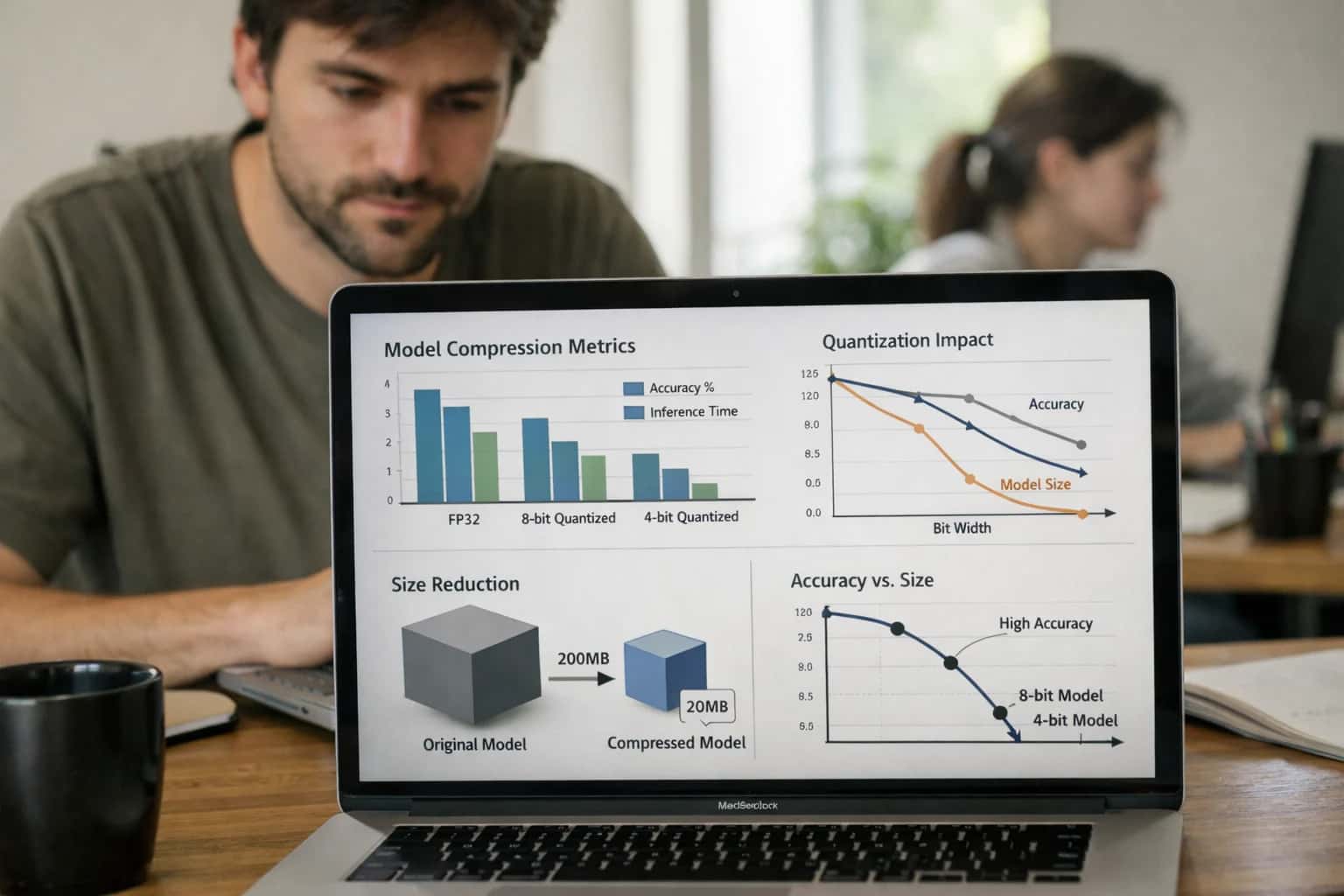
NEURAL NETWORK QUANTIZATION
What is Static Quantization?
A core technique in on-device model compression for deploying efficient AI to edge hardware.
The calibration process involves running a small, representative dataset through the pre-trained model to observe the dynamic ranges of activation tensors. Statistics like min/max values or histograms are collected to compute optimal, fixed quantization scales. This fixed mapping allows for aggressive compiler optimizations, such as quantization folding and pre-computation of constants, resulting in a highly efficient, static computational graph. Consequently, static quantization offers predictable latency and is the preferred method for production deployment on resource-constrained edge devices and Neural Processing Units (NPUs) where runtime overhead must be minimized.
POST-TRAINING QUANTIZATION METHOD
Key Characteristics of Static Quantization
Static quantization is a post-training compression technique where quantization parameters are determined once during calibration and remain fixed for all inference runs. This contrasts with dynamic methods, offering deterministic latency and lower runtime overhead.
01
Fixed Calibration
The defining feature of static quantization is a one-time calibration step. A small, representative dataset is passed through the pre-trained model to observe the dynamic ranges (min/max) of all activation tensors. These observed ranges are used to calculate the scale and zero-point parameters, which are then baked into the model and remain constant for all future inferences. This eliminates the need for runtime statistics collection.
02
Deterministic Latency & Overhead
Because all quantization parameters are predetermined, the inference graph is fully static and known at compile time. This leads to:
- Predictable, consistent latency for every inference run.
- Zero runtime overhead for calculating activation ranges, unlike dynamic quantization.
- Enables aggressive graph optimizations and operator fusion by the inference engine (e.g., TensorFlow Lite, PyTorch Mobile) since the entire data flow is fixed.
03
Requires Representative Data
The accuracy of a statically quantized model is highly dependent on the quality of the calibration dataset. This dataset must accurately reflect the statistical distribution of real-world inference data. Poor calibration can lead to:
- Range mismatch, where activations during inference fall outside the calibrated range, causing clipping/saturation.
- Increased quantization error and significant accuracy degradation.
- The need for techniques like percentile calibration to mitigate outliers in the calibration data.
04
Hardware Optimization Target
Static quantization is the primary method for deploying models to fixed-function hardware accelerators like Digital Signal Processors (DSPs), Neural Processing Units (NPUs), and many mobile System-on-Chips (SoCs). These chips have dedicated integer arithmetic logic units (ALUs) and require a fully defined, static execution graph. The fixed 8-bit (INT8) or 4-bit (INT4) operations map directly to these efficient hardware pathways.
05
Asymmetric vs. Symmetric Schemes
Static quantization commonly employs two schemes:
- Asymmetric Quantization: Uses separate scale and zero-point parameters. It maps the quantized range directly to the observed min/max values of the tensor, providing a tight fit for distributions not centered on zero (e.g., ReLU activations).
- Symmetric Quantization: Constrains the range to be symmetric around zero, forcing the zero-point to be 0. This simplifies the arithmetic (eliminating zero-point addition) but can be less efficient if the data range is not symmetric. The choice is a trade-off between accuracy and computational simplicity.
06
Contrast with Dynamic Quantization
It is crucial to distinguish static from its sibling technique, dynamic quantization.
- Static: Activation ranges fixed during calibration. Weights are quantized ahead of time.
- Dynamic: Activation ranges are computed on-the-fly per inference batch. Weights are quantized ahead of time. Key Trade-off: Static quantization offers lower latency and overhead but risks accuracy loss if calibration data is unrepresentative. Dynamic quantization adapts to input data, often preserving higher accuracy, but incurs runtime computation cost.
POST-TRAINING QUANTIZATION METHODS
Static vs. Dynamic Quantization
A comparison of two primary methods for quantizing neural network activations after training, focusing on their operational characteristics and trade-offs.
| Feature | Static Quantization | Dynamic Quantization |
|---|---|---|
Core Mechanism | Uses fixed, pre-calibrated quantization parameters (scale/zero-point) for all activations. | Calculates quantization parameters for activations on-the-fly for each input at runtime. |
Calibration Step | ||
Runtime Overhead | Low (< 1% typical). Parameters are constants. | Moderate (5-15% typical). Requires min/max observation per tensor. |
Inference Speed | Maximum. Enables full pre-compilation of integer kernels. | Slightly reduced due to parameter calculation. |
Memory Footprint | Minimal. Only weights and fixed quantization parameters are stored. | Slightly higher. Requires logic for runtime range estimation. |
Accuracy Profile | Stable and deterministic for data similar to the calibration set. | Adapts to input distribution, potentially more robust to distribution shifts. |
Hardware Compatibility | Excellent. Fully compatible with fixed-function integer units (e.g., NPUs, DSPs). | Good. Requires general-purpose cores for range calculation, limiting peak accelerator utilization. |
Typical Use Case | Production deployment with stable input data (e.g., mobile vision, always-on sensors). | Models with highly variable activation ranges (e.g., NLP models with variable sequence lengths). |
IMPLEMENTATION ECOSYSTEM
Frameworks and Hardware Supporting Static Quantization
Static quantization's efficiency gains are realized through specialized software frameworks and hardware accelerators designed for low-precision integer arithmetic. This ecosystem enables the deployment of compressed models from development to production silicon.
03
Mobile & Embedded CPUs (ARM)
Mobile Application Processors (e.g., ARM Cortex-A series, Apple Silicon) contain instruction set extensions that accelerate INT8 operations, making static quantization critical for on-device AI.
- ARM NEON & SVE: SIMD (Single Instruction, Multiple Data) extensions that parallelize low-precision integer arithmetic.
- Apple Neural Engine (ANE): A dedicated neural processor that requires models to be quantized and compiled via Core ML to leverage its 8-bit and 16-bit compute units.
Static quantization reduces memory bandwidth, which is often the bottleneck on these power-constrained systems, enabling faster and more energy-efficient inference.
INT8
Native Precision
>50%
Typical Speedup vs. FP32
04
Dedicated AI Accelerators (NPUs/TPUs)
Neural Processing Units (NPUs) and Tensor Processing Units (TPUs) are specialized hardware with integer arithmetic logic units (ALUs) designed for quantized tensor operations.
- Google Edge TPU: Executes INT8 models exclusively; requires full integer quantization via the Edge TPU Compiler.
- Qualcomm Hexagon DSP/NPU: Central to Snapdragon platforms, optimized for INT8 and INT16 quantized models.
- Intel Movidius VPUs & Habana Gaudi: Use static quantization to maximize throughput in vision and data center inference scenarios.
These accelerators often require a specific toolchain or compiler (e.g., Qualcomm's SNPE, Intel's OpenVINO) to convert a framework-quantized model into a proprietary, hardware-optimized format.
06
Microcontroller Frameworks (TinyML)
For extreme edge devices, TinyML frameworks enable static quantization to run models on microcontrollers (MCUs) with < 1 MB of RAM.
- TensorFlow Lite for Microcontrollers: A port of TFLite that supports INT8 static quantization, generating C++ arrays of quantized weights and kernels.
- CMSIS-NN: ARM's optimized library of neural network kernels for Cortex-M CPUs, designed for INT8 and INT16 quantized operations.
These frameworks perform full integer quantization, where all operations, including activation functions, are executed using integer math, eliminating the need for any floating-point library on the device.
KB
Model Memory Footprint
mW
Power Consumption
STATIC QUANTIZATION
Frequently Asked Questions
Static quantization is a core technique for deploying neural networks on resource-constrained devices. These questions address its core mechanics, trade-offs, and practical implementation.
Static quantization is a Post-Training Quantization (PTQ) method that converts a pre-trained neural network's weights and activations from high-precision floating-point (e.g., FP32) to lower-precision integers (e.g., INT8) using a fixed set of parameters determined once before deployment.
It works in two phases:
- Calibration: A representative dataset is passed through the model without training. Statistics (like min/max values) are collected for each layer's activation tensors to determine their dynamic ranges.
- Parameter Freezing: Based on these statistics, the quantization scale and zero-point parameters for every tensor are calculated and permanently fixed. The model is then converted to its quantized integer form.
During inference, all operations use these pre-calculated parameters, enabling efficient integer-only arithmetic on hardware like CPUs, GPUs, and Neural Processing Units (NPUs) without runtime overhead for parameter calculation.
Enabling Efficiency, Speed & Accuracy
Intelligent Analysis, Decision & Execution
We build AI systems for teams that need search across company data, workflow automation across tools, or AI features inside products and internal software.
Talk to Us
Search across company data
Give teams answers from docs, tickets, runbooks, and product data with sources and permissions.
Useful when people spend too long searching or get different answers from different systems.
Enterprise searchRAGPermissions
Read more
Automate internal workflows
Use AI to route work, draft outputs, trigger actions, and keep approvals and logs in place.
Useful when repetitive work moves across multiple tools and teams.
AI agentsWorkflow automationGovernance
Read more
Add AI to products and internal tools
Build assistants, guided actions, or decision support into the software your team or customers already use.
Useful when AI needs to be part of the product, not a separate tool.
AI integrationDecision supportModel routing
Read more
About the author
Prasad Kumkar
CEO & MD, Inference Systems
Prasad Kumkar is the CEO & MD of Inference Systems and writes about AI systems architecture, LLM infrastructure, model serving, evaluation, and production deployment. Over 5+ years, he has worked across computer vision models, L5 autonomous vehicle systems, and LLM research, with a focus on taking complex AI ideas into real-world engineering systems.
His work and writing cover AI systems, large language models, AI agents, multimodal systems, autonomous systems, inference optimization, RAG, evaluation, and production AI engineering.
LinkedIn
Limited slotsGet a Free AI Consultation
Partnered with leading AI, data, and software stack.





How We Work
Custom AI workflows for your Business
One-fit-all AI don't work for modern businesses. At Inferensys, we aim to understand your business & custom requirements; which we use to define most efficient agentic workflows, the data, and the tools for your business.
01
Review the use case
We understand the task, the users, and where AI can actually help.
Read more02
Pick the right approach
We define what needs search, automation, or product integration.
Read more03
Build the first useful version
We implement the part that proves the value first.
Read more04
Improve from there
We add the checks and visibility needed to keep it useful.
Read moreThe first call is a practical review of your use case and the right next step.
Talk to Us