TinyBERT is a distilled language model that applies a novel transformer distillation framework to compress the BERT architecture for efficient inference. Unlike general-purpose distillation, it employs a two-stage process: first distilling general knowledge during pre-training, then performing task-specific distillation during fine-tuning. This method transfers knowledge not just from the teacher's final output logits, but also from its attention matrices and hidden layer embeddings, capturing the transformer's internal mechanisms. The result is a model that is 7.5x smaller and 9.4x faster than BERT-base while retaining competitive performance on language understanding benchmarks.

Glossary
TinyBERT
TinyBERT is a task-specific, distilled version of the BERT language model that uses transformer distillation during both pre-training and fine-tuning to achieve high compression for efficient on-device deployment.
KNOWLEDGE DISTILLATION
What is TinyBERT?
TinyBERT is a task-specific, highly compressed version of the BERT language model, created via transformer distillation to enable efficient on-device deployment.
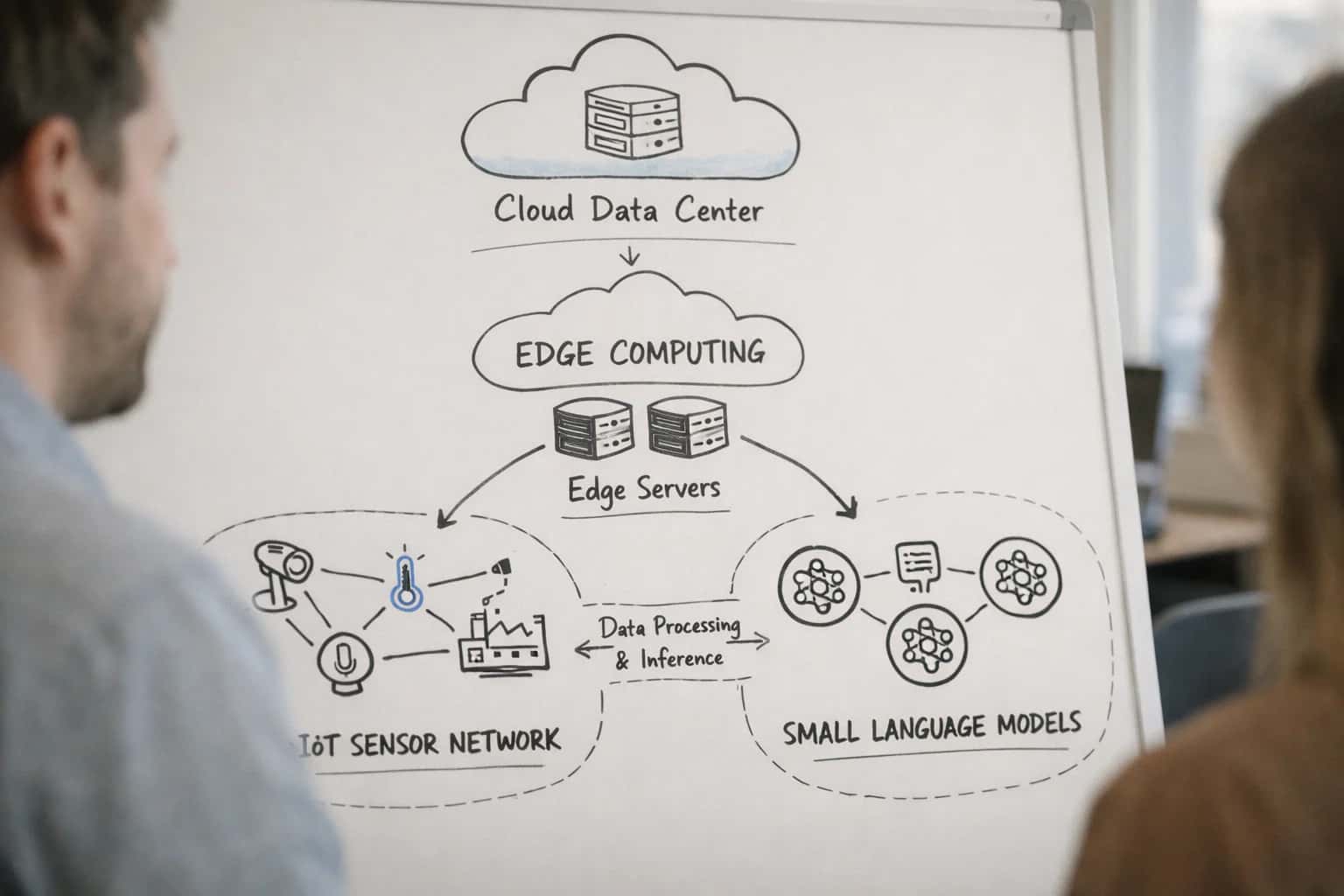
The compression is achieved through a layer-wise distillation strategy, where the smaller student transformer's layers are aligned to specific layers of the larger teacher BERT. A dedicated distillation loss function minimizes the difference between their attention distributions and hidden states. This approach is a cornerstone of on-device model compression, allowing advanced NLP capabilities to run on mobile and edge devices with limited memory and compute. TinyBERT exemplifies hardware-aware compression, where algorithmic efficiency is co-designed with deployment constraints, making it a key technique in small language model engineering for private, low-latency applications.
KNOWLEDGE DISTILLATION
Key Features of TinyBERT
TinyBERT is a task-specific distilled version of BERT that employs transformer distillation at both the pre-training and task-specific fine-tuning stages to achieve high compression rates for on-device deployment.
01
Two-Stage Transformer Distillation
TinyBERT's core innovation is its two-stage distillation process, which transfers knowledge from a large BERT teacher to a compact student model at two distinct levels:
- General-Distillation: The student model is first distilled during the teacher's pre-training phase on a large, general-domain corpus. This transfers broad linguistic knowledge and world understanding.
- Task-Distillation: The model then undergoes a second, task-specific distillation using data from the target downstream task (e.g., sentiment analysis, question answering). This stage fine-tunes the model's knowledge for optimal performance on the intended application. This layered approach ensures the student model learns both universal language representations and specialized task behaviors.
02
Multi-Layer Feature Alignment
Unlike simpler logit-based distillation, TinyBERT employs feature-based distillation across multiple transformer layers. The student model is trained to mimic the teacher's intermediate representations, not just its final outputs. Key alignment points include:
- Embedding Layer Output: Aligns the token and positional embeddings.
- Hidden States of Transformer Layers: Aligns the output of selected, layer-mapped student layers to corresponding teacher layers.
- Attention Matrices: Aligns the self-attention distributions (before softmax), capturing the teacher's contextual focus patterns.
- Predictive Layer Output: Aligns the final hidden state before the task-specific head. This comprehensive alignment ensures the student internalizes the teacher's representational transformations throughout the network.
03
Task-Specific Architecture Design
TinyBERT is not a one-size-fits-all model; its architecture is co-designed with the distillation process for a specific task. The design involves:
- Layer Reduction: The number of transformer layers (depth) is significantly reduced. A typical configuration uses 4 layers for the student versus BERT-base's 12.
- Dimension Reduction: The hidden size and feed-forward network dimensions are shrunk, reducing the parameter count per layer.
- Attention Head Configuration: The number of attention heads is often reduced, simplifying the self-attention mechanism. The exact architecture (e.g., 4 layers, 312-hidden, 12-heads) is a hyperparameter optimized during the distillation process to balance size and accuracy for the target task.
04
Distillation for On-Device Efficiency
The primary goal of TinyBERT is to enable high-performance NLP on resource-constrained devices. Its design directly targets key mobile and edge deployment metrics:
- Model Size: Achieves a 7.5x reduction in parameters compared to BERT-base (from ~110M to ~14.5M parameters).
- Inference Latency: Demonstrates a 9.4x speedup in inference time on CPU, crucial for real-time applications.
- Memory Footprint: The dramatically smaller model fits into the limited RAM of mobile phones and embedded systems.
- Energy Efficiency: Reduced computational load translates directly to lower power consumption, extending battery life for mobile applications.
7.5x
Parameter Reduction
9.4x
Inference Speedup
05
Loss Function Composition
Training TinyBERT involves optimizing a composite loss function that combines multiple distillation objectives, each targeting a different aspect of the teacher's knowledge:
- Embedding-Layer Loss (L_emb): Mean Squared Error (MSE) between teacher and student token embeddings.
- Hidden-State Loss (L_hid): MSE loss applied to the aligned outputs of selected transformer layers.
- Attention-Matrix Loss (L_att): MSE loss applied to the attention scores (before softmax) of the aligned attention heads.
- Predictive-Layer Loss (L_pred): Either Kullback-Leibler Divergence (KL Divergence) on the softened logits (for logit distillation) or a task-specific loss (e.g., cross-entropy). The total loss is a weighted sum: L_total = L_emb + L_hid + L_att + L_pred. This multi-faceted objective ensures holistic knowledge transfer.
06
Performance & Benchmark Results
On the GLUE benchmark for natural language understanding, TinyBERT demonstrates that aggressive compression does not necessitate a severe performance drop:
- It retains 96.8% of the performance of BERT-base on average across GLUE tasks, despite being 7.5x smaller.
- On specific tasks like SST-2 (sentiment analysis), it achieves over 92% accuracy, closely matching the teacher.
- Its performance significantly outperforms other compression techniques like pruning or post-training quantization when applied in isolation.
- The task-specific distillation stage is critical; a generically distilled TinyBERT performs notably worse, highlighting the importance of the two-stage process for achieving state-of-the-art results in compact models.
FEATURE COMPARISON
TinyBERT vs. Other Distilled Models
A technical comparison of task-specific distillation approaches, highlighting TinyBERT's unique two-stage transformer distillation against other prominent model compression techniques.
| Feature / Metric | TinyBERT | DistilBERT | DeiT (Data-efficient Image Transformer) |
|---|---|---|---|
Primary Compression Method | Transformer Distillation (Two-Stage) | General-Purpose Knowledge Distillation | Distillation Token & Teacher-Student |
Distillation Target | Embeddings, Attention, & Hidden States | Output Logits (Soft Targets) | Distillation Token & Class Logits |
Training Stage Applied | Pre-training & Task-Specific Fine-tuning | Pre-training only | Pre-training only |
Model Architecture Family | Transformer (BERT-based) | Transformer (BERT-based) | Vision Transformer (ViT-based) |
Primary Modality | Text (NLP) | Text (NLP) | Image (Computer Vision) |
Key Innovation | Layer-to-layer transformer distillation | General-purpose BERT distillation | Native distillation token for ViTs |
Typical Size Reduction vs. Teacher | ~7.5x smaller (4-layer vs. 12-layer BERT) | ~40% smaller (6-layer vs. 12-layer BERT) | Architecture-specific (no direct BERT reduction) |
Inference Speed-Up (Approx.) | ~9.4x faster | ~60% faster | Varies by model size; designed for efficiency |
Task-Specific Optimization | Yes, via fine-tuning stage distillation | No, general-purpose | No, general-purpose for vision |
Requires Original Training Data | Yes, for pre-training distillation | Yes, for pre-training distillation | No, designed for data-efficient training |
TINYBERT
Frequently Asked Questions
TinyBERT is a task-specific distilled version of BERT that employs transformer distillation at both the pre-training and task-specific fine-tuning stages to achieve high compression rates for on-device deployment.
TinyBERT is a highly compressed version of the BERT language model created through a two-stage knowledge distillation process designed specifically for efficient on-device inference. It works by distilling the dark knowledge from a larger BERT teacher model into a smaller, transformer-based student model with fewer layers and hidden units. This process occurs in two phases: first, during general distillation on the general pre-training corpus to transfer broad linguistic knowledge, and second, during task-specific distillation on downstream task data (like GLUE benchmarks) where the student learns to mimic the teacher's task-specific predictions and intermediate attention matrices. This layered approach allows TinyBERT to achieve a significant size reduction (over 7.5x smaller) and speedup (over 9.4x faster) while retaining competitive accuracy.
Enabling Efficiency, Speed & Accuracy
Intelligent Analysis, Decision & Execution
We build AI systems for teams that need search across company data, workflow automation across tools, or AI features inside products and internal software.
Talk to Us
Search across company data
Give teams answers from docs, tickets, runbooks, and product data with sources and permissions.
Useful when people spend too long searching or get different answers from different systems.
Enterprise searchRAGPermissions
Read more
Automate internal workflows
Use AI to route work, draft outputs, trigger actions, and keep approvals and logs in place.
Useful when repetitive work moves across multiple tools and teams.
AI agentsWorkflow automationGovernance
Read more
Add AI to products and internal tools
Build assistants, guided actions, or decision support into the software your team or customers already use.
Useful when AI needs to be part of the product, not a separate tool.
AI integrationDecision supportModel routing
Read more
About the author
Prasad Kumkar
CEO & MD, Inference Systems
Prasad Kumkar is the CEO & MD of Inference Systems and writes about AI systems architecture, LLM infrastructure, model serving, evaluation, and production deployment. Over 5+ years, he has worked across computer vision models, L5 autonomous vehicle systems, and LLM research, with a focus on taking complex AI ideas into real-world engineering systems.
His work and writing cover AI systems, large language models, AI agents, multimodal systems, autonomous systems, inference optimization, RAG, evaluation, and production AI engineering.
LinkedIn
Limited slotsGet a Free AI Consultation
Partnered with leading AI, data, and software stack.





How We Work
Custom AI workflows for your Business
One-fit-all AI don't work for modern businesses. At Inferensys, we aim to understand your business & custom requirements; which we use to define most efficient agentic workflows, the data, and the tools for your business.
01
Review the use case
We understand the task, the users, and where AI can actually help.
Read more02
Pick the right approach
We define what needs search, automation, or product integration.
Read more03
Build the first useful version
We implement the part that proves the value first.
Read more04
Improve from there
We add the checks and visibility needed to keep it useful.
Read moreThe first call is a practical review of your use case and the right next step.
Talk to Us