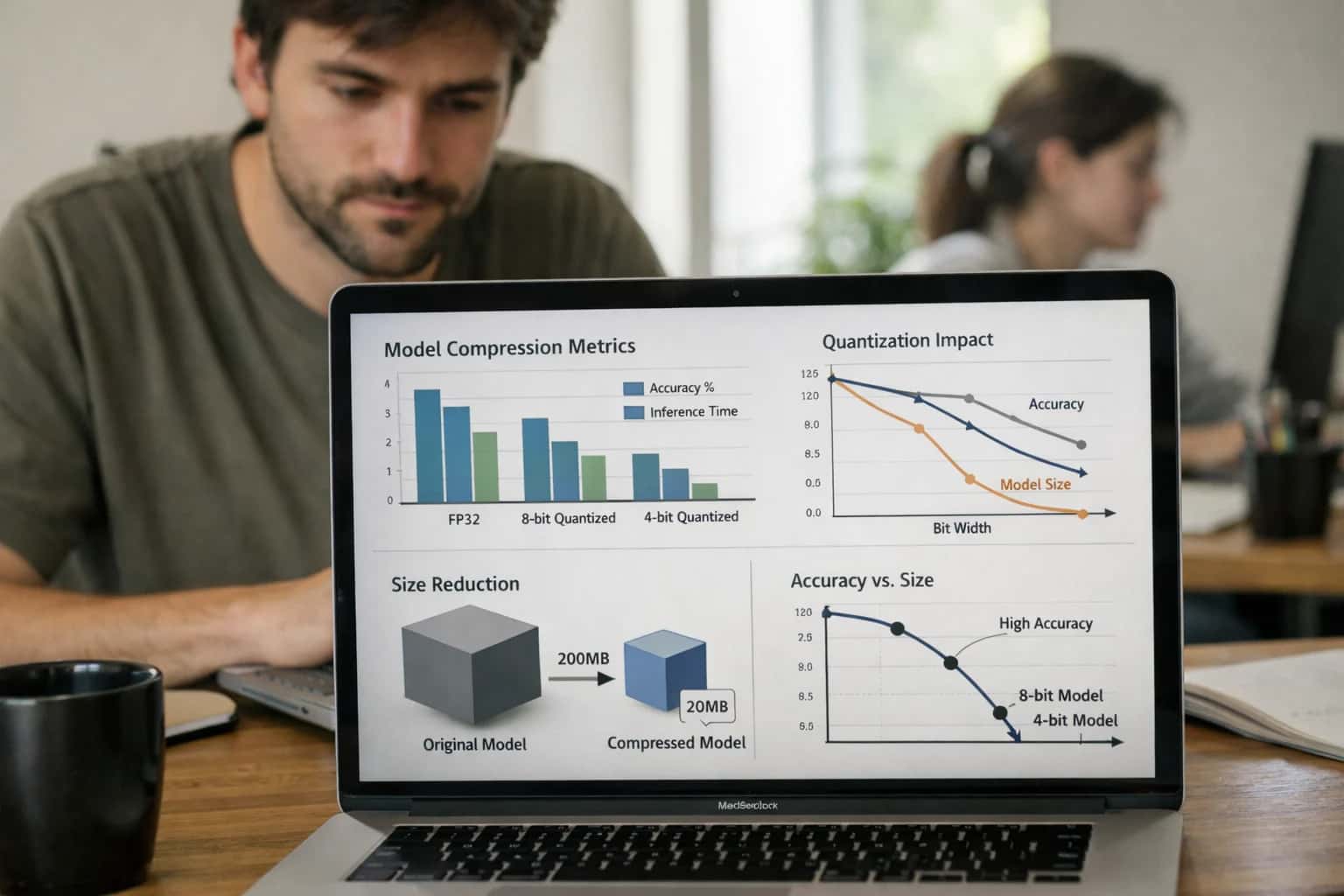
A compression benchmark is a standardized suite of models, datasets, and metrics used to objectively evaluate and compare the effectiveness of different model compression techniques. It provides a controlled environment to measure the fundamental compression-accuracy tradeoff, quantifying metrics like accuracy drop, compression ratio, latency, and power consumption. This allows engineers to profile model degradation and identify optimal configurations for deployment.

Glossary
Compression Benchmark
A compression benchmark is a standardized suite of models, datasets, and metrics used to objectively evaluate and compare the effectiveness of different neural network compression techniques and tools.
GLOSSARY
What is a Compression Benchmark?
A standardized evaluation framework for objectively measuring the impact of model compression techniques.
Core components include a performance baseline (the original 'golden model'), a calibration dataset, and precise evaluation protocols for on-device evaluation. By running a candidate compression algorithm through a benchmark, teams can generate a tradeoff curve, analyze layer-wise sensitivity, and determine if the result meets an application's degradation threshold before committing to production deployment.
COMPRESSION BENCHMARK
Core Components of a Compression Benchmark
A compression benchmark is a standardized evaluation framework that provides objective, reproducible metrics to compare the efficacy of different model compression techniques. Its core components ensure a fair and comprehensive assessment of the tradeoffs between model size, speed, and accuracy.
01
Standardized Model Zoo
A benchmark's foundation is a curated set of reference models spanning architectures (e.g., ResNet, BERT, Vision Transformer) and complexities. This zoo provides a common baseline for comparison. Key aspects include:
- Diverse Architectures: Coverage of CNNs, Transformers, and RNNs.
- Pre-trained Weights: Publicly available, well-performing checkpoints.
- Task Variety: Models for image classification, object detection, NLP, and speech recognition.
Examples include models from PyTorch's TorchVision, Hugging Face's Transformers library, and TensorFlow's Model Garden.
02
Calibration & Evaluation Datasets
Benchmarks require standardized datasets for two distinct phases:
- Calibration Dataset: A small, representative subset (e.g., 500-1000 samples) used during post-training quantization to estimate activation ranges. It must not overlap with evaluation data.
- Evaluation Dataset: A large, held-out validation or test set (e.g., ImageNet-1k val, GLUE benchmark) used to measure final accuracy metrics like Top-1, mAP, or F1-score. This ensures performance is measured on unseen data, preventing overfitting to the benchmark.
03
Quantitative Performance Metrics
The definitive output of a benchmark is a suite of quantitative metrics that capture the compression-accuracy tradeoff. Core metrics include:
- Model Size: Measured in megabytes (MB) or parameter count, indicating storage and memory footprint reduction.
- Computational Cost: Measured in FLOPs (Floating Point Operations) or MACs (Multiply-Accumulate Operations).
- Inference Latency: End-to-end execution time (in milliseconds), ideally measured on target hardware.
- Accuracy: Primary task performance (e.g., classification accuracy).
- Compression Ratio: The ratio of original model size to compressed model size.
Advanced metrics may include energy consumption (joules per inference) and peak memory usage during inference.
04
Hardware & Runtime Environment
For latency and power metrics to be meaningful, the benchmark must specify a controlled execution environment. This includes:
- Target Hardware: Specific CPUs (e.g., ARM Cortex-A78), GPUs, or NPUs (e.g., Google Edge TPU, Qualcomm Hexagon).
- Software Stack: Precise versions of the OS, drivers, inference frameworks (e.g., TensorFlow Lite, PyTorch Mobile, ONNX Runtime), and compiler flags.
- Execution Settings: Batch size (typically 1 for edge scenarios), number of warm-up runs, and number of measurement iterations.
This standardization prevents variance from software optimizations or thermal throttling from skewing results.
05
Compression Technique Implementations
A benchmark evaluates specific, reproducible implementations of compression algorithms. Common categories include:
- Post-Training Quantization (PTQ): Converting FP32 models to INT8 using calibration data.
- Quantization-Aware Training (QAT): Fine-tuning models with simulated quantization.
- Pruning: Structured (removing entire filters/channels) or unstructured (removing individual weights) sparsity.
- Knowledge Distillation: Training a small student model using outputs from a large teacher.
The benchmark must document the exact hyperparameters, libraries (e.g., TensorFlow Model Optimization Toolkit, PyTorch FX Graph Mode Quantization), and procedures used for each technique.
06
Reporting & Visualization Standards
The final component is a standardized format for presenting results, enabling clear comparison. This involves:
- Tradeoff Curves: 2D plots with accuracy (y-axis) versus model size or latency (x-axis), highlighting the Pareto frontier of optimal configurations.
- Summary Tables: Consolidated metrics for all model-technique combinations.
- Fidelity Metrics: Reporting of KL divergence or cosine similarity between original and compressed model outputs to measure behavioral fidelity beyond top-line accuracy.
Established benchmarks like MLPerf Tiny provide templates for this structured reporting, ensuring results are interpretable and actionable for engineers.
COMPRESSION-ACCURACY TRADEOFF ANALYSIS
How a Compression Benchmark Works
A compression benchmark is a standardized evaluation suite used to objectively measure and compare the impact of model optimization techniques.
A compression benchmark is a standardized suite of models, datasets, and metrics designed to objectively evaluate and compare the effectiveness of different model compression techniques like quantization and pruning. It provides a controlled environment to measure the fundamental compression-accuracy tradeoff, quantifying metrics such as model size, inference latency, memory footprint, and accuracy drop against a performance baseline. This allows engineers to profile techniques fairly and identify optimal configurations for deployment.
Execution involves running a golden model (the uncompressed reference) and its compressed variants through identical inference tasks. Key outputs include tradeoff curves and Pareto frontiers that visualize optimal balances between size and accuracy. The benchmark culminates in on-device evaluation on target hardware to validate real-world gains. This rigorous profiling is essential for ML engineers and CTOs to make data-driven decisions about deployment feasibility and select the right compression tools.
STANDARDIZED EVALUATION SUITES
Examples of Popular Compression Benchmarks
A comparison of widely used benchmark suites that provide standardized models, datasets, and metrics for evaluating the effectiveness of model compression techniques.
| Benchmark Suite | Primary Focus | Key Models | Core Metrics | Hardware Target |
|---|---|---|---|---|
MLPerf Tiny | Ultra-low-power inference on microcontrollers | Keyword Spotting, Visual Wake Words | Accuracy, Latency, Energy (uJ/inf) | Microcontrollers (MCUs) |
EEMBC MLMark | Performance-per-Watt on embedded processors | MobileNetV1, ResNet-50 (quantized) | Inferences/sec/Watt, Accuracy | Embedded CPUs, MCUs, NPUs |
AI Benchmark (MLCommons Mobile) | On-device AI for smartphones & edge devices | Mobilenet, Inception, BERT variants | Latency (ms), Accuracy, FPS | Mobile SoCs (CPU/GPU/NPU) |
TinyML Perf | Standardized evaluation for TinyML systems | Multiple vision/audio models | Accuracy, Latency, Peak Memory | Broad TinyML hardware |
DeepBench (for inference) | Low-level kernel & hardware performance | Convolution, RNN, GEMM operations | GFLOPS/s, Memory Bandwidth | CPUs, GPUs, NPUs |
ONNX Runtime Benchmark | Framework & backend performance comparison | Portfolio of ONNX models | Throughput (inf/sec), Latency | Cross-platform (CPU/GPU) |
Neural Network Distillation Benchmark | Teacher-student knowledge transfer | ResNet, BERT pairs | Student Accuracy, Compression Ratio | Algorithm-focused (hardware-agnostic) |
Hardware-Aware NAS Benchmarks | Neural Architecture Search with constraints | Search spaces (e.g., NAS-Bench-201) | Accuracy, Latency, Parameter Count | Target-specific (e.g., Pixel 4, Raspberry Pi) |
COMPRESSION BENCHMARK
Frequently Asked Questions
A compression benchmark is a standardized evaluation suite used to objectively measure and compare the effectiveness of model compression techniques. This FAQ addresses common questions about their purpose, components, and role in deployment decisions.
A compression benchmark is a standardized suite of models, datasets, and metrics designed to objectively evaluate and compare the effectiveness of different neural network compression techniques, such as quantization, pruning, and knowledge distillation. Its importance lies in providing reproducible, apples-to-apples comparisons that allow engineers and CTOs to make informed decisions about which compression tools and methods are best suited for their specific hardware constraints and accuracy requirements. Without a standardized benchmark, claims about compression performance are anecdotal and difficult to verify, leading to suboptimal deployment choices and increased engineering overhead.
Key reasons for its importance include:
- Objective Comparison: Eliminates vendor hype by providing neutral, data-driven evaluations.
- Reproducibility: Ensures results can be independently verified by the research and engineering community.
- Deployment Confidence: Provides realistic performance profiles (accuracy, latency, memory) that predict real-world on-device behavior.
- Research Direction: Guides the development of new compression algorithms by establishing clear state-of-the-art baselines.
Enabling Efficiency, Speed & Accuracy
Intelligent Analysis, Decision & Execution
We build AI systems for teams that need search across company data, workflow automation across tools, or AI features inside products and internal software.
Talk to Us
Search across company data
Give teams answers from docs, tickets, runbooks, and product data with sources and permissions.
Useful when people spend too long searching or get different answers from different systems.
Enterprise searchRAGPermissions
Read more
Automate internal workflows
Use AI to route work, draft outputs, trigger actions, and keep approvals and logs in place.
Useful when repetitive work moves across multiple tools and teams.
AI agentsWorkflow automationGovernance
Read more
Add AI to products and internal tools
Build assistants, guided actions, or decision support into the software your team or customers already use.
Useful when AI needs to be part of the product, not a separate tool.
AI integrationDecision supportModel routing
Read more
About the author
Prasad Kumkar
CEO & MD, Inference Systems
Prasad Kumkar is the CEO & MD of Inference Systems and writes about AI systems architecture, LLM infrastructure, model serving, evaluation, and production deployment. Over 5+ years, he has worked across computer vision models, L5 autonomous vehicle systems, and LLM research, with a focus on taking complex AI ideas into real-world engineering systems.
His work and writing cover AI systems, large language models, AI agents, multimodal systems, autonomous systems, inference optimization, RAG, evaluation, and production AI engineering.
LinkedIn
Limited slotsGet a Free AI Consultation
Partnered with leading AI, data, and software stack.





How We Work
Custom AI workflows for your Business
One-fit-all AI don't work for modern businesses. At Inferensys, we aim to understand your business & custom requirements; which we use to define most efficient agentic workflows, the data, and the tools for your business.
01
Review the use case
We understand the task, the users, and where AI can actually help.
Read more02
Pick the right approach
We define what needs search, automation, or product integration.
Read more03
Build the first useful version
We implement the part that proves the value first.
Read more04
Improve from there
We add the checks and visibility needed to keep it useful.
Read moreThe first call is a practical review of your use case and the right next step.
Talk to Us