Knowledge Distillation (KD) is a model compression technique where a smaller, more efficient 'student' model is trained to mimic the predictive behavior and learned representations of a larger, more accurate 'teacher' model. The process transfers the teacher's generalized 'knowledge'—often embodied in its softened output probabilities (logits) or intermediate feature maps—to the student, enabling a compact model to achieve performance closer to a cumbersome one. This is fundamental for hardware-aware model optimization, allowing models to be tailored for deployment on resource-constrained Neural Processing Units (NPUs) where latency, memory, and power are critical constraints.

Glossary
Knowledge Distillation (KD)
Knowledge Distillation (KD) is a model compression technique where a smaller, more efficient 'student' model is trained to mimic the behavior and predictions of a larger, more accurate 'teacher' model, transferring the teacher's learned knowledge.
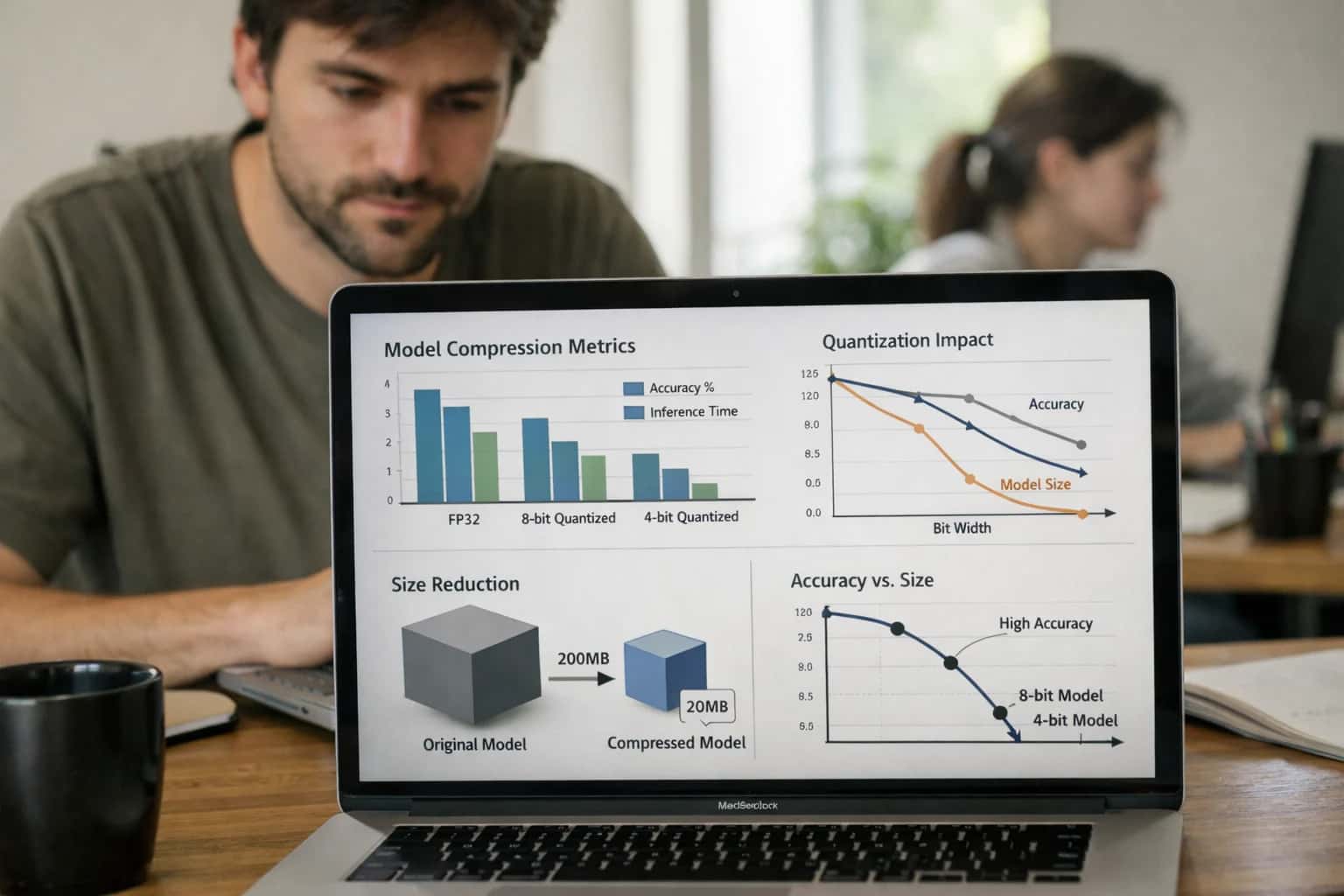
MODEL COMPRESSION
What is Knowledge Distillation (KD)?
Knowledge Distillation is a core technique in hardware-aware model optimization for deploying efficient AI on specialized accelerators like NPUs.
The distillation objective typically combines a standard task loss (e.g., cross-entropy with ground truth labels) with a distillation loss that minimizes the difference between the student and teacher outputs. Common variants include response-based distillation (matching final logits), feature-based distillation (matching intermediate activations), and relation-based distillation (matching relationships between data samples). This technique is often used in conjunction with other hardware-aware optimizations like quantization and pruning to produce ultra-efficient models. The resulting student model retains much of the teacher's accuracy while being significantly faster and smaller, making it ideal for on-device inference and edge AI deployment.
HARDWARE-AWARE MODEL OPTIMIZATION
Key Components of Knowledge Distillation
Knowledge Distillation is a model compression technique where a smaller 'student' model learns to replicate the behavior of a larger 'teacher' model. Its core components define the transfer mechanism, loss functions, and architectural considerations for efficient deployment.
01
Teacher-Student Architecture
The fundamental framework consists of two neural networks. The teacher model is a large, pre-trained, and highly accurate network (e.g., BERT, ResNet-50). The student model is a smaller, more efficient network designed for deployment on constrained hardware (e.g., MobileNet, DistilBERT). Knowledge is transferred from teacher to student, not by copying weights, but by mimicking the teacher's output behavior and internal representations.
02
Knowledge Transfer: Logits & Soft Labels
The primary transfer medium is the teacher's output logits (pre-softmax activations). These contain richer 'dark knowledge' than one-hot labels, including inter-class relationships. A softmax temperature parameter (T) is applied to soften the probability distribution, creating soft labels.
- High Temperature (T > 1): Produces a softer probability distribution, emphasizing similarities between classes.
- Standard Temperature (T = 1): Recovers the normal softmax. The student is trained using a weighted combination of a distillation loss (KL divergence between teacher and student soft labels) and a standard student loss (cross-entropy with ground truth labels).
03
Distillation Loss Functions
The student's training objective combines multiple loss terms to guide learning:
- Distillation Loss (L_KD): Typically the Kullback-Leibler (KL) Divergence between the softened output distributions of the teacher and student. This forces the student to match the teacher's relative class confidences.
- Student Loss (L_CE): The standard Cross-Entropy loss between the student's predictions (at T=1) and the true hard labels. This ensures the student doesn't drift from the correct task.
- Total Loss: L_total = α * L_CE + (1 - α) * T² * L_KD, where α is a weighting hyperparameter and T² scales the gradients appropriately.
- Hint Loss: An auxiliary loss that matches intermediate feature maps or attention distributions from the teacher's hidden layers to the student's, providing richer guidance.
04
Intermediate Representation Matching
Beyond soft labels, more advanced distillation techniques transfer knowledge from the teacher's intermediate representations (feature maps, attention maps, or layer outputs). This provides a stronger learning signal.
- FitNets: Introduces a regressor to align the student's hidden layer to a specific teacher layer, trained with a Mean Squared Error (MSE) hint loss.
- Attention Transfer: Matches the spatial attention maps derived from teacher and student activation tensors, encouraging the student to focus on the same informative regions.
- Relational Knowledge Distillation: Transfers relationships between data samples as measured in the teacher's feature space, rather than just per-sample outputs.
05
Hardware-Aware Student Design
The student model's architecture is explicitly chosen or searched for to meet hardware deployment constraints. Key considerations include:
- Parameter Count & FLOPs: Directly impacts model size and inference latency.
- Operator Compatibility: Using layers efficiently supported by the target NPU/GPU (e.g., depthwise convolutions, GELU activations).
- Memory Access Patterns: Optimizing for the hardware's memory hierarchy to reduce data movement.
- Joint Search & Distillation: Techniques like Hardware-Aware Neural Architecture Search (NAS) can be used to discover an optimal student architecture that is then trained via distillation from a fixed teacher.
06
Online vs. Offline Distillation
Distillation can be performed in different training regimes:
- Offline Distillation: The standard approach. A large teacher model is pre-trained and frozen. Its predictions are then used to train the student model in a separate, sequential phase. Simple but requires two full training cycles.
- Online Distillation: The teacher and student are updated simultaneously during a single training run. The teacher is often an ensemble of students or a larger model sharing parts of its architecture. This is more efficient but can be more complex to stabilize.
- Self-Distillation: A special case where the teacher and student are the same model architecture, often distilling knowledge from deeper layers to shallower layers of the same network to improve its own performance and calibration.
HARDWARE-AWARE MODEL OPTIMIZATION
How Knowledge Distillation Works
Knowledge Distillation (KD) is a model compression technique where a smaller, more efficient 'student' model is trained to mimic the behavior and predictions of a larger, more accurate 'teacher' model, transferring the teacher's learned knowledge.
Knowledge Distillation is a model compression and transfer learning technique designed to create a compact, deployable model. A large, pre-trained teacher model provides training signals to a smaller student model. The student is trained not only on the original dataset's hard labels but also on the teacher's softened output probability distributions, which contain richer inter-class relationship information. This process transfers the teacher's generalized 'knowledge' to the student, enabling the smaller model to achieve higher accuracy than if trained from scratch.
The core mechanism involves a distillation loss term, typically the Kullback-Leibler (KL) Divergence, which minimizes the difference between the teacher and student output distributions. This is combined with a standard cross-entropy loss against the true labels. The temperature parameter in the softmax function controls the softening of logits, making the probability distribution smoother and emphasizing the teacher's relative confidence across classes. This technique is fundamental to hardware-aware model optimization, enabling the deployment of performant models on NPUs and other resource-constrained edge artificial intelligence hardware.
HARDWARE-AWARE MODEL OPTIMIZATION
Primary Use Cases and Applications
Knowledge Distillation (KD) is a versatile technique primarily used to compress large models for efficient deployment. Its applications extend beyond simple size reduction to enabling specialized, high-performance models across diverse hardware environments.
01
Model Compression for Edge & Mobile Deployment
The canonical use of KD is to create compact student models from large teacher models (e.g., BERT, ResNet) for deployment on resource-constrained devices like smartphones, IoT sensors, and embedded systems. The student retains much of the teacher's accuracy while having a drastically smaller memory footprint and lower latency. This enables advanced AI capabilities like real-time image recognition and natural language understanding directly on-device, reducing cloud dependency and improving privacy.
- Key Benefit: Enables complex model functionality where memory, power, and compute are severely limited.
- Example: Distilling a 110M parameter BERT model into a 14M parameter DistilBERT model for mobile NLP tasks.
02
Efficient Inference in Production Systems
KD is critical for reducing inference cost and latency in high-throughput production environments, such as web services and data centers. By replacing a large ensemble of models or a single massive model with a distilled student, organizations can serve more requests per second using less GPU/CPU hardware. This directly addresses the CTO's mandate for infrastructure cost control. The technique is often combined with post-training quantization and pruning for maximum efficiency.
- Key Benefit: Lowers cloud compute bills and improves user experience through faster response times.
- Example: Using a distilled model for product recommendation, reducing p95 latency from 100ms to 25ms.
03
Enabling Specialized Hardware (NPU/TPU) Utilization
KD is a key step in hardware-aware model optimization for specialized accelerators like Neural Processing Units (NPUs) and Tensor Processing Units (TPUs). These chips are optimized for specific operation types (e.g., INT8 quantized matrix multiplies). A teacher model trained in FP32 can be distilled directly into a student model that is quantization-aware and uses operators favored by the target hardware. This bridges the gap between algorithmic research and efficient silicon execution.
- Key Benefit: Maximizes throughput and energy efficiency on dedicated AI accelerators.
- Example: Distilling a vision model into a student that uses only 3x3 convolutions and ReLU6 activations optimal for a mobile NPU.
04
Cross-Architecture & Cross-Modal Transfer
KD can transfer knowledge between different model architectures or even different data modalities. A teacher trained on one data type (e.g., high-resolution images) can guide a student learning from a different, more efficient input (e.g., lower-resolution images or depth data). Similarly, knowledge can be transferred from a CNN to a Transformer-based student, or from a model with access to privileged information (like bounding boxes) to one without. This allows the student to learn a richer representation than its training data alone would permit.
- Key Benefit: Improves model performance when ideal training data or architecture is unavailable.
- Example: A teacher trained on RGB-D images distilling a student trained only on RGB, improving the student's depth perception.
05
Dataset Distillation & Synthetic Data Enhancement
In dataset distillation, the 'knowledge' transferred is not to another model but to a small, synthetic dataset. The goal is to condense a large training dataset into a tiny set of synthetic samples that, when used to train a model from scratch, yields performance comparable to training on the full dataset. This is closely related to creating synthetic data for privacy preservation or to address data scarcity. KD provides the mechanism to define the 'important' information that must be captured in the synthetic set.
- Key Benefit: Reduces storage and compute needs for model development and protects sensitive source data.
- Example: Generating 50 synthetic CIFAR-10 images per class that enable 70% test accuracy when used for training, versus 94% with the full 5,000-image-per-class dataset.
06
Improving Small & Efficient Model Families
KD is foundational to the development of high-performing small language models (SLMs) and tiny machine learning (TinyML) models. Large, general-purpose foundation models (the teachers) act as repositories of broad world knowledge and reasoning ability. Through distillation, this capability is infused into specialized, efficient students like Phi-3 or Gemma 2B, making robust AI feasible on edge hardware. This process often uses not just the teacher's final outputs but also its intermediate layer representations (hints) to better guide the student's learning.
- Key Benefit: Creates domain-specific, private, and cost-effective AI models that do not require massive cloud APIs.
- Example: Using GPT-4 as a teacher to train a 3B parameter SLM for a company's internal document analysis, ensuring data never leaves the premises.
HARDWARE-AWARE MODEL OPTIMIZATION
Knowledge Distillation vs. Other Compression Techniques
A comparison of primary model compression and optimization techniques, highlighting their mechanisms, hardware suitability, and trade-offs for NPU deployment.
| Feature / Metric | Knowledge Distillation (KD) | Pruning | Quantization (PTQ/QAT) | Neural Architecture Search (NAS) |
|---|---|---|---|---|
Primary Compression Mechanism | Function approximation (mimicking teacher outputs/logits) | Sparsity induction (removing weights/neurons) | Numerical precision reduction (e.g., FP32 to INT8) | Architecture search for optimal layer types and connections |
Typical Model Size Reduction | 2x - 10x (via smaller student architecture) | 2x - 10x (via zero-valued weights) | 4x (FP32->FP16) to 16x (FP32->INT4) (via smaller data types) | Varies widely; targets direct hardware constraints |
Accuracy Recovery Method | Training student with teacher's soft labels | Fine-tuning after weight removal | Calibration (PTQ) or simulated quantization during training (QAT) | Training the discovered architecture from scratch |
Hardware Agnostic? | Yes (student architecture is chosen independently) | Partially (sparsity pattern may need hardware support for speedup) | No (requires target hardware support for low-precision ops) | No (inherently hardware-aware; search is constrained by target) |
Requires Retraining? | Yes (full training cycle for student) | Yes (fine-tuning required post-pruning) | QAT: Yes. PTQ: No (calibration only). | Yes (training is core to the search and evaluation process) |
Preserves Model Architecture? | No (student is a different, usually smaller, network) | Yes (same graph, with sparse weights) | Yes (same graph, with quantized parameters/activations) | No (generates a novel architecture) |
Compiler Support Complexity | Low (treated as a standard model post-training) | Medium (requires runtime/sparsity-aware kernels) | High (requires full quantization toolchain and low-precision kernels) | Very High (requires integration of search space with compiler) |
Best Suited For | Creating small, fast, standalone models for edge deployment | Reducing memory footprint and FLOPs for models running on sparse accelerators | Maximizing inference speed on hardware with dedicated INT8/FP16 units (e.g., NPUs, GPUs) | Designing optimal models from scratch for a specific hardware-performance-accuracy trade-off |
KNOWLEDGE DISTILLATION
Frequently Asked Questions
Knowledge Distillation (KD) is a core technique in hardware-aware model optimization, enabling the deployment of performant AI on resource-constrained NPUs and edge devices. These FAQs address its mechanisms, applications, and relationship to other optimization strategies.
Knowledge Distillation (KD) is a model compression technique where a compact, efficient 'student' model is trained to replicate the predictive behavior and learned representations of a larger, more accurate 'teacher' model. The process works by using the teacher's output probabilities (the 'soft labels') as a training target for the student, rather than just the hard, one-hot labels from the original dataset. This 'softening' of labels, controlled by a temperature parameter, transfers the teacher's nuanced understanding of class relationships and decision boundaries, often allowing the student to achieve higher accuracy than if trained on the original data alone. The student's loss function is typically a weighted combination of a distillation loss (e.g., Kullback-Leibler divergence between teacher and student outputs) and the standard cross-entropy loss with the true labels.
Enabling Efficiency, Speed & Accuracy
Intelligent Analysis, Decision & Execution
We build AI systems for teams that need search across company data, workflow automation across tools, or AI features inside products and internal software.
Talk to Us
Search across company data
Give teams answers from docs, tickets, runbooks, and product data with sources and permissions.
Useful when people spend too long searching or get different answers from different systems.
Enterprise searchRAGPermissions
Read more
Automate internal workflows
Use AI to route work, draft outputs, trigger actions, and keep approvals and logs in place.
Useful when repetitive work moves across multiple tools and teams.
AI agentsWorkflow automationGovernance
Read more
Add AI to products and internal tools
Build assistants, guided actions, or decision support into the software your team or customers already use.
Useful when AI needs to be part of the product, not a separate tool.
AI integrationDecision supportModel routing
Read more
About the author
Prasad Kumkar
CEO & MD, Inference Systems
Prasad Kumkar is the CEO & MD of Inference Systems and writes about AI systems architecture, LLM infrastructure, model serving, evaluation, and production deployment. Over 5+ years, he has worked across computer vision models, L5 autonomous vehicle systems, and LLM research, with a focus on taking complex AI ideas into real-world engineering systems.
His work and writing cover AI systems, large language models, AI agents, multimodal systems, autonomous systems, inference optimization, RAG, evaluation, and production AI engineering.
LinkedIn
Limited slotsGet a Free AI Consultation
Partnered with leading AI, data, and software stack.





How We Work
Custom AI workflows for your Business
One-fit-all AI don't work for modern businesses. At Inferensys, we aim to understand your business & custom requirements; which we use to define most efficient agentic workflows, the data, and the tools for your business.
01
Review the use case
We understand the task, the users, and where AI can actually help.
Read more02
Pick the right approach
We define what needs search, automation, or product integration.
Read more03
Build the first useful version
We implement the part that proves the value first.
Read more04
Improve from there
We add the checks and visibility needed to keep it useful.
Read moreThe first call is a practical review of your use case and the right next step.
Talk to Us