MQTT (Message Queuing Telemetry Transport) is a lightweight, open-standard publish-subscribe messaging protocol designed for constrained devices and low-bandwidth, high-latency networks. It operates over TCP/IP and is optimized for minimal network bandwidth and device resource requirements, making it the de facto standard for Internet of Things (IoT) telemetry and machine-to-machine (M2M) communication. Its core architecture involves clients that connect to a central broker to publish messages to topics or subscribe to them, enabling efficient one-to-many data distribution.

Glossary
MQTT
MQTT (Message Queuing Telemetry Transport) is a lightweight, open-standard publish-subscribe network protocol designed for efficient machine-to-machine communication in constrained IoT environments.
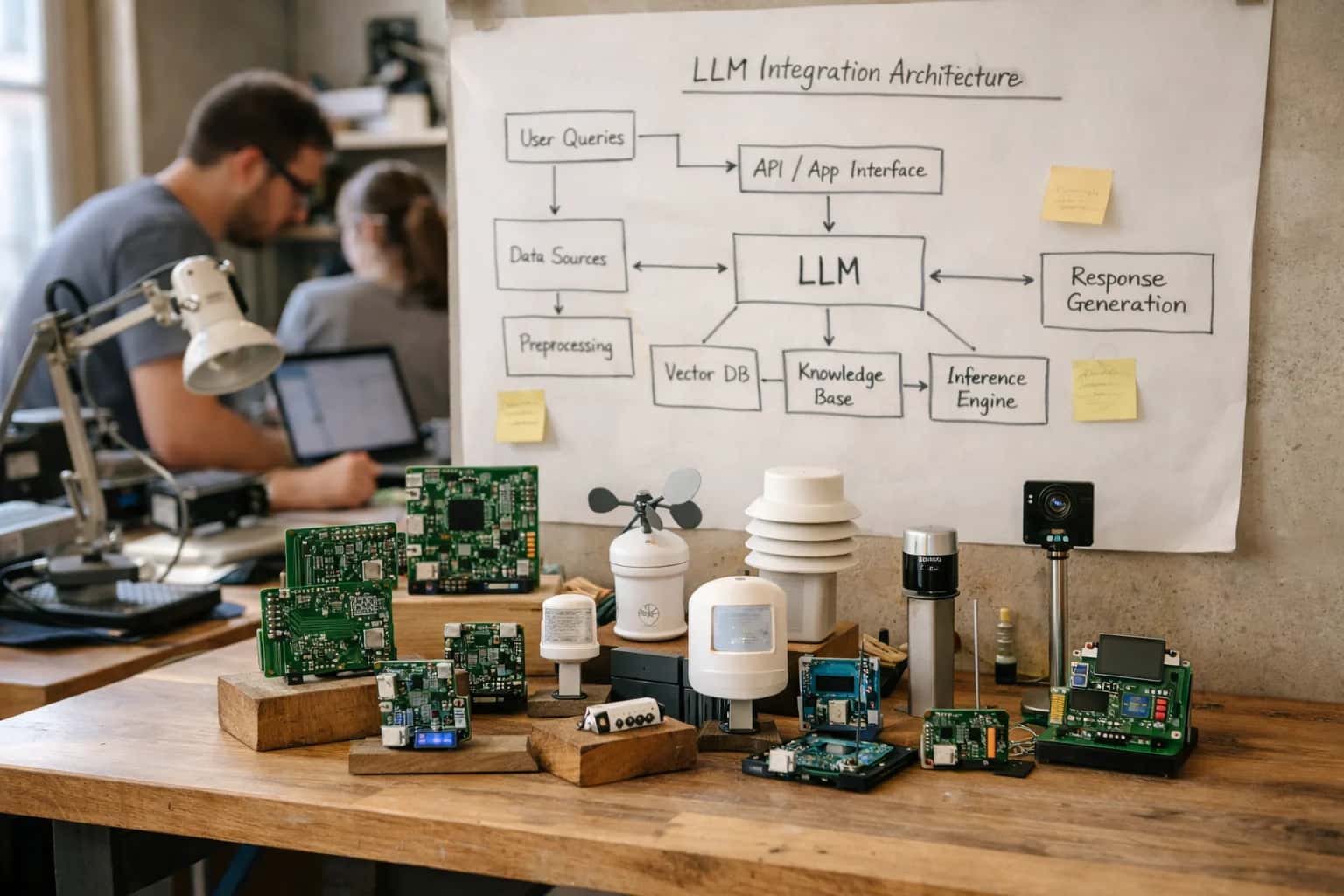
MULTIMODAL DATA INGESTION
What is MQTT?
MQTT (Message Queuing Telemetry Transport) is a lightweight, publish-subscribe network protocol designed for efficient communication between IoT devices and low-bandwidth, high-latency networks.
The protocol's efficiency stems from its small packet overhead, Quality of Service (QoS) levels for delivery guarantees, and a persistent session state. It is foundational for multimodal data ingestion pipelines, streaming sensor readings, telemetry, and device status from heterogeneous edge sources into unified processing systems. Key implementations include the open-source Eclipse Mosquitto broker, while cloud services like AWS IoT Core and Azure IoT Hub provide managed MQTT endpoints. Its design directly addresses the challenges of edge AI architectures and sensor fusion by providing a reliable, low-latency transport layer.
MULTIMODAL DATA INGESTION
Core Architectural Features of MQTT
MQTT is a lightweight, publish-subscribe messaging protocol designed for constrained devices and low-bandwidth, high-latency networks. Its core features enable efficient, reliable, and scalable data ingestion from IoT sensors, a critical component for multimodal data pipelines.
01
Publish-Subscribe Pattern
MQTT operates on a publish-subscribe (pub/sub) messaging pattern, decoupling data producers (publishers) from consumers (subscribers). Devices publish messages to a central broker under specific topics (e.g., factory/sensor1/temperature). Subscribers express interest in topics and receive relevant messages from the broker. This one-to-many model is ideal for scalable IoT deployments where multiple systems (e.g., databases, dashboards, alerting services) need the same sensor data stream without direct point-to-point connections.
02
Quality of Service (QoS) Levels
MQTT defines three Quality of Service (QoS) levels to guarantee message delivery across unreliable networks, a critical feature for mission-critical telemetry.
- QoS 0 (At most once): Fire-and-forget. No delivery guarantee. Lowest overhead.
- QoS 1 (At least once): Broker and client acknowledge receipt. Guarantees delivery but may cause duplicates.
- QoS 2 (Exactly once): Four-step handshake ensures the message is delivered precisely once. Highest reliability and overhead. Engineers select QoS based on network stability and data criticality, balancing reliability against latency and bandwidth.
03
Lightweight Packet Structure
The protocol uses a compact, binary packet format with a minimal 2-byte fixed header. This lightweight design minimizes network overhead, making it exceptionally efficient for small, frequent telemetry messages from battery-powered devices. Compared to text-based protocols like HTTP with bulky headers, MQTT's small packet size conserves bandwidth and reduces power consumption, which is essential for large-scale sensor networks and edge computing scenarios.
04
Persistent Sessions & Last Will and Testament
MQTT supports persistent sessions where the broker stores subscriptions and missed messages (QoS 1/2) for a disconnected client. Upon reconnection, the session resumes. The Last Will and Testament (LWT) is a pre-defined message the broker publishes if the client disconnects ungracefully. This acts as a failure notification mechanism, alerting other systems that a sensor or device has gone offline, which is vital for system health monitoring in multimodal architectures.
05
Topic-Based Filtering with Wildcards
Topics are hierarchical strings (e.g., us/ny/building1/floor3/thermostat). Subscribers can use wildcards for flexible filtering:
- Single-level (
+): Matches any name in one level.us/ny/+/thermostatmatchesbuilding1andbuilding2. - Multi-level (
#): Matches all subsequent levels.us/ny/building1/#subscribes to all devices in that building. This allows for efficient, granular data routing and subscription management without clients needing to know every specific topic in advance.
06
Broker-Centric Architecture
All MQTT communication flows through a central broker, which is responsible for authentication, authorization, message routing, and session management. This hub-and-spoke model simplifies network configuration (clients only need to connect to the broker), enhances security through a single enforcement point, and provides a natural point for integration, monitoring, and data transformation before forwarding to downstream multimodal data lakes or processing engines like Apache Kafka.
PROTOCOL OVERVIEW
How MQTT Works: Protocol Mechanics
MQTT (Message Queuing Telemetry Transport) is a lightweight, publish-subscribe network protocol designed for efficient communication between IoT devices and low-bandwidth, high-latency networks.
MQTT operates on a publish-subscribe model, decoupling data producers (publishers) from consumers (subscribers) via a central broker. Clients connect to the broker using a TCP/IP connection, initiating a session with a CONNECT packet that specifies a Client ID, clean session flag, and optional credentials. The broker responds with a CONNACK packet to establish the session. This architecture allows for one-to-many message distribution where publishers send messages to topics (hierarchical strings like sensor/floor1/temperature), and the broker forwards these messages to all clients subscribed to matching topics.
The protocol's efficiency stems from its minimal packet headers and Quality of Service (QoS) levels. QoS 0 (at most once) offers fire-and-forget delivery. QoS 1 (at least once) guarantees delivery via acknowledgment packets but may cause duplicates. QoS 2 (exactly once) ensures assured delivery through a four-step handshake, eliminating duplicates at the cost of higher overhead. The broker can also retain the last message on a topic and send it to new subscribers via the Last Will and Testament (LWT) feature, which publishes a predefined message if a client disconnects ungracefully.
DATA INGESTION
MQTT Use Cases in Multimodal Systems
MQTT's lightweight publish-subscribe protocol is uniquely suited for ingesting real-time, heterogeneous data streams from distributed sensors and devices, forming the foundational transport layer for multimodal AI pipelines.
01
Real-Time Sensor Telemetry Ingestion
MQTT is the dominant protocol for streaming time-series sensor data from IoT devices into multimodal data lakes. Its minimal overhead (2-byte header) and Quality of Service (QoS) levels make it ideal for constrained networks.
- Use Case: Ingesting synchronized data from LiDAR, cameras, and inertial measurement units (IMUs) on autonomous vehicles.
- Key Feature: Last Will and Testament (LWT) messages notify the broker if a sensor disconnects unexpectedly, ensuring data pipeline integrity.
- Example: A warehouse robot publishing its location (GPS), battery level, and camera feed status to different MQTT topics every 100ms.
02
Unified Data Bus for Heterogeneous Modalities
MQTT acts as a unified message bus where different data types (modalities) are published to logically separated topics, enabling parallel ingestion.
- Topic Hierarchy: Devices publish to structured topics like
site/zone17/device_camera234/video_frameorsite/zone17/device_mic456/audio_chunk. - Decoupling: Downstream consumers (e.g., a video processor, an audio analyzer) subscribe only to the topics they need, enabling loose coupling in the architecture.
- Scalability: New sensor types (e.g., thermal cameras) can be added by simply having them publish to a new topic pattern without disrupting existing flows.
03
Edge-to-Cloud Data Synchronization
MQTT bridges edge computing devices and central cloud systems, facilitating the hybrid ingestion required for multimodal AI. Lightweight clients on edge gateways buffer and forward data when connectivity is intermittent.
- Pattern: Edge devices perform initial modality-specific feature extraction (e.g., compressing video frames) and publish results to a cloud broker.
- QoS for Reliability: Using QoS 1 (at least once) delivery ensures critical sensor data reaches the cloud despite network drops, which is essential for training and inference.
- Example: Offshore wind turbines streaming vibration (sensor), video (visual), and audio data to a central monitoring AI, with MQTT managing the high-latency satellite link.
04
Command & Control for Data Pipeline Orchestration
Beyond ingestion, MQTT's bidirectional capability allows central systems to send configuration commands back to edge devices, dynamically controlling the data collection pipeline.
- Use Case: An AI orchestrator detecting data drift in video feeds can publish a command to
device_camera123/control/resolutionto increase frame capture rate for debugging. - Retained Messages: Critical configuration (e.g., sample rate) is published as a retained message so any newly connected device immediately receives the latest settings.
- Integration: This enables event-driven architecture where the data ingestion parameters are dynamically adjusted based on real-time AI model feedback.
05
Foundation for Cross-Modal Alignment Triggers
MQTT messages can carry temporal synchronization metadata and act as triggers to align data streams from different modalities, a prerequisite for multimodal model training.
- Mechanism: A device publishes a shared timestamp or sequence ID in the payload of messages across different modality topics (e.g.,
/video/frameand/audio/chunk). - Downstream Processing: A session manager service subscribes to all related topics, uses the metadata to buffer and pair the data, then forwards aligned batches to a unified embedding pipeline.
- Example: In a telemedicine kit, MQTT topics for vitals sensor data and the video feed include a patient session ID, allowing an AI to correlate visual symptoms with physiological signals.
06
Lightweight Alternative for Constrained Devices
Compared to HTTP or gRPC, MQTT's small code footprint (client libraries can be < 50KB) and efficient persistent TCP connections make it the pragmatic choice for battery-powered or microcontroller-based sensors in multimodal networks.
- Contrast with HTTP: No repetitive headers and connection setup; one connection handles all publish/subscribe traffic, conserving power and bandwidth.
- Contrast with Apache Kafka: MQTT brokers (like Mosquitto, EMQX) are far lighter and designed for the edge, while Kafka is optimized for high-throughput data centers. They are often used together via connectors.
- Real-World Fit: Deploying thousands of tinyML sensors in an agricultural field to stream soil (sensor), image (visual), and microclimate (audio) data for a multimodal crop health model.
PROTOCOL COMPARISON
MQTT vs. Other Messaging Protocols
A technical comparison of MQTT against other common messaging protocols used in data ingestion and IoT architectures, focusing on characteristics relevant to multimodal data pipelines.
| Feature / Metric | MQTT | AMQP | HTTP/1.1 | WebSocket |
|---|---|---|---|---|
Primary Design Goal | Lightweight IoT telemetry | Enterprise message queuing | Document transfer (REST APIs) | Full-duplex browser communication |
Communication Model | Publish/Subscribe | Publish/Subscribe & Point-to-Point | Request/Response | Full-Duplex Message Stream |
Default Transport | TCP/IP (Port 1883) | TCP/IP (Port 5672) | TCP/IP (Port 80/443) | TCP/IP (Upgrades from HTTP) |
Header Overhead | < 10 bytes | ~ 40-60 bytes | ~ 800+ bytes | ~ 2-14 bytes (after handshake) |
Message QoS Levels | 0, 1, 2 (Exactly-Once) | 0, 1 (At-Least-Once) | 0 (At-Most-Once) | 0 (At-Most-Once) |
Built-in Last Will & Testament | ||||
Native Session Persistence | ||||
Typical Latency | < 100 ms | 10-100 ms | 500-2000 ms | 50-200 ms |
Optimal Payload Size | Small (< 256 KB) | Medium-Large | Medium-Large | Small-Medium |
Built-in Topic Wildcards | ||||
Standard Use Case | Sensor telemetry, Command & Control | Financial transactions, Work queues | API calls, Web content | Real-time web apps, Chat |
MQTT
Frequently Asked Questions
Essential questions and answers about MQTT (Message Queuing Telemetry Transport), the lightweight publish-subscribe protocol fundamental to IoT and multimodal data ingestion pipelines.
MQTT (Message Queuing Telemetry Transport) is a lightweight, publish-subscribe network protocol designed for efficient, bidirectional communication between devices over unreliable or constrained networks. It operates on a central broker model where clients (publishers or subscribers) connect to the broker. Publishers send messages to topics (hierarchical strings like sensors/floor1/temperature), and the broker forwards those messages to all clients that have subscribed to that topic. This decouples data producers from consumers, enabling scalable and resilient communication for IoT and edge data ingestion.
Key Mechanism:
- A client establishes a persistent TCP/IP connection (or WebSocket) to the broker.
- It can publish a message with a Quality of Service (QoS) level (0, 1, or 2) that defines delivery guarantees.
- Other clients subscribe to topic filters (which can include wildcards like
+or#). - The broker manages all subscriptions and performs the message routing.
Enabling Efficiency, Speed & Accuracy
Intelligent Analysis, Decision & Execution
We build AI systems for teams that need search across company data, workflow automation across tools, or AI features inside products and internal software.
Talk to Us
Search across company data
Give teams answers from docs, tickets, runbooks, and product data with sources and permissions.
Useful when people spend too long searching or get different answers from different systems.
Enterprise searchRAGPermissions
Read more
Automate internal workflows
Use AI to route work, draft outputs, trigger actions, and keep approvals and logs in place.
Useful when repetitive work moves across multiple tools and teams.
AI agentsWorkflow automationGovernance
Read more
Add AI to products and internal tools
Build assistants, guided actions, or decision support into the software your team or customers already use.
Useful when AI needs to be part of the product, not a separate tool.
AI integrationDecision supportModel routing
Read more
About the author
Prasad Kumkar
CEO & MD, Inference Systems
Prasad Kumkar is the CEO & MD of Inference Systems and writes about AI systems architecture, LLM infrastructure, model serving, evaluation, and production deployment. Over 5+ years, he has worked across computer vision models, L5 autonomous vehicle systems, and LLM research, with a focus on taking complex AI ideas into real-world engineering systems.
His work and writing cover AI systems, large language models, AI agents, multimodal systems, autonomous systems, inference optimization, RAG, evaluation, and production AI engineering.
LinkedIn
Limited slotsGet a Free AI Consultation
Partnered with leading AI, data, and software stack.





How We Work
Custom AI workflows for your Business
One-fit-all AI don't work for modern businesses. At Inferensys, we aim to understand your business & custom requirements; which we use to define most efficient agentic workflows, the data, and the tools for your business.
01
Review the use case
We understand the task, the users, and where AI can actually help.
Read more02
Pick the right approach
We define what needs search, automation, or product integration.
Read more03
Build the first useful version
We implement the part that proves the value first.
Read more04
Improve from there
We add the checks and visibility needed to keep it useful.
Read moreThe first call is a practical review of your use case and the right next step.
Talk to Us