Retrieval-Augmented Generation (RAG) is an architecture that grounds a generative language model in external, verifiable data. It works by first converting a user query into a dense vector embedding and using it to perform a semantic search over a vector database containing document chunks. The most relevant retrieved passages are then injected as context into the model's prompt, conditioning its generation on this specific information to reduce hallucinations and improve factual consistency.

Glossary
Retrieval-Augmented Generation (RAG)
Retrieval-Augmented Generation (RAG) is an AI architecture that enhances a generative model's output by retrieving relevant information from an external knowledge source before generating a response.
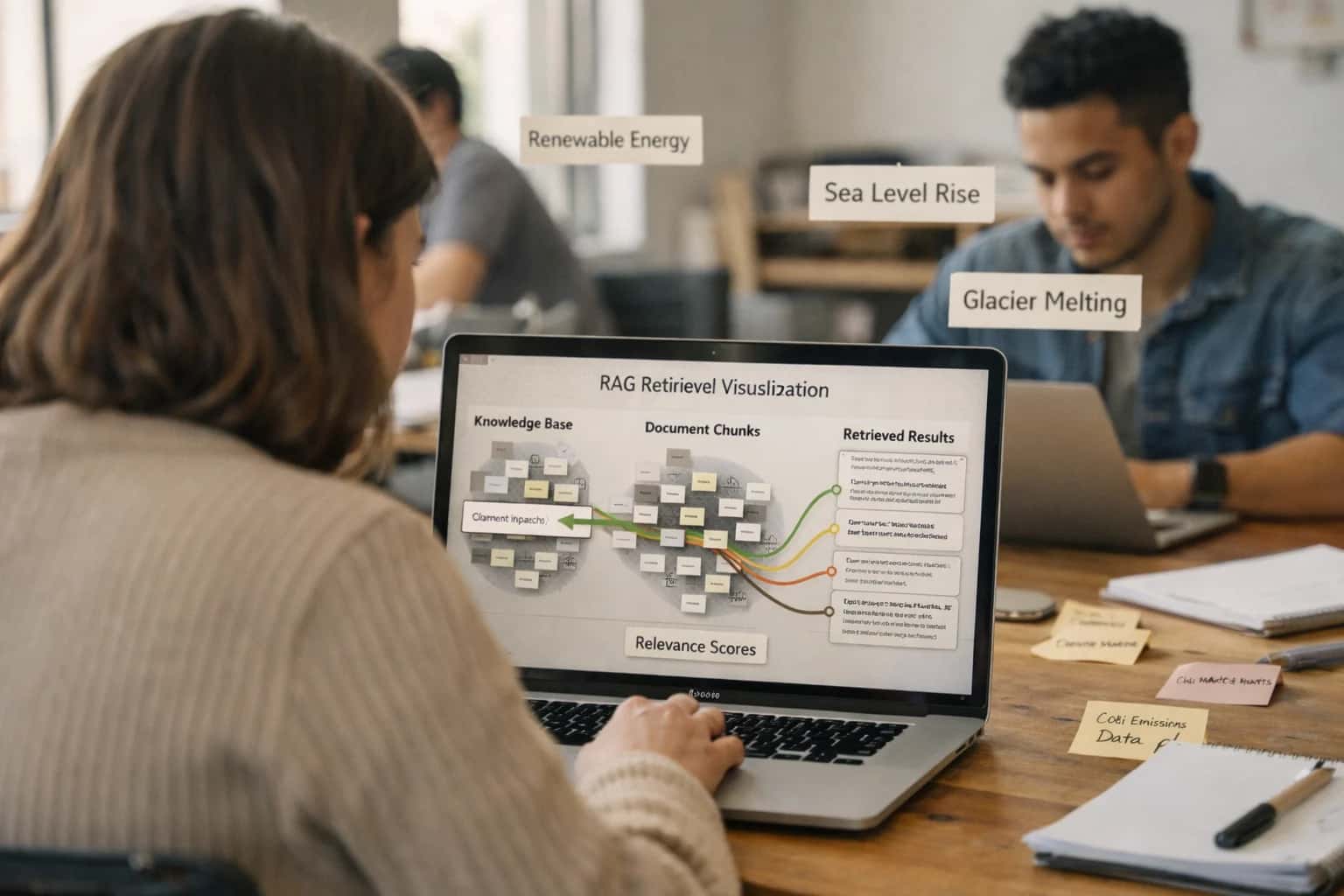
ARCHITECTURE
What is Retrieval-Augmented Generation (RAG)?
Retrieval-Augmented Generation (RAG) is a hybrid artificial intelligence architecture that enhances a generative language model's factual accuracy and relevance by dynamically retrieving information from an external knowledge source before generating a response.
The RAG pipeline integrates components from information retrieval and natural language generation. A query encoder maps the input to the embedding space, while an approximate nearest neighbor (ANN) index, such as HNSW or IVF, enables fast retrieval. This retrieved context is passed alongside the original query to the generator, typically a large language model, which synthesizes the final answer. This decouples the model's parametric knowledge from its access to dynamic, proprietary data.
ARCHITECTURAL BREAKDOWN
Core Components of a RAG System
A Retrieval-Augmented Generation (RAG) system is an architecture that enhances a generative model's output by first retrieving relevant information from an external knowledge source. Its core components work in a sequential pipeline to ground generation in factual, up-to-date context.
01
Document Indexing Pipeline
This is the offline preprocessing stage where source documents are prepared for retrieval. Raw text is chunked into manageable segments, each is encoded into a dense vector embedding using a model like BERT or a sentence transformer, and these embeddings are stored in a vector database alongside the original text chunks. The quality of this pipeline directly determines the system's knowledge base.
- Key Steps: Data ingestion, cleaning, chunking, embedding generation, and index creation.
- Critical Choice: The embedding model defines the semantic quality of the index, while the chunking strategy balances context completeness with retrieval precision.
02
Retriever
The retriever is the real-time search engine of the RAG system. When a user query is received, it is converted into a query embedding. This embedding is used to perform a similarity search (e.g., cosine similarity) against the indexed document chunks in the vector database. The top-K most semantically relevant chunks are returned as context.
- Primary Function: Efficiently find the most relevant information from a massive corpus.
- Common Algorithms: Uses Approximate Nearest Neighbor (ANN) search algorithms like HNSW or IVF for speed at scale.
- Output: A ranked list of text passages (context) to be passed to the generator.
03
Generator (LLM)
This is the large language model that synthesizes the final answer. It takes the original user query and the retrieved context as combined input. The model is instructed (via prompt engineering) to generate an answer based strictly on the provided context, which reduces hallucinations. The generator's role is to interpret, summarize, and integrate the retrieved facts into a coherent, natural language response.
- Input Format: A structured prompt like: "Answer the question based on the following context: [Retrieved Context]\n\nQuestion: [User Query]"
- Key Benefit: Decouples the model's parametric knowledge from its factual grounding, allowing updates without retraining the LLM.
04
Vector Database & Search Index
This is the specialized storage and retrieval infrastructure that enables the retriever's function. It is optimized for high-dimensional vector operations. Unlike traditional databases, it uses algorithms designed for Maximum Inner Product Search (MIPS) or cosine similarity. It must handle high query throughput and low latency while scaling to billions of vectors.
- Core Capability: Fast ANN search.
- Examples: Pinecone, Weaviate, Qdrant, Milvus, and open-source libraries like FAISS.
- Additional Features: Often includes metadata filtering (e.g., filter by date or source) alongside vector search.
05
Query Transformer & Reranker
These are optional but critical enhancement components that improve retrieval quality. The query transformer rewrites or expands the user's raw query (e.g., using the LLM itself) to be more effective for retrieval. The reranker acts as a second-stage filter; it takes the top-N results from the fast vector search and uses a more computationally intensive model (like a cross-encoder) to precisely reorder them for relevance before passing the best to the generator.
- Reranker Purpose: Improves precision@K by mitigating errors from the approximate first-stage search.
- Query Transformation: Can involve hybrid retrieval, combining sparse (keyword) and dense (vector) search signals.
06
Evaluation & Observability Layer
This component monitors the health and performance of the RAG pipeline in production. It tracks key metrics to ensure the system is functioning correctly and provides data for continuous improvement.
- Core Retrieval Metrics: Recall@K (did we find the right context?), Mean Reciprocal Rank (MRR) (how high is the correct context ranked?).
- End-to-End Metrics: Faithfulness (is the answer grounded in the context?), Answer Relevance (does the output address the query?).
- Observability: Logs retrieval latency, tracks query patterns, and monitors for retrieval failures or degraded context quality.
ARCHITECTURE OVERVIEW
How Does RAG Work? A Step-by-Step Process
Retrieval-Augmented Generation (RAG) is a hybrid architecture that grounds a generative language model's responses in factual, external data. It operates by first retrieving relevant information from a knowledge source and then using that context to inform the generation process.
The process begins with a user query. A query encoder, often a separate embedding model, converts this text into a dense vector. This query embedding is used to perform a similarity search against a pre-indexed vector database containing chunked document embeddings. The system retrieves the top-K most semantically relevant text chunks, known as the retrieved context. This step ensures the model has access to specific, up-to-date, or proprietary information not contained in its original training data.
The retrieved context and the original user query are then combined into a structured prompt for the generative language model (LLM). This prompt instructs the model to synthesize an answer based strictly on the provided context. The LLM, conditioned on this grounding context, generates a final, coherent response. This two-stage retrieve-then-generate pipeline significantly reduces hallucinations by tethering the model's output to verifiable source material, making RAG a cornerstone of enterprise AI systems.
ARCHITECTURE COMPARISON
RAG vs. Alternative Knowledge Integration Methods
A technical comparison of methods for integrating external knowledge into generative language models, focusing on architectural trade-offs for production systems.
| Feature / Metric | Retrieval-Augmented Generation (RAG) | Fine-Tuning (Full) | Prompt Engineering (In-Context Learning) | Knowledge Graph Integration |
|---|---|---|---|---|
Core Mechanism | Retrieves relevant context from an external datastore (e.g., vector DB) and prepends it to the prompt. | Updates the model's internal weights via gradient descent on a domain-specific dataset. | Formulates the task and provides examples directly within the input prompt. | Queries a structured graph of entities and relationships, injecting the subgraph or facts into the prompt. |
Knowledge Update Speed | < 1 sec (index update) | Hours to days (training job) | Immediate (prompt edit) | Minutes (graph update) |
Hallucination Mitigation | High (grounded in retrieved docs) | Medium (depends on training data quality & coverage) | Low (no new factual grounding) | Very High (deterministic factual grounding) |
Handling Dynamic/Proprietary Data | ||||
Explainability / Citation | ||||
Inference Latency Overhead | Medium (+ retrieval + context window) | None (after training) | Low (longer prompt processing) | Medium to High (+ graph query) |
Compute Cost Profile | Low ongoing (indexing + longer context) | Very High upfront (training), low ongoing | Very Low | Medium (maintain graph, longer context) |
Architectural Complexity | Medium (requires retrieval pipeline & DB) | Low (training pipeline only) | Very Low | High (requires KG construction & maintenance) |
RETRIEVAL-AUGMENTED GENERATION
Common Challenges & Advanced RAG Patterns
While RAG provides factual grounding, production systems face significant hurdles. This section details core challenges and the advanced architectural patterns developed to overcome them.
01
Retrieval Hallucination & Context Distillation
A primary failure mode where the retriever fetches irrelevant or contradictory passages, leading the generator to produce confident but incorrect outputs. This is distinct from a model's parametric hallucination.
Mitigation strategies include:
- Hybrid Search: Combining dense retrieval (semantic) with sparse retrieval (keyword, e.g., BM25) to improve recall.
- Re-ranking: Using a computationally expensive but accurate cross-encoder model to reorder the top candidates from a fast initial ANN search.
- Query Expansion & Reformulation: Automatically rewriting the user query using the LLM itself to generate multiple search perspectives or include missing keywords.
- Context Compression/Selective Context: Using a smaller model to summarize or extract only the most salient sentences from long retrieved documents before passing them to the generator.
02
Lost-in-the-Middle & Long Context Issues
LLMs exhibit a positional bias where information at the very beginning and end of a long input context is attended to more effectively than information in the middle. This can cause relevant retrieved chunks to be ignored if they are placed centrally in the prompt.
Advanced patterns to address this:
- Recursive Retrieval & Iterative RAG: The system doesn't stop at one retrieval step. It can generate a follow-up query based on initial results or decompose a complex question into sub-questions for sequential retrieval.
- Fusion-in-Decoder & Late Interaction: Architectures like ColBERT store token-level embeddings, allowing the generator to interact with all retrieved passages simultaneously during the decoding phase, bypassing the fixed-context-order problem.
- Hierarchical Chunking: Storing data at multiple granularities (e.g., document summary, section, paragraph) and retrieving the appropriate level of detail based on the query.
03
Multi-Hop & Complex Query Reasoning
Simple RAG often fails on questions requiring synthesis across multiple documents or logical inference steps (e.g., 'Compare the marketing strategies of Company A in 2023 to Company B in 2021').
Patterns for multi-step reasoning:
- Agentic RAG: Framing the retriever and generator as agents with planning capabilities. The system might first retrieve a high-level overview, then formulate a new query to find specific comparative data.
- GraphRAG: Augmenting the vector database with an enterprise knowledge graph. Retrieval can follow semantic relationships (entities, events) between chunks, enabling traversal for connected reasoning.
- Sub-Query Decomposition: Using an LLM to break the user's question into independent, answerable sub-queries, retrieving for each, and then synthesizing the final answer.
04
Structured & Multi-Modal Data Integration
Traditional RAG assumes a corpus of unstructured text. Enterprise data often resides in tables, PDFs with figures, slides, and internal APIs.
Advanced patterns for heterogeneous data:
- Multi-Vector Retrievers: Representing a single document with multiple vectors—for example, one for a summary, one for each key claim, and one for each data table within it. This increases the 'surface area' for retrieval.
- Multi-Modal RAG: Extending retrieval to images, audio, and video by using vision-language models (VLMs) to create joint embedding spaces. A text query can retrieve relevant images or video segments, and their textual descriptions are fed to the LLM.
- Self-Querying Retrievers: Training the LLM to parse a user's natural language query and output a structured query (e.g., metadata filters, date ranges, SQL WHERE clauses) for a hybrid search system.
05
Evaluation & Observability
Measuring RAG system quality is complex, as it requires evaluating both retrieval and generation components. Traditional NLP metrics like BLEU are insufficient.
Key evaluation frameworks and metrics:
- Retrieval Metrics: Recall@K, Mean Reciprocal Rank (MRR) assess the quality of the fetched context.
- End-to-End Metrics: Faithfulness (is the answer grounded solely in the context?), Answer Relevance (does it directly address the query?), and Context Relevance (is all retrieved context used?).
- Benchmarks: Datasets like RAGAS (Retrieval Augmented Generation Assessment) and ARES provide structured ways to score these dimensions using LLMs-as-judges.
- Tracing & Telemetry: Instrumenting each step (query, retrieved chunks, final generation) for debugging and monitoring performance drift over time.
06
Optimization for Scale & Latency
Production RAG must balance high accuracy with strict latency budgets and the cost of running large models.
Critical optimization techniques:
- Embedding Model Selection: Choosing the right model (size, speed, accuracy) for encoding documents and queries. Smaller, domain-fine-tuned models often outperform large general ones.
- Indexing Strategy: Selecting the appropriate ANN search algorithm (e.g., HNSW, IVF) and tuning its parameters (efConstruction, M) for the trade-off between recall, search speed, and memory usage.
- Caching & Pre-Computation: Caching frequent query embeddings and their top results, or pre-computing and storing answer summaries for common 'head' queries.
- Generator Optimization: Using techniques like speculative decoding or smaller, specialized SLMs for the final answer generation when possible.
RETRIEVAL-AUGMENTED GENERATION (RAG)
Frequently Asked Questions
Essential questions and answers about Retrieval-Augmented Generation (RAG), an architecture that grounds generative AI in factual, external data sources.
Retrieval-Augmented Generation (RAG) is an AI architecture that enhances a generative language model's output by first retrieving relevant information from an external knowledge source and then conditioning the generation on that retrieved context. It works through a two-stage pipeline: a retriever component, often a dense retrieval system using a vector database, fetches pertinent documents or data chunks based on a user query. A generator component, typically a large language model (LLM), then synthesizes a final answer using both the original query and the retrieved context as input. This process mitigates hallucination by tethering responses to verifiable source material.
Enabling Efficiency, Speed & Accuracy
Intelligent Analysis, Decision & Execution
We build AI systems for teams that need search across company data, workflow automation across tools, or AI features inside products and internal software.
Talk to Us
Search across company data
Give teams answers from docs, tickets, runbooks, and product data with sources and permissions.
Useful when people spend too long searching or get different answers from different systems.
Enterprise searchRAGPermissions
Read more
Automate internal workflows
Use AI to route work, draft outputs, trigger actions, and keep approvals and logs in place.
Useful when repetitive work moves across multiple tools and teams.
AI agentsWorkflow automationGovernance
Read more
Add AI to products and internal tools
Build assistants, guided actions, or decision support into the software your team or customers already use.
Useful when AI needs to be part of the product, not a separate tool.
AI integrationDecision supportModel routing
Read more
About the author
Prasad Kumkar
CEO & MD, Inference Systems
Prasad Kumkar is the CEO & MD of Inference Systems and writes about AI systems architecture, LLM infrastructure, model serving, evaluation, and production deployment. Over 5+ years, he has worked across computer vision models, L5 autonomous vehicle systems, and LLM research, with a focus on taking complex AI ideas into real-world engineering systems.
His work and writing cover AI systems, large language models, AI agents, multimodal systems, autonomous systems, inference optimization, RAG, evaluation, and production AI engineering.
LinkedIn
Limited slotsGet a Free AI Consultation
Partnered with leading AI, data, and software stack.





How We Work
Custom AI workflows for your Business
One-fit-all AI don't work for modern businesses. At Inferensys, we aim to understand your business & custom requirements; which we use to define most efficient agentic workflows, the data, and the tools for your business.
01
Review the use case
We understand the task, the users, and where AI can actually help.
Read more02
Pick the right approach
We define what needs search, automation, or product integration.
Read more03
Build the first useful version
We implement the part that proves the value first.
Read more04
Improve from there
We add the checks and visibility needed to keep it useful.
Read moreThe first call is a practical review of your use case and the right next step.
Talk to Us