A temporal trigger is the logical mechanism that bridges a real-world event to a time-bound legal consequence. Unlike a fixed Effective Date Anchor, a trigger's activation date is contingent on an action or state change, such as a delivery confirmation, a missed payment, or a regulatory filing. This concept is fundamental to Temporal Constraint Satisfaction and Complex Event Processing (CEP) systems, which must monitor event streams to detect when a trigger's precondition has been met and automatically initiate the corresponding Obligation Lifecycle state transition.

Glossary
Temporal Trigger
A specific event or condition that, upon occurrence, activates a contractual obligation, right, or change in legal status at a defined point in time.
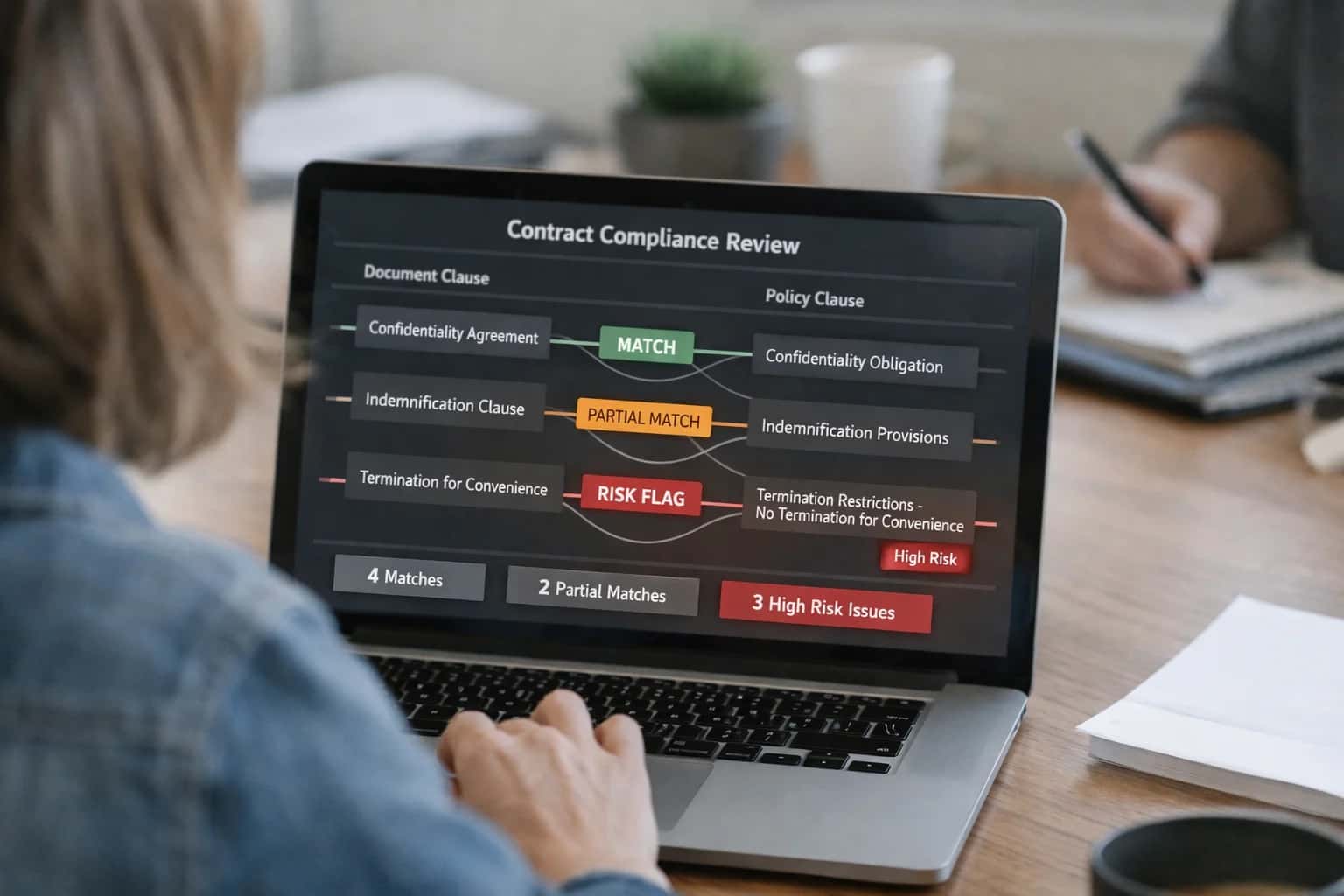
DEFINITION
What is Temporal Trigger?
A temporal trigger is a specific event or condition that, upon occurrence, activates a contractual obligation, right, or change in legal status at a defined point in time.
In computational contract analysis, modeling a temporal trigger requires linking a deontic modality (an obligation, permission, or prohibition) to a temporal operator like 'upon' or 'when.' This creates a Happens-Before Relationship between the triggering event and the resulting duty. Automated systems use Deadline Extraction and Duration Parser components to calculate the precise deadline following a trigger, often applying a Business Day Convention to resolve the final date, ensuring the triggered obligation is accurately calendared.
MECHANISMS
Core Characteristics of Temporal Triggers
A temporal trigger is a specific event or condition that, upon occurrence, activates a contractual obligation, right, or change in legal status at a defined point in time. The following cards break down the key structural and functional characteristics that define how these triggers operate within legal agreements.
01
Event-Condition-Action (ECA) Structure
Temporal triggers are fundamentally modeled using an Event-Condition-Action (ECA) paradigm. The Event is the temporal occurrence (e.g., a date, a deadline expiry). The Condition is a logical check that evaluates to true or false (e.g., 'payment has not been received'). The Action is the resulting legal consequence (e.g., 'assess a late fee'). This structure allows for the precise formalization of complex contractual logic, enabling automated obligation management systems to monitor for events, evaluate conditions, and execute actions deterministically.
02
Types of Triggering Events
Triggers are activated by distinct categories of events:
- Absolute Temporal Events: A fixed, immutable calendar date or time, such as 'January 1, 2025'.
- Relative Temporal Events: A date calculated from a defined anchor, such as '30 days after the Effective Date'.
- Conditional Temporal Events: A point in time defined by the occurrence of another non-temporal event, such as 'upon delivery of the goods' or 'the date of regulatory approval'.
- Recurring Temporal Events: Periodic obligations defined by rules, such as 'the first business day of each calendar month'.
03
State Transition Activation
A temporal trigger functions as a state transition mechanism within the Obligation Lifecycle. The trigger's firing moves a contractual duty from one state to another. Common state transitions include:
- Pending → Active: A non-disclosure agreement's confidentiality obligations activate on the Effective Date.
- Active → Breached: A failure to perform by a deadline triggers a state of breach.
- Active → Expired: A Sunset Clause automatically terminates a right on a specific date.
- Pending → Terminated: An offer automatically lapses if not accepted by a stated deadline.
04
Temporal Dependencies and Ordering
Triggers rarely exist in isolation; they form chains of temporal dependencies. One trigger's action often establishes a new temporal anchor for a subsequent trigger. For example, a 'closing date' trigger activates a post-closing obligation, which itself has a deadline 90 days later. These relationships are formally modeled using Temporal Dependency Graphs, where nodes are events and edges represent precedence constraints. This allows for Critical Path Analysis to identify the sequence of triggers that governs a transaction's overall timeline.
05
Computational Normalization
For a system to automatically execute a temporal trigger, the unstructured text of a contract must be computationally normalized. This involves two key NLP tasks:
- Deadline Extraction: Identifying the specific date or time by which an obligation must be performed.
- Duration Parsing: Interpreting expressions like 'fifteen calendar days' into a machine-readable standard duration (e.g.,
P15D). These normalized values are then processed by a Business Day Convention to adjust for weekends and holidays, producing the final, executable trigger date.
06
Real-Time Monitoring with CEP
In modern obligation management systems, temporal triggers are not just static data points; they are actively monitored using Complex Event Processing (CEP). A CEP engine ingests a stream of real-world events (e.g., a payment confirmation, a missed deadline) and evaluates them against predefined trigger patterns. When a pattern matches—such as a sequence of events that fulfills the conditions of a default clause—the CEP engine fires the trigger in real-time, enabling proactive risk management rather than reactive review.
TEMPORAL TRIGGERS EXPLAINED
Frequently Asked Questions
Clear, technical answers to the most common questions about how time-bound events activate contractual obligations and rights in automated legal reasoning systems.
A temporal trigger is a specific event or condition that, upon occurrence, activates a contractual obligation, right, or change in legal status at a defined point in time. Unlike a simple calendar date, a temporal trigger is a logical predicate that couples a world-state condition with a temporal constraint. For example, 'within 30 days of receiving a notice of claim' is a temporal trigger where the event (receipt of notice) starts a countdown. In computational contract analysis, temporal triggers are modeled as event-condition-action (ECA) rules where the event is the trigger, the condition is any additional qualifying logic, and the action is the resulting obligation. These triggers are the fundamental building blocks of obligation lifecycle state machines, moving duties from pending to active states. Accurate extraction of temporal triggers is critical for building automated compliance systems, as a missed trigger can cascade into a temporal contradiction or an unintended breach.
Enabling Efficiency, Speed & Accuracy
Intelligent Analysis, Decision & Execution
We build AI systems for teams that need search across company data, workflow automation across tools, or AI features inside products and internal software.
Talk to Us
Search across company data
Give teams answers from docs, tickets, runbooks, and product data with sources and permissions.
Useful when people spend too long searching or get different answers from different systems.
Enterprise searchRAGPermissions
Read more
Automate internal workflows
Use AI to route work, draft outputs, trigger actions, and keep approvals and logs in place.
Useful when repetitive work moves across multiple tools and teams.
AI agentsWorkflow automationGovernance
Read more
Add AI to products and internal tools
Build assistants, guided actions, or decision support into the software your team or customers already use.
Useful when AI needs to be part of the product, not a separate tool.
AI integrationDecision supportModel routing
Read more
About the author
Prasad Kumkar
CEO & MD, Inference Systems
Prasad Kumkar is the CEO & MD of Inference Systems and writes about AI systems architecture, LLM infrastructure, model serving, evaluation, and production deployment. Over 5+ years, he has worked across computer vision models, L5 autonomous vehicle systems, and LLM research, with a focus on taking complex AI ideas into real-world engineering systems.
His work and writing cover AI systems, large language models, AI agents, multimodal systems, autonomous systems, inference optimization, RAG, evaluation, and production AI engineering.
LinkedIn
Limited slotsGet a Free AI Consultation
Partnered with leading AI, data, and software stack.





How We Work
Custom AI workflows for your Business
One-fit-all AI don't work for modern businesses. At Inferensys, we aim to understand your business & custom requirements; which we use to define most efficient agentic workflows, the data, and the tools for your business.
01
Review the use case
We understand the task, the users, and where AI can actually help.
Read more02
Pick the right approach
We define what needs search, automation, or product integration.
Read more03
Build the first useful version
We implement the part that proves the value first.
Read more04
Improve from there
We add the checks and visibility needed to keep it useful.
Read moreThe first call is a practical review of your use case and the right next step.
Talk to Us