Deadline extraction is a specialized natural language processing (NLP) task that identifies the specific date, time, or temporal boundary by which a party must perform a contractual duty. It involves parsing unstructured legal prose to locate the temporal trigger or fixed calendar date associated with an obligation, distinguishing it from other temporal references like effective dates or recitals. The core challenge lies in resolving linguistic ambiguity, such as 'within 30 days of closing,' into a machine-readable, absolute date.

Glossary
Deadline Extraction
The NLP task of automatically identifying and normalizing the specific date or time by which a contractual obligation must be performed from unstructured legal text.
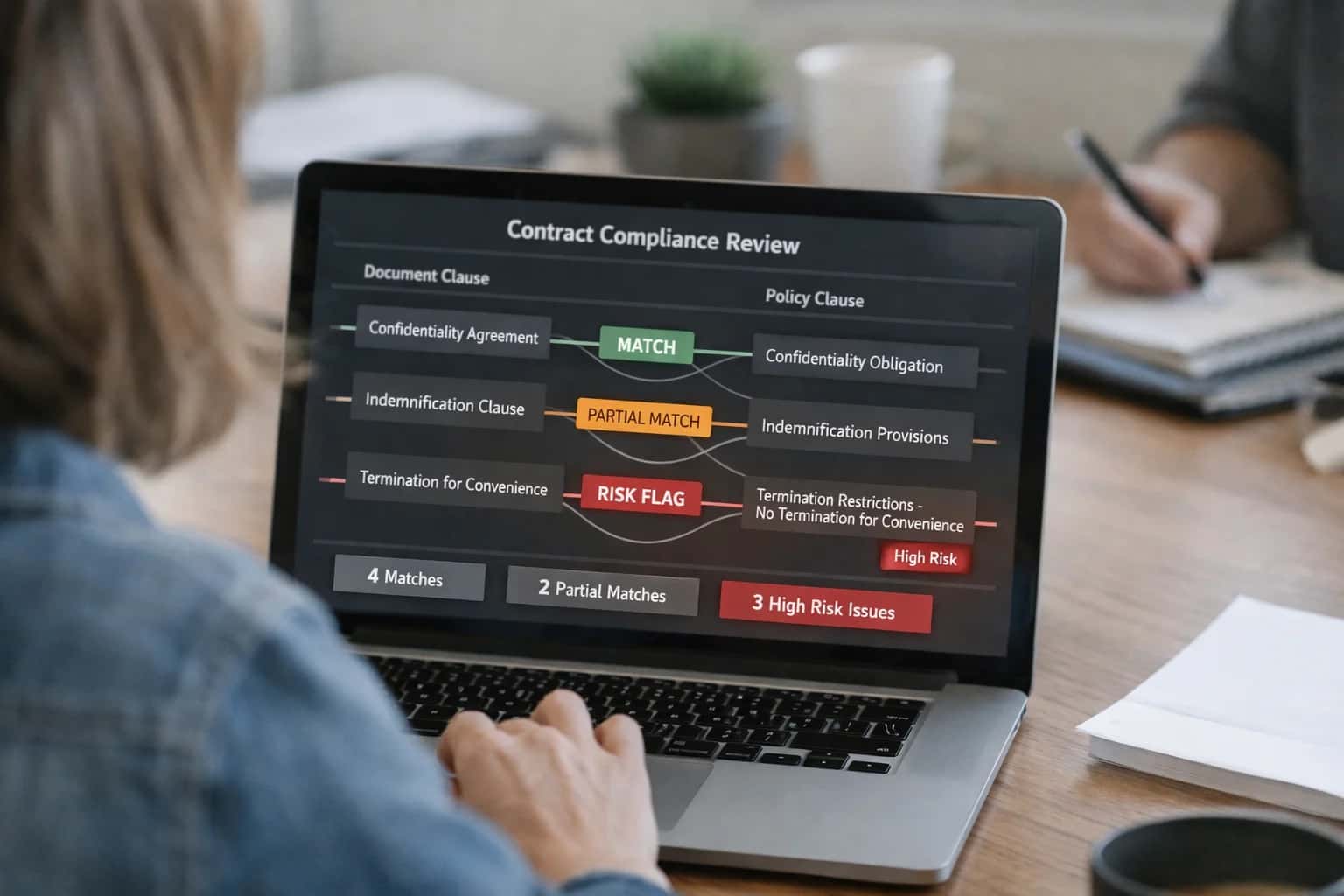
TEMPORAL NLP
What is Deadline Extraction?
Deadline extraction is the computational task of automatically identifying and normalizing specific dates or times by which a contractual obligation must be performed from unstructured legal text.
This process relies on a pipeline of date normalization, duration parsing, and temporal anchor resolution. A system must first detect a time expression, then normalize it to a standard like ISO 8601, and finally resolve it against a known effective date anchor or event. Accurate deadline extraction is the foundational step for building temporal dependency graphs and automated obligation management systems, enabling critical path analysis and proactive compliance monitoring.
Deadline Extraction
Core Capabilities
The foundational NLP task of automatically identifying and normalizing time-bound obligations from unstructured legal text, transforming vague prose into machine-actionable dates.
01
Temporal Expression Recognition
The core information extraction task of locating and classifying spans of text that denote a point in time, a duration, or a frequency. Modern systems use fine-tuned transformer models to identify expressions like 'within 30 calendar days of the Effective Date' or 'on the last business day of each fiscal quarter'. This phase must distinguish between deictic expressions (relative to the document's signing date) and absolute calendar dates.
95%+
F1 Score on Legal Corpora
02
Date Normalization & Resolution
The computational process of converting heterogeneous date expressions into a single, unambiguous standard like ISO 8601 (YYYY-MM-DD). This involves resolving relative anchors such as 'Effective Date' against a known Effective Date Anchor, calculating durations like 'ten business days' using a Business Day Convention, and handling underspecified dates like 'Q3 2024' by anchoring to a defined fiscal calendar. The output is a deterministic, sortable timestamp.
ISO 8601
Output Standard
03
Obligation Linkage
The critical step of associating an extracted deadline with its corresponding deontic modality—the specific obligation, prohibition, or permission it governs. A date is meaningless without its predicate. This requires syntactic dependency parsing to link the temporal adverbial clause to the main verb phrase, answering the question: 'What exactly must be done by this date?' The result populates a Temporal Dependency Graph.
Obligation-Deadline
Entity Linking Task
04
Recurrence Rule Parsing
The specialized capability to interpret and serialize periodic obligations, such as 'monthly on the 15th' or 'annually on the anniversary of the Closing Date'. The output is often structured as an iCalendar (RFC 5545) RRULE string, which encodes the frequency, interval, and count of recurrences. This must correctly model exceptions, such as adjustments for holidays using a Business Day Convention, to generate an accurate schedule of future deadlines.
RFC 5545
Serialization Format
05
Temporal Contradiction Detection
The logical validation step that identifies inconsistencies between extracted deadlines. A Temporal Contradiction occurs when constraints are mutually exclusive—for example, a payment due 'within 15 days' of an event that itself occurs '30 days after' the same payment's stated absolute deadline. This capability uses Temporal Constraint Satisfaction solvers to flag impossible timelines before they corrupt downstream obligation management systems.
Constraint Solver
Validation Method
06
Point-in-Time Retrieval
The query capability that leverages normalized deadlines to reconstruct the state of a contract at any historical moment. By indexing all temporal expressions as a Bitemporal Model—tracking both the 'valid time' of the obligation and the 'transaction time' of its recording—a system can answer: 'What obligations were active as of June 1, 2023?' This is essential for legal forensics and Temporal Audit Trails.
Bitemporal
Data Model
Enabling Efficiency, Speed & Accuracy
Intelligent Analysis, Decision & Execution
We build AI systems for teams that need search across company data, workflow automation across tools, or AI features inside products and internal software.
Talk to Us
Search across company data
Give teams answers from docs, tickets, runbooks, and product data with sources and permissions.
Useful when people spend too long searching or get different answers from different systems.
Enterprise searchRAGPermissions
Read more
Automate internal workflows
Use AI to route work, draft outputs, trigger actions, and keep approvals and logs in place.
Useful when repetitive work moves across multiple tools and teams.
AI agentsWorkflow automationGovernance
Read more
Add AI to products and internal tools
Build assistants, guided actions, or decision support into the software your team or customers already use.
Useful when AI needs to be part of the product, not a separate tool.
AI integrationDecision supportModel routing
Read moreDEADLINE EXTRACTION FAQ
Frequently Asked Questions
Clear, technically precise answers to the most common questions about the automated identification and normalization of temporal obligations in legal documents.
Deadline extraction is the NLP task of automatically identifying and normalizing the specific date or time by which a contractual obligation must be performed from unstructured legal text. It works by combining several computational techniques: a named entity recognition (NER) model first identifies temporal expressions like 'within 30 days of the Effective Date.' A duration parser then interprets natural language lengths such as 'thirty calendar days' and converts them into a machine-readable standard duration. Finally, a date normalization engine resolves the expression against a known Effective Date Anchor to produce an absolute, unambiguous date in a standard format like ISO 8601 (YYYY-MM-DD). Advanced systems also apply Business Day Conventions to adjust the calculated date if it falls on a weekend or holiday, ensuring the final output is a legally actionable, precise deadline.
DEADLINE EXTRACTION IN PRODUCTION
Practical Applications
Deadline extraction is not merely an academic NLP task; it is the foundational engine for enterprise obligation management. The following applications demonstrate how parsed and normalized temporal data is operationalized across legal, financial, and compliance workflows.
01
Automated Obligation Tickler Systems
The primary application of deadline extraction is populating obligation tickler systems. By converting unstructured text like 'within 30 days of the Effective Date' into a concrete ISO 8601 timestamp, these systems generate automated reminders. This prevents missed renewal dates, termination windows, and regulatory filing deadlines, transforming static documents into dynamic, actionable calendars.
< 1 sec
Per-Clause Extraction Latency
02
M&A Due Diligence Acceleration
During mergers and acquisitions, legal teams must review thousands of contracts to identify critical change-of-control deadlines and consent requirements. Deadline extraction models rapidly scan target company agreements to surface all time-bound obligations. This allows deal teams to instantly identify contracts requiring third-party consent before a looming transaction close date, compressing weeks of manual review into hours.
03
Regulatory Compliance Monitoring
Financial institutions use deadline extraction to monitor regulatory filing calendars. The system parses complex statutes like the SEC's reporting requirements to extract periodic deadlines (e.g., 10-K, 10-Q). By normalizing these to a central compliance calendar and cross-referencing them with business day conventions, the system provides a definitive, audit-proof schedule of upcoming regulatory obligations, reducing the risk of late filing penalties.
04
Supply Chain Contract Lifecycle Management
Global supply chains are governed by master service agreements with intricate temporal triggers. Deadline extraction identifies and normalizes key dates such as:
- Delivery milestones with liquidated damages triggers
- Auto-renewal opt-out windows
- Price renegotiation periods This structured data feeds into enterprise resource planning systems to automate procurement actions and prevent costly evergreen contract rollovers.
05
Litigation Docketing and Court Deadlines
Litigation is a strict timeline of court-mandated events. Deadline extraction models parse judicial orders and procedural rules to automatically calculate docketing deadlines. The system interprets relative temporal expressions like '14 days after service of the complaint' by anchoring them to the Effective Date Anchor of the service event. This ensures that responses, discovery deadlines, and motions are calendared with precision, mitigating malpractice risk.
06
Lease Abstraction for CRE Portfolios
Commercial real estate portfolios contain hundreds of leases with critical option exercise windows and rent escalation dates. Deadline extraction automates lease abstraction by identifying and normalizing dates for:
- Renewal option deadlines
- Rent commencement dates
- Co-tenancy violation triggers This structured data enables portfolio managers to proactively manage lease expiries and optimize occupancy costs.

About the author
Prasad Kumkar
CEO & MD, Inference Systems
Prasad Kumkar is the CEO & MD of Inference Systems and writes about AI systems architecture, LLM infrastructure, model serving, evaluation, and production deployment. Over 5+ years, he has worked across computer vision models, L5 autonomous vehicle systems, and LLM research, with a focus on taking complex AI ideas into real-world engineering systems.
His work and writing cover AI systems, large language models, AI agents, multimodal systems, autonomous systems, inference optimization, RAG, evaluation, and production AI engineering.
LinkedIn
Limited slotsGet a Free AI Consultation
Partnered with leading AI, data, and software stack.





How We Work
Custom AI workflows for your Business
One-fit-all AI don't work for modern businesses. At Inferensys, we aim to understand your business & custom requirements; which we use to define most efficient agentic workflows, the data, and the tools for your business.
01
Review the use case
We understand the task, the users, and where AI can actually help.
Read more02
Pick the right approach
We define what needs search, automation, or product integration.
Read more03
Build the first useful version
We implement the part that proves the value first.
Read more04
Improve from there
We add the checks and visibility needed to keep it useful.
Read moreThe first call is a practical review of your use case and the right next step.
Talk to Us