Regulatory Change Observability is the practice of instrumenting a regulatory change detection pipeline to expose its internal state. Unlike simple monitoring, which tracks predefined failure modes, observability allows engineers to interrogate the system and understand why a specific regulatory delta was or was not flagged, by analyzing rich telemetry data such as change detection latency, change detection precision, and change detection recall.

Glossary
Regulatory Change Observability
The capability to monitor the internal state and performance of a regulatory change detection system through its outputs, logs, and metrics to ensure it is functioning correctly.
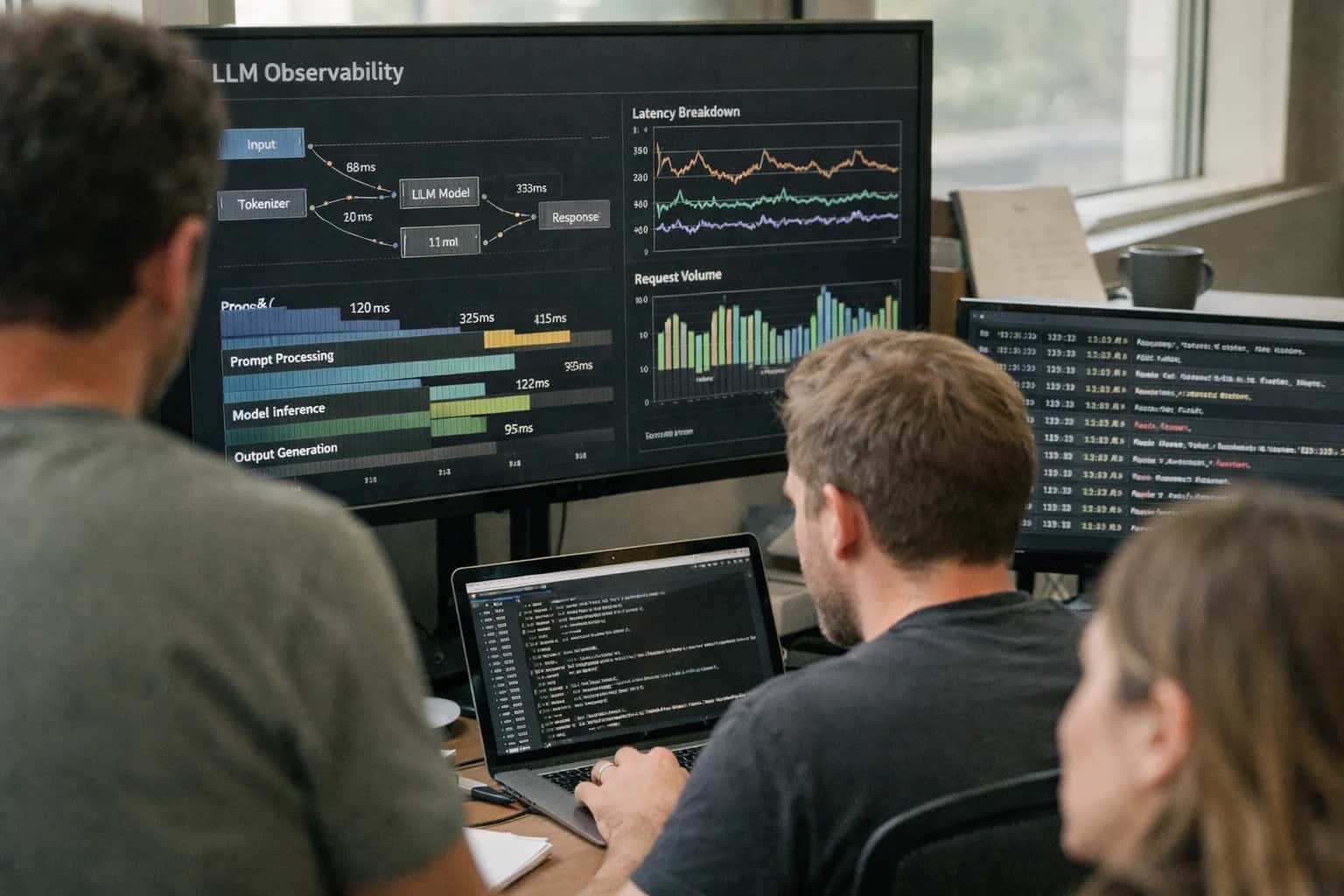
MONITORING & TELEMETRY
What is Regulatory Change Observability?
Regulatory Change Observability is the capability to monitor the internal state, performance, and health of a regulatory change detection system through the continuous analysis of its outputs, logs, and metrics to ensure correct and reliable functioning.
A robust observability framework surfaces the regulatory change audit trail and provides change detection explainability, enabling teams to debug false positives from an automated redline or diagnose concept drift in regulatory AI. This ensures the regulatory intelligence platform maintains high fidelity, allowing compliance officers to trust the regulatory event stream feeding downstream compliance gap analysis workflows.
REGULATORY CHANGE OBSERVABILITY
Core Pillars of Observability for Regulatory AI
The capability to monitor the internal state and performance of a regulatory change detection system through its outputs, logs, and metrics to ensure it is functioning correctly.
01
Change Detection Recall
The metric measuring the proportion of all actual regulatory changes in a corpus that were successfully identified by an automated detection system. High recall is critical to avoid missing a compliance-critical amendment. This is calculated as True Positives divided by the sum of True Positives and False Negatives. A system with poor recall creates compliance gap risk by silently skipping updates.
02
Change Detection Precision
The metric measuring the proportion of flagged regulatory changes that are genuine, relevant amendments, as opposed to false positives. Low precision leads to alert fatigue among compliance analysts. Common sources of false positives include inconsequential formatting shifts, renumbering without textual change, and the republication of unchanged sections within a larger amending document.
03
Change Detection Latency
The time delay between the official publication of a regulatory change and its successful identification and alerting by an automated monitoring system. This is a critical Service Level Objective (SLO) for regulatory intelligence platforms. Latency is measured in distinct phases: ingestion lag (time to acquire the source document), processing time (computational differencing and classification), and notification delay (time to deliver the alert to the end-user).
04
Regulatory Change Audit Trail
An immutable, time-stamped log that records every detected regulatory change, its source, the transformation applied, and the analyst's disposition. This ensures full traceability for governance and audit purposes. Each entry typically captures: the source document URI, the regulatory delta identified, the classification label applied, the analyst's verdict (confirmed, dismissed, escalated), and a cryptographic hash for tamper-proofing.
05
Change Detection Explainability
The ability to articulate the specific textual evidence and logical rules that caused a regulatory change detection system to flag a particular passage as a relevant amendment. This moves the system beyond a black box. Techniques include saliency mapping over the input text to highlight the exact tokens that triggered the classification, and generating a natural language rationale that cites the specific amendment instruction parsed.
06
Concept Drift in Regulatory AI
The degradation of a machine learning model's performance over time because the underlying statistical properties of the regulatory language or amendment patterns have changed. This is a silent failure mode. For example, a legislative body may change its drafting style, or a new type of regulatory instrument may be introduced. Monitoring for concept drift requires tracking the distribution of input features and the model's prediction confidence scores over time to trigger retraining.
REGULATORY CHANGE OBSERVABILITY
Frequently Asked Questions
Clear, technically precise answers to the most common questions about monitoring the internal state and performance of regulatory change detection systems.
Regulatory change observability is the capability to infer the internal state of a regulatory change detection system from its external outputs, logs, and metrics, enabling operators to understand why a specific change was or was not detected. It differs fundamentally from simple monitoring, which only tracks predefined, known failure modes. Observability allows engineers to explore arbitrary questions about system behavior—such as why a regulatory delta was misclassified or why change detection latency spiked for a specific jurisdiction—without needing to ship new code. In a regulatory intelligence platform, observability is achieved by instrumenting the change detection pipeline to emit high-cardinality, high-dimensionality telemetry data, including structured logs, traces, and metrics, that can be dynamically queried to debug novel failure modes in amendment parsing or effective date extraction.
Enabling Efficiency, Speed & Accuracy
Intelligent Analysis, Decision & Execution
We build AI systems for teams that need search across company data, workflow automation across tools, or AI features inside products and internal software.
Talk to Us
Search across company data
Give teams answers from docs, tickets, runbooks, and product data with sources and permissions.
Useful when people spend too long searching or get different answers from different systems.
Enterprise searchRAGPermissions
Read more
Automate internal workflows
Use AI to route work, draft outputs, trigger actions, and keep approvals and logs in place.
Useful when repetitive work moves across multiple tools and teams.
AI agentsWorkflow automationGovernance
Read more
Add AI to products and internal tools
Build assistants, guided actions, or decision support into the software your team or customers already use.
Useful when AI needs to be part of the product, not a separate tool.
AI integrationDecision supportModel routing
Read more
About the author
Prasad Kumkar
CEO & MD, Inference Systems
Prasad Kumkar is the CEO & MD of Inference Systems and writes about AI systems architecture, LLM infrastructure, model serving, evaluation, and production deployment. Over 5+ years, he has worked across computer vision models, L5 autonomous vehicle systems, and LLM research, with a focus on taking complex AI ideas into real-world engineering systems.
His work and writing cover AI systems, large language models, AI agents, multimodal systems, autonomous systems, inference optimization, RAG, evaluation, and production AI engineering.
LinkedIn
Limited slotsGet a Free AI Consultation
Partnered with leading AI, data, and software stack.





How We Work
Custom AI workflows for your Business
One-fit-all AI don't work for modern businesses. At Inferensys, we aim to understand your business & custom requirements; which we use to define most efficient agentic workflows, the data, and the tools for your business.
01
Review the use case
We understand the task, the users, and where AI can actually help.
Read more02
Pick the right approach
We define what needs search, automation, or product integration.
Read more03
Build the first useful version
We implement the part that proves the value first.
Read more04
Improve from there
We add the checks and visibility needed to keep it useful.
Read moreThe first call is a practical review of your use case and the right next step.
Talk to Us