Hierarchical Summarization is a divide-and-conquer strategy that first partitions a long document into chunks fitting within a model's context window, generates independent summaries for each chunk, and then recursively summarizes those intermediate summaries until a final, coherent condensation is produced. This method overcomes the quadratic complexity of standard self-attention mechanisms, enabling the processing of arbitrarily long legal texts like multi-hundred-page contracts or consolidated case law.

Glossary
Hierarchical Summarization
A recursive AI strategy that first summarizes chunks of a document and then summarizes those summaries to handle texts that exceed a model's context window.
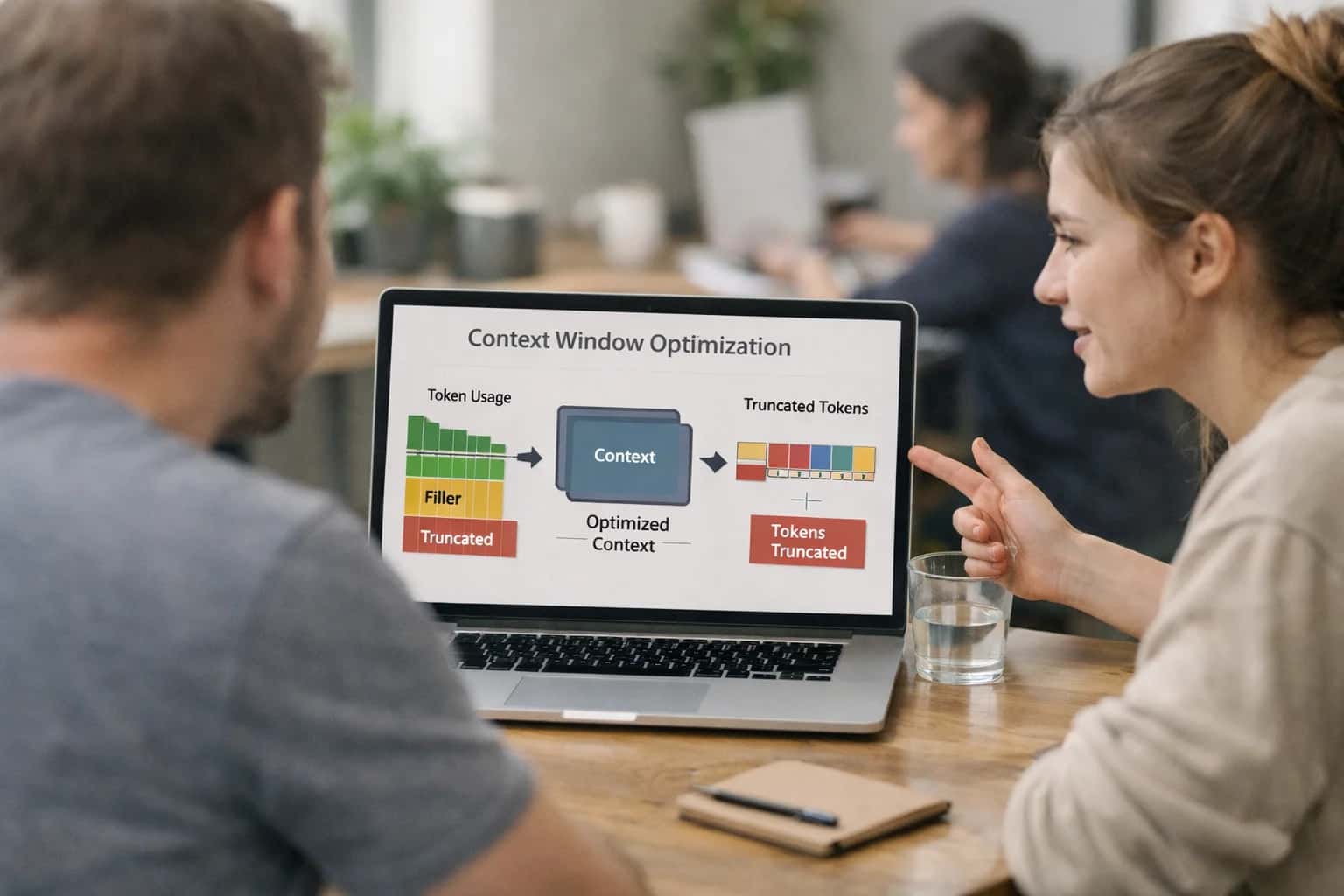
RECURSIVE CONTEXT WINDOW EXTENSION
What is Hierarchical Summarization?
A multi-stage summarization strategy that recursively condenses text to process documents far exceeding a model's native context window.
The technique relies on a map-reduce architecture: a 'map' step generates local chunk summaries, and a 'reduce' step synthesizes them. To maintain factual consistency across recursion layers, implementations often employ source attribution and Natural Language Inference (NLI) verification at each stage, ensuring that higher-level summaries do not drift from the evidentiary facts contained in the original source document.
HIERARCHICAL SUMMARIZATION
Key Features
A divide-and-conquer strategy that recursively condenses long documents by first summarizing chunks, then summarizing those summaries, enabling processing of texts far exceeding a model's context window.
01
Chunk-Level Extraction
The first pass divides the source document into manageable segments that fit within the model's context window. Each chunk undergoes extractive or abstractive summarization independently.
- Chunk size is determined by the model's maximum token limit (e.g., 4,096 for older models, 128k+ for modern ones)
- Overlap windows between chunks prevent information loss at boundaries
- Each chunk summary captures the salient facts, parties, and legal principles within that segment
- This stage is embarrassingly parallel, allowing distributed processing of massive documents
02
Recursive Aggregation
The intermediate summaries from the first pass become the input for a second round of summarization. This process repeats until a final, coherent summary of the desired length is produced.
- A merge operation combines adjacent chunk summaries into larger context groups
- Each recursion level reduces total token count by a compression ratio (typically 3:1 to 10:1)
- The recursion tree can be depth-2 for most legal documents or depth-3+ for book-length texts
- This mirrors the map-reduce paradigm adapted for language model processing
03
Context Retention Mechanisms
Critical legal details can be lost across recursive steps. Retention mechanisms preserve key information that must survive compression.
- Entity extraction identifies and preserves named parties, dates, jurisdictions, and citations across all recursion levels
- Salience scoring assigns importance weights to facts, ensuring high-value information survives each compression pass
- Coreference resolution normalizes all references to the same entity (e.g., 'the plaintiff,' 'Mr. Smith,' 'he') before summarization
- A fact registry can be maintained as a sidecar data structure, tracking extracted assertions independently of the summary text
04
Factual Consistency Verification
Each recursion level introduces risk of hallucination or distortion. Verification steps validate that intermediate summaries remain faithful to their source chunks.
- Natural Language Inference (NLI) models check whether each summary sentence is entailed by the source chunk
- Atomic fact decomposition breaks summaries into minimal claims for individual verification
- Source attribution links each claim back to its originating passage for human auditability
- A consistency threshold can trigger re-generation if the factual alignment score drops below an acceptable level
05
Legal-Specific Optimization
Legal documents present unique challenges that generic hierarchical summarization must address.
- Ratio decidendi extraction ensures the binding legal principle survives compression, while obiter dictum can be safely compressed
- Citation preservation maintains the integrity of legal references (e.g., 347 U.S. 483) across recursion levels
- Deontic logic markers — obligations ('shall'), prohibitions ('must not'), permissions ('may') — receive elevated salience scores
- Temporal sequences (effective dates, deadlines, statutes of limitations) are explicitly tracked to prevent chronological distortion
06
Evaluation Metrics
Hierarchical summarization quality is measured differently than single-pass approaches due to the compounding nature of errors.
- ROUGE and BERTScore measure lexical and semantic overlap with human-written reference summaries
- Hallucination rate is measured at each recursion level, not just the final output, to identify problematic compression stages
- Factual consistency scores compare each intermediate summary against its direct source chunk using NLI entailment
- Information retention curves track what percentage of original key facts survive each recursion level, identifying optimal compression ratios
HIERARCHICAL SUMMARIZATION EXPLAINED
Frequently Asked Questions
Clear, technical answers to the most common questions about recursively condensing long-form legal documents that exceed standard context windows.
Hierarchical summarization is a recursive text condensation strategy designed to process documents that far exceed a language model's maximum context window. The process operates in two distinct phases: first, the source document is segmented into discrete, manageable chunks—typically aligned with natural structural boundaries like sections or paragraphs—and each chunk is independently summarized using a map step. Second, these intermediate summaries are concatenated and passed through a reduce step, where a final, coherent summary is generated from the aggregated intermediate outputs. This divide-and-conquer approach effectively allows models with a 4,096 or 8,192 token limit to synthesize a 500-page legal filing. The critical engineering challenge lies in the chunking strategy; naive splitting can sever coreference chains or split a single legal argument across two chunks, leading to a fragmented final summary. Advanced implementations use overlapping sliding windows or structure-aware parsers that respect the document's inherent hierarchy—summarizing at the clause level, then the section level, then the article level—to preserve factual consistency across the recursive layers.
Enabling Efficiency, Speed & Accuracy
Intelligent Analysis, Decision & Execution
We build AI systems for teams that need search across company data, workflow automation across tools, or AI features inside products and internal software.
Talk to Us
Search across company data
Give teams answers from docs, tickets, runbooks, and product data with sources and permissions.
Useful when people spend too long searching or get different answers from different systems.
Enterprise searchRAGPermissions
Read more
Automate internal workflows
Use AI to route work, draft outputs, trigger actions, and keep approvals and logs in place.
Useful when repetitive work moves across multiple tools and teams.
AI agentsWorkflow automationGovernance
Read more
Add AI to products and internal tools
Build assistants, guided actions, or decision support into the software your team or customers already use.
Useful when AI needs to be part of the product, not a separate tool.
AI integrationDecision supportModel routing
Read more
About the author
Prasad Kumkar
CEO & MD, Inference Systems
Prasad Kumkar is the CEO & MD of Inference Systems and writes about AI systems architecture, LLM infrastructure, model serving, evaluation, and production deployment. Over 5+ years, he has worked across computer vision models, L5 autonomous vehicle systems, and LLM research, with a focus on taking complex AI ideas into real-world engineering systems.
His work and writing cover AI systems, large language models, AI agents, multimodal systems, autonomous systems, inference optimization, RAG, evaluation, and production AI engineering.
LinkedIn
Limited slotsGet a Free AI Consultation
Partnered with leading AI, data, and software stack.





How We Work
Custom AI workflows for your Business
One-fit-all AI don't work for modern businesses. At Inferensys, we aim to understand your business & custom requirements; which we use to define most efficient agentic workflows, the data, and the tools for your business.
01
Review the use case
We understand the task, the users, and where AI can actually help.
Read more02
Pick the right approach
We define what needs search, automation, or product integration.
Read more03
Build the first useful version
We implement the part that proves the value first.
Read more04
Improve from there
We add the checks and visibility needed to keep it useful.
Read moreThe first call is a practical review of your use case and the right next step.
Talk to Us