Clause-Level Summary is a targeted summarization technique that condenses the meaning of a specific, isolated clause within a contract rather than summarizing the entire agreement. It applies extractive or abstractive methods to a single semantic unit—such as an indemnification, termination, or governing law clause—to produce a concise, accurate restatement of that provision's legal effect.

Glossary
Clause-Level Summary
A targeted summarization technique that condenses the meaning of a specific, isolated clause within a contract rather than summarizing the entire agreement.
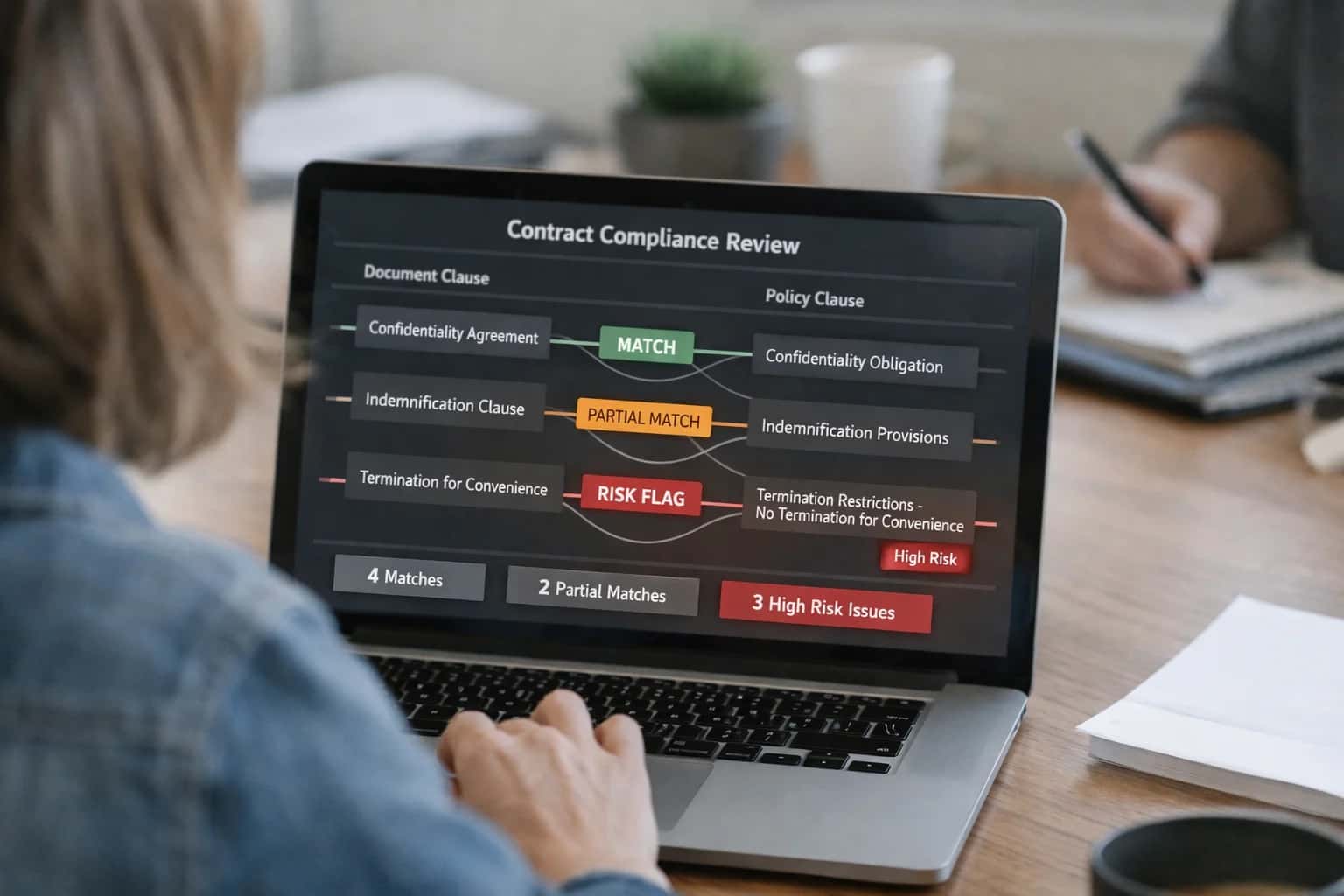
TARGETED CONTRACT CONDENSATION
What is Clause-Level Summary?
A focused summarization technique that isolates and condenses the semantic meaning of a single, specific clause within a contract, rather than processing the entire agreement.
This approach relies on precise legal document structure parsing to first segment a contract into its constituent clauses. By limiting the context window to a single clause, the technique dramatically reduces the risk of cross-clause hallucination and improves factual consistency, ensuring the generated summary faithfully reflects the specific rights, obligations, or conditions stated in that isolated provision.
PRECISION EXTRACTION
Key Features of Clause-Level Summarization
Clause-level summarization isolates and condenses individual contractual provisions, enabling granular analysis without the noise of the full agreement.
01
Semantic Isolation
Unlike document-wide summarization, this technique first identifies the precise boundaries of a target clause (e.g., Indemnification, Limitation of Liability). It then processes only that segment, ensuring the summary is not contaminated by unrelated boilerplate or definitions from elsewhere in the contract.
02
Obligation Extraction
The core function is to convert dense legalese into a structured synopsis of duties and rights. The summary explicitly identifies:
- Active Obligations: What a party must do (e.g., 'maintain insurance').
- Prohibitions: What a party must not do (e.g., 'assign without consent').
- Conditional Triggers: Events that activate the clause (e.g., 'upon a breach').
03
Cross-Reference Resolution
Clauses rarely exist in isolation. A robust system resolves internal cross-references (e.g., 'as defined in Section 1.2') to pull in the necessary context without summarizing the entire cross-referenced section. This maintains the clause's standalone logical integrity.
04
Deontic Logic Mapping
Advanced systems map the summary to a formal deontic logic structure. This involves tagging extracted statements with modalities:
- Obligation: 'Party A shall indemnify Party B.'
- Permission: 'Party A may subcontract.'
- Prohibition: 'Party A shall not compete.' This structured output enables downstream automated reasoning and compliance checking.
05
Deviation Detection
By comparing a clause-level summary against a golden standard or playbook, the system can instantly flag deviations. For example, it can detect if a specific indemnification clause lacks a 'duty to defend' obligation that is standard for the organization, highlighting the risk without manual review.
06
Temporal Logic Parsing
The summary explicitly captures the temporal mechanics of a clause, distinguishing between:
- Survival Periods: 'Representations survive for 12 months post-closing.'
- Recurring Obligations: 'Reports shall be delivered quarterly.'
- Deadline Triggers: 'Notice must be provided within 30 days of discovery.' This prevents critical timing nuances from being lost in a general summary.
Enabling Efficiency, Speed & Accuracy
Intelligent Analysis, Decision & Execution
We build AI systems for teams that need search across company data, workflow automation across tools, or AI features inside products and internal software.
Talk to Us
Search across company data
Give teams answers from docs, tickets, runbooks, and product data with sources and permissions.
Useful when people spend too long searching or get different answers from different systems.
Enterprise searchRAGPermissions
Read more
Automate internal workflows
Use AI to route work, draft outputs, trigger actions, and keep approvals and logs in place.
Useful when repetitive work moves across multiple tools and teams.
AI agentsWorkflow automationGovernance
Read more
Add AI to products and internal tools
Build assistants, guided actions, or decision support into the software your team or customers already use.
Useful when AI needs to be part of the product, not a separate tool.
AI integrationDecision supportModel routing
Read moreClause-Level Summarization
Frequently Asked Questions
Targeted answers to common questions about isolating and condensing specific contractual provisions using AI.
Clause-level summarization is a targeted natural language processing technique that condenses the meaning of a specific, isolated clause within a contract rather than summarizing the entire agreement. Unlike full-document summarization, which produces a general overview of a contract's purpose and key terms, clause-level summarization operates on a single, semantically distinct provision—such as an indemnification clause, a force majeure provision, or a limitation of liability section. The process typically involves first performing legal document structure parsing to segment the contract into its constituent clauses, then applying either extractive or abstractive summarization methods to that isolated text block. This granular approach is critical for contract clause extraction workflows where legal professionals need to rapidly understand the operative language of a specific obligation without reading surrounding boilerplate. The technique preserves the precise legal meaning of the provision while eliminating verbose prefatory language and cross-references that do not alter the core obligation.

About the author
Prasad Kumkar
CEO & MD, Inference Systems
Prasad Kumkar is the CEO & MD of Inference Systems and writes about AI systems architecture, LLM infrastructure, model serving, evaluation, and production deployment. Over 5+ years, he has worked across computer vision models, L5 autonomous vehicle systems, and LLM research, with a focus on taking complex AI ideas into real-world engineering systems.
His work and writing cover AI systems, large language models, AI agents, multimodal systems, autonomous systems, inference optimization, RAG, evaluation, and production AI engineering.
LinkedIn
Limited slotsGet a Free AI Consultation
Partnered with leading AI, data, and software stack.





How We Work
Custom AI workflows for your Business
One-fit-all AI don't work for modern businesses. At Inferensys, we aim to understand your business & custom requirements; which we use to define most efficient agentic workflows, the data, and the tools for your business.
01
Review the use case
We understand the task, the users, and where AI can actually help.
Read more02
Pick the right approach
We define what needs search, automation, or product integration.
Read more03
Build the first useful version
We implement the part that proves the value first.
Read more04
Improve from there
We add the checks and visibility needed to keep it useful.
Read moreThe first call is a practical review of your use case and the right next step.
Talk to Us