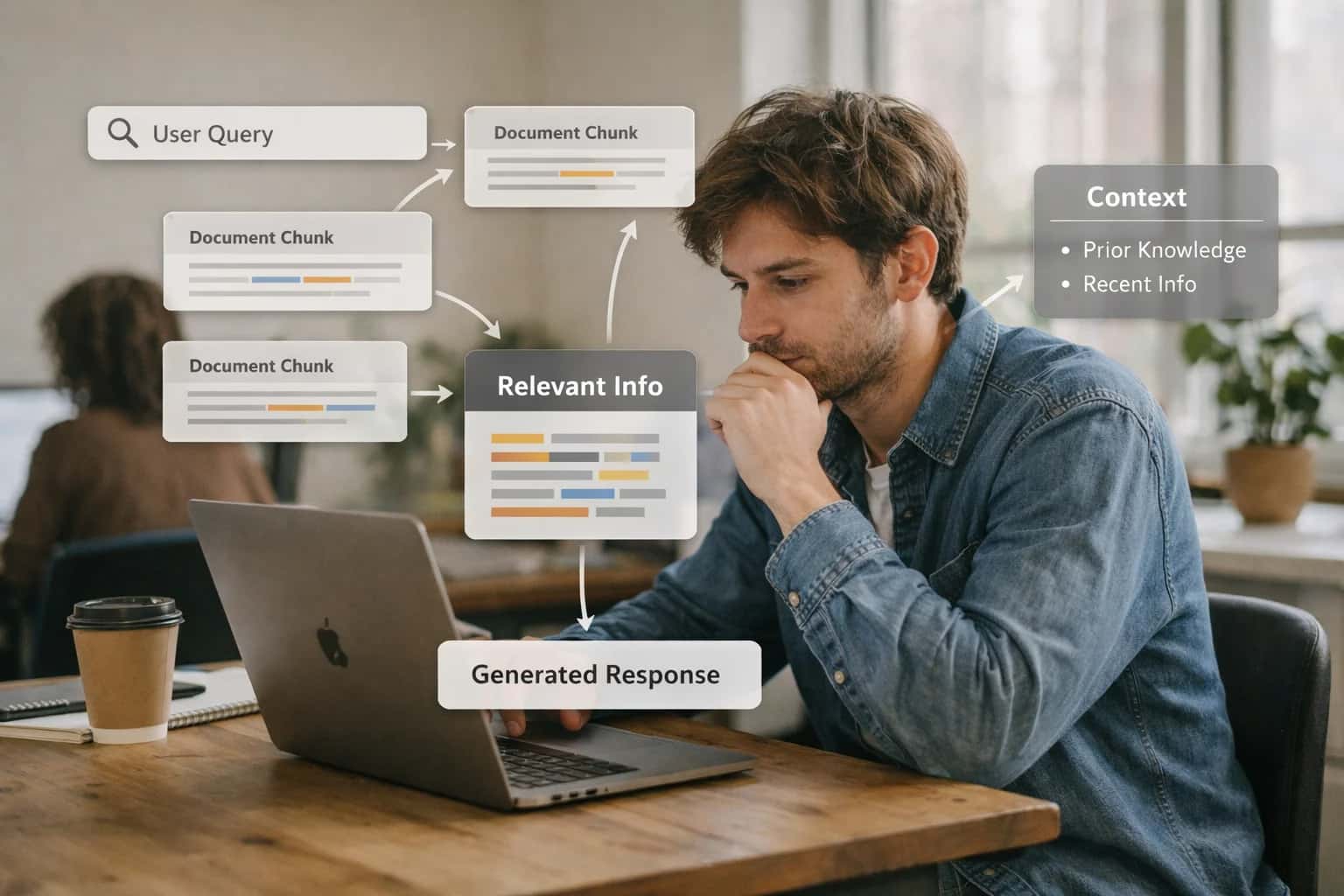
Contextual Retrieval is a preprocessing technique that prepends chunk-specific explanatory context—such as document title, section heading, and a concise summary of surrounding content—to each text chunk before it is embedded and indexed. This enrichment ensures that an otherwise isolated chunk of legal text retains its full semantic meaning, preventing the loss of critical jurisdictional or doctrinal framing when it is retrieved independently by a vector search.

Glossary
Contextual Retrieval
A preprocessing technique that prepends chunk-specific explanatory context to each text chunk before embedding, preventing isolated chunks from losing their legal meaning when retrieved.
CHUNK ENRICHMENT TECHNIQUE
What is Contextual Retrieval?
A preprocessing technique that prepends chunk-specific explanatory context to each text chunk before embedding, preventing isolated chunks from losing their legal meaning when retrieved.
In Legal RAG Architectures, this method is essential for maintaining high citation integrity. A raw chunk stating 'the defendant is liable' is ambiguous; a contextualized chunk prepended with 'From Smith v. Jones, Section IV(A) on Negligence:' transforms it into a self-contained, retrievable proposition. This directly mitigates retrieval failures caused by fragmented text, ensuring the generator receives legally coherent evidence.
CHUNK ENRICHMENT
Key Features of Contextual Retrieval
Contextual Retrieval solves the 'lost context' problem in legal RAG by prepending chunk-specific explanatory metadata before embedding. This ensures that an isolated clause about 'indemnification' retains its connection to the specific contract and party obligations.
01
Chunk-Specific Contextualization
Before embedding, each chunk is augmented with a generated preamble that situates it within the whole document. This prevents semantic drift where a clause loses its legal meaning in isolation.
- Example: A chunk reading 'The term shall be 5 years' is prepended with 'This excerpt is from Section 4.2 of the Master Service Agreement between Acme Corp and Beta LLC, defining the initial term of the engagement.'
- Mechanism: A language model processes the entire document and generates a concise, factual context string for each chunk.
02
Document-Level Anchoring
The generated context explicitly links the chunk to its source document title, parties, and effective date. This allows retrieval systems to distinguish between identical clauses in different contracts.
- Benefit: Prevents cross-contamination where a limitation of liability clause from a vendor agreement is retrieved for a question about a customer contract.
- Metadata: Context strings include canonical document identifiers for precise jurisdictional filtering.
03
Semantic Scope Preservation
Contextual Retrieval clarifies the legal scope of a provision by specifying the section heading and its role in the agreement's architecture.
- Example: 'This excerpt is from the Force Majeure section of the supply agreement, excusing performance under specified extraordinary events.'
- Impact: The embedding vector for the chunk now captures the concept of 'excused performance' rather than just the generic text of the clause.
04
Pre-Embedding Enrichment Pipeline
This technique is a preprocessing step applied to the entire corpus before indexing. It is not a runtime retrieval trick.
- Workflow: Document → Chunking → Context Generation (LLM) → Concatenation → Embedding → Vector Store Indexing.
- Cost: Incurs a one-time token cost for context generation but adds zero latency to the actual retrieval query.
05
Contrast with Generic Chunking
Standard chunking strategies rely on arbitrary token windows or paragraph breaks, often severing critical context. Contextual Retrieval actively repairs this fragmentation.
- Naive Chunking: Loses the connection between a defined term and its definition section.
- Contextual Retrieval: The chunk containing the defined term is prepended with 'This term is defined in Section 1.1 of the Credit Agreement.'
06
Integration with Hybrid Search
Contextual Retrieval enhances both dense vector search and sparse lexical (BM25) retrieval. The added context text provides richer semantic signals for embeddings and more precise keywords for sparse indexing.
- Synergy: A search for 'governing law' will match a chunk whose context explicitly states 'This excerpt is from the Governing Law clause of the Software License Agreement,' even if the chunk text itself only mentions 'the State of Delaware.'
Enabling Efficiency, Speed & Accuracy
Intelligent Analysis, Decision & Execution
We build AI systems for teams that need search across company data, workflow automation across tools, or AI features inside products and internal software.
Talk to Us
Search across company data
Give teams answers from docs, tickets, runbooks, and product data with sources and permissions.
Useful when people spend too long searching or get different answers from different systems.
Enterprise searchRAGPermissions
Read more
Automate internal workflows
Use AI to route work, draft outputs, trigger actions, and keep approvals and logs in place.
Useful when repetitive work moves across multiple tools and teams.
AI agentsWorkflow automationGovernance
Read more
Add AI to products and internal tools
Build assistants, guided actions, or decision support into the software your team or customers already use.
Useful when AI needs to be part of the product, not a separate tool.
AI integrationDecision supportModel routing
Read moreCONTEXTUAL RETRIEVAL
Frequently Asked Questions
Explore the mechanics of contextual retrieval, a preprocessing technique that preserves the semantic integrity of legal text chunks by prepending explanatory context before embedding, ensuring isolated passages remain meaningful during retrieval-augmented generation.
Contextual retrieval is a preprocessing technique that prepends chunk-specific explanatory context to each text chunk before embedding, preventing isolated chunks from losing their legal meaning when retrieved. The process works by first chunking a legal document into smaller segments, then using a language model to generate a concise contextual summary that situates each chunk within the broader document structure. This generated context—typically including the document title, section heading, and a brief description of the chunk's role—is prepended to the chunk text. The augmented chunk is then embedded and indexed. At query time, when a chunk is retrieved, the prepended context provides the retriever and generator with critical metadata about the chunk's provenance, jurisdiction, and argumentative function, dramatically reducing retrieval errors caused by decontextualized text fragments.

About the author
Prasad Kumkar
CEO & MD, Inference Systems
Prasad Kumkar is the CEO & MD of Inference Systems and writes about AI systems architecture, LLM infrastructure, model serving, evaluation, and production deployment. Over 5+ years, he has worked across computer vision models, L5 autonomous vehicle systems, and LLM research, with a focus on taking complex AI ideas into real-world engineering systems.
His work and writing cover AI systems, large language models, AI agents, multimodal systems, autonomous systems, inference optimization, RAG, evaluation, and production AI engineering.
LinkedIn
Limited slotsGet a Free AI Consultation
Partnered with leading AI, data, and software stack.





How We Work
Custom AI workflows for your Business
One-fit-all AI don't work for modern businesses. At Inferensys, we aim to understand your business & custom requirements; which we use to define most efficient agentic workflows, the data, and the tools for your business.
01
Review the use case
We understand the task, the users, and where AI can actually help.
Read more02
Pick the right approach
We define what needs search, automation, or product integration.
Read more03
Build the first useful version
We implement the part that proves the value first.
Read more04
Improve from there
We add the checks and visibility needed to keep it useful.
Read moreThe first call is a practical review of your use case and the right next step.
Talk to Us